This comprehensive analysis examines CUDIS price dynamics and investment potential through 2031, positioning it as a pioneering longevity-focused blockchain protocol merging health-tech with tokenomics. Currently trading at $0.0273 with a $6.76 million market cap, CUDIS faces both growth opportunities and significant challenges requiring careful investor evaluation. The article systematically reviews historical price volatility (75.27% annual decline), supply mechanisms, and market sentiment (currently in fear phase at index 29) to construct tiered price forecasts: conservative $0.01586-$0.02734 for 2026, scaling to potential $0.04653 by 2031 under favorable conditions. Critical success factors include ecosystem adoption of CUDIS Ring hardware, AI-powered Longevity Hub development, and DePIN narrative integration across BSC and Solana networks. Professional investment frameworks address portfolio allocation strategies, risk management protocols using Gate Web3 Wallet for secure custody, and due diligence requ
Introduction: CUDIS Market Position and Investment Value
CUDIS, as a pioneering longevity-focused blockchain protocol, has been making strides in the health and wellness sector since its launch. As of January 2026, CUDIS maintains a market capitalization of approximately $6.76 million, with a circulating supply of 247.5 million tokens and a current price around $0.0273. This asset, positioned as "A Rewarding Longevity Protocol for Everyone," is playing an increasingly important role in the intersection of blockchain technology and health data management.
The protocol integrates hardware (CUDIS Ring), AI-powered analytics (Longevity Hub), and blockchain infrastructure (Super App) to create an ecosystem where users gain ownership of their health data while receiving economic incentives for optimizing their biological health. With deployment on both BSC and Solana networks, CUDIS has attracted over 19,000 holders and maintains listings on 18 exchanges, demonstrating growing market interest in health-tech tokenization.
This article will comprehensively analyze CUDIS price trends from 2026 through 2031, combining historical patterns, market supply-demand dynamics, ecosystem development, and macroeconomic factors to provide investors with professional price forecasts and practical investment strategies.
I. CUDIS Price History Review and Market Status
CUDIS Historical Price Evolution Trajectory
- 2025: CUDIS launched its trading on multiple platforms in January 2025, with price performance showing significant volatility throughout the year.
- November 2025: The token experienced substantial upward movement, reaching a notable price level of $0.31204 on November 4, 2025, marking a significant milestone in its early trading history.
- December 2025: Following the November peak, the market entered a correction phase, with the price declining to $0.02352 on December 1, 2025, representing a considerable adjustment from previous levels.
CUDIS Current Market Status
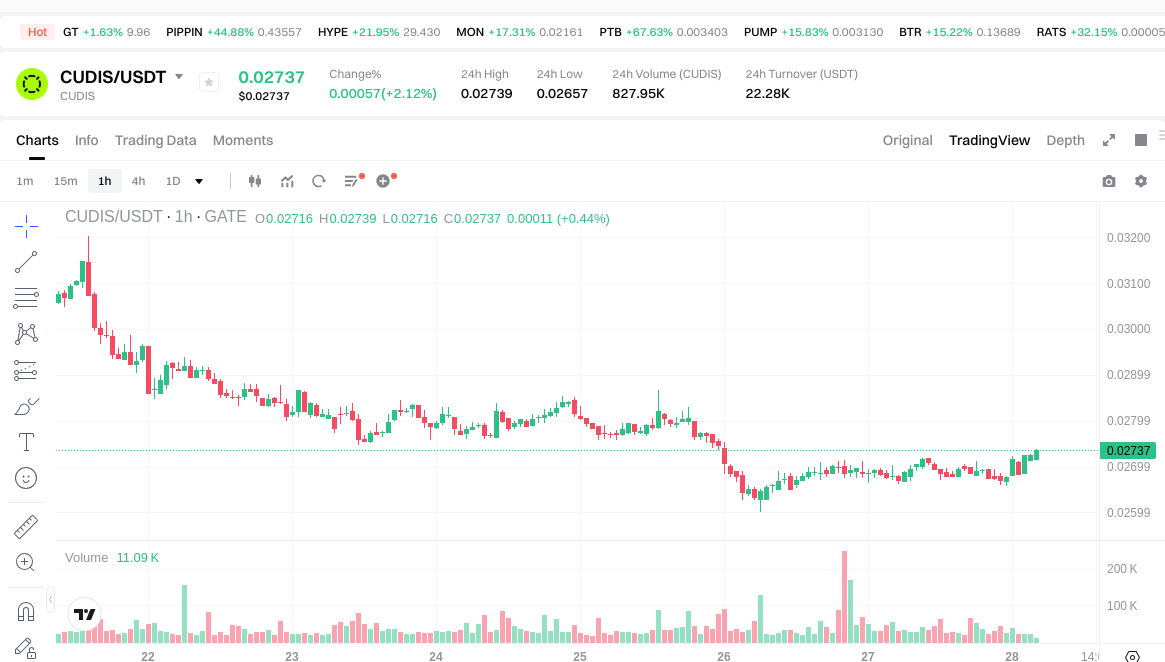
As of January 28, 2026, CUDIS is trading at $0.02731, reflecting a 24-hour price change of 2.08%. The token has demonstrated mixed performance across different timeframes, with short-term indicators showing modest gains while longer periods reveal more pronounced adjustments. The 1-hour movement indicates a 0.48% increase, while the 7-day performance shows an 11.86% decline. Over the past 30 days, CUDIS has experienced a 3.96% decrease.
The current circulating supply stands at 247,500,000 tokens, representing 24.75% of the maximum supply of 1,000,000,000 tokens. The market capitalization is approximately $6.76 million, with a fully diluted market cap of $27.31 million. The 24-hour trading volume amounts to $22,285.68, positioning CUDIS at rank 1389 in the cryptocurrency market with a market dominance of 0.00086%.
The token maintains trading activity across 18 exchanges and has attracted 19,035 holders. CUDIS operates with contract addresses on both BSC and Solana networks, providing multi-chain accessibility for users and traders.
Click to view the current CUDIS market price
CUDIS Market Sentiment Index
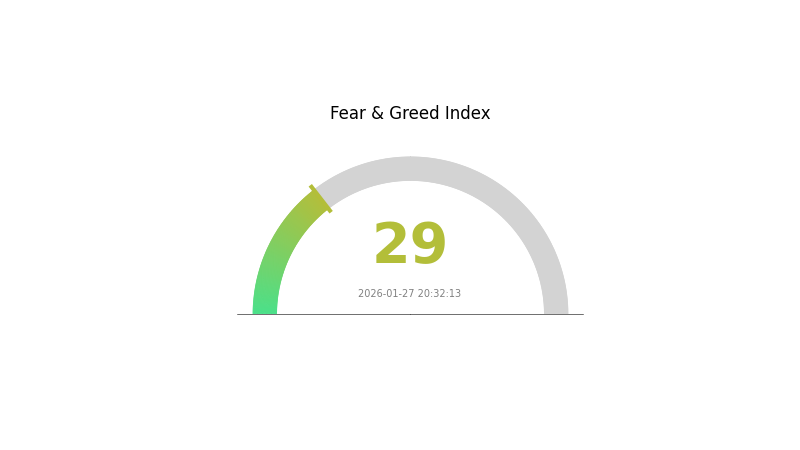
2026-01-27 Fear and Greed Index: 29 (Fear)
Click to view the current Fear & Greed Index
The cryptocurrency market is currently experiencing a fear sentiment phase with a CUDIS reading of 29. This indicates heightened market anxiety and risk aversion among investors. During periods of fear, market volatility typically increases as participants adopt more cautious trading strategies. This environment often presents opportunities for contrarian investors and long-term believers to accumulate assets at relatively lower valuations. However, traders should remain vigilant with proper risk management and maintain adequate portfolio diversification to navigate through this uncertain period effectively.
CUDIS Token Holding Distribution
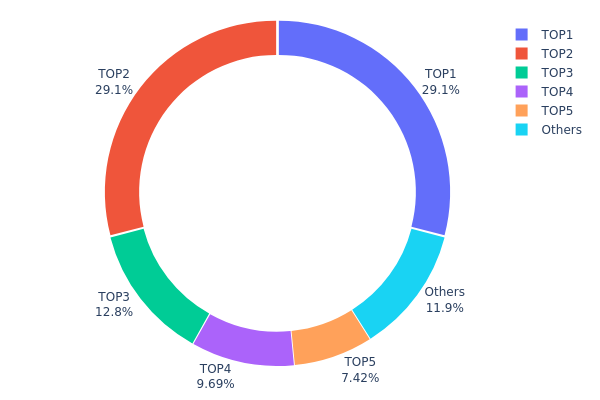
According to on-chain data analysis, CUDIS exhibits a highly concentrated holding pattern. The top 5 addresses collectively control 416,289.58K tokens, representing 80.72% of the total circulating supply. Specifically, the top two addresses each hold 150,000K tokens (29.07% each), while the third-largest holder possesses 66,000K tokens (12.79%). This tri-polar concentration structure suggests that a small number of entities maintain decisive influence over the token's market behavior.
From a market structure perspective, such high concentration levels pose significant implications for price volatility and liquidity dynamics. When major holders execute large-scale transactions, the limited free-floating supply can amplify price fluctuations. Additionally, the "Others" category accounts for only 11.96% of holdings, indicating relatively weak retail participation and limited decentralization. This distribution pattern may increase susceptibility to coordinated market movements and reduces the project's resilience against single-point failures in governance or liquidity provision.
The current holding structure reflects a centralized control mechanism that contradicts typical decentralization principles in blockchain ecosystems. While concentrated holdings can provide price stability during early project stages, they simultaneously introduce governance risks and potential manipulation vulnerabilities. Investors should carefully evaluate whether this distribution aligns with the project's long-term development roadmap and community governance objectives, particularly regarding token unlock schedules and distribution improvement plans.
Click to view current CUDIS Holding Distribution
| Top |
Address |
Holding Qty |
Holding (%) |
| 1 |
0x98e1...55080a |
150000.00K |
29.07% |
| 2 |
0x29b4...75dcd3 |
150000.00K |
29.07% |
| 3 |
0x7fad...4d8cce |
66000.00K |
12.79% |
| 4 |
0x9540...7714ad |
50000.00K |
9.69% |
| 5 |
0xf89d...5eaa40 |
38289.58K |
7.42% |
| - |
Others |
61563.26K |
11.96% |
II. Core Factors Influencing CUDIS Future Price
Supply Mechanism
- Liquidity Pool Mechanism: Project teams can use a portion of revenue to purchase tokens and pair them with major cryptocurrencies or stablecoins to join liquidity pools, ensuring tokens have sufficient liquidity and allowing users to trade without significantly impacting prices.
- Current Impact: The supply mechanism aims to maintain stable liquidity, which may help reduce price volatility and support more efficient market transactions.
Market Demand and Adoption Trends
- Market Demand: The price outlook for CUDIS is influenced by market demand, adoption trends, institutional participation, and broader economic factors.
- Growth Expectations: Based on projections with an estimated annual growth rate of approximately 5%, CUDIS shows potential for gradual value appreciation in the coming years.
Macroeconomic Environment
- Capital Cost and Risk Appetite: There is a high correlation between global liquidity and cryptocurrency prices, with the core factor being the market's dynamic assessment of "capital cost" and "risk appetite."
- Economic Factors: The broader economic environment plays a significant role in shaping cryptocurrency market trends, affecting investor behavior and asset allocation decisions.
Technical Development and Ecosystem Building
- DePIN Narrative: CUDIS is associated with the emerging DePIN (Decentralized Physical Infrastructure Networks) narrative, which represents a growing sector in the cryptocurrency space.
- Ecosystem Applications: The token benefits from integration within DePIN-related projects, potentially expanding its utility and application scenarios in decentralized infrastructure development.
III. 2026-2031 CUDIS Price Prediction
2026 Outlook
- Conservative Prediction: $0.01586 - $0.02734
- Neutral Prediction: $0.02734
- Optimistic Prediction: $0.03281 (requires favorable market conditions and increased adoption)
2027-2029 Outlook
- Market Stage Expectation: CUDIS may enter a gradual growth phase, with price showing modest upward momentum as the project potentially expands its ecosystem and user base.
- Price Range Prediction:
- 2027: $0.02286 - $0.03789
- 2028: $0.02685 - $0.04520
- 2029: $0.02890 - $0.04988
- Key Catalysts: Potential technological developments, broader market recovery trends, and possible expansion of use cases could serve as primary drivers for price appreciation during this period.
2030-2031 Long-term Outlook
- Baseline Scenario: $0.03087 - $0.04832 (assuming steady project development and stable market conditions)
- Optimistic Scenario: $0.04474 - $0.05071 (contingent on successful ecosystem expansion and increased market penetration)
- Transformative Scenario: Above $0.05071 (requires exceptional adoption rates, major partnerships, or significant technological breakthroughs)
- 2026-01-28: CUDIS price predictions indicate potential growth trajectory with estimated average price of $0.02734 in 2026, potentially reaching $0.04653 by 2031 under favorable conditions
| Year |
Predicted High Price |
Predicted Average Price |
Predicted Low Price |
Price Change |
| 2026 |
0.03281 |
0.02734 |
0.01586 |
0 |
| 2027 |
0.03789 |
0.03007 |
0.02286 |
10 |
| 2028 |
0.0452 |
0.03398 |
0.02685 |
24 |
| 2029 |
0.04988 |
0.03959 |
0.0289 |
44 |
| 2030 |
0.04832 |
0.04474 |
0.03087 |
63 |
| 2031 |
0.05071 |
0.04653 |
0.03071 |
70 |
IV. CUDIS Professional Investment Strategy and Risk Management
CUDIS Investment Methodology
(I) Long-term Holding Strategy
- Suitable for: Investors seeking exposure to the emerging longevity and health-data economy with a horizon of 1-3 years
- Operational Recommendations:
- Consider dollar-cost averaging (DCA) during periods of lower volatility to build positions gradually
- Monitor developments in CUDIS Ring adoption, AI-powered Longevity Hub updates, and partnership announcements
- Storage Solution: Use Gate Web3 Wallet for secure self-custody, enabling full control over private keys while maintaining accessibility
(II) Active Trading Strategy
- Technical Analysis Tools:
- Moving Averages: Track 7-day and 30-day moving averages to identify short-term trend reversals; current 7-day decline of 11.86% may signal potential entry points if support holds
- Volume Analysis: Monitor 24-hour trading volume trends (current: $22,285.68) relative to price movements to confirm breakout validity
- Swing Trading Key Points:
- Observe price reaction near recent low of $0.02352 as potential support zone
- Set profit targets incrementally, considering high volatility evidenced by 75.27% decline over one year
CUDIS Risk Management Framework
(I) Asset Allocation Principles
- Conservative Investors: 1-3% of crypto portfolio, prioritizing capital preservation
- Aggressive Investors: 5-10% allocation, accepting higher volatility for growth potential
- Professional Investors: Up to 15% with active hedging strategies and continuous monitoring
(II) Risk Hedging Solutions
- Position Sizing: Limit single-position exposure to prevent significant capital loss during drawdowns
- Stop-Loss Implementation: Set dynamic stop-loss orders 10-15% below entry points to manage downside risk
(III) Secure Storage Solutions
- Web3 Wallet Recommendation: Gate Web3 Wallet offers multi-chain support (BSC, SOL) compatible with CUDIS contract addresses, providing user-friendly interface and enhanced security features
- Hardware Wallet Solution: For larger holdings, consider transferring to hardware wallets after initial accumulation
- Security Precautions: Enable two-factor authentication, regularly update software, and never share private keys or seed phrases
V. CUDIS Potential Risks and Challenges
CUDIS Market Risks
- High Volatility: CUDIS has experienced significant price fluctuations, declining 75.27% over the past year and 11.86% over the past week, indicating substantial market risk
- Liquidity Constraints: With 24-hour trading volume of approximately $22,285, liquidity may be limited during periods of market stress, potentially impacting execution prices
- Market Capitalization: Current market cap of approximately $6.76 million represents a relatively small project, subject to higher volatility and lower institutional participation
CUDIS Regulatory Risks
- Health Data Privacy: As CUDIS integrates health data collection through wearable devices, evolving global data protection regulations (such as GDPR, HIPAA) may impact operational models
- Token Classification: Regulatory clarity around tokens incentivizing health behaviors remains uncertain across jurisdictions, potentially affecting future compliance requirements
- Cross-border Operations: CUDIS's global partnership strategy may face varying regulatory frameworks that could constrain expansion or require operational adjustments
CUDIS Technical Risks
- Smart Contract Vulnerabilities: Deployment on BSC and SOL chains requires ongoing audits; any undiscovered vulnerabilities could expose user funds to exploits
- Platform Integration: Dependence on seamless integration between CUDIS Ring, AI-powered Longevity Hub, and blockchain Super App creates technical complexity and potential points of failure
- Adoption Uncertainty: Success relies on widespread adoption of CUDIS Ring and ecosystem services; slower-than-expected user onboarding may impact token utility and value proposition
VI. Conclusion and Action Recommendations
CUDIS Investment Value Assessment
CUDIS presents an innovative approach to longevity management through blockchain-based incentivization and AI-driven health insights. The project's long-term value proposition centers on ownership of health data and economic rewards for optimizing biological health. However, short-term risks include significant price volatility (75.27% decline over one year), limited liquidity, and execution challenges in scaling the ecosystem. The circulating supply of 247.5 million tokens (24.75% of max supply) suggests potential dilution concerns as more tokens enter circulation.
CUDIS Investment Recommendations
✅ Beginners: Allocate only a small portion (1-2%) of your crypto portfolio to CUDIS, focusing on learning about the longevity and health-data sectors before increasing exposure
✅ Experienced Investors: Consider 3-7% allocation with active monitoring of ecosystem developments, partnership announcements, and technical chart patterns to time entries and exits
✅ Institutional Investors: Conduct thorough due diligence on team credentials, roadmap execution, and competitive positioning within decentralized health ecosystems before committing capital
CUDIS Trading Participation Methods
- Spot Trading: Purchase CUDIS on Gate.com and other supported exchanges (currently listed on 18 exchanges) for direct ownership and long-term holding
- Dollar-Cost Averaging: Establish recurring purchase schedules to smooth out entry prices and reduce timing risk in volatile markets
- Ecosystem Engagement: Participate in CUDIS ecosystem activities (if available) to earn rewards and gain firsthand experience with platform utility
Cryptocurrency investment carries extreme risk, and this article does not constitute investment advice. Investors should make prudent decisions based on their own risk tolerance and are advised to consult professional financial advisors. Never invest more than you can afford to lose.
FAQ
What is CUDIS? What are its uses and value?
CUDIS is an AI-powered smart ring built on Solana blockchain that tracks health data including heart rate, steps, and sleep. Users earn rewards through daily activities, combining DePIN technology with health monitoring for tangible value.
What factors influence CUDIS price?
CUDIS price is influenced by supply and demand dynamics, market sentiment driven by news and social media, regulatory developments like ETF approvals and government policies, and overall investor confidence in the crypto market.
How to predict the price of CUDIS?
CUDIS price prediction can be analyzed through multiple indicators including trading volume, market sentiment, and historical price trends. Based on current data as of January 27, 2026, with a 5% annualized growth rate model, CUDIS is projected to reach approximately $0.02658 within 30 days. Monitor on-chain metrics and market movements for more accurate predictions.
What is the historical price trend of CUDIS?
CUDIS has experienced volatility in recent trading. In the past 24 hours, the price declined 6.81% to ¥0.2009. The highest price reached ¥0.2295 while the lowest was ¥0.1934, with trading volume of ¥28.70 million.
What are the risks of investing in CUDIS?
CUDIS faces business model viability risks and regulatory uncertainties. The long-term sustainability of data monetization remains unproven. Early-stage projects carry market volatility and adoption risks. Investors should assess their risk tolerance carefully.
What are the advantages and disadvantages of CUDIS compared to other cryptocurrencies?
CUDIS combines blockchain and AI technology for health data tracking with token rewards, offering real-world utility. Advantages include innovative health applications and user incentives. Disadvantages may include technical complexity and limited market adoption compared to established cryptocurrencies.
What is the future development prospect of CUDIS?
CUDIS has strong institutional backing from reputable funds and is building a unique decentralized health ecosystem. With solid technical foundations and growing market adoption, CUDIS shows promising long-term growth potential and market expansion opportunities.
* The information is not intended to be and does not constitute financial advice or any other recommendation of any sort offered or endorsed by Gate.