CUDIS, a longevity protocol token operating on BSC and Solana, currently trades at $0.019 with a $4.71 million market cap as of January 2026. This comprehensive analysis examines CUDIS price forecasts from 2026 to 2031, incorporating historical patterns, supply-demand dynamics, ecosystem development, and macroeconomic factors to guide investor decision-making. The article projects conservative 2026 targets of $0.0172-$0.0189, with gradual appreciation through 2031 potentially reaching $0.04948 under optimistic scenarios. Key catalysts include Web3 smart ring integration, AI-powered health coaching, ecosystem partnerships, and health-tech adoption trends. Professional investment strategies encompass long-term holding for 3-5 year horizons and active trading approaches with risk management frameworks tailored to conservative, aggressive, and institutional investors. Critical risks include 82.66% historical price decline, regulatory uncertainty in health data compliance, multi-chain technical complexity, and ext
Introduction: CUDIS's Market Position and Investment Value
CUDIS, a longevity protocol token operating on BSC and SOL chains, has positioned itself in the emerging health-tech and blockchain intersection since its launch in 2025. As of January 29, 2026, CUDIS maintains a market capitalization of approximately $4.71 million, with a circulating supply of around 247.5 million tokens, and the price hovering near $0.019. This asset, often described as a "rewarding longevity protocol token," is playing an increasingly notable role in incentivizing health data management and personalized wellness optimization.
This article will comprehensively analyze CUDIS's price trends from 2026 to 2031, combining historical patterns, market supply-demand dynamics, ecosystem development, and macroeconomic conditions to provide investors with professional price forecasts and practical investment strategies.
I. CUDIS Price History Review and Current Market Status
CUDIS Historical Price Evolution Trajectory
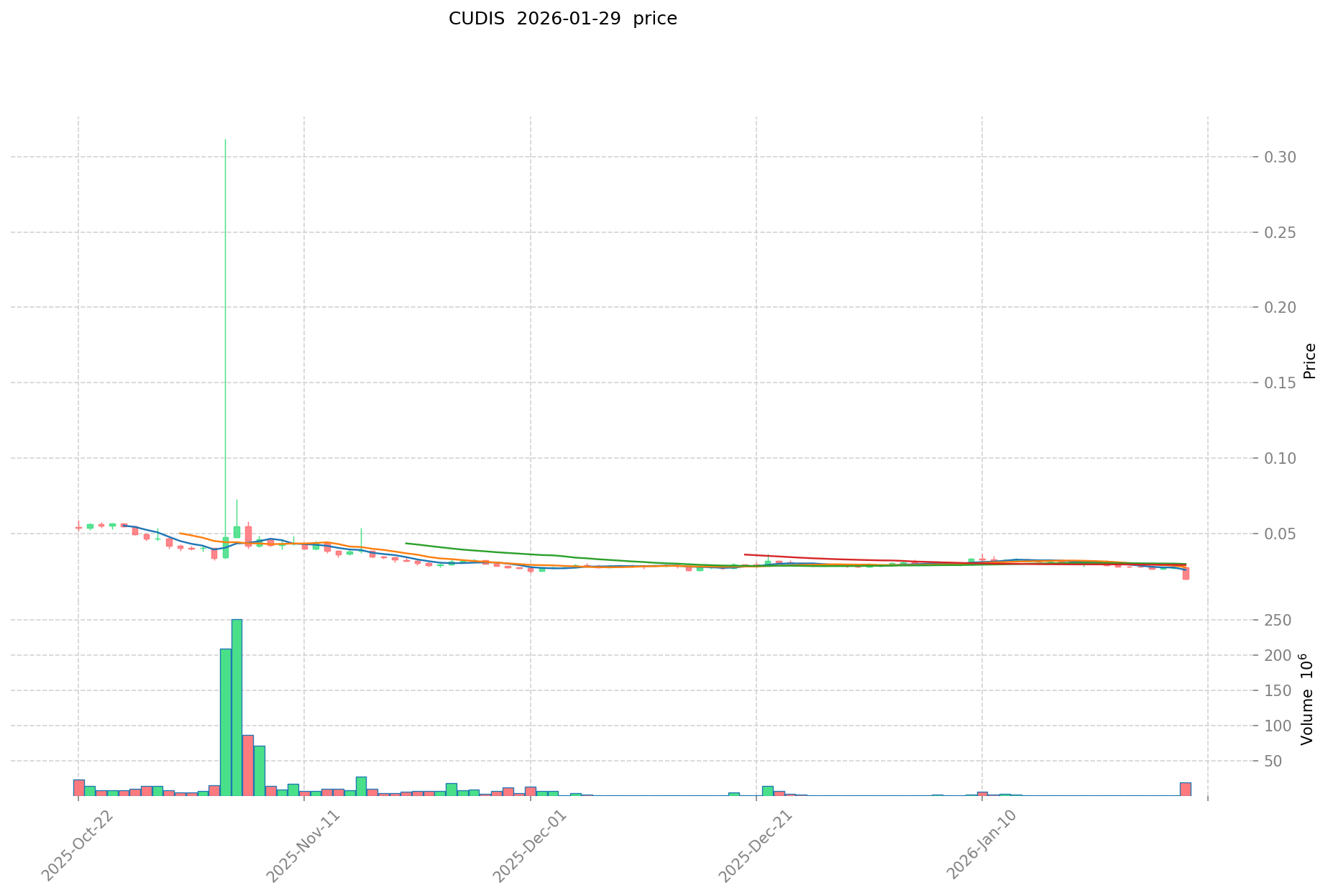
- 2025: The project launched its token trading in October, with CUDIS reaching a notable price level of $0.31204 on November 4, 2025, marking an early peak in its market trajectory
- 2026: Following the initial enthusiasm, the token entered a correction phase, with prices declining significantly to $0.0188 on January 29, 2026, reflecting broader market adjustments
CUDIS Current Market Dynamics
As of January 29, 2026, CUDIS is trading at $0.01902, with a market capitalization of approximately $4.71 million and a fully diluted valuation of $19.02 million. The token has experienced notable volatility across multiple timeframes, with a 1-hour decline of 1.5%, a 24-hour decrease of 28.86%, and a 7-day drop of 33.47%. Over the past 30 days, the price has decreased by 31.65%.
The circulating supply stands at 247.5 million tokens, representing 24.75% of the maximum supply of 1 billion tokens. The 24-hour trading volume reaches approximately $502,618, indicating active market participation despite recent price pressures. CUDIS currently holds a market ranking of 1565 among digital assets, with a market share of 0.00060%.
The token's 24-hour price range spans from $0.0188 to $0.02682, demonstrating considerable intraday volatility. With 19,055 token holders and availability on 19 exchanges, CUDIS maintains a growing user base within its longevity-focused ecosystem. The current market sentiment index indicates a fear level at 26, reflecting cautious investor attitudes in the broader cryptocurrency environment.
Click to view the current CUDIS market price
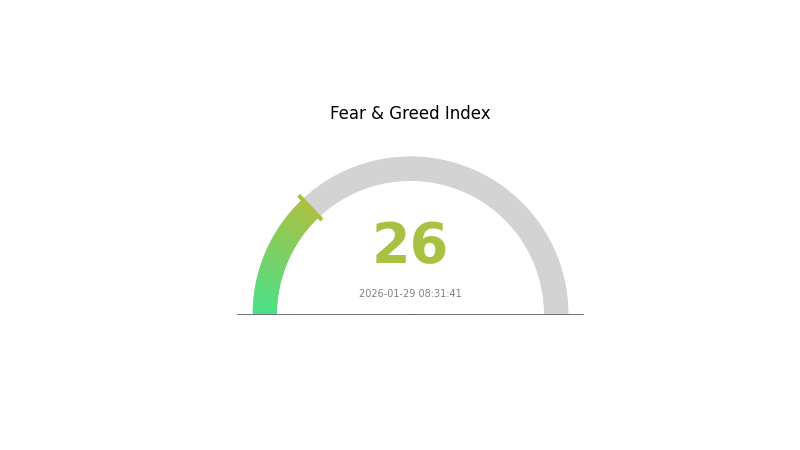
CUDIS Market Sentiment Index
2026-01-29 Fear and Greed Index: 26 (Fear)
Click to view the current Fear & Greed Index
The cryptocurrency market is currently experiencing a fear sentiment with a CUDIS index reading of 26. This indicates heightened market anxiety and risk aversion among investors. During periods of fear, market volatility tends to increase as participants adopt a more cautious stance. Such conditions often create both challenges and opportunities for traders and investors to reassess their positions. Market participants should remain vigilant and monitor key support levels while considering their risk management strategies carefully.
CUDIS Holding Distribution
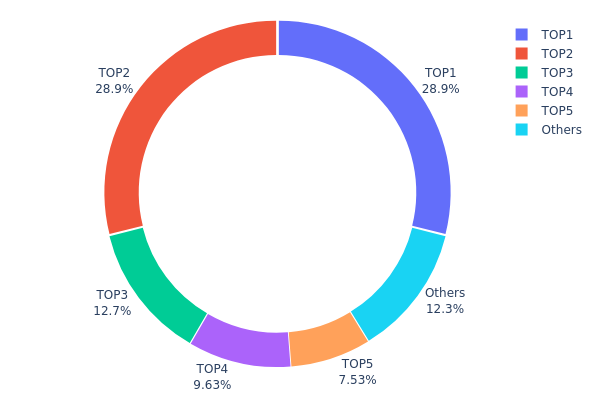
The holding distribution chart reflects the concentration of token ownership across different wallet addresses, serving as a key indicator of market structure and decentralization level. As of January 29, 2026, CUDIS exhibits a highly concentrated holding pattern that warrants careful analysis.
The top five addresses collectively hold 87.64% of the total CUDIS supply, with the two largest wallets each controlling 150,000K tokens (28.89% each), totaling 57.78% of the entire circulation. The third-largest address holds 66,000K tokens (12.71%), while the fourth and fifth positions account for 9.63% and 7.52% respectively. The remaining 63,997.17K tokens (12.36%) are distributed among other addresses, indicating minimal dispersion beyond the core holders.
This extreme concentration presents significant implications for market dynamics. The dominance of top holders creates substantial price vulnerability, as coordinated selling by major addresses could trigger sharp downward movements. Additionally, such centralized distribution may facilitate potential market manipulation, as a small number of entities effectively control the majority of circulating supply. From a decentralization perspective, this structure contradicts the fundamental principles of distributed ownership that typically characterize healthy blockchain ecosystems. Investors should recognize that this concentration pattern increases volatility risk and reduces market resilience during stress periods.
Click to view current CUDIS Holding Distribution
| Top |
Address |
Holding Qty |
Holding (%) |
| 1 |
0x98e1...55080a |
150000.00K |
28.89% |
| 2 |
0x29b4...75dcd3 |
150000.00K |
28.89% |
| 3 |
0x7fad...4d8cce |
66000.00K |
12.71% |
| 4 |
0x9540...7714ad |
50000.00K |
9.63% |
| 5 |
0xf89d...5eaa40 |
39080.53K |
7.52% |
| - |
Others |
63997.17K |
12.36% |
II. Core Factors Influencing CUDIS's Future Price
Supply Mechanism
- Token Distribution Model: CUDIS has a total supply of 1 billion tokens, with 25% allocated to the community. The first quarter airdrop distribution has released 50 million CUDIS tokens, which creates initial circulation while maintaining controlled supply expansion.
- Historical Pattern: Early-stage token distribution through community airdrops typically generates initial market interest and establishes baseline liquidity, though price stability depends on sustained adoption momentum.
- Current Impact: The structured quarterly airdrop approach may help maintain steady market engagement while avoiding sudden supply shocks that could pressure token valuation.
Institutional and Major Holder Dynamics
- Institutional Holdings: CUDIS secured $5 million in seed funding led by Draper Associates, with participation from notable institutions including Skybridge Capital, Penrose, SNZ, NGC Ventures, Foresight Ventures, and Morningstar Ventures. Individual investors include representatives from Helium, Render Network, Dimo, and Solana Foundation.
- Enterprise Adoption: The project targets partnerships with health and medical industry players to drive practical applications of health innovation, though specific enterprise deployments have not been disclosed in available materials.
- Regulatory Environment: The project operates within the evolving regulatory landscape for health data and blockchain technology, where clarity on data ownership rights and tokenized health information could significantly impact adoption trajectories.
Macroeconomic Environment
- Market Sentiment Impact: As a health-focused DePIN project within the Solana ecosystem, CUDIS pricing may reflect broader cryptocurrency market cycles and investor risk appetite for emerging Web3 infrastructure plays.
- Health Tech Investment Trends: Growing consumer interest in personal health data ownership and privacy concerns may create favorable conditions for health-oriented blockchain projects.
- Sector Competition Dynamics: The project faces competition from established wearable device manufacturers and other Web3 health initiatives, requiring differentiation through its data monetization model and tokenized incentive structure.
Technology Development and Ecosystem Building
- Web3 Smart Ring Integration: CUDIS combines AI-powered health tracking with blockchain-based data ownership, allowing users to monitor health metrics while maintaining control over their personal health information.
- AI Coach and Gamification Features: Planned development includes AI-driven health coaching and gamified user engagement mechanisms designed to enhance retention and active participation within the health ecosystem.
- Ecosystem Applications: The project aims to establish an open API framework, developer tools, and health innovation grants to support DeSci (Decentralized Science) initiatives and third-party application development within its health data infrastructure.
III. 2026-2031 CUDIS Price Prediction
2026 Outlook
- Conservative Prediction: $0.0172 - $0.0189
- Neutral Prediction: $0.0189
- Optimistic Prediction: $0.02325 (requires favorable market conditions)
2027-2029 Outlook
- Market Stage Expectation: CUDIS is anticipated to enter a gradual growth phase, with increasing market recognition and potential ecosystem development driving broader adoption.
- Price Range Prediction:
- 2027: $0.01454 - $0.02339
- 2028: $0.02001 - $0.03313
- 2029: $0.0191 - $0.03571
- Key Catalysts: Market expansion, technological improvements, and growing community engagement may serve as primary drivers for price appreciation during this period.
2030-2031 Long-term Outlook
- Baseline Scenario: $0.0168 - $0.04215 (assuming steady market development and moderate adoption rates)
- Optimistic Scenario: $0.02954 - $0.04948 (assuming accelerated ecosystem growth and enhanced utility)
- Transformative Scenario: Prices could potentially exceed current projections if exceptional market conditions emerge, including widespread institutional adoption and significant technological breakthroughs.
- 2026-01-29: CUDIS shows baseline stability with potential for gradual appreciation over the forecast period.
| Year |
Predicted High Price |
Predicted Average Price |
Predicted Low Price |
Price Change |
| 2026 |
0.02325 |
0.0189 |
0.0172 |
0 |
| 2027 |
0.02339 |
0.02107 |
0.01454 |
10 |
| 2028 |
0.03313 |
0.02223 |
0.02001 |
16 |
| 2029 |
0.03571 |
0.02768 |
0.0191 |
45 |
| 2030 |
0.04215 |
0.03169 |
0.0168 |
66 |
| 2031 |
0.04948 |
0.03692 |
0.02954 |
94 |
IV. CUDIS Professional Investment Strategy and Risk Management
CUDIS Investment Methodology
(1) Long-term Holding Strategy
- Suitable for: Investors seeking exposure to the health-tech and longevity sector with a 3-5 year horizon
- Operational Recommendations:
- Consider accumulating positions during market corrections when price approaches support levels
- Monitor developments in CUDIS Ring adoption and ecosystem partnerships as indicators of fundamental growth
- Storage Solution: Use Gate Web3 Wallet for secure multi-chain asset management supporting both BSC and SOL networks
(2) Active Trading Strategy
- Technical Analysis Tools:
- Moving Averages: Monitor 50-day and 200-day moving averages to identify trend reversals and momentum shifts
- Volume Analysis: Track 24-hour trading volume trends ($502,618 as of January 29, 2026) to confirm price movements
- Swing Trading Key Points:
- Set stop-loss orders to protect against volatility, given recent 24-hour decline of 28.86%
- Consider position sizing based on recent price range between $0.0188 and $0.02682
CUDIS Risk Management Framework
(1) Asset Allocation Principles
- Conservative Investors: 1-3% of crypto portfolio allocation
- Aggressive Investors: 5-10% of crypto portfolio allocation
- Professional Investors: Up to 15% with active monitoring and hedging strategies
(2) Risk Hedging Approaches
- Diversification: Maintain exposure across multiple health-tech and DePIN projects to reduce single-asset risk
- Staged Entry: Dollar-cost averaging to mitigate timing risk in volatile market conditions
(3) Secure Storage Solutions
- Multi-Chain Wallet Recommendation: Gate Web3 Wallet supports both BSC and SOL contract addresses for CUDIS
- Hardware Wallet Option: Consider cold storage solutions for long-term holdings exceeding 6 months
- Security Precautions: Enable two-factor authentication, regularly backup recovery phrases, and never share private keys
V. CUDIS Potential Risks and Challenges
CUDIS Market Risks
- Price Volatility: CUDIS has experienced significant decline of 82.66% over the past year, with recent 7-day drop of 33.47%
- Liquidity Concerns: Daily trading volume of approximately $500,000 may result in slippage during large transactions
- Market Capitalization: With a market cap of $4.7 million and ranking around 1565, the token faces competition from established projects
CUDIS Regulatory Risks
- Health Data Compliance: The intersection of blockchain and health data may face evolving regulations regarding data privacy and medical device standards
- Token Classification: Potential regulatory scrutiny regarding the classification of health-incentive tokens across different jurisdictions
- Cross-Border Operations: Global partnership model may encounter varying regulatory frameworks affecting ecosystem expansion
CUDIS Technical Risks
- Multi-Chain Complexity: Operating on both BSC and Solana networks increases technical maintenance requirements and potential vulnerability surfaces
- Ecosystem Development: Success depends on continued development of CUDIS Ring hardware and AI-powered Longevity Hub integration
- Smart Contract Risks: Token contracts on both chains require ongoing security audits to prevent exploitation vulnerabilities
VI. Conclusion and Action Recommendations
CUDIS Investment Value Assessment
CUDIS presents an innovative approach to the emerging longevity and health-tech sector through blockchain integration. The project's vision to extend health-span to 140 years addresses a growing market interest in preventive healthcare and biohacking. However, the significant price decline of 82.66% over the past year and current low trading volume indicate substantial short-term volatility and execution risks. The 24.75% circulation ratio suggests potential supply pressure as more tokens enter circulation. Long-term value proposition depends heavily on successful hardware deployment, ecosystem partnerships, and user adoption of the integrated CUDIS Ring and Super App platform.
CUDIS Investment Recommendations
✅ Beginners: Limit exposure to 1-2% of total crypto allocation, focusing on understanding the longevity-tech sector before committing significant capital
✅ Experienced Investors: Consider 3-5% allocation with staged entry strategy, monitoring ecosystem milestones and partnership announcements for accumulation opportunities
✅ Institutional Investors: Conduct thorough due diligence on hardware deployment timelines and regulatory compliance framework before position sizing beyond 5%
CUDIS Trading Participation Methods
- Spot Trading: Execute buy/sell orders on Gate.com with attention to liquidity conditions and order book depth
- Dollar-Cost Averaging: Establish systematic purchase schedules to reduce timing risk exposure in volatile price environment
- Ecosystem Monitoring: Track developments in CUDIS Ring adoption, Longevity Hub features, and partnership announcements through official channels (website: cudis.xyz, Twitter: @cudiswellness)
Cryptocurrency investment carries extremely high risk, and this article does not constitute investment advice. Investors should make prudent decisions based on their own risk tolerance and are advised to consult professional financial advisors. Never invest more than you can afford to lose.
FAQ
What is CUDIS token and what are its practical uses?
CUDIS token serves as the ecosystem connector, enabling access, incentives, and governance of health data utilization. Users mint health records as NFTs through Longevity Decentralized ID (LDID) and earn rewards for participating in the health data economy.
What is the current CUDIS price level? What are the historical high and low prices?
CUDIS is currently trading at $0.027379. The historical lowest price recorded is $0.023529, while historical highs remain to be documented as the token continues its market journey.
What price will CUDIS reach in 2024? What factors will influence price movement?
CUDIS price in 2024 depends on market sentiment, investor confidence, and technology development. Broader adoption and positive news can drive prices higher. Monitor market dynamics and project milestones for price trends.
What are the risks of investing in CUDIS and what should I pay attention to?
CUDIS investment may result in partial or total loss. Investors should determine investment amounts based on acceptable loss levels. Virtual asset investments carry specific risks; seek professional financial advice if uncertain about your investment strategy.
What are CUDIS's advantages or disadvantages compared to similar projects?
CUDIS offers decentralized mining with reduced centralization risks and community-driven governance on Solana's ecosystem. Its strength lies in blockchain innovation, though community governance may slow decision-making compared to centralized alternatives.
What is the background of CUDIS's development team? What is the project's roadmap?
CUDIS development team comprises blockchain experts focused on building on the Sui platform. The roadmap includes progressive technology improvements and user expansion, aiming to create a healthier blockchain ecosystem.
* The information is not intended to be and does not constitute financial advice or any other recommendation of any sort offered or endorsed by Gate.