This comprehensive article analyzes FLUX's price dynamics from 2026 to 2031, providing investors with data-driven forecasts and actionable strategies. FLUX, a decentralized computing infrastructure platform, currently trades at $0.11171 with a market cap of $44.60 million. The analysis covers historical price trends, market sentiment indicators, and token distribution patterns. Expert predictions range from conservative estimates of $0.077 to optimistic projections near $0.162 for 2026, with anticipated gradual appreciation through 2031. The article examines core influencing factors including supply mechanisms, institutional adoption, and ecosystem development, then outlines professional investment methodologies suitable for different investor profiles. Risk management frameworks address volatility concerns, liquidity challenges, and regulatory uncertainties. Detailed trading strategies include long-term holding and active trading approaches, alongside secure storage solutions on Gate platforms. The guide con
Introduction: FLUX's Market Position and Investment Value
Flux (FLUX), operating as a decentralized computing service and blockchain cloud infrastructure solution, has established its presence in the cryptocurrency ecosystem since its inception in 2018. As of 2026, Flux maintains a market capitalization of approximately $44.60 million, with a circulating supply of around 399.23 million tokens, and trades at $0.11171. This asset, recognized as a distributed cloud computing infrastructure provider, plays a role in delivering decentralized computing power and blockchain-as-a-service solutions.
This article will comprehensively analyze FLUX's price movements from 2026 to 2031, integrating historical patterns, market supply-demand dynamics, ecosystem development, and macroeconomic conditions to provide investors with professional price forecasts and practical investment strategies.
I. FLUX Price History Review and Market Status
FLUX Historical Price Evolution Trajectory
- 2021: During the early development phase, the price experienced significant volatility, with the lowest point recorded at $0.016 on January 13, 2021
- 2022: The token reached a notable price level of $3.33 on January 3, 2022
- 2023-2025: The market entered an adjustment period, with price movements reflecting broader market conditions
FLUX Current Market Situation
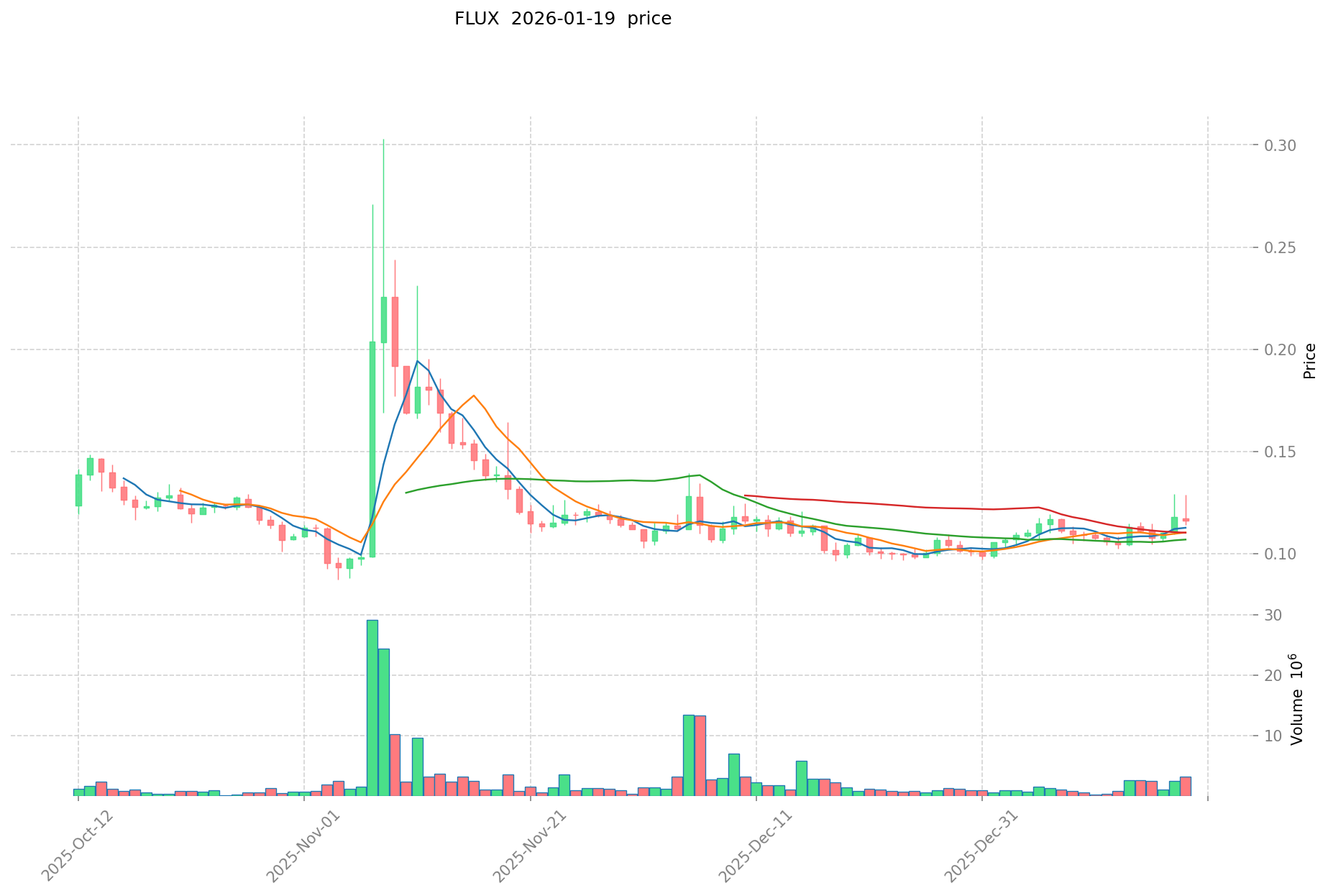
As of January 20, 2026, FLUX is trading at $0.11171, showing mixed short-term performance across different timeframes. The token has experienced an 8.77% decline over the past 24 hours, with the price ranging between $0.10254 and $0.12889 during this period.
Looking at broader trends, FLUX has demonstrated positive momentum in the medium term, with gains of 6.61% over the past week and 6.90% over the past month. However, the yearly performance shows a decline of 80.52%, reflecting the challenging market conditions faced over the past year.
The token maintains a market capitalization of approximately $44.60 million, with a circulating supply of 399.23 million FLUX tokens, representing 90.74% of the total supply of 400.13 million. The fully diluted market cap stands at $44.70 million. The 24-hour trading volume reaches $434,721, indicating moderate market activity. FLUX holds the 567th position in the cryptocurrency market rankings, with a market dominance of 0.0013%.
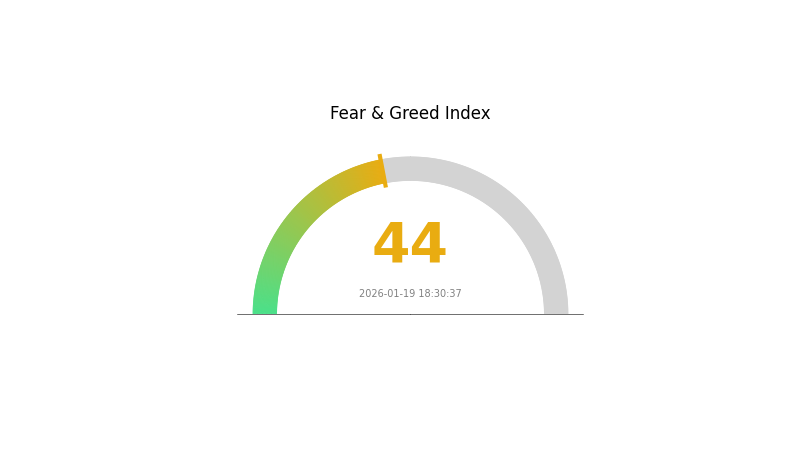
The current market sentiment index stands at 44, indicating a "Fear" level in the market, which may influence investor behavior and price movements in the near term.
Click to view the current FLUX market price
FLUX Market Sentiment Indicator
2026-01-19 Fear and Greed Index: 44 (Fear)
Click to view current Fear & Greed Index
The cryptocurrency market is currently experiencing a fear sentiment, with the Fear and Greed Index standing at 44. This reading indicates that market participants are showing heightened caution and risk aversion. During periods of fear, investors tend to become more conservative, reducing their exposure to digital assets. This environment often presents opportunities for long-term investors to accumulate positions at potentially favorable prices. Market participants should remain vigilant and monitor key support levels while staying informed about macroeconomic developments that could influence sentiment direction.
FLUX Holdings Distribution
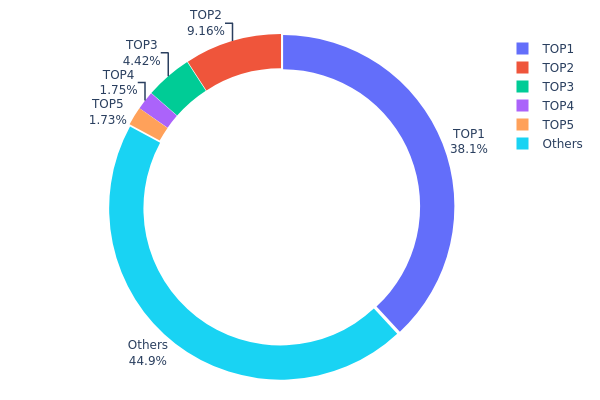
The holdings distribution chart illustrates the concentration of token ownership across different wallet addresses, providing insights into the degree of decentralization and potential market control within the FLUX ecosystem. As of January 20, 2026, the data reveals a moderately concentrated ownership structure that warrants careful examination.
The top holder controls approximately 160 million FLUX tokens, representing 38.06% of the total supply, while the second-largest address holds 38.5 million tokens (9.15%). The top five addresses collectively account for 55.1% of the total supply, with the remaining 44.9% distributed among other addresses. This concentration level suggests a relatively centralized ownership pattern, where a small number of entities possess significant influence over the token's market dynamics. Such concentration typically increases vulnerability to large-scale sell pressure and price manipulation, as major holders have the capacity to significantly impact market liquidity through their trading activities.
The current distribution structure presents both risks and considerations for market participants. The dominant position of the largest holder creates potential for heightened volatility, as any substantial movement of these tokens could trigger significant price fluctuations. However, the presence of a substantial "Others" category at 44.9% indicates that nearly half of the supply is distributed among a broader base of participants, which provides some counterbalance to the concentration at the top. This mixed characteristic reflects a network that, while not fully decentralized, maintains a degree of token diffusion that could support long-term stability as the ecosystem matures and potentially achieves greater distribution equality over time.
Click to view current FLUX Holdings Distribution
| Top |
Address |
Holding Qty |
Holding (%) |
| 1 |
t3ThbW...jSUK4T |
160000.03K |
38.06% |
| 2 |
t1cjcL...vzfYAN |
38500.00K |
9.15% |
| 3 |
t1gorw...aimUbF |
18576.56K |
4.41% |
| 4 |
t3gCpp...4BbR7d |
7375.11K |
1.75% |
| 5 |
t1Yvim...z4X5m2 |
7283.35K |
1.73% |
| - |
Others |
188650.27K |
44.9% |
II. Core Factors Influencing Future FLUX Prices
Supply Mechanism
- Supply Volatility: FLUX's supply volume exhibits inherent volatility, which directly impacts price movements. The supply mechanism remains uncertain in the short term, presenting considerable fluctuation risks.
- Current Impact: The existing supply mechanism uncertainty suggests that short-term price volatility may continue to affect market stability and investor sentiment.
Institutional and Major Holder Dynamics
- Institutional Investment: Institutional investment and mainstream adoption represent key factors influencing FLUX's long-term investment value. The level of institutional participation significantly affects price trends and market confidence.
Macroeconomic Environment
- Market Risk: Cryptocurrency prices are influenced by multiple factors, including market sentiment, macroeconomic conditions, news events, and regulatory developments. Even projects with strong fundamentals may experience significant price volatility in response to broader economic factors.
Technology Development and Ecosystem Building
- Decentralized Cloud Computing: FLUX operates as a decentralized cloud computing platform, with its technological development and ecosystem expansion serving as core elements affecting its market value. The platform's ability to attract users and developers will influence its long-term price prospects.
III. 2026-2031 FLUX Price Prediction
2026 Outlook
- Conservative prediction: $0.07705 - $0.11166
- Neutral prediction: $0.11166
- Optimistic prediction: $0.16191 (requires favorable market conditions and increased adoption)
2027-2029 Outlook
- Market stage expectation: The token is anticipated to enter a gradual growth phase, with potential consolidation periods as the project matures and expands its ecosystem.
- Price range prediction:
- 2027: $0.12037 - $0.1573 (approximately 22% increase from 2026 average)
- 2028: $0.1044 - $0.18233 (approximately 31% increase from 2026 average)
- 2029: $0.15151 - $0.22233 (approximately 47% increase from 2026 average)
- Key catalysts: Ecosystem development, technological upgrades, broader market recovery, and increased institutional interest in decentralized computing infrastructure.
2030-2031 Long-term Outlook
- Base scenario: $0.13546 - $0.19351 (assuming steady ecosystem growth and moderate market conditions)
- Optimistic scenario: $0.19351 - $0.23801 (assuming strong adoption rates and favorable regulatory environment)
- Transformative scenario: $0.21576 - $0.23949 (requires breakthrough technological achievements, major partnerships, and significant market expansion)
- 2026-01-20: FLUX price predictions suggest potential appreciation ranging from conservative estimates around $0.077 to optimistic projections near $0.162, with mid-term forecasts indicating gradual value appreciation through 2031.
| Year |
Predicted High Price |
Predicted Average Price |
Predicted Low Price |
Price Change |
| 2026 |
0.16191 |
0.11166 |
0.07705 |
0 |
| 2027 |
0.1573 |
0.13678 |
0.12037 |
22 |
| 2028 |
0.18233 |
0.14704 |
0.1044 |
31 |
| 2029 |
0.22233 |
0.16469 |
0.15151 |
47 |
| 2030 |
0.23801 |
0.19351 |
0.13546 |
73 |
| 2031 |
0.23949 |
0.21576 |
0.11651 |
93 |
IV. FLUX Professional Investment Strategy and Risk Management
FLUX Investment Methodology
(I) Long-term Holding Strategy
- Suitable for: Investors seeking exposure to decentralized computing infrastructure with medium to high risk tolerance
- Operational Recommendations:
- Consider accumulating FLUX during market downturns when the price approaches technical support levels
- Monitor network growth metrics such as FluxNode deployment and computing resource utilization
- Utilize Gate Web3 Wallet for secure long-term storage with private key control
(II) Active Trading Strategy
- Technical Analysis Tools:
- Moving Averages: Track 50-day and 200-day moving averages to identify trend directions and potential entry/exit points
- RSI (Relative Strength Index): Monitor overbought (>70) and oversold (<30) conditions for swing trading opportunities
- Swing Trading Key Points:
- Set stop-loss orders 8-12% below entry points to manage downside risk
- Consider taking partial profits when FLUX experiences rapid gains exceeding 15-20% in short timeframes
FLUX Risk Management Framework
(I) Asset Allocation Principles
- Conservative Investors: 1-3% of crypto portfolio
- Aggressive Investors: 5-8% of crypto portfolio
- Professional Investors: Up to 10% of crypto portfolio with active management
(II) Risk Hedging Solutions
- Portfolio Diversification: Combine FLUX with established cryptocurrencies and stablecoins to reduce concentration risk
- Position Sizing: Use dollar-cost averaging to build positions gradually rather than committing large sums at once
(III) Secure Storage Solutions
- Hot Wallet Recommendation: Gate Web3 Wallet for active trading and easy access to decentralized applications
- Cold Storage Solution: Hardware wallets for long-term holdings exceeding $5,000 in value
- Security Considerations: Enable two-factor authentication, maintain backup recovery phrases in secure offline locations, and never share private keys
V. FLUX Potential Risks and Challenges
FLUX Market Risks
- High Volatility: FLUX has demonstrated significant price fluctuations, with a 1-year decline of approximately 80.52%, indicating substantial downside potential
- Liquidity Concerns: With a 24-hour trading volume of approximately $434,721, relatively thin liquidity may result in slippage during large transactions
- Competition Pressure: The decentralized computing sector faces competition from established cloud providers and emerging blockchain infrastructure projects
FLUX Regulatory Risks
- Infrastructure Classification: Potential regulatory scrutiny regarding whether decentralized computing networks require compliance with data protection regulations
- Mining Operations: Changes in environmental regulations or energy policies could impact the PoW consensus mechanism and node operations
- Cross-border Operations: Decentralized node networks may face jurisdictional challenges as regulatory frameworks evolve globally
FLUX Technical Risks
- Network Security: As a PoW-based network, FLUX faces potential 51% attack risks if hash rate becomes concentrated
- FluxOS Adoption: The success of the ecosystem depends on developer adoption and deployment of applications on FluxOS
- Node Centralization: If node operation becomes economically unfavorable, network decentralization could be compromised
VI. Conclusion and Action Recommendations
FLUX Investment Value Assessment
FLUX presents a speculative opportunity in the decentralized computing infrastructure sector, combining PoW security with cloud service functionality. The project's long-term value proposition depends on FluxOS adoption and competitive differentiation in the blockchain-as-a-service market. However, the significant 1-year price decline and modest market capitalization of approximately $44.59 million indicate elevated risk. Short-term volatility remains substantial, with recent 24-hour decline of 8.77% reflecting continued market uncertainty.
FLUX Investment Recommendations
✅ Beginners: Consider waiting for clearer market trends and stronger adoption signals before allocating capital. If interested, limit exposure to less than 2% of total crypto portfolio
✅ Experienced Investors: May consider small speculative positions (3-5% of crypto portfolio) with strict risk management and regular portfolio rebalancing
✅ Institutional Investors: Evaluate FLUX as part of a broader decentralized infrastructure thesis, with thorough due diligence on network economics and competitive positioning
FLUX Trading Participation Methods
- Spot Trading: Purchase FLUX directly on Gate.com with multiple trading pairs for flexible entry and exit
- Dollar-Cost Averaging: Implement systematic purchase plans to reduce timing risk in volatile markets
- Staking and Node Operation: Participate in FluxNode operations to earn network rewards while contributing to ecosystem growth, though this requires technical expertise and hardware investment
Cryptocurrency investment carries extremely high risks, and this article does not constitute investment advice. Investors should make prudent decisions based on their own risk tolerance and are advised to consult professional financial advisors. Never invest more than you can afford to lose.
FAQ
What is FLUX? What are its main uses and technical features?
FLUX is an AI image generation model developed by Black Forest Labs. It converts text descriptions into high-quality images. Main uses include creative design and artistic content creation. Technical features include efficient image generation, fast processing speed, and superior image quality compared to other models.
How has FLUX performed historically in price, and what are the main factors affecting its price fluctuations?
FLUX's price has experienced volatility driven by market trends and investor sentiment. Key factors include regulatory developments, network adoption rates, macroeconomic conditions, and technical indicators. Recent analysis indicates a downward trend in price movement.
What is the FLUX price prediction for 2024? What is the analyst's target price?
Analysts' target price for FLUX is USD 5.67, with the highest prediction at USD 8 and lowest at USD 3. Overall rating is strong buy with +267.97% upside potential.
What are the advantages and disadvantages of FLUX compared to other GPU computing tokens such as GRT and RLC?
FLUX excels in GPU computing efficiency and real-time processing power. Its advantage lies in dedicated computational infrastructure. Compared to GRT's indexing focus and RLC's broader compute scope, FLUX offers specialized performance. However, FLUX may have smaller ecosystem adoption and community support than established competitors, potentially limiting long-term network effects and liquidity.
What are the main risks of investing in FLUX? How should I evaluate its long-term investment value?
FLUX faces crypto market volatility and technology risks. Evaluate long-term value by assessing its utility in distributed computing, adoption trends, and ecosystem development. Strong technical fundamentals support potential growth.
* The information is not intended to be and does not constitute financial advice or any other recommendation of any sort offered or endorsed by Gate.