This comprehensive analysis examines FOREST Protocol's price trajectory from 2026 through 2031, combining historical market data, ecosystem fundamentals, and macroeconomic factors. FOREST, an innovative blockchain gaming launchpad backed by Mechanism Capital and Twitch co-founder Kevin Lin, currently trades at $0.02574 with a market cap of $2.08 million. The article projects conservative 2026 price ranges of $0.02246-$0.02642, with potential growth to $0.06073 by 2031 contingent on ecosystem expansion and mass adoption. Key sections detail investment strategies for different investor profiles, risk management frameworks including secure storage via Gate Web3 Wallet, and critical risk factors such as limited liquidity (8.1% circulating supply) and high volatility. Designed for crypto investors seeking professional guidance on FOREST's emerging gaming infrastructure potential, this analysis balances optimistic growth catalysts against substantial market uncertainties and regulatory challenges.
Introduction: FOREST Market Position and Investment Value
Forest Protocol (FOREST), positioned as an innovative launchpad and AMM protocol enabling creators to launch Playable Tokens, has been making strides in the blockchain gaming and decentralized application space since its launch in 2025. As of 2026, FOREST has achieved a market capitalization of approximately 2.08 million USD, with a circulating supply of around 81 million tokens, maintaining a price level near 0.02574 USD. This asset, recognized as a pioneer in the "plug-and-play mini-app with built-in economic flywheel" category, is playing an increasingly vital role in bringing gaming and application teams fully on-chain.
Backed by prominent investors including Mechanism Capital, TreasureDAO, Cherubic Ventures, and notable angels such as Twitch co-founder Kevin Lin, Forest Protocol has demonstrated its ecosystem's growing adoption through its flagship project Zeeverse, which maintains over 20,000 daily active players and has attracted more than 300,000 registrations for its Telegram mini-game. With a total supply of 1 billion tokens and current circulation representing 8.1% of the fully diluted market cap, FOREST presents a unique case study in early-stage blockchain gaming infrastructure.
This article will comprehensively analyze FOREST's price trajectory from 2026 through 2031, combining historical patterns, market supply-demand dynamics, ecosystem development milestones, and macroeconomic environmental factors to provide investors with professional price forecasts and practical investment strategies for navigating this emerging sector.
I. FOREST Price History Review and Market Status
FOREST Historical Price Evolution Trajectory
- September 2025: FOREST recorded its all-time low at $0.02, marking the token's initial price discovery phase
- October 2025: The token experienced substantial growth momentum, reaching its all-time high of $0.09454 on October 13th, representing a price appreciation of over 370% from its launch level
- Late 2025 to Early 2026: FOREST entered a market correction phase, with prices declining from the October peak to current trading levels around $0.02574
FOREST Current Market Situation
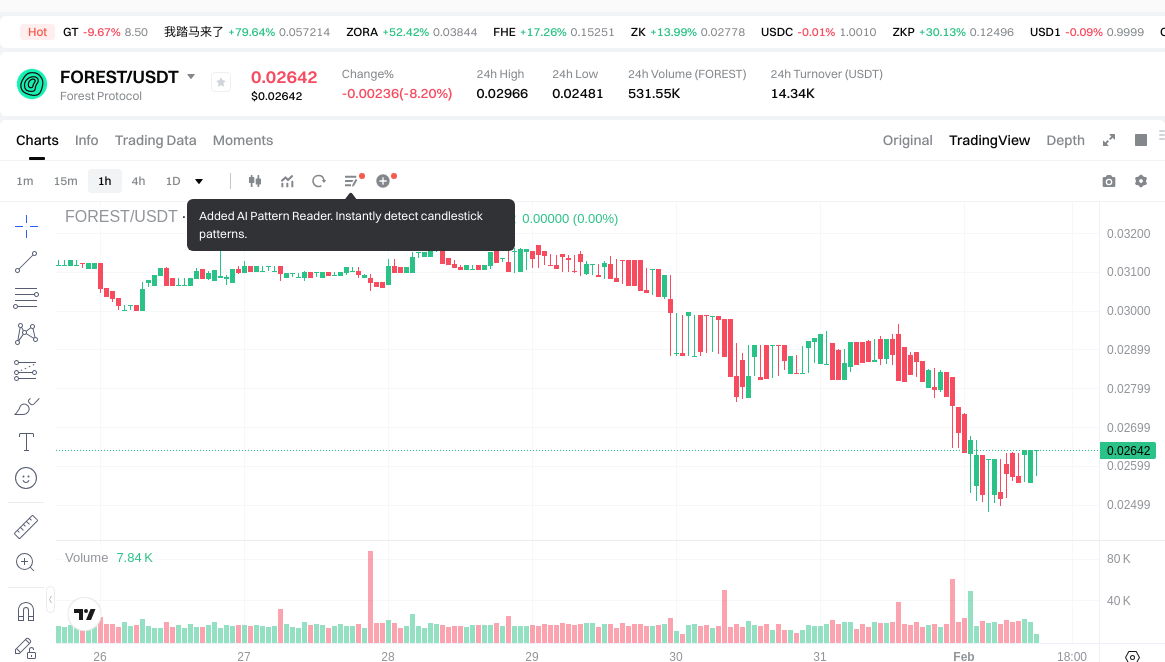
As of February 1, 2026, FOREST is trading at $0.02574, showing mixed short-term momentum with a 1-hour decline of 0.22% and a 24-hour decrease of 12.15%. The token has experienced downward pressure across multiple timeframes, declining 15.73% over the past 7 days, 18.33% over 30 days, and 49.097% over the past year.
The token maintains a market capitalization of approximately $2.08 million with a fully diluted valuation of $25.74 million. Trading volume over the past 24 hours reached $14,377.15, indicating moderate market activity. FOREST's circulating supply stands at 81 million tokens, representing 8.1% of the maximum supply of 1 billion tokens.
The token holder count has reached 3,976 addresses, demonstrating a growing community base. FOREST currently ranks #2032 in the overall cryptocurrency market, with a market dominance of 0.00092%. The 24-hour trading range spans from $0.02481 to $0.02966, reflecting intraday volatility of approximately 19.5%.
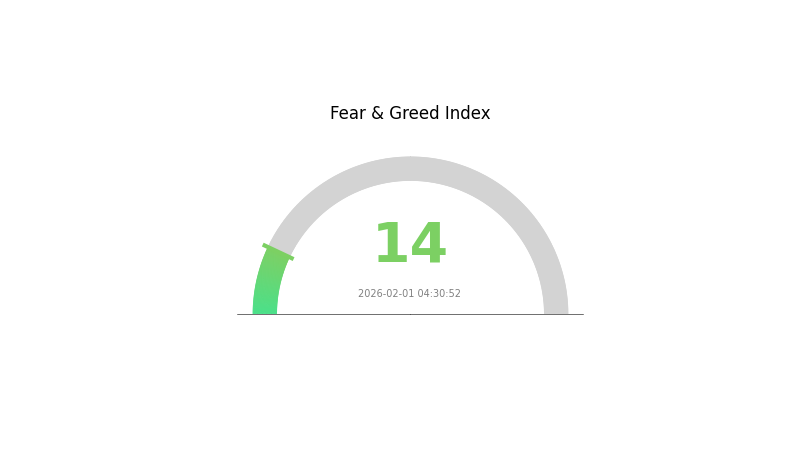
The broader market sentiment indicator shows a reading of 14 (Extreme Fear), which may be influencing FOREST's recent price performance alongside other digital assets in the current market environment.
Click to view the current FOREST market price
FOREST Market Sentiment Index
2026-02-01 Fear and Greed Index: 14 (Extreme Fear)
Click to view current Fear & Greed Index
The cryptocurrency market is currently experiencing extreme fear, with the Fear and Greed Index at 14. This exceptionally low reading indicates significant market pessimism and heightened risk aversion among investors. When fear reaches such extreme levels, it often signals potential capitulation and may present contrarian opportunities for risk-tolerant traders. Market participants should exercise caution while monitoring key support levels. Such sentiment extremes typically precede notable market reversals, making this period important for strategic positioning and portfolio reassessment.
FOREST Holding Distribution
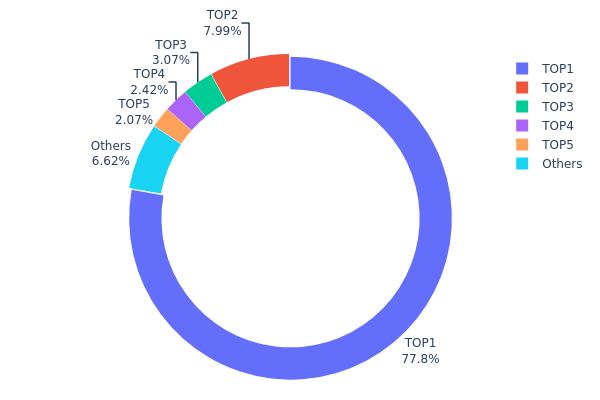
The holding distribution chart reflects the concentration of token allocation across different addresses on the blockchain, serving as a crucial indicator for assessing the decentralization level and potential market manipulation risks of a cryptocurrency. By analyzing the distribution pattern of FOREST tokens among major holders, we can evaluate the health of its on-chain structure and the stability of market participation.
According to the current data, FOREST exhibits an extremely high concentration characteristic. The top holder (0xb785...582c54) alone controls 389,600K tokens, accounting for 77.82% of the total supply, while the second-largest holder (0x92f2...b9fd73) holds 40,000K tokens at 7.99%. The top two addresses collectively control over 85% of the circulating supply, indicating a significantly centralized distribution structure. The remaining top 5 addresses hold between 2-3% each, with all other addresses combined accounting for merely 6.64% of the total supply. This pattern suggests that FOREST's token distribution is heavily skewed toward a few dominant entities.
Such concentration poses considerable risks to market stability and price discovery mechanisms. The overwhelming dominance of the top holder creates potential vulnerabilities, as any substantial sell-off from this address could trigger severe price volatility and liquidity crises. The limited circulation among smaller holders restricts genuine market participation and may facilitate price manipulation by major stakeholders. From a decentralization perspective, this distribution structure contradicts the fundamental principles of blockchain technology, potentially undermining investor confidence and long-term project sustainability. The current on-chain structure reveals a fragile ecosystem highly susceptible to single-entity influence, warranting cautious evaluation by potential investors regarding FOREST's market maturity and governance transparency.
Click to view the current FOREST Holding Distribution
| Top |
Address |
Holding Qty |
Holding (%) |
| 1 |
0xb785...582c54 |
389600.00K |
77.82% |
| 2 |
0x92f2...b9fd73 |
40000.00K |
7.99% |
| 3 |
0xf060...6f4aa0 |
15387.56K |
3.07% |
| 4 |
0xb6c6...c5dc94 |
12108.02K |
2.41% |
| 5 |
0xfc89...0bdec3 |
10382.07K |
2.07% |
| - |
Others |
33121.85K |
6.64% |
II. Core Factors Affecting FOREST's Future Price
Supply Mechanism
-
Timber Market Dynamics: The supply mechanism is closely tied to timber market prices and forest management practices. Research indicates that optimal harvesting decisions are influenced by price volatility, with rotation periods for plantations typically ranging between 8 to 9 years when considering multiple carbon pools including biomass, dead organic matter, and wood products.
-
Historical Patterns: Timber prices and carbon pricing mechanisms have historically demonstrated significant influence on forest management decisions. Studies show that discount rates and long-term equilibrium prices of timber and carbon sinks serve as pivotal factors in shaping supply dynamics.
-
Current Impact: The integration of carbon sequestration into forest management practices has shown potential for economic optimization, with multi-carbon pool scenarios demonstrating substantial revenue potential for forest managers.
Institutional and Macro Dynamics
-
Policy Framework: Government policies on forestry and climate change play significant roles in market dynamics. Environmental protection regulations and forestry development strategies continue to shape the operational landscape, with various jurisdictions implementing measures to reduce deforestation and promote climate action.
-
Carbon Market Integration: The carbon pricing mechanism has emerged as a key factor, with policies aimed at biodiversity protection and food security influencing market valuations. Agricultural subsidy reforms are being considered to reduce deforestation while promoting climate initiatives.
Macroeconomic Environment
-
Economic Growth Correlation: Economic growth patterns demonstrate correlation with forest carbon sequestration dynamics. Research indicates that factors including urbanization rates, energy consumption structures, forest harvesting volumes, forest area coverage, and temperature changes all contribute to market influences to varying degrees.
-
Climate Change Considerations: Natural environmental factors, particularly temperature variations and climate patterns, continue to impact forest management decisions and market valuations. The relationship between environmental sustainability and economic development remains a focal point for policy considerations.
Technical Development and Ecosystem Building
-
Carbon Pool Optimization: Advanced frameworks incorporating multiple carbon pools have been developed, including biomass carbon storage, dead organic matter management, wood forest products utilization, and biomass energy applications. These multi-pool approaches have enhanced the economic potential of forest management practices.
-
Assessment Methodologies: Research demonstrates that carbon sequestration potential estimation methods, carbon pool selection criteria, data sources, and spatial characteristics all significantly impact evaluation outcomes. Meta-regression models and analytical frameworks continue to evolve for more accurate assessments.
-
Sustainability Integration: The integration of environmental sustainability considerations into forest management represents an ongoing development, with frameworks addressing the balance between economic growth and environmental conservation becoming increasingly sophisticated.
III. 2026-2031 FOREST Price Prediction
2026 Outlook
- Conservative Prediction: $0.02246 - $0.02642
- Neutral Prediction: Around $0.02642
- Optimistic Prediction: Up to $0.02933 (requiring favorable market conditions and continued project development)
2027-2029 Outlook
- Market Stage Expectation: FOREST may enter a gradual growth phase, with price volatility expected as the project matures and adoption expands
- Price Range Prediction:
- 2027: $0.02397 - $0.03791
- 2028: $0.02631 - $0.0467
- 2029: $0.02268 - $0.05134
- Key Catalysts: Ecosystem expansion, increased user adoption, potential partnerships, and broader market sentiment in the crypto space
2030-2031 Long-term Outlook
- Baseline Scenario: $0.03964 - $0.0565 (assuming steady ecosystem growth and stable market conditions)
- Optimistic Scenario: $0.05104 - $0.06073 (contingent on significant technological breakthroughs and mass adoption)
- Transformative Scenario: Potential to exceed $0.06073 (in case of exceptional market conditions, major institutional adoption, and groundbreaking platform developments)
- 2026-02-01: FOREST trading within early-year range as market participants assess project trajectory and upcoming developments
| Year |
Predicted High Price |
Predicted Average Price |
Predicted Low Price |
Price Change |
| 2026 |
0.02933 |
0.02642 |
0.02246 |
2 |
| 2027 |
0.03791 |
0.02787 |
0.02397 |
8 |
| 2028 |
0.0467 |
0.03289 |
0.02631 |
27 |
| 2029 |
0.05134 |
0.0398 |
0.02268 |
54 |
| 2030 |
0.0565 |
0.04557 |
0.03964 |
77 |
| 2031 |
0.06073 |
0.05104 |
0.03317 |
98 |
IV. FOREST Professional Investment Strategies and Risk Management
FOREST Investment Methodology
(1) Long-term Holding Strategy
- Target Audience: Investors optimistic about blockchain gaming infrastructure and playable token ecosystems
- Operational Recommendations:
- Consider accumulating during market corrections while monitoring project development progress
- Focus on Zeeverse user growth metrics and partner studio expansion as key indicators
- Storage Solution: Use Gate Web3 Wallet for secure storage with regular backup of private keys
(2) Active Trading Strategy
- Technical Analysis Tools:
- Volume Analysis: Monitor 24-hour trading volume fluctuations to identify potential entry and exit points
- Support and Resistance Levels: Track the historical low at $0.02 as potential support and the all-time high of $0.09454 as resistance
- Swing Trading Key Points:
- Be aware of the current low circulating supply (8.1% of total supply) which may contribute to higher volatility
- Monitor announcements regarding new partner studios or ecosystem developments for potential catalysts
FOREST Risk Management Framework
(1) Asset Allocation Principles
- Conservative Investors: 1-3% of crypto portfolio
- Aggressive Investors: 5-10% of crypto portfolio
- Professional Investors: May allocate higher percentages based on comprehensive due diligence and risk models
(2) Risk Hedging Solutions
- Diversification Strategy: Balance FOREST holdings with established blockchain gaming tokens and blue-chip cryptocurrencies
- Position Sizing: Scale into positions gradually rather than entering all at once given the token's relatively low liquidity
(3) Secure Storage Solutions
- Hot Wallet Recommendation: Gate Web3 Wallet for convenient trading and staking access
- Cold Storage Option: Consider hardware wallet solutions for long-term holdings exceeding your active trading amount
- Security Precautions: Enable two-factor authentication, never share private keys, and verify contract addresses (0x11cf6bf6d87cb0eb9c294fd6cbfec91ee3a1a7d0 on BSC) before transactions
V. FOREST Potential Risks and Challenges
FOREST Market Risks
- Limited Liquidity: With a 24-hour trading volume of approximately $14,377, sudden exits may face significant slippage
- High Volatility: The token has experienced a 49.097% decline over the past year and 18.33% decline in the past 30 days, indicating substantial price fluctuations
- Low Circulation Rate: Only 8.1% of total supply is currently circulating, presenting potential dilution risk as more tokens enter the market
FOREST Regulatory Risks
- Gaming Token Classification: Evolving regulations regarding blockchain gaming tokens and their legal status across jurisdictions may impact the project
- Compliance Requirements: Future regulatory frameworks for launchpad platforms and tokenized gaming economies remain uncertain
- Cross-border Operations: As a global platform, FOREST may face varying regulatory standards in different markets
FOREST Technical Risks
- Smart Contract Vulnerabilities: As with any blockchain protocol, potential bugs or exploits in smart contracts could affect user funds
- Platform Dependency: The project's success is closely tied to the performance of its flagship title Zeeverse and the broader adoption of playable tokens
- Competition Intensity: The blockchain gaming and launchpad space is highly competitive, with numerous established platforms vying for market share
VI. Conclusion and Action Recommendations
FOREST Investment Value Assessment
Forest Protocol presents an innovative approach to blockchain gaming through its playable token concept and integrated launchpad-AMM mechanism. The project benefits from backing by notable investors including Mechanism Capital, TreasureDAO, and Twitch co-founder Kevin Lin, alongside demonstrated user adoption with Zeeverse's 20,000+ daily active players and 300,000+ Telegram mini-game registrations. However, investors should carefully weigh the long-term potential against current challenges including limited liquidity, significant price volatility, and a low circulation rate. The token's performance over the past year, with a decline of approximately 49%, reflects both broader market conditions and project-specific factors that warrant cautious evaluation.
FOREST Investment Recommendations
✅ Beginners: Start with minimal allocation (under 2% of crypto portfolio) and focus on understanding the playable token ecosystem before increasing exposure. Consider dollar-cost averaging to mitigate volatility risk.
✅ Experienced Investors: May allocate 3-7% of crypto portfolio with active monitoring of ecosystem developments, particularly Zeeverse user metrics and new studio partnerships. Utilize technical analysis for potential swing trading opportunities.
✅ Institutional Investors: Conduct comprehensive due diligence on the team's 10+ years of gaming experience, evaluate tokenomics structure, and assess the competitive positioning of the launchpad model. Consider staged investment approach aligned with milestone achievements.
FOREST Trading Participation Methods
- Spot Trading: Purchase FOREST tokens through Gate.com and other supported exchanges with BEP-20 compatibility
- Active Portfolio Management: Monitor the 3,976 holder count and trading volume trends for liquidity assessment before executing larger orders
- Community Engagement: Follow official channels on X (formerly Twitter) @ProtocolForest and review documentation at docs.forest.inc for project updates
Cryptocurrency investment carries extremely high risks, and this article does not constitute investment advice. Investors should make prudent decisions based on their own risk tolerance and are advised to consult professional financial advisors. Never invest more than you can afford to lose.
FAQ
What is the current price of FOREST token, and what are its historical highest and lowest prices?
FOREST token's historical all-time high is US$0.07165 and all-time low is US$0.0002753. Current price fluctuates based on real-time market conditions. Check live charts for current trading price.
What are the main factors affecting FOREST price?
FOREST price is primarily influenced by market demand, trading volume, ecosystem adoption, community sentiment, and broader cryptocurrency market conditions. Supply dynamics and project developments also play significant roles in price movements.
How to conduct price prediction and technical analysis for FOREST tokens?
FOREST price prediction uses technical analysis tools including moving averages, RSI indicators, and K-line charts. Analyze trading volume and market trends to identify price movements. Common methods help assess whether FOREST is overbought or oversold in current market conditions.
What are the advantages and differences of FOREST token compared to other ecosystem tokens?
FOREST token distinguishes itself through unique supply mechanics, superior liquidity, and lower transaction fees. It plays a vital role in the ecosystem by promoting user participation and offering enhanced reward mechanisms.
What are the main risks of investing in FOREST tokens?
Main risks include market volatility, token inflation from unreleased supply, and uncertainty from future unlock schedules. Token value depends on network adoption for fee payments and staking utility.
What are the future development prospects and application scenarios for FOREST tokens?
FOREST tokens show strong potential in education, gaming, and digital asset trading. The token enables NFT applications and decentralized ecosystems. With increasing adoption and diversification, FOREST is positioned for significant growth and widespread mainstream integration across multiple sectors.
Where can I buy FOREST tokens?
FOREST tokens are available on decentralized exchanges, with Raydium being the most popular platform. The most active trading pair is FOREST/SOL, offering the highest trading volume.
* The information is not intended to be and does not constitute financial advice or any other recommendation of any sort offered or endorsed by Gate.