This comprehensive analysis examines FUEL's price trajectory and investment potential through 2031, establishing a foundational framework for cryptocurrency investors. Currently trading at $0.001564 with a market cap of $11.04 million, FUEL operates as an Ethereum Layer 2 rollup solution offering superior scalability and cost-efficiency. The article synthesizes historical price evolution, market sentiment, and technical developments to provide professional price forecasts ranging from $0.00136 to $0.00364 by 2031. Key sections address core influencing factors, risk management frameworks, and diversified investment strategies suitable for beginners, experienced, and institutional investors. The analysis highlights FUEL's extreme volatility (-95.11% decline from all-time high), competitive positioning, and regulatory uncertainties while offering practical recommendations for portfolio allocation and secure storage on Gate. Strategic dollar-cost averaging and disciplined position sizing emerge as prudent approac
Introduction: FUEL's Market Position and Investment Value
Fuel (FUEL), as a next-generation Ethereum rollup solution designed to enhance scalability and transaction efficiency, has been making significant strides in the blockchain ecosystem since its launch in 2024. As of 2026, FUEL has achieved a market capitalization of approximately $11.04 million, with a circulating supply of around 7.06 billion tokens, and the price maintaining at approximately $0.001564. This asset, recognized as "the fastest and most cost-efficient Optimistic rollup on Ethereum," is playing an increasingly vital role in advancing Ethereum's Layer-2 scaling solutions and developer ecosystem.
This article will comprehensively analyze FUEL's price trajectory from 2026 to 2031, combining historical patterns, market supply-demand dynamics, ecosystem development, and macroeconomic conditions to provide investors with professional price forecasts and practical investment strategies.
I. FUEL Price History Review and Current Market Status
FUEL Historical Price Evolution Trajectory
- December 2024: FUEL token launched with an initial listing price of $0.01694, representing the project's entry into the cryptocurrency market
- April 2025: FUEL reached its all-time high of $0.021383, marking a notable appreciation from its listing price
- January 2026: The token experienced significant volatility, recording an all-time low of $0.001469 on January 11th
FUEL Current Market Situation
As of January 26, 2026, FUEL is trading at $0.001564, reflecting a modest decline of 0.38% over the past 24 hours. The token has demonstrated relatively stable short-term performance with a 1-hour decrease of 0.13%. However, broader timeframe analysis reveals more substantial downward pressure, with weekly and monthly declines of 5.31% and 7.39% respectively.
The 24-hour trading range has been contained between $0.001561 and $0.001594, indicating limited volatility in the immediate term. Trading volume stands at approximately $18,349.29, suggesting moderate market activity for the token.
FUEL maintains a market capitalization of approximately $11.04 million, with a circulating supply of 7.06 billion tokens representing 69.04% of its total supply of 10.22 billion. The fully diluted market cap reaches $15.98 million. The token holds a market dominance of 0.00051% within the broader cryptocurrency ecosystem.
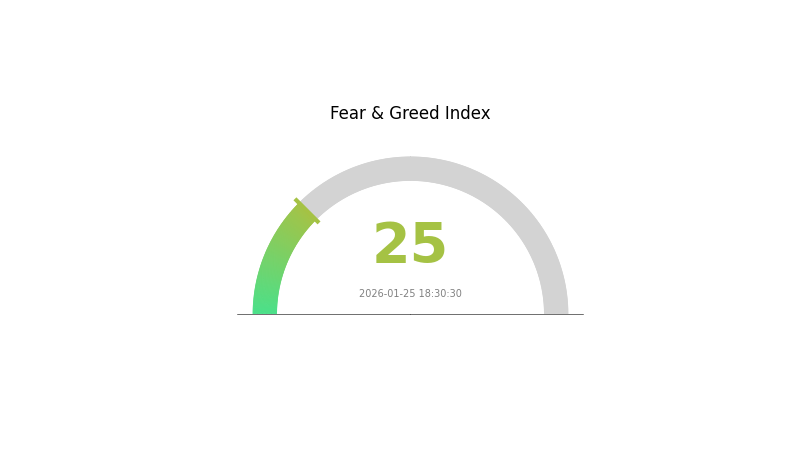
With 13 exchanges listing the token and approximately 7,190 holders, FUEL demonstrates a growing but still developing community presence. The market sentiment indicator currently registers at 25, classified within the extreme fear zone, reflecting cautious investor sentiment across the market.
The token operates on dual-chain infrastructure, utilizing both the Ethereum network and the native FUEL L2 solution, with contract addresses available on both platforms.
Click to view the current FUEL market price

FUEL Market Sentiment Index
2026-01-25 Fear and Greed Index: 25 (Extreme Fear)
Click to view current Fear & Greed Index
The FUEL market is currently experiencing extreme fear, with the Fear and Greed Index reading at 25. This indicates heightened market anxiety and risk aversion among investors. During periods of extreme fear, opportunities may emerge for contrarian traders, while cautious investors should carefully assess their positions. Market sentiment remains volatile, reflecting broader uncertainty in the cryptocurrency sector. Monitor key support levels and consider dollar-cost averaging strategies to navigate this turbulent environment effectively.
FUEL Holdings Distribution
The holdings distribution chart illustrates the percentage of total token supply held by different wallet addresses, serving as a key indicator of token concentration and decentralization level. This metric helps assess the market structure's stability and potential vulnerability to manipulation by large holders.
Based on the current data, FUEL exhibits a highly concentrated holdings pattern. The top address (0xd57d...c169ee) holds 4.39 billion tokens, accounting for 42.44% of the total supply, while the second-largest holder (0xa4ca...f43f67) controls 2.80 billion tokens or 27.08%. Combined, these two addresses alone hold nearly 70% of the entire token supply. The top five addresses collectively control over 80% of FUEL tokens, with only 19.5% distributed among other addresses.
Such extreme concentration poses significant risks to market stability and price dynamics. The dominance of a few large holders creates an asymmetric power structure where major selling pressure from any top address could trigger substantial price volatility. This configuration also raises concerns about potential market manipulation, as coordinated actions among top holders could artificially influence price movements. From a decentralization perspective, this distribution pattern contradicts the fundamental principles of blockchain technology, suggesting that decision-making power and market control remain centralized in the hands of very few entities. The limited token circulation among the broader community may also hinder organic price discovery and reduce market liquidity depth.
Click to view current FUEL Holdings Distribution

| Top |
Address |
Holding Qty |
Holding (%) |
| 1 |
0xd57d...c169ee |
4392678.81K |
42.44% |
| 2 |
0xa4ca...f43f67 |
2803102.10K |
27.08% |
| 3 |
0x2ac7...ebb0d5 |
497547.13K |
4.80% |
| 4 |
0x50ed...5edfe8 |
381218.28K |
3.68% |
| 5 |
0xa312...4ab647 |
259316.14K |
2.50% |
| - |
Others |
2016137.56K |
19.5% |
II. Core Factors Influencing FUEL's Future Price
Based on the currently available information, comprehensive data regarding FUEL's supply mechanisms, institutional dynamics, macroeconomic correlations, and technical development remains limited. As market conditions evolve and more verifiable data becomes accessible, these factors may provide clearer insights into potential price trajectories.
Investors should monitor official project announcements, on-chain metrics, and broader cryptocurrency market trends to better understand FUEL's fundamental drivers. Given the nascent stage of available data, exercising caution and conducting thorough independent research is advisable before making investment decisions related to FUEL.
III. 2026-2031 FUEL Price Prediction
2026 Outlook
- Conservative Prediction: $0.00136 - $0.00156
- Neutral Prediction: Around $0.00156
- Optimistic Prediction: Up to $0.00206 (requires favorable market conditions and increased adoption)
2027-2029 Outlook
- Market Phase Expectation: FUEL is anticipated to enter a gradual growth phase, with price volatility potentially influenced by broader cryptocurrency market trends and project development milestones.
- Price Range Predictions:
- 2027: $0.00138 - $0.00236 (approximately 15% increase from 2026)
- 2028: $0.00163 - $0.00255 (approximately 33% cumulative increase)
- 2029: $0.00171 - $0.00315 (approximately 47% cumulative increase)
- Key Catalysts: Ecosystem expansion, technological upgrades, strategic partnerships, and increased network activity could serve as primary drivers for price appreciation during this period.
2030-2031 Long-term Outlook
- Baseline Scenario: $0.00186 - $0.00273 in 2030 (assuming steady project development and moderate market conditions)
- Optimistic Scenario: $0.00168 - $0.00364 by 2031 (conditional upon significant technological breakthroughs and widespread adoption)
- Transformative Scenario: Potential to reach the upper price range if FUEL achieves major ecosystem milestones, attracts institutional interest, and benefits from favorable regulatory developments
- 2026-01-26: FUEL demonstrates initial price stability with an average prediction of $0.00156, establishing a foundation for potential multi-year growth trajectory with projected increases ranging from 15% to 78% through 2031.
| Year |
Predicted High Price |
Predicted Average Price |
Predicted Low Price |
Price Change |
| 2026 |
0.00206 |
0.00156 |
0.00136 |
0 |
| 2027 |
0.00236 |
0.00181 |
0.00138 |
15 |
| 2028 |
0.00255 |
0.00209 |
0.00163 |
33 |
| 2029 |
0.00315 |
0.00232 |
0.00171 |
47 |
| 2030 |
0.00287 |
0.00273 |
0.00186 |
74 |
| 2031 |
0.00364 |
0.0028 |
0.00168 |
78 |
IV. FUEL Professional Investment Strategies and Risk Management
FUEL Investment Methodology
(I) Long-Term Holding Strategy
- Suitable for: Investors believing in Ethereum Layer 2 ecosystem development and blockchain scalability solutions
- Operational Recommendations:
- Consider accumulating during significant price pullbacks, as FUEL has experienced a -95.11% decline from its all-time high of $0.021383
- Maintain disciplined position sizing given the token's high volatility and relatively low market cap of approximately $11.04 million
- Storage Solution: Use Gate Web3 Wallet for secure custody, supporting both Ethereum (ERC-20) and Fuel L2 network formats
(II) Active Trading Strategy
- Technical Analysis Tools:
- Volume Analysis: Monitor the 24-hour trading volume of $18,349.29 to identify potential breakout or breakdown points
- Support and Resistance Levels: Track the recent 24-hour range between $0.001561 (low) and $0.001594 (high) for short-term trading opportunities
- Swing Trading Considerations:
- Focus on the 7-day trend showing -5.31% decline for potential reversal signals
- Set stop-loss orders below the all-time low of $0.001469 recorded on January 11, 2026
FUEL Risk Management Framework
(I) Asset Allocation Principles
- Conservative Investors: 1-2% of cryptocurrency portfolio allocation
- Aggressive Investors: 3-5% of cryptocurrency portfolio allocation
- Professional Investors: Up to 5-8% with hedging strategies in place
(II) Risk Hedging Solutions
- Portfolio Diversification: Balance FUEL exposure with established Layer 1 and Layer 2 tokens
- Position Scaling: Implement gradual entry and exit strategies rather than lump-sum investments
(III) Secure Storage Solutions
- Web3 Wallet Recommendation: Gate Web3 Wallet, supporting both ERC-20 and Fuel L2 network addresses
- Multi-Signature Solution: Consider multi-signature wallets for larger holdings to enhance security
- Security Precautions: Never share private keys, enable two-factor authentication, and regularly update wallet software; be aware of phishing attempts targeting cryptocurrency holders
V. FUEL Potential Risks and Challenges
FUEL Market Risks
- Extreme Volatility: FUEL has experienced a -95.11% decline over one year, indicating substantial price volatility and market uncertainty
- Low Liquidity: With a market cap of $11.04 million and ranking #1149, liquidity may be limited during periods of market stress
- Competition: The Layer 2 scaling solution market is highly competitive with numerous established players, potentially impacting FUEL's market share
FUEL Regulatory Risks
- Evolving Regulations: Changes in cryptocurrency regulations globally may affect Layer 2 solutions and their operational models
- Compliance Requirements: Future regulatory frameworks may impose additional compliance burdens on Ethereum-based rollup technologies
- Jurisdictional Uncertainty: Different regulatory approaches across jurisdictions may create operational complexity
FUEL Technical Risks
- Smart Contract Vulnerabilities: Despite optimized design, potential bugs or exploits in FuelVM, Sway language, or Forc toolchain could pose security risks
- Network Dependencies: As an Ethereum-based rollup, FUEL inherits risks from the underlying Ethereum network
- Adoption Challenges: The success of Fuel's technical innovations (parallelized execution, native account abstraction) depends on developer and user adoption
VI. Conclusion and Action Recommendations
FUEL Investment Value Assessment
Fuel presents an innovative approach to Ethereum scaling with features including parallelized transaction execution, high throughput (>600 TPS), and low transaction costs (<$0.0002 per transaction). However, the token has experienced significant price depreciation (-95.11% from all-time high) and maintains a relatively small market capitalization. The long-term value proposition depends on successful ecosystem development and increased adoption of the Fuel network. Short-term risks include continued price volatility, low liquidity, and intense competition in the Layer 2 space.
FUEL Investment Recommendations
✅ Beginners: Exercise extreme caution given the high volatility and -95.11% one-year decline; limit exposure to no more than 1% of your cryptocurrency portfolio; focus on education about Layer 2 technologies before investing
✅ Experienced Investors: Consider small speculative positions (2-3% of crypto portfolio) with strict risk management; monitor technological developments and ecosystem growth metrics; utilize dollar-cost averaging to mitigate timing risk
✅ Institutional Investors: Conduct thorough due diligence on Fuel's technology stack and team credentials; assess competitive positioning within the Layer 2 landscape; implement sophisticated hedging strategies if taking positions; consider pilot allocations within broader Ethereum ecosystem strategies
FUEL Trading Participation Methods
- Spot Trading: Purchase FUEL tokens directly on Gate.com with 13 exchanges currently supporting trading pairs
- Gradual Accumulation: Implement systematic investment plans to average entry prices over time
- Portfolio Integration: Include FUEL as part of a diversified Layer 2 and Ethereum ecosystem allocation strategy
Cryptocurrency investment carries extremely high risks, and this article does not constitute investment advice. Investors should make cautious decisions based on their own risk tolerance and are advised to consult professional financial advisors. Never invest more than you can afford to lose.
FAQ
FUEL token has demonstrated significant growth trajectory over the past year, with notable price appreciation from its early 2025 levels. The token experienced moderate volatility characteristic of emerging layer-2 solutions, with periodic consolidation phases followed by bullish breakouts. Current momentum suggests continued upward pressure into 2026.
What are the main factors affecting FUEL price?
FUEL price is influenced by network activity, developer adoption, ecosystem development, market demand, trading volume, and overall crypto market sentiment. Supply dynamics and technological upgrades also play significant roles in price movements.
What are professional analysts' predictions for FUEL's future price?
Analysts project FUEL could see significant growth driven by increased adoption and ecosystem expansion. Long-term forecasts suggest potential price appreciation, though exact targets vary based on market conditions and network developments.
What is the market liquidity and trading volume of FUEL tokens?
FUEL tokens demonstrate strong market liquidity with consistent daily trading activity. The token maintains healthy order book depth across multiple trading pairs, ensuring efficient execution for both retail and institutional traders. Trading volume remains robust, reflecting growing market demand and active participation from the community.
What are FUEL's competitive advantages and disadvantages compared to similar tokens?
FUEL's advantages include innovative consensus mechanism, faster transaction speed, and lower fees. Disadvantages are smaller community size and limited ecosystem compared to established competitors. The token shows strong technical fundamentals with growth potential in the emerging infrastructure sector.
How will FUEL project's technical updates and development roadmap affect the price?
FUEL's technological upgrades and roadmap milestones typically drive positive price momentum. Major updates improving network efficiency, scalability, and utility increase investor confidence and adoption, potentially boosting demand and price appreciation. Successful implementations of planned features strengthen long-term value.
What risks should I consider when investing in FUEL tokens?
FUEL token investments carry market volatility risk, liquidity risk, and regulatory uncertainty. Price fluctuations can be significant, especially in emerging crypto projects. Conduct thorough research, diversify your portfolio, and only invest capital you can afford to lose.
* The information is not intended to be and does not constitute financial advice or any other recommendation of any sort offered or endorsed by Gate.