This comprehensive analysis examines FUEL token's price trajectory from 2026 to 2031, providing professional investment guidance for the Ethereum Layer 2 scaling solution. The article reviews FUEL's market position since December 2024 launch, analyzing current trading data on Gate at $0.001577 with $11.13 million market cap. It delivers detailed price forecasts across conservative, neutral, and optimistic scenarios, projects potential 123% growth by 2031, and outlines tailored investment strategies for beginners through institutional investors. The guide addresses key risk factors including market volatility, regulatory uncertainty, and technical vulnerabilities while offering practical trading methods and storage solutions. Essential reading for evaluating FUEL's investment potential in the competitive Layer 2 ecosystem.
Introduction: FUEL's Market Position and Investment Value
Fuel (FUEL), positioned as an innovative Ethereum Layer 2 scaling solution, has established itself in the blockchain ecosystem since its launch in December 2024. As of January 2026, FUEL maintains a market capitalization of approximately $11.13 million, with a circulating supply of around 7.06 billion tokens and a current trading price near $0.001577. This asset, recognized for its high-performance transaction processing capabilities exceeding 600 TPS and minimal transaction costs below $0.0002, is playing an increasingly important role in Ethereum scalability solutions.
This article will comprehensively analyze FUEL's price trajectory from 2026 to 2031, combining historical patterns, market supply and demand dynamics, ecosystem development, and macroeconomic factors to provide investors with professional price forecasts and practical investment strategies.
I. FUEL Price History Review and Market Status
FUEL Historical Price Evolution Trajectory
- December 2024: FUEL token launched on Gate.com at an initial price of $0.01694, marking its entry into the cryptocurrency exchange market
- April 2025: Token reached its all-time high of $0.021383, demonstrating early market interest and momentum in the Ethereum Layer 2 scaling solution sector
- January 2026: Price experienced significant correction, touching an all-time low of $0.001469 on January 11, reflecting broader market adjustment patterns
FUEL Current Market Status
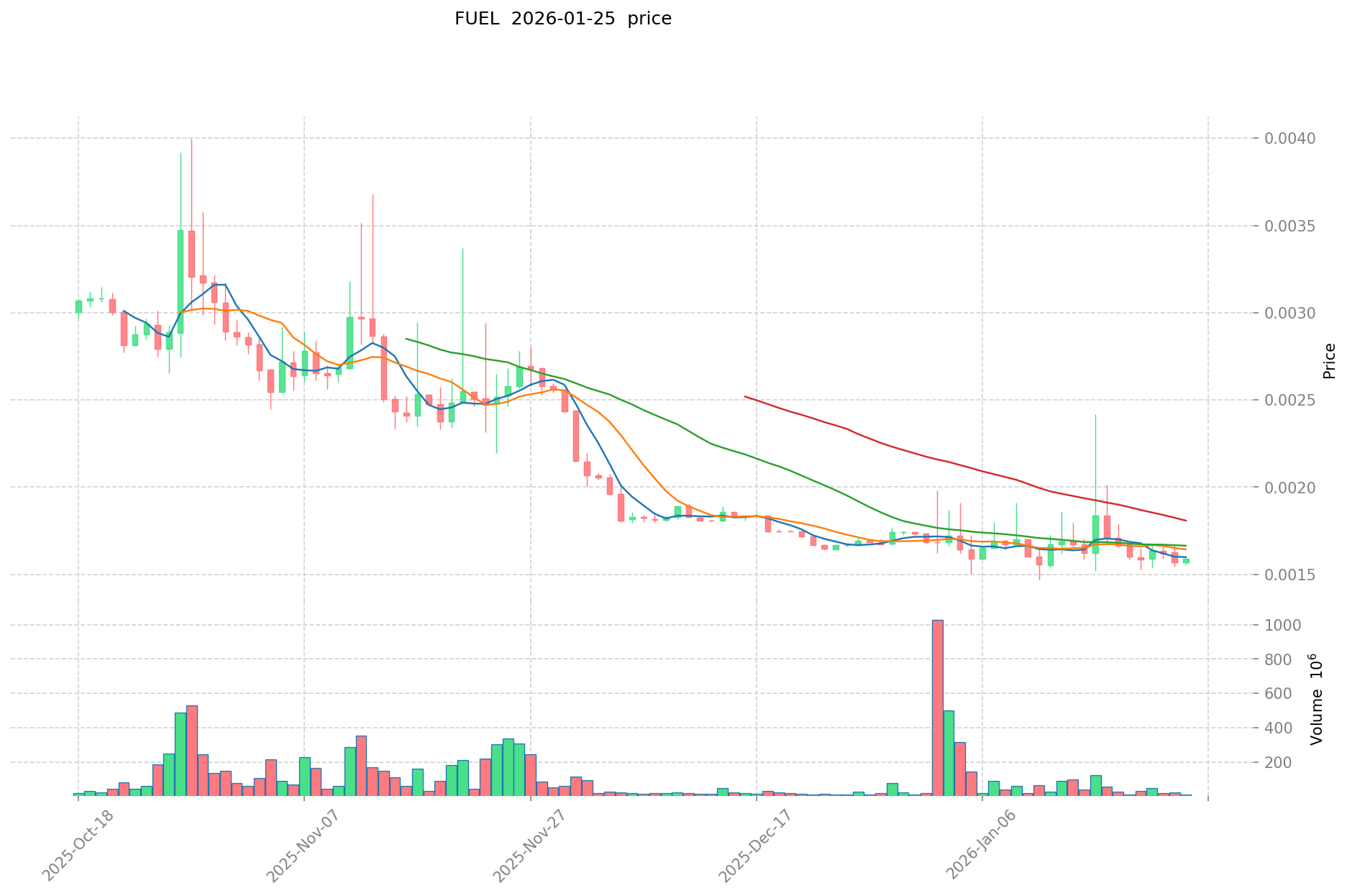
As of January 26, 2026, FUEL is trading at $0.001577, with a 24-hour trading volume of $17,772.50. The token shows a modest 24-hour price increase of 0.89%, while experiencing a 1-hour gain of 0.38%. Over longer timeframes, the token has seen a 7-day decline of 5.06% and a 30-day decrease of 6.80%.
The current market capitalization stands at $11.13 million, with a circulating supply of 7.06 billion FUEL tokens, representing 69.02% of the total supply of 10.22 billion tokens. The fully diluted market cap is calculated at $16.12 million. FUEL maintains a market dominance of 0.00051% within the cryptocurrency ecosystem.
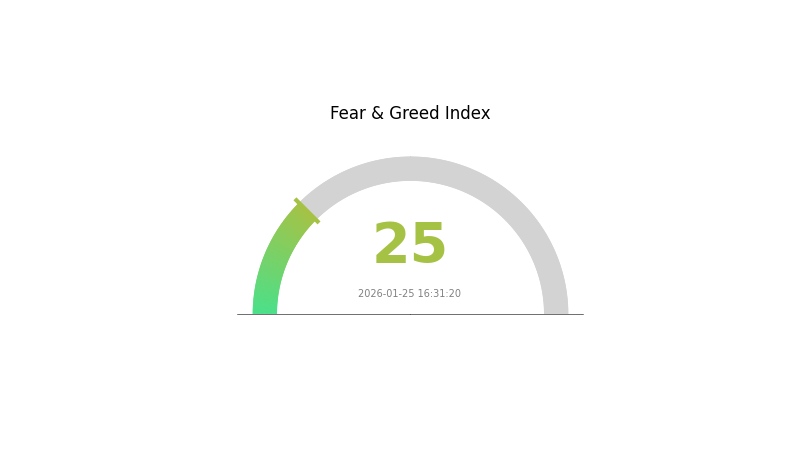
The token is currently ranked #1146 in the cryptocurrency market. With 7,190 holders and listing on 13 exchanges, FUEL demonstrates moderate adoption within the Ethereum Layer 2 infrastructure space. The current market sentiment indicator registers at 25 on the fear and greed index, indicating extreme fear conditions in the broader market environment.
FUEL operates with dual-chain infrastructure, maintaining presence on both the Ethereum mainnet (ERC-20) and its native FUEL Layer 2 network. The project positions itself as a high-performance Ethereum rollup solution, claiming transaction speeds exceeding 600 TPS with transaction costs below $0.0002.
Click to view current FUEL market price
FUEL Market Sentiment Indicator
2026-01-25 Fear and Greed Index: 25 (Extreme Fear)
Click to view current Fear & Greed Index
The cryptocurrency market is experiencing extreme fear, with the Fear and Greed Index dropping to 25. This indicates significant market pessimism and heightened investor anxiety. During such periods, market volatility typically increases as traders reassess their positions. While extreme fear often presents contrarian buying opportunities for long-term investors, caution is advised. Monitor key support levels and consider dollar-cost averaging strategies rather than making large lump-sum investments. Stay informed on market developments and maintain proper risk management protocols.
FUEL Holding Distribution
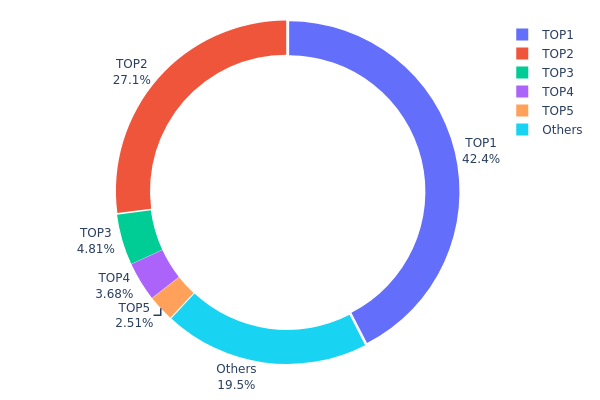
The holding distribution chart reveals the concentration of token ownership across different wallet addresses, serving as a critical indicator of decentralization and potential market manipulation risks. Based on the current data, FUEL exhibits a highly concentrated holding structure, with the top two addresses controlling 42.44% and 27.08% respectively, together accounting for approximately 69.52% of the total circulating supply. This concentration level significantly exceeds the healthy threshold typically observed in mature cryptocurrency projects.
Such extreme centralization poses substantial risks to market stability. The top five addresses collectively hold over 80% of FUEL tokens, creating a market structure vulnerable to coordinated selling pressure or price manipulation. Large holders can exert disproportionate influence on market sentiment and liquidity, potentially leading to heightened volatility during periods of distribution or accumulation. The remaining 19.5% held by other addresses suggests limited retail participation and weak organic demand distribution.
From a market structure perspective, this concentration pattern indicates an early-stage project with incomplete token distribution or persistent whale dominance. While centralized holdings may provide price stability during bull markets through reduced selling pressure, they simultaneously create significant downside risks if major holders decide to liquidate positions. Investors should monitor on-chain activity from these top addresses closely, as any significant transfer or exchange deposit could signal impending price movements.
Click to view current FUEL Holding Distribution
| Top |
Address |
Holding Qty |
Holding (%) |
| 1 |
0xd57d...c169ee |
4392678.81K |
42.44% |
| 2 |
0xa4ca...f43f67 |
2803102.10K |
27.08% |
| 3 |
0x2ac7...ebb0d5 |
497547.13K |
4.80% |
| 4 |
0x50ed...5edfe8 |
381218.28K |
3.68% |
| 5 |
0xa312...4ab647 |
259316.14K |
2.50% |
| - |
Others |
2016137.56K |
19.5% |
II. Core Factors Affecting FUEL's Future Price
Based on the available information, specific data regarding FUEL's supply mechanisms, institutional dynamics, macroeconomic influences, and technical developments are not currently accessible through the provided materials. A comprehensive analysis of these factors requires detailed project documentation, on-chain metrics, and market data that would typically include tokenomics structures, major holder activities, development roadmaps, and ecosystem partnerships.
For investors seeking to understand FUEL's price drivers, it would be advisable to monitor official project announcements, blockchain analytics platforms, and verified sources for updates on supply schedules, institutional adoption patterns, technical upgrades, and broader market conditions that may impact the asset's valuation over time.
III. 2026-2031 FUEL Price Prediction
2026 Outlook
- Conservative Forecast: $0.00108 - $0.00156
- Neutral Forecast: Around $0.00156
- Optimistic Forecast: Up to $0.002 (requires favorable market conditions and increased adoption)
The 2026 forecast suggests a potential downward adjustment of approximately 1% compared to current levels, reflecting possible market consolidation phase. Price movement is expected to fluctuate within a relatively narrow range as the token establishes its market position.
2027-2029 Mid-term Outlook
- Market Stage Expectation: Recovery and gradual growth phase with increasing institutional interest
- Price Range Forecast:
- 2027: $0.00119 - $0.00222 (potential 12% increase)
- 2028: $0.00152 - $0.00296 (potential 26% increase)
- 2029: $0.00236 - $0.00325 (potential 57% increase)
- Key Catalysts: Enhanced ecosystem development, potential technological upgrades, growing market adoption, and favorable regulatory developments could drive price appreciation during this period
This mid-term phase indicates a recovery trajectory with progressively stronger growth momentum, particularly as the market matures and adoption metrics improve.
2030-2031 Long-term Outlook
- Baseline Scenario: $0.00206 - $0.00287 in 2030 (assuming steady ecosystem growth and stable market conditions, potential 81% increase)
- Optimistic Scenario: $0.00282 - $0.00353 in 2031 (contingent on successful platform expansion and strong user base growth, potential 123% increase)
- Transformative Scenario: Up to $0.00419 in 2030 (requires exceptional adoption rates, major partnerships, and breakthrough technological implementations)
The long-term forecast reflects potential substantial growth as the FUEL ecosystem matures. However, investors should note that these projections are subject to market volatility, technological developments, regulatory changes, and broader cryptocurrency market trends. The predicted growth trajectory from 2026 to 2031 suggests increasing confidence in the token's value proposition over time.
| Year |
Predicted High Price |
Predicted Average Price |
Predicted Low Price |
Price Change |
| 2026 |
0.002 |
0.00156 |
0.00108 |
-1 |
| 2027 |
0.00222 |
0.00178 |
0.00119 |
12 |
| 2028 |
0.00296 |
0.002 |
0.00152 |
26 |
| 2029 |
0.00325 |
0.00248 |
0.00236 |
57 |
| 2030 |
0.00419 |
0.00287 |
0.00206 |
81 |
| 2031 |
0.00406 |
0.00353 |
0.00282 |
123 |
IV. FUEL Professional Investment Strategy and Risk Management
FUEL Investment Methodology
(1) Long-term Holding Strategy
- Target Audience: Investors seeking exposure to Ethereum Layer 2 scaling solutions with technical innovation focus
- Operational Recommendations:
- Consider accumulating positions during periods of reduced volatility, with FUEL trading near its support levels around $0.00156
- Establish a structured entry approach across multiple price points to reduce average cost basis
- Storage Solution: Gate Web3 Wallet provides secure non-custodial storage supporting both ERC-20 and FUEL L2 network standards
(2) Active Trading Strategy
- Technical Analysis Tools:
- Moving Averages: Monitor 7-day and 30-day trends, currently showing -5.06% and -6.80% respectively, to identify potential reversal signals
- Volume Analysis: Track the 24-hour trading volume of approximately $17,772 to assess market liquidity and momentum shifts
- Swing Trading Points:
- Establish positions near the recent low of $0.00156 and consider profit-taking near resistance levels around $0.00159
- Monitor hourly price changes (+0.38% recently) to identify short-term momentum shifts
FUEL Risk Management Framework
(1) Asset Allocation Principles
- Conservative Investors: 1-3% of crypto portfolio allocation
- Aggressive Investors: 5-8% of crypto portfolio allocation
- Professional Investors: Up to 10-15% with active hedging strategies
(2) Risk Hedging Solutions
- Portfolio Diversification: Balance FUEL exposure with established Layer 1 assets and stablecoins
- Position Sizing: Limit individual trade exposure to no more than 2-3% of total capital
(3) Secure Storage Solutions
- Hot Wallet Recommendation: Gate Web3 Wallet for active trading with multi-signature support
- Cold Storage Approach: Hardware wallet solutions for long-term holdings exceeding 30-day time horizons
- Security Considerations: Enable two-factor authentication, regularly update wallet software, and never share private keys or seed phrases
V. FUEL Potential Risks and Challenges
FUEL Market Risks
- High Volatility: FUEL has experienced significant price fluctuations, with a 1-year decline of approximately -94.95% from its all-time high of $0.021383
- Limited Liquidity: With a market capitalization of approximately $11.13 million and ranking #1146, FUEL may experience increased price slippage during large transactions
- Market Cap to FDV Gap: The 69.02% circulating supply ratio indicates potential dilution pressure as additional tokens enter circulation
FUEL Regulatory Risks
- Layer 2 Classification Uncertainty: Evolving regulatory frameworks may impact how optimistic rollups are classified and regulated
- Cross-Border Compliance: Operating across 13 exchanges may subject FUEL to varying jurisdictional requirements
- Disclosure Requirements: Increasing regulatory scrutiny on tokenomics and project transparency could impact market sentiment
FUEL Technical Risks
- Smart Contract Vulnerabilities: As with any blockchain protocol, potential undiscovered bugs in FuelVM or related infrastructure could pose security risks
- Network Competition: Intense competition from other Ethereum Layer 2 solutions may impact adoption and market share
- Bridge Security: Cross-chain functionality between ETH and FUEL L2 introduces additional technical complexity and potential attack vectors
VI. Conclusion and Action Recommendations
FUEL Investment Value Assessment
FUEL represents an innovative approach to Ethereum scaling with technical features including parallelized transaction execution and native account abstraction. The project claims high throughput (>600 TPS) and low transaction costs (<$0.0002). However, investors should weigh these potential advantages against significant short-term risks, including substantial price depreciation from historical highs, relatively low market capitalization, and intense competition in the Layer 2 ecosystem. The long-term value proposition depends heavily on successful adoption, ecosystem development, and the project's ability to differentiate itself in a crowded market.
FUEL Investment Recommendations
✅ Beginners: Limit exposure to 1-2% of crypto portfolio; focus on understanding Layer 2 technology before investing; consider starting with small positions to learn market dynamics
✅ Experienced Investors: Implement dollar-cost averaging during periods of reduced volatility; monitor technical developments and ecosystem growth metrics; maintain strict stop-loss discipline given historical volatility
✅ Institutional Investors: Conduct thorough due diligence on smart contract security audits and team credentials; consider strategic allocations as part of broader Layer 2 thesis; establish clear risk parameters and rebalancing triggers
FUEL Trading Participation Methods
- Spot Trading: Direct purchase and sale of FUEL tokens on Gate.com with support for multiple trading pairs
- DeFi Integration: Participate in liquidity provision or yield farming opportunities within the Fuel ecosystem
- Long-term Accumulation: Establish systematic purchase plans during market corrections to build positions over time
Cryptocurrency investment carries extremely high risk, and this article does not constitute investment advice. Investors should make cautious decisions based on their own risk tolerance and are advised to consult professional financial advisors. Never invest more than you can afford to lose.
FAQ
What is FUEL token and what is its purpose?
FUEL is the native token powering the Fuel blockchain ecosystem. It serves as gas for transaction fees, governance participation, and network security. FUEL enables fast, low-cost transactions on the Fuel L2 solution, designed for high-speed decentralized applications and DeFi protocols.
What factors affect FUEL price?
FUEL price is influenced by market demand and supply dynamics, project development progress, network activity levels, overall cryptocurrency market sentiment, Bitcoin and Ethereum price movements, and macroeconomic conditions. Token utility within the ecosystem and community adoption also play significant roles in price fluctuations.
How to analyze FUEL's historical price trends?
Analyze FUEL's historical price trends by examining price charts across different timeframes, tracking trading volume and transaction value patterns, identifying support and resistance levels, and monitoring correlation with market cycles. Use technical indicators like moving averages and RSI to identify trend direction and momentum shifts.
What are the future development prospects of FUEL?
FUEL has strong growth potential driven by increasing demand for decentralized infrastructure and blockchain scalability solutions. With expanding ecosystem partnerships and continuous technological upgrades, FUEL is positioned to capture significant market share in the Web3 sector, showing promising long-term appreciation prospects.
What advantages does FUEL have compared to other Layer2 tokens?
FUEL offers superior transaction throughput, lower fees, and faster settlement times. Its optimized architecture enables parallel transaction processing, delivering better performance and scalability than competing Layer2 solutions while maintaining robust security.
What risks should I pay attention to when investing in FUEL?
Monitor market volatility and liquidity conditions. FUEL's price fluctuates based on market demand and ecosystem developments. Conduct thorough research on project fundamentals, team background, and tokenomics. Diversify your portfolio and only invest capital you can afford to lose. Stay updated on regulatory changes and technological updates affecting the project.
Which exchanges can FUEL be traded on?
FUEL is available for trading on multiple major cryptocurrency exchanges worldwide. You can access FUEL through leading platforms that support diverse digital assets. Check your preferred exchange's listing to confirm FUEL availability and current trading pairs.
* The information is not intended to be and does not constitute financial advice or any other recommendation of any sort offered or endorsed by Gate.