This comprehensive analysis examines GITCOIN's price trajectory and investment potential from 2026 to 2031. As a pioneering governance token for decentralized public goods funding, GITCOIN currently trades at $0.1331 with a market cap of $11.65 million. The article reviews historical price evolution, current market status showing extreme fear sentiment (Fear Index: 25), and holding concentration risks with top addresses controlling 62.11% of supply. Expert forecasts predict gradual recovery through 2031, ranging from conservative scenarios ($0.07454-$0.1331 in 2026) to optimistic scenarios exceeding $0.23501 by 2031. Professional investment strategies include dollar-cost averaging, technical analysis approaches, and portfolio diversification. Detailed risk management frameworks address price volatility, low liquidity, regulatory uncertainties, and smart contract vulnerabilities. Ideal for long-term believers in decentralized funding ecosystems seeking exposure to governance tokens on Gate exchange.
Introduction: GITCOIN's Market Position and Investment Value
Gitcoin (GTC), as a pioneering governance token in the decentralized funding ecosystem for open-source development, has been facilitating innovative public goods funding since its launch in 2021. As of 2026, Gitcoin holds a market capitalization of approximately 11.65 million USD, with a circulating supply of around 87.49 million tokens, and the price maintains at approximately 0.1331 USD. This asset, recognized as a "cornerstone of open-source collaboration", is playing an increasingly vital role in funding next-generation public goods and empowering decentralized governance.
This article will comprehensively analyze Gitcoin's price trajectory from 2026 to 2031, combining historical patterns, market supply-demand dynamics, ecosystem development, and macroeconomic conditions to provide investors with professional price forecasting and practical investment strategies.
I. GITCOIN Price History Review and Current Market Status
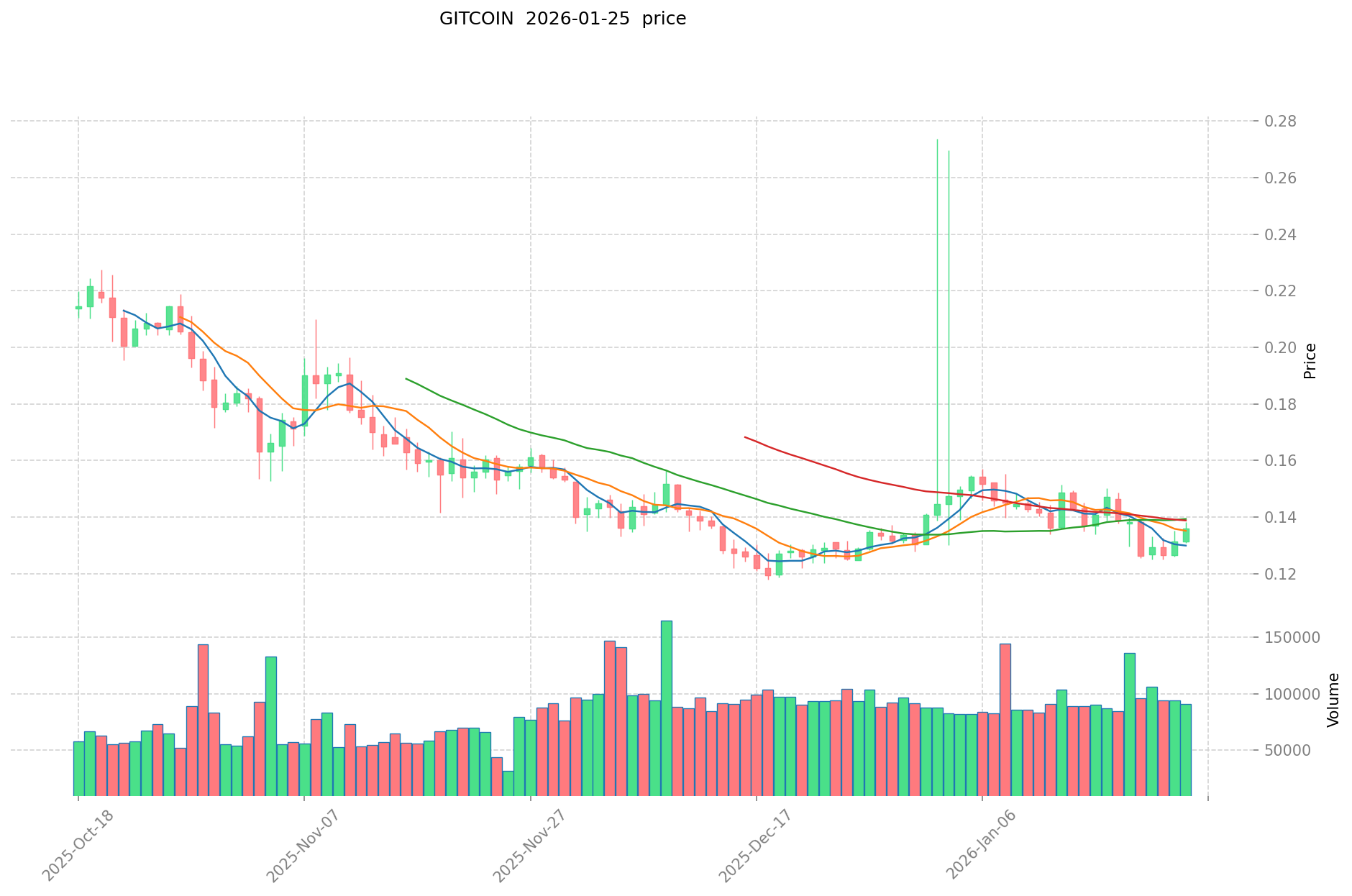
GITCOIN Historical Price Evolution Trajectory
- 2021: Gitcoin launched its governance token GTC in May 2021 with a publishing price of $3.5281, reaching its all-time high of $22.37 in November 2021 during the cryptocurrency market bull run.
- 2022-2024: Following the broader market correction, GITCOIN experienced significant price decline as the crypto market entered a prolonged bear cycle, with prices gradually retreating from peak levels.
- 2025: The token continued facing downward pressure, recording its all-time low of $0.118188 in December 2025, representing a substantial decline from its historical peak.
GITCOIN Current Market Status
As of January 25, 2026, GITCOIN is trading at $0.1331, showing a slight recovery from its December 2025 low. The token has experienced a 0.08% increase over the past hour, though it remains down 1.55% in the last 24 hours. Over the weekly timeframe, GITCOIN has declined 8.7%, while the monthly performance shows a modest gain of 3.74%. The annual performance reflects a significant decline of 77.01%, indicating sustained bearish pressure throughout the past year.
The token's 24-hour trading range spans between $0.1308 and $0.1383, with a total trading volume of $12,315.99. GITCOIN maintains a market capitalization of approximately $11.65 million, with 87.49 million tokens in circulation out of a maximum supply of 100 million tokens. The fully diluted market cap stands at $13.31 million, representing a market cap to FDV ratio of 87.49%. The token's market dominance is minimal at 0.00042%.
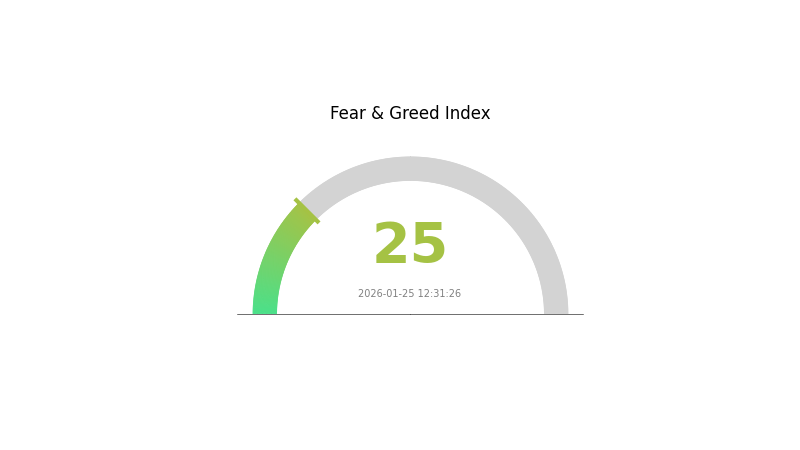
GITCOIN currently ranks #1,127 among cryptocurrencies and is supported by 21 exchanges, with an estimated 91,106 token holders. The market sentiment index indicates a value of 25, reflecting "Extreme Fear" conditions in the broader cryptocurrency market environment.
Click to view current GITCOIN market price
GITCOIN Market Sentiment Index
2026-01-25 Fear and Greed Index: 25 (Extreme Fear)
Click to view current Fear & Greed Index
The market is currently experiencing extreme fear, with the Fear and Greed Index standing at 25. This indicates significant pessimism among investors, reflecting heightened concerns about market volatility and downside risks. During periods of extreme fear, risk-averse investors typically adopt defensive positions, while contrarian traders may view this as a potential buying opportunity. Market participants should carefully assess their risk tolerance and portfolio allocation strategies in response to current sentiment conditions.
GITCOIN Holding Distribution
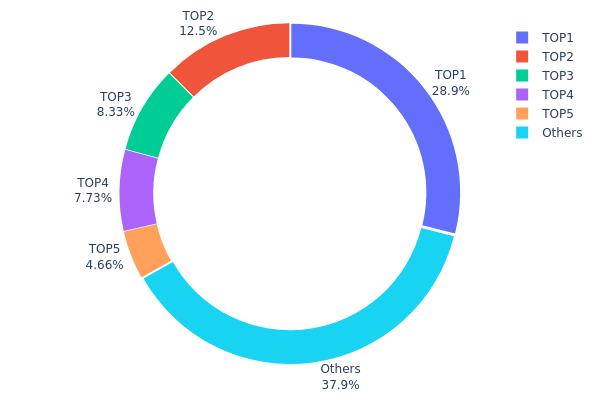
The holding distribution chart illustrates how GITCOIN tokens are allocated across different wallet addresses, revealing the concentration level of token ownership within the network. This metric serves as a crucial indicator for assessing decentralization and potential market manipulation risks.
Current data demonstrates a notably concentrated holding pattern for GITCOIN. The top holder controls approximately 28.91% of total supply (28,917.41K tokens), while the second-largest address holds 12.50% (12,508.50K tokens). The top five addresses collectively account for 62.11% of circulating supply, leaving only 37.89% distributed among other market participants. This concentration level suggests a relatively centralized token distribution structure, which is significantly higher than optimal decentralization thresholds typically observed in mature cryptocurrency projects.
Such concentration poses several structural implications for market dynamics. The substantial holdings controlled by a limited number of addresses creates potential vulnerability to large-scale selling pressure, potentially triggering significant price volatility. Furthermore, this distribution pattern may enable coordinated market actions by major holders, raising concerns about price manipulation possibilities. The heavy concentration in top addresses could also impact governance processes if GITCOIN employs token-based voting mechanisms, potentially centralizing decision-making power among few participants. Market liquidity may experience constraints during periods when major holders remain inactive, while sudden movements from these addresses could generate disproportionate market reactions.
Click to view current GITCOIN Holding Distribution
| Top |
Address |
Holding Qty |
Holding (%) |
| 1 |
0xf977...41acec |
28917.41K |
28.91% |
| 2 |
0x57a8...5be518 |
12508.50K |
12.50% |
| 3 |
0x4da8...932a14 |
8330.19K |
8.33% |
| 4 |
0x74be...873f13 |
7729.08K |
7.72% |
| 5 |
0x14d7...90f86c |
4658.99K |
4.65% |
| - |
Others |
37855.83K |
37.89% |
II. Core Factors Influencing GITCOIN's Future Price
Due to the absence of specific data in the provided materials regarding Gitcoin's supply mechanisms, institutional dynamics, macroeconomic correlations, and technical developments, a comprehensive analysis of the core factors influencing its future price cannot be completed at this time.
Investors are advised to monitor official announcements from the Gitcoin project team, on-chain data analytics platforms, and reputable cryptocurrency research institutions for the most current information on token economics, governance updates, and ecosystem expansion initiatives that may impact price movements.
III. 2026-2031 GITCOIN Price Prediction
2026 Outlook
- Conservative forecast: $0.07454 - $0.1331
- Neutral forecast: Around $0.1331
- Optimistic forecast: Up to $0.14907 (requires favorable market conditions and increased adoption)
2027-2029 Outlook
- Market stage expectation: Gradual growth phase with moderate volatility, transitioning from early recovery to potential expansion
- Price range forecast:
- 2027: $0.09735 - $0.182 (approximately 6% increase from 2026)
- 2028: $0.15508 - $0.20354 (approximately 21% increase from 2026)
- 2029: $0.15881 - $0.19897 (approximately 37% increase from 2026)
- Key catalysts: Enhanced ecosystem development, increased platform utility, broader Web3 adoption, and community engagement initiatives
2030-2031 Long-term Outlook
- Baseline scenario: $0.1259 - $0.22891 (assuming steady ecosystem growth and sustained market interest)
- Optimistic scenario: $0.17836 - $0.23501 (assuming accelerated adoption of public goods funding mechanisms and expanded partnership network)
- Transformative scenario: Potential to exceed $0.23501 (requires breakthrough developments in decentralized funding models and mainstream institutional participation)
- 2026-01-25: GITCOIN trading within projected range, positioning for potential multi-year growth trajectory
| Year |
Predicted High Price |
Predicted Average Price |
Predicted Low Price |
Price Change |
| 2026 |
0.14907 |
0.1331 |
0.07454 |
0 |
| 2027 |
0.182 |
0.14109 |
0.09735 |
6 |
| 2028 |
0.20354 |
0.16154 |
0.15508 |
21 |
| 2029 |
0.19897 |
0.18254 |
0.15881 |
37 |
| 2030 |
0.22891 |
0.19076 |
0.1259 |
43 |
| 2031 |
0.23501 |
0.20983 |
0.17836 |
57 |
IV. GITCOIN Professional Investment Strategy and Risk Management
GITCOIN Investment Methodology
(1) Long-term Holding Strategy
- Target Investors: believers in decentralized public goods funding and open-source development, long-term crypto asset holders
- Operational Recommendations:
- Accumulate positions during market pullbacks, particularly when GITCOIN trades near support levels
- Consider dollar-cost averaging to mitigate timing risk in volatile markets
- Storage Solution: Use Gate Web3 Wallet for secure self-custody with multi-signature capabilities
(2) Active Trading Strategy
- Technical Analysis Tools:
- Moving Averages: Monitor 50-day and 200-day moving averages to identify trend reversals
- Relative Strength Index (RSI): Track overbought (above 70) and oversold (below 30) conditions for entry and exit signals
- Swing Trading Key Points:
- Set stop-loss orders at 5-8% below entry price to manage downside risk
- Take partial profits at resistance levels identified through historical price action
GITCOIN Risk Management Framework
(1) Asset Allocation Principles
- Conservative Investors: 1-2% of crypto portfolio
- Aggressive Investors: 3-5% of crypto portfolio
- Professional Investors: 5-10% with hedging strategies
(2) Risk Hedging Solutions
- Portfolio Diversification: Balance GITCOIN with stablecoins and established cryptocurrencies to reduce concentration risk
- Position Sizing: Avoid overexposure by maintaining strict allocation limits based on risk tolerance
(3) Secure Storage Solutions
- Hot Wallet Recommendation: Gate Web3 Wallet for active trading and convenient access
- Cold Storage Solution: Hardware wallets for long-term holdings exceeding trading needs
- Security Considerations: Enable two-factor authentication, never share private keys, and regularly update wallet software to protect against vulnerabilities
V. GITCOIN Potential Risks and Challenges
GITCOIN Market Risks
- Price Volatility: GITCOIN has experienced significant price fluctuations, with a 1-year decline of 77.01%, indicating high volatility risk
- Low Liquidity: With 24-hour trading volume of approximately $12,315.99, limited liquidity may result in slippage during large transactions
- Market Sentiment Dependency: As a governance token for public goods funding, GITCOIN's value is closely tied to ecosystem adoption and broader crypto market sentiment
GITCOIN Regulatory Risks
- DAO Governance Uncertainty: Evolving regulatory frameworks for decentralized autonomous organizations may impact GITCOIN's operational model
- Securities Classification: Regulatory authorities may classify governance tokens differently across jurisdictions, potentially affecting trading accessibility
- Compliance Requirements: Increased regulatory scrutiny on crypto platforms could impose additional compliance burdens on projects like Gitcoin
GITCOIN Technical Risks
- Smart Contract Vulnerabilities: Potential bugs or exploits in deployed contracts could compromise funds or governance mechanisms
- Network Dependency: GITCOIN operates on Ethereum, making it subject to network congestion and high gas fees during peak usage
- Governance Attack Risks: Centralization of token holdings (91,106 holders) may expose the DAO to coordinated governance attacks or manipulation
VI. Conclusion and Action Recommendations
GITCOIN Investment Value Assessment
GITCOIN presents a specialized investment opportunity focused on decentralized public goods funding and open-source development incentivization. The token's long-term value proposition depends on the sustained growth of the Gitcoin ecosystem and broader adoption of DAO-based funding mechanisms. However, short-term risks include significant price volatility, as evidenced by the 77.01% decline over the past year and current trading near historical lows. The circulating supply represents 87.49% of maximum supply, suggesting limited future dilution risk. Investors should recognize GITCOIN as a higher-risk asset suitable for those aligned with its mission and comfortable with potential price fluctuations.
GITCOIN Investment Recommendations
✅ Beginners: Start with minimal allocation (under 1% of portfolio), focus on understanding Gitcoin's ecosystem and governance before increasing exposure
✅ Experienced Investors: Consider strategic accumulation during market downturns, employ technical analysis for entry timing, and participate in governance to maximize utility
✅ Institutional Investors: Evaluate GITCOIN as part of a diversified DAO governance token portfolio, conduct thorough due diligence on ecosystem metrics, and assess long-term alignment with ESG and public goods funding trends
GITCOIN Trading Participation Methods
- Spot Trading: Purchase GITCOIN directly on Gate.com with low trading fees and high security standards
- Grid Trading: Utilize Gate.com's automated grid trading tools to capitalize on price fluctuations within defined ranges
- DeFi Integration: Participate in decentralized finance protocols supporting GITCOIN for yield generation opportunities while maintaining self-custody through Gate Web3 Wallet
Cryptocurrency investment carries extremely high risks, and this article does not constitute investment advice. Investors should make prudent decisions based on their own risk tolerance and are advised to consult professional financial advisors. Never invest more than you can afford to lose.
FAQ
What is Gitcoin (GTC) and what is its purpose in the blockchain ecosystem?
Gitcoin (GTC) is a decentralized platform funding public goods in blockchain development. It enables community-driven funding through quadratic grants, democratizing support for open-source projects and infrastructure that strengthen the Web3 ecosystem's sustainability and innovation.
What are the key factors that influence Gitcoin token price movements?
Gitcoin token price is influenced by platform adoption rates, DAO treasury activities, grant funding volumes, community governance decisions, broader crypto market sentiment, and ecosystem development milestones.
What is the price prediction for Gitcoin in 2024 and 2025?
Based on market analysis, Gitcoin was projected to reach $15-25 in 2024 and potentially $30-50 by 2025, driven by increased Web3 adoption and platform growth. However, actual performance depends on market conditions and ecosystem development.
Gitcoin leads in decentralized funding for public goods, offering transparent quadratic funding mechanisms. Unlike traditional grant platforms, it empowers communities directly through blockchain technology, enabling developers to monetize open-source contributions efficiently and sustainably.
What are the risks and opportunities for investing in Gitcoin?
Gitcoin offers opportunities through its growing quadratic funding ecosystem and developer grants platform. Risks include market volatility, regulatory uncertainty, and competition. Early adopters may benefit from ecosystem expansion, while long-term value depends on Web3 adoption and community governance success.
What is Gitcoin's tokenomics and how does the supply affect price?
Gitcoin's token supply is capped at 100 million GTC. Reduced supply through burns and increased utility in governance and staking typically support price appreciation. Growing adoption in community funding strengthens long-term value potential.
Gitcoin has demonstrated strong resilience during market cycles, often outperforming during bull phases due to its essential role in decentralized funding. The token typically shows higher volatility but stronger recovery patterns than broader market indices.
* The information is not intended to be and does not constitute financial advice or any other recommendation of any sort offered or endorsed by Gate.