This comprehensive analysis examines GITCOIN price trajectory from 2026 through 2031, providing professional forecasts for the governance token of GitcoinDAO's decentralized funding platform. Currently trading at $0.1265 with extreme fear market sentiment (index: 25), GITCOIN presents both opportunities and risks for investors seeking exposure to public goods funding mechanisms. The article reviews historical price evolution, current market status with 87.49% circulating supply, and detailed price predictions ranging from $0.08236 to $0.30058 across different scenarios. Core analysis covers supply-demand dynamics, ecosystem development catalysts, and macroeconomic conditions influencing valuations. Professional investment strategies include long-term accumulation, active trading techniques, and comprehensive risk management frameworks suitable for beginners through institutional investors. The guide addresses key investment challenges including high volatility, limited liquidity, regulatory uncertainties, and
Introduction: GITCOIN's Market Position and Investment Value
Gitcoin (GITCOIN) serves as an open-source funding platform and governance token for decentralized public goods, having established itself in the crypto ecosystem since its launch in 2021. As of 2026, GITCOIN holds a market capitalization of approximately $11.07 million, with a circulating supply of around 87.49 million tokens, trading at $0.1265. This asset, recognized as a key governance token within the GitcoinDAO ecosystem, plays an increasingly important role in funding open-source development and coordinating community-driven initiatives.
This article provides a comprehensive analysis of GITCOIN's price trajectory from 2026 through 2031, examining historical patterns, market supply-demand dynamics, ecosystem development, and macroeconomic conditions to deliver professional price forecasts and practical investment strategies for participants in the decentralized funding space.
I. GITCOIN Price History Review and Market Status
GITCOIN Historical Price Evolution Trajectory
- 2021: Gitcoin launched GTC governance token in May with a publish price of $3.5281, and reached its historical peak of $22.37 in November during the DeFi and DAO governance boom period
- 2022-2024: The token experienced significant price corrections along with broader crypto market cycles, reflecting the overall downturn in the public goods funding and DAO governance sectors
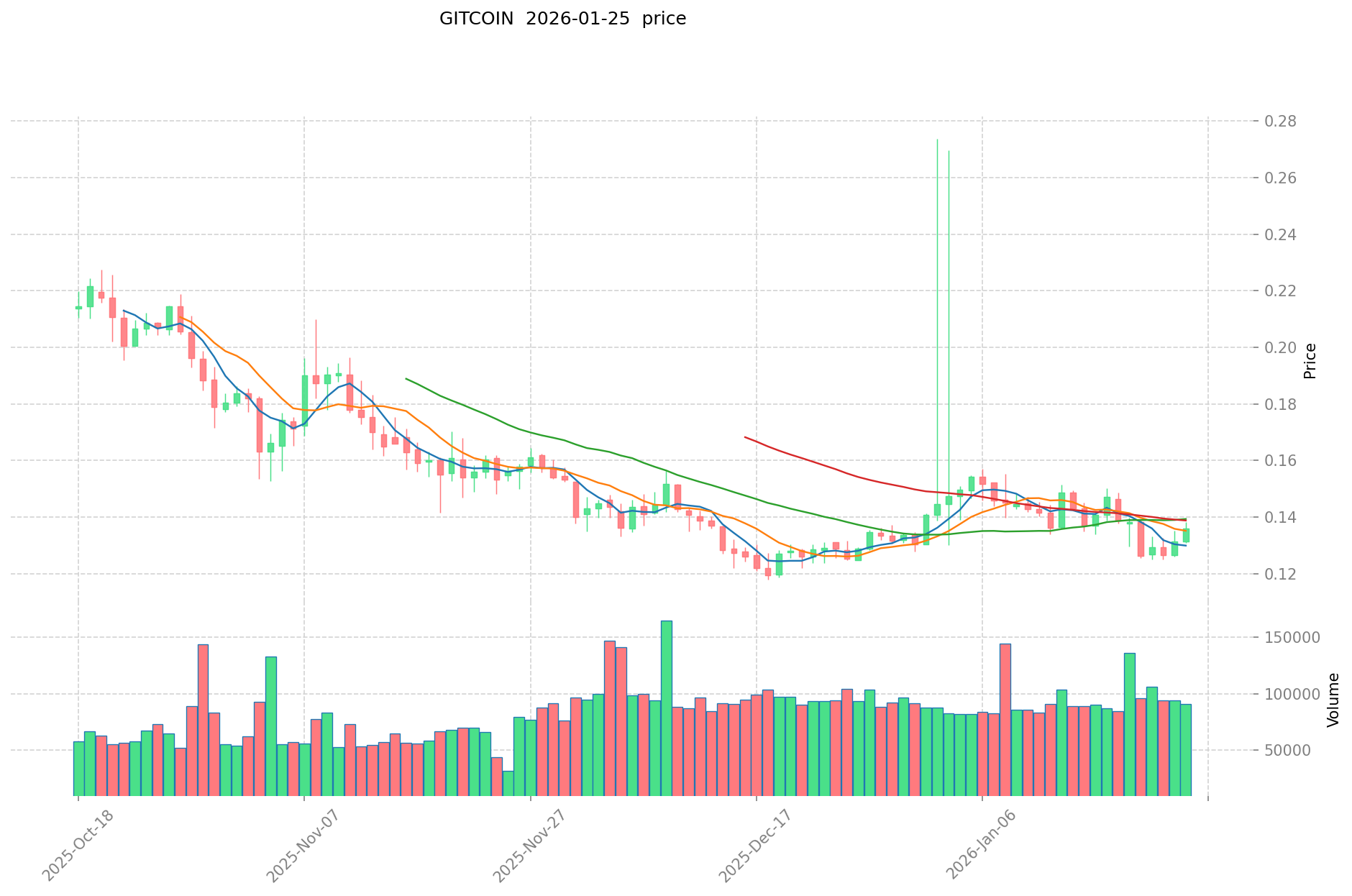
- 2025: The price dropped to its historical low of $0.118188 in December, marking a substantial decline from its all-time high as market sentiment weakened and trading activity decreased
GITCOIN Current Market Status
As of January 26, 2026, GITCOIN is trading at $0.1265, showing a decline of 6.78% over the past 24 hours. The token has experienced negative momentum across multiple timeframes, with a 0.25% decrease in the past hour, a 13.08% drop over the past 7 days, and a 0.86% decline over the past 30 days. The yearly performance indicates a significant decrease of 78.18%, reflecting challenging market conditions for the project.
The 24-hour trading range has fluctuated between $0.1258 and $0.1372, with total trading volume reaching $12,220.29. GITCOIN currently holds a market ranking of 1146, with a circulating supply of 87.49 million tokens representing 87.49% of the maximum supply of 100 million tokens. The current market capitalization stands at approximately $11.07 million, with a fully diluted market cap of $12.65 million. The token maintains a market dominance of 0.0004%.
The market cap to fully diluted valuation ratio of 87.49% suggests that most of the token supply is already in circulation. The token is held by 91,106 addresses and is listed on 21 exchanges. Current market sentiment, as indicated by the fear and greed index, registers at 25, reflecting "Extreme Fear" conditions in the broader cryptocurrency market.
Click to view current GITCOIN market price
GITCOIN Market Sentiment Indicator
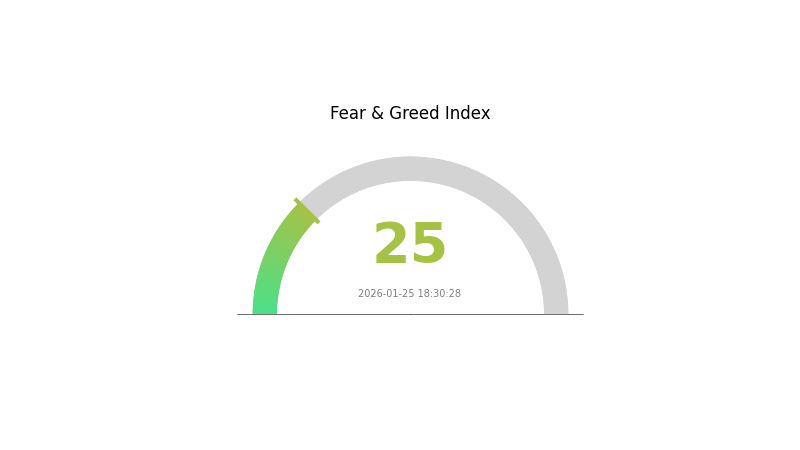
2026-01-25 Fear and Greed Index: 25 (Extreme Fear)
Click to view current Fear & Greed Index
The market is currently experiencing extreme fear, with the Fear and Greed Index dropping to 25. This indicates significant pessimism among investors and widespread risk aversion in the crypto market. During such periods, many traders adopt a cautious stance, and market volatility tends to increase. However, extreme fear often presents contrarian opportunities for long-term investors seeking entry points at lower valuations. Monitor market developments closely and consider your risk tolerance carefully before making investment decisions during this heightened uncertainty phase.
GITCOIN Holding Distribution
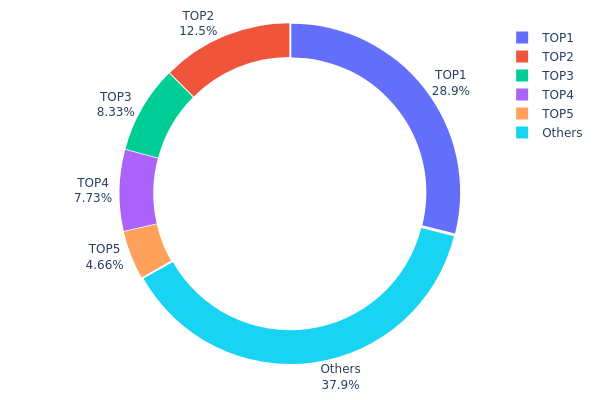
Based on the on-chain holding distribution data, the GITCOIN token exhibits a notably high concentration among top addresses. The largest holder controls approximately 28.91% of the total supply, holding 28.917 million tokens, while the top five addresses collectively account for 62.11% of the circulating supply. This concentration level places GITCOIN in the moderate-to-high risk category from a decentralization perspective.
The dominance of whale addresses creates several structural implications for market dynamics. With the top holder alone controlling nearly 30% of supply, any significant movement from this address could trigger substantial price volatility. The second-largest holder at 12.50% and third at 8.33% further compound this concentration risk. Such a distribution pattern suggests that a relatively small number of entities possess considerable influence over price formation and trading liquidity. The remaining 37.89% distributed among "Others" indicates some level of retail participation, yet the market remains vulnerable to coordinated large-scale selling pressure.
From a market microstructure standpoint, this holding pattern reflects a governance token model where early contributors, treasury allocations, or institutional stakeholders maintain significant positions. While this concentration may facilitate coordinated ecosystem development and voting efficiency, it simultaneously raises concerns about market manipulation potential and true decentralization. The current distribution suggests GITCOIN's on-chain structure leans toward centralized control, which could impact investor confidence particularly during market stress periods when liquidity concentration becomes a critical vulnerability factor.
Click to view current GITCOIN Holding Distribution
| Top |
Address |
Holding Qty |
Holding (%) |
| 1 |
0xf977...41acec |
28917.41K |
28.91% |
| 2 |
0x57a8...5be518 |
12508.50K |
12.50% |
| 3 |
0x4da8...932a14 |
8330.19K |
8.33% |
| 4 |
0x74be...873f13 |
7729.08K |
7.72% |
| 5 |
0x14d7...90f86c |
4658.99K |
4.65% |
| - |
Others |
37855.83K |
37.89% |
II. Core Factors Affecting GITCOIN's Future Price
Based on the available information, there is currently insufficient data to provide a comprehensive analysis of the core factors affecting Gitcoin's future price. The key areas that typically influence cryptocurrency valuations include supply mechanisms, institutional dynamics, macroeconomic conditions, and technological developments. However, without specific data points regarding Gitcoin's current supply structure, institutional holdings, technical roadmap, or ecosystem developments, a detailed assessment cannot be accurately provided at this time.
For investors and observers interested in Gitcoin's price trajectory, it would be advisable to monitor official project announcements, on-chain metrics, and ecosystem growth indicators as they become available through verified sources.
III. 2026-2031 GITCOIN Price Prediction
2026 Outlook
- Conservative Prediction: $0.08236 - $0.1267
- Neutral Prediction: Around $0.1267
- Optimistic Prediction: Up to $0.15077 (requires favorable market conditions and increased adoption)
2027-2029 Outlook
- Market Stage Expectation: The market may enter a gradual recovery phase with increasing institutional interest in decentralized funding mechanisms and Web3 infrastructure development.
- Price Range Predictions:
- 2027: $0.13457 - $0.16371
- 2028: $0.1361 - $0.2102
- 2029: $0.13734 - $0.22227
- Key Catalysts: Enhanced ecosystem development, expansion of grant programs, broader adoption of quadratic funding models, and potential partnerships within the decentralized governance space.
2030-2031 Long-term Outlook
- Baseline Scenario: $0.16522 - $0.24381 (assuming steady platform growth and maintained community engagement)
- Optimistic Scenario: $0.20149 - $0.30058 (contingent on significant protocol upgrades and wider integration across Web3 projects)
- Transformative Scenario: Potentially reaching the upper range of $0.30058 (under conditions of mass adoption of public goods funding mechanisms and substantial ecosystem expansion)
- 2026-01-26: GITCOIN trading within the predicted initial range (current market positioning phase)
| Year |
Predicted High Price |
Predicted Average Price |
Predicted Low Price |
Price Change |
| 2026 |
0.15077 |
0.1267 |
0.08236 |
0 |
| 2027 |
0.16371 |
0.13874 |
0.13457 |
9 |
| 2028 |
0.2102 |
0.15122 |
0.1361 |
19 |
| 2029 |
0.22227 |
0.18071 |
0.13734 |
42 |
| 2030 |
0.24381 |
0.20149 |
0.16522 |
59 |
| 2031 |
0.30058 |
0.22265 |
0.13804 |
76 |
IV. GITCOIN Professional Investment Strategy and Risk Management
GITCOIN Investment Methodology
(I) Long-term Holding Strategy
- Suitable for: Investors who believe in the long-term development of decentralized public goods funding and open-source ecosystem
- Operational Recommendations:
- Accumulate positions gradually during market downturns, avoiding one-time large purchases
- Set a holding period of at least 12-24 months to weather market volatility
- Store assets in Gate Web3 Wallet for secure long-term custody with private key control
(II) Active Trading Strategy
- Technical Analysis Tools:
- Moving Averages: Use 50-day and 200-day moving averages to identify trend directions and potential entry/exit points
- Relative Strength Index (RSI): Monitor overbought (above 70) and oversold (below 30) conditions to time trades
- Band Trading Key Points:
- Establish clear profit-taking levels (e.g., 15-25% gains) and stop-loss thresholds (e.g., 8-12% losses)
- Monitor trading volume changes as confirmation signals for price movements
GITCOIN Risk Management Framework
(I) Asset Allocation Principles
- Conservative Investors: 2-5% of crypto portfolio
- Aggressive Investors: 8-15% of crypto portfolio
- Professional Investors: Up to 20% of crypto portfolio with active hedging strategies
(II) Risk Hedging Solutions
- Portfolio Diversification: Combine GITCOIN holdings with established cryptocurrencies and stablecoins to reduce concentration risk
- Position Sizing: Never allocate more than a predetermined percentage to any single asset, maintaining liquidity for market opportunities
(III) Secure Storage Solutions
- Hot Wallet Recommendation: Gate Web3 Wallet for convenient trading and staking access with multi-layer security
- Cold Storage Solution: Transfer large holdings to hardware wallets for long-term storage, keeping only trading amounts in hot wallets
- Security Precautions: Enable two-factor authentication, never share private keys, verify all transaction addresses before confirming, and beware of phishing attempts
V. GITCOIN Potential Risks and Challenges
GITCOIN Market Risks
- High Volatility: GITCOIN experienced a 6.78% decline in 24 hours and 13.08% drop over 7 days, demonstrating significant short-term price fluctuations
- Low Liquidity: With 24-hour trading volume of approximately $12,220, limited liquidity may result in higher slippage during large transactions
- Market Sentiment: Trading at $0.1265, far below its historical high of $22.37, reflecting substantial distance from previous peak valuations
GITCOIN Regulatory Risks
- DAO Governance Uncertainty: As a governance token for GitcoinDAO, regulatory frameworks for decentralized autonomous organizations remain evolving across jurisdictions
- Securities Classification: Potential classification as a security in certain jurisdictions could impact trading availability and compliance requirements
- Cross-border Compliance: Operating across multiple jurisdictions exposes GITCOIN to varying regulatory standards and potential enforcement actions
GITCOIN Technical Risks
- Smart Contract Vulnerabilities: As an Ethereum-based token, GITCOIN depends on smart contract security; any exploits could affect token value and ecosystem stability
- Platform Dependency: The token's utility is closely tied to Gitcoin platform adoption; reduced platform usage could negatively impact token demand
- Competition Risk: Emergence of alternative public goods funding mechanisms or competing platforms could reduce GITCOIN's market position
VI. Conclusion and Action Recommendations
GITCOIN Investment Value Assessment
GITCOIN represents a unique value proposition in the public goods funding sector, serving as the governance token for GitcoinDAO ecosystem. With 87.49% of maximum supply already circulating and 91,106 holders, the token demonstrates established community participation. However, current price levels ($0.1265) reflect a 78.18% decline over one year, presenting both potential opportunity and continued downside risk. The token's long-term value depends on sustained growth in open-source developer adoption and successful execution of the Gitcoin funding model. Short-term outlook remains uncertain given recent negative price momentum and limited trading volume.
GITCOIN Investment Recommendations
✅ Beginners: Start with small allocations (1-3% of crypto portfolio), focus on understanding the Gitcoin ecosystem and DAO governance before increasing exposure
✅ Experienced Investors: Consider dollar-cost averaging during market weakness, maintain strict risk management protocols, and monitor governance proposals for ecosystem developments
✅ Institutional Investors: Evaluate GITCOIN as part of a diversified DeFi and public goods sector allocation, conduct thorough due diligence on tokenomics and regulatory implications
GITCOIN Trading Participation Methods
- Spot Trading: Trade GITCOIN on Gate.com with competitive fees and deep order books for efficient execution
- DeFi Integration: Participate in Ethereum-based DeFi protocols supporting GITCOIN for yield opportunities (verify contract addresses: 0xde30da39c46104798bb5aa3fe8b9e0e1f348163f)
- DAO Participation: Acquire GITCOIN to participate in GitcoinDAO governance, influencing funding decisions for public goods projects
Cryptocurrency investment carries extremely high risks, and this article does not constitute investment advice. Investors should make prudent decisions based on their own risk tolerance and are advised to consult professional financial advisors. Never invest more than you can afford to lose.
FAQ
What is GITCOIN? What are its main uses and value?
GITCOIN is a decentralized platform enabling developers to earn funding through open-source contributions. It facilitates quadratic funding and grants, connecting builders with communities. GTC token powers governance, enabling holders to shape platform direction and participate in ecosystem decisions, driving sustainable open-source development.
What is the historical price trend of GITCOIN token?
GITCOIN has experienced significant volatility since its launch. The token peaked during the 2021 bull market, then corrected substantially in 2022. Recent years show gradual recovery with increased adoption in the Web3 ecosystem. Long-term trend indicates growing momentum as decentralized governance gains prominence.
What are the main factors affecting GITCOIN price?
GITCOIN price is primarily influenced by platform adoption and user growth, total transaction volume, developer ecosystem expansion, market sentiment toward Gitcoin grants, competing platforms, and overall crypto market conditions. Regulatory developments and technological upgrades also play significant roles in price movement.
What is the GITCOIN price prediction for 2024-2025?
Based on market analysis, GITCOIN showed strong growth momentum through 2024-2025. Analysts projected prices ranging from $15-$25 during this period, driven by increasing governance adoption and ecosystem development. Actual performance varied based on market conditions and protocol updates.
What are the advantages and disadvantages of GITCOIN compared to other DeFi tokens?
GITCOIN advantages: strong community governance, focus on public goods funding, unique quadratic funding mechanism, established ecosystem. Disadvantages: smaller transaction volume than major DeFi tokens, lower liquidity, narrower use cases, higher volatility risk.
What are the risks to pay attention to when investing in GITCOIN?
GITCOIN faces market volatility, regulatory uncertainty, and adoption risks. Price fluctuations depend on ecosystem development, community sentiment, and macroeconomic factors. Conduct thorough research before investing.
* The information is not intended to be and does not constitute financial advice or any other recommendation of any sort offered or endorsed by Gate.