This comprehensive HSK cryptocurrency analysis examines HashKey Platform Token's market dynamics and investment potential through 2031. As of January 2026, HSK trades at $0.1616 with a $17.78M market cap, following a 87.89% annual decline. The article evaluates HSK's ecosystem role within HashKey Group's licensed global exchanges and Layer 2 infrastructure, analyzing historical price trajectories and market sentiment. Core sections provide professional price forecasts ranging from $0.13558 to $0.35873 by 2031, investment strategies for different investor profiles, and comprehensive risk management frameworks. The analysis addresses volatility concerns, regulatory dependencies, and technical risks while offering actionable trading recommendations. Suitable for risk-tolerant investors researching crypto infrastructure tokens, the guide emphasizes secure storage via Gate.com and strategic position-sizing to navigate HSK's high-volatility market environment.
Introduction: HSK's Market Position and Investment Value
Hashkey Platform Token (HSK), as the ecosystem token of HashKey Group spanning licensed global exchanges, investment management, tokenization, and infrastructure services, has been gaining attention since its launch in 2024. As of January 2026, HSK maintains a market capitalization of approximately $17.78 million, with a circulating supply of 110 million tokens, and the price hovers around $0.1616. This asset, serving as both the native and gas token for HashKey Chain L2 public chain, is playing an increasingly important role in empowering the HashKey ecosystem's long-term growth.
This article will comprehensively analyze HSK's price trends from 2026 to 2031, combining historical patterns, market supply and demand dynamics, ecosystem development, and macroeconomic conditions to provide investors with professional price forecasts and practical investment strategies.
I. HSK Price History Review and Market Status
HSK Historical Price Evolution Trajectory
- November 2024: HSK was officially launched on Gate.com with an initial listing, entering the cryptocurrency market as HashKey Group's ecosystem token.
- December 2024: The token experienced significant volatility, reaching a historical peak of $2.5936 on December 20, 2024, demonstrating strong initial market enthusiasm.
- January 2026: Following broader market corrections, HSK price declined substantially, recording a historical low of $0.1581 on January 22, 2026.
HSK Current Market Status
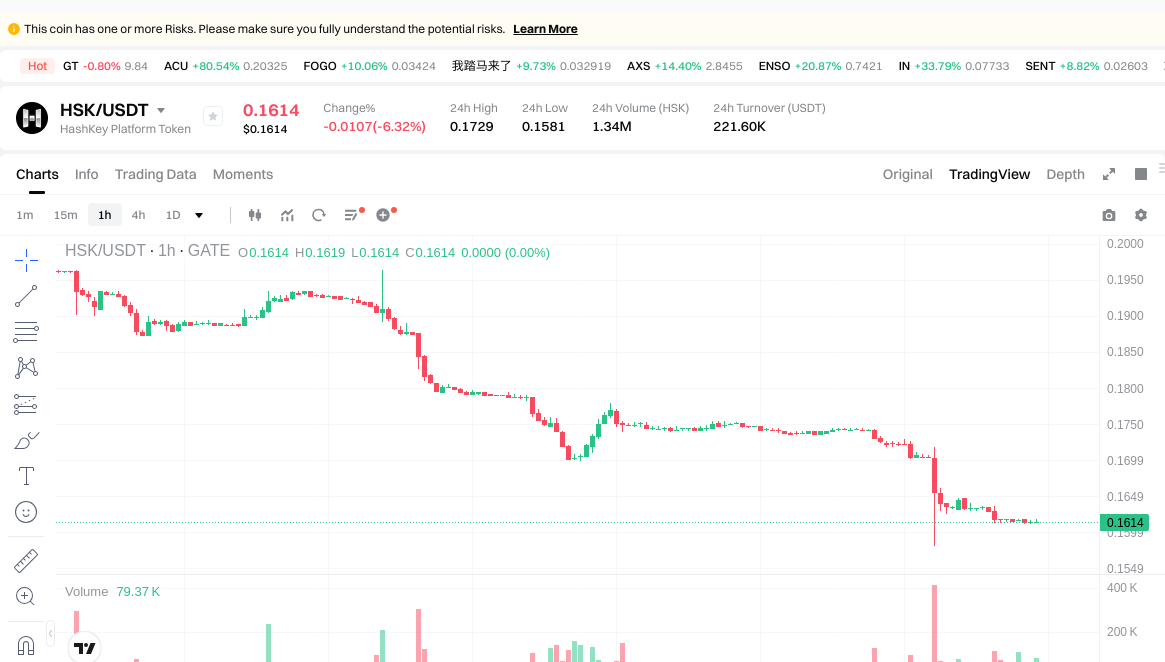
As of January 23, 2026, HSK is trading at $0.1616, representing a minor recovery of 0.12% over the past hour. However, the token has experienced considerable pressure across multiple timeframes, with a 6.21% decline over 24 hours, 17.84% decrease over the past week, and 29.79% drop over the past month. The year-over-year performance shows a substantial 87.89% decline from its previous levels.
The current market capitalization stands at $17.78 million, with 110 million HSK tokens in circulation, representing 11% of the maximum supply of 1 billion tokens. The fully diluted market cap reaches $161.6 million. Trading volume over the past 24 hours amounts to $221,683, indicating moderate liquidity levels.
The token's market dominance is currently at 0.0051%, ranking at position 921 among cryptocurrencies. The holder count stands at 4,173 addresses, reflecting the current adoption level of the token across the ecosystem. HSK is listed on 10 exchanges globally, with Gate.com being a primary trading venue.
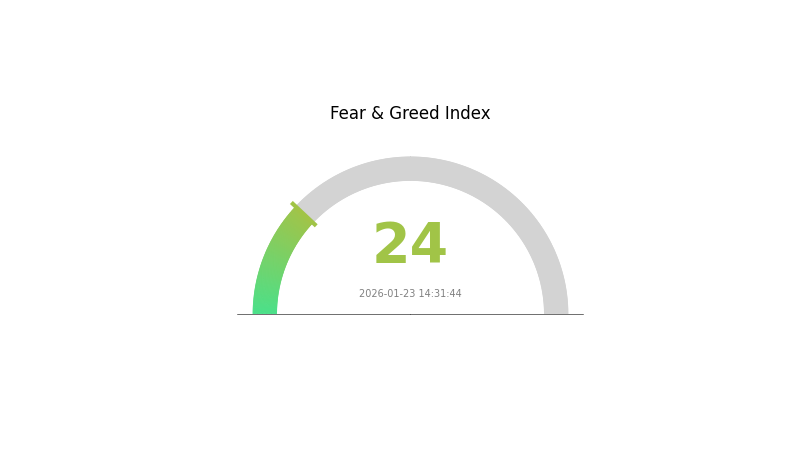
The cryptocurrency market sentiment indicator shows a reading of 24, classified as "Extreme Fear," suggesting heightened caution among market participants. This sentiment aligns with HSK's recent price action and broader market conditions.
Click to view current HSK market price
HSK Market Sentiment Indicator
2026-01-23 Fear and Greed Index: 24 (Extreme Fear)
Click to view current Fear & Greed Index
The cryptocurrency market is currently experiencing extreme fear, with the Fear and Greed Index standing at 24. This indicates heightened market pessimism and risk aversion among investors. During such periods, market volatility typically increases, and prices may experience significant downward pressure. However, extreme fear often presents opportunities for long-term investors to accumulate positions at lower valuations. Market participants should exercise caution while considering their investment strategies carefully during this phase of pronounced market uncertainty.
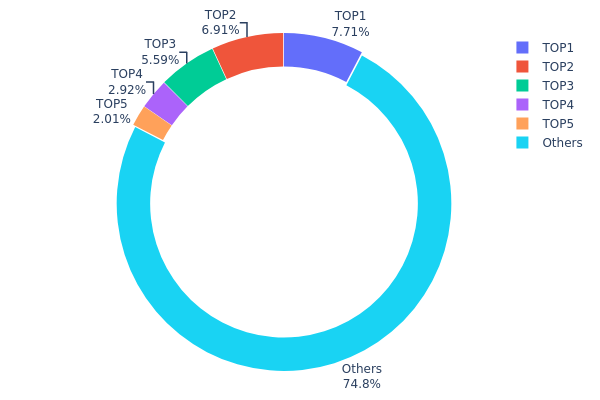
HSK Holding Distribution
The holding distribution chart illustrates the allocation of HSK tokens across different wallet addresses, providing critical insights into the degree of decentralization within the token's ecosystem. This metric serves as a fundamental indicator for assessing market structure, potential concentration risks, and the overall health of token circulation among participants.
Based on the current data, HSK exhibits a moderate level of concentration in its top holding addresses. The largest holder controls approximately 7.71% of the total supply (77,137.36K tokens), while the top five addresses collectively account for 25.13% of the circulating supply. Notably, the remaining 74.87% is distributed among other addresses, suggesting a relatively diversified ownership structure compared to many emerging tokens. This distribution pattern indicates that while significant positions exist among top holders, no single entity possesses overwhelming control that could enable unilateral market manipulation.
The current holding distribution reflects a balanced market structure that mitigates extreme volatility risks while maintaining sufficient liquidity depth. The absence of dominant whale positions reduces the probability of large-scale coordinated sell-offs that could trigger cascading liquidations. However, the combined influence of the top five addresses still warrants monitoring, as coordinated actions among these major holders could impact short-term price dynamics. From a decentralization perspective, HSK demonstrates reasonable token dispersion, contributing to enhanced on-chain structural stability and fostering a healthier trading environment for both institutional and retail participants.
Click to view current HSK Holding Distribution
| Top |
Address |
Holding Qty |
Holding (%) |
| 1 |
0x6c6c...8ead52 |
77137.36K |
7.71% |
| 2 |
0xe7aa...da8bd3 |
69077.11K |
6.90% |
| 3 |
0x5569...67c7a9 |
55947.24K |
5.59% |
| 4 |
0x866d...4afe01 |
29247.76K |
2.92% |
| 5 |
0xc882...84f071 |
20147.32K |
2.01% |
| - |
Others |
748443.21K |
74.87% |
II. Core Factors Affecting HSK's Future Price
Based on the available information, there is insufficient data to provide a comprehensive analysis of the core factors affecting HSK's future price. The fundamental elements including supply mechanisms, institutional dynamics, macroeconomic conditions, and technical development require verifiable data from reliable sources to ensure accuracy.
Without concrete information about HSK's tokenomics, institutional adoption, or technical roadmap, any analysis would be speculative and potentially misleading. Investors and readers are encouraged to conduct thorough research and consult official project documentation before making any investment decisions.
III. 2026-2031 HSK Price Prediction
2026 Outlook
- Conservative forecast: $0.13558 - $0.1614
- Neutral forecast: $0.1614
- Optimistic forecast: $0.16947 (contingent on favorable market conditions and increased adoption)
2027-2029 Outlook
- Market stage expectations: HSK may experience gradual growth as the project matures and expands its ecosystem. The token could benefit from broader cryptocurrency market recovery cycles and enhanced utility within its native platform.
- Price range forecasts:
- 2027: $0.10753 - $0.1886
- 2028: $0.1186 - $0.21596
- 2029: $0.1788 - $0.27508
- Key catalysts: Potential drivers include platform development milestones, strategic partnerships, increased trading volume, and overall crypto market sentiment improvements.
2030-2031 Long-term Outlook
- Baseline scenario: $0.16976 - $0.25229 (assuming steady project development and moderate market conditions)
- Optimistic scenario: $0.21963 - $0.35873 (contingent on significant ecosystem expansion and favorable regulatory environment)
- Transformative scenario: Potential to reach upper price targets if HSK achieves breakthrough adoption, forms major institutional partnerships, or benefits from exceptional market bull runs
- 2026-01-23: HSK trading near baseline levels as the market evaluates long-term potential
| Year |
Predicted High Price |
Predicted Average Price |
Predicted Low Price |
Price Change |
| 2026 |
0.16947 |
0.1614 |
0.13558 |
0 |
| 2027 |
0.1886 |
0.16544 |
0.10753 |
2 |
| 2028 |
0.21596 |
0.17702 |
0.1186 |
9 |
| 2029 |
0.27508 |
0.19649 |
0.1788 |
21 |
| 2030 |
0.25229 |
0.23578 |
0.16976 |
45 |
| 2031 |
0.35873 |
0.24404 |
0.21963 |
51 |
IV. HSK Professional Investment Strategy and Risk Management
HSK Investment Methodology
(1) Long-term Holding Strategy
- Suitable for: Investors seeking exposure to HashKey Group's ecosystem growth and Layer 2 blockchain infrastructure
- Operational recommendations:
- Consider accumulating positions during market corrections, as HSK has experienced significant volatility with a 1-year decline of 87.89%
- Monitor HashKey Chain development progress and ecosystem expansion for long-term value assessment
- Utilize Gate Web3 Wallet for secure storage with multi-signature protection
(2) Active Trading Strategy
- Technical analysis tools:
- Support and resistance levels: Monitor the current low of $0.1581 (ATL) and 24-hour high of $0.1729 for short-term trading ranges
- Volume analysis: Current 24-hour trading volume of $221,683 suggests moderate liquidity for active trading
- Swing trading considerations:
- The 7-day decline of 17.84% and 30-day decline of 29.79% indicate potential opportunities for contrarian positions
- Monitor 1-hour movements (currently +0.12%) for short-term entry and exit points
HSK Risk Management Framework
(1) Asset Allocation Principles
- Conservative investors: 1-3% portfolio allocation given the high volatility and 87.89% yearly decline
- Moderate investors: 3-5% allocation with regular rebalancing
- Professional investors: 5-10% allocation with active risk hedging strategies
(2) Risk Hedging Approaches
- Diversification strategy: Balance HSK exposure with established Layer 1 and Layer 2 tokens to mitigate ecosystem-specific risks
- Position sizing: Implement dollar-cost averaging during volatile periods to manage entry risk
(3) Secure Storage Solutions
- Hardware wallet recommendation: Gate Web3 Wallet for ERC-20 token management
- Multi-signature setup: Implement multi-sig protocols for larger holdings
- Security precautions: Verify the official contract address (0xe7c6bf469e97eeb0bfb74c8dbff5bd47d4c1c98a) on Etherscan before any transaction
V. HSK Potential Risks and Challenges
HSK Market Risks
- High volatility exposure: The token has declined 87.89% over one year, reflecting significant market risks and price instability
- Low circulation ratio: With only 11% of total supply in circulation (110M out of 1B tokens), future token unlocks may create downward price pressure
- Limited liquidity: Trading across only 10 exchanges with moderate daily volume may result in slippage during larger transactions
HSK Regulatory Risks
- Compliance dependency: As an ecosystem token for a licensed exchange group, HSK's value is closely tied to regulatory approvals and licensing maintenance across multiple jurisdictions
- Jurisdictional uncertainties: Operating in multiple regulatory environments may expose HSK to varying compliance requirements
- Exchange token scrutiny: Increased global regulatory focus on exchange-issued tokens could impact HSK's utility and trading availability
HSK Technical Risks
- Smart contract vulnerabilities: As an ERC-20 token, HSK is subject to potential security flaws in its contract implementation
- Layer 2 execution risks: Serving as the native token for HashKey Chain introduces dependencies on the Layer 2 network's stability and adoption
- Ecosystem concentration: Heavy reliance on HashKey Group's business performance creates single-point-of-failure risks
VI. Conclusion and Action Recommendations
HSK Investment Value Assessment
HSK presents a high-risk, high-potential investment opportunity tied to HashKey Group's multi-faceted ecosystem spanning licensed exchanges, asset management, and Layer 2 infrastructure. While the token serves critical utility functions as both an ecosystem currency and gas token for HashKey Chain, the significant 87.89% yearly decline and low 11% circulation ratio indicate substantial near-term headwinds. Long-term value depends heavily on HashKey Group's execution across its diverse business lines and HashKey Chain's adoption trajectory. Current market positioning suggests HSK may appeal to risk-tolerant investors with conviction in licensed crypto infrastructure providers, though caution is warranted given recent price action and market volatility.
HSK Investment Recommendations
✅ Beginners: Start with minimal allocation (under 2% of portfolio) after thorough research of HashKey Group's ecosystem; consider waiting for clearer market stabilization signals
✅ Experienced investors: Implement dollar-cost averaging with 3-5% allocation, monitoring HashKey Chain development milestones and ecosystem growth metrics
✅ Institutional investors: Conduct detailed due diligence on HashKey Group's licensed operations and Layer 2 roadmap; consider strategic positions with appropriate hedging mechanisms
HSK Trading Participation Methods
- Spot trading: Access HSK trading pairs on Gate.com and other supported exchanges with appropriate order types based on liquidity conditions
- Ecosystem participation: Utilize HSK within HashKey Group's services including HashKey Chain gas fees and platform benefits
- Long-term accumulation: Consider systematic investment approaches during market dips, storing holdings securely in Gate Web3 Wallet or compatible ERC-20 wallets
Cryptocurrency investment carries extreme risk. This article does not constitute investment advice. Investors should make prudent decisions based on their individual risk tolerance and are recommended to consult professional financial advisors. Never invest more than you can afford to lose.
FAQ
What are the HSK exam registration fees? Are there price differences for different levels?
HSK exam registration fees vary by level. Levels 1-2 typically cost around 150-200 CNY, levels 3-4 cost 200-250 CNY, and levels 5-6 cost 250-300 CNY. Fees may differ by testing center and region. Check official HSK websites for current pricing.
Will HSK exam prices rise in the future? What are the historical price trends?
HSK prices are expected to appreciate over time. Historically, HSK has shown consistent upward momentum, driven by increasing adoption and limited supply. Market fundamentals suggest continued price growth potential in the coming years.
Are there significant differences in HSK registration fees across different countries and regions?
HSK registration fees vary by region due to local market conditions and currency differences. Generally, fees range from modest to moderate amounts, with developed markets sometimes charging slightly higher rates. Check your local testing center for exact pricing.
What does the HSK registration fee include? Are there any hidden additional fees?
HSK registration fee typically covers exam materials, testing administration, and score reporting. No hidden fees—all costs are transparent and disclosed upfront during registration.
How to participate in HSK exam at the most favorable price? Are there any discounts or preferential policies?
HSK exam fees vary by level and location. Check official HSK websites for early registration discounts, group rates, and seasonal promotions. Student discounts may apply. Plan ahead to secure the best pricing options available.
How does HSK exam pricing compare with other Chinese proficiency tests like YCT?
HSK exam fees are generally competitive with YCT pricing. HSK typically ranges from 150-250 USD depending on level, while YCT costs around 100-180 USD. HSK offers broader international recognition and more comprehensive assessment levels, making it a preferred choice for serious learners despite slightly higher fees in some regions.
* The information is not intended to be and does not constitute financial advice or any other recommendation of any sort offered or endorsed by Gate.