This comprehensive analysis examines HSK (HashKey Platform Token) price dynamics from 2026 to 2031, providing expert forecasts and actionable investment strategies. HSK serves as the ecosystem and native gas token for HashKey Chain Layer 2 blockchain, currently trading at $0.16 with a $17.6 million market cap. The article reviews historical price evolution, analyzes current market sentiment (extreme fear at 24), and projects price ranges: 2026 ($0.12952-$0.18868), 2027-2029 gradual growth, and 2030-2031 potential upside to $0.35223. Key sections cover long-term holding and active trading strategies, risk management frameworks with proper asset allocation, secure storage solutions on Gate Web3 Wallet, and critical risk factors including high volatility, low circulation ratio (11%), and regulatory uncertainties. Tailored recommendations address beginners, experienced, and institutional investors with specific allocation percentages and entry strategies.
Introduction: HSK's Market Position and Investment Value
Hashkey Platform Token (HSK), as the ecosystem token of HashKey Group that serves across all business scenarios including global licensed exchanges, investment and asset management, tokenization, and infrastructure services, has established its presence since its launch in 2024. As of 2026, HSK maintains a market capitalization of approximately $17.6 million, with a circulating supply of 110 million tokens, and the price hovers around $0.16. This asset, serving as both the native and gas token of HashKey Chain L2 public blockchain, is playing an increasingly important role in empowering ecosystem growth.
This article will comprehensively analyze HSK's price trends from 2026 to 2031, combining historical patterns, market supply and demand dynamics, ecosystem development, and macroeconomic environment to provide investors with professional price forecasts and practical investment strategies.
I. HSK Price History Review and Current Market Status
HSK Historical Price Evolution Trajectory
- November 2024: HSK launched on November 25, 2024, with an initial listing price marking its entry into the cryptocurrency market.
- December 2024: The token reached a significant milestone on December 20, 2024, achieving a price level of $2.5936, representing a notable surge in market valuation following its launch.
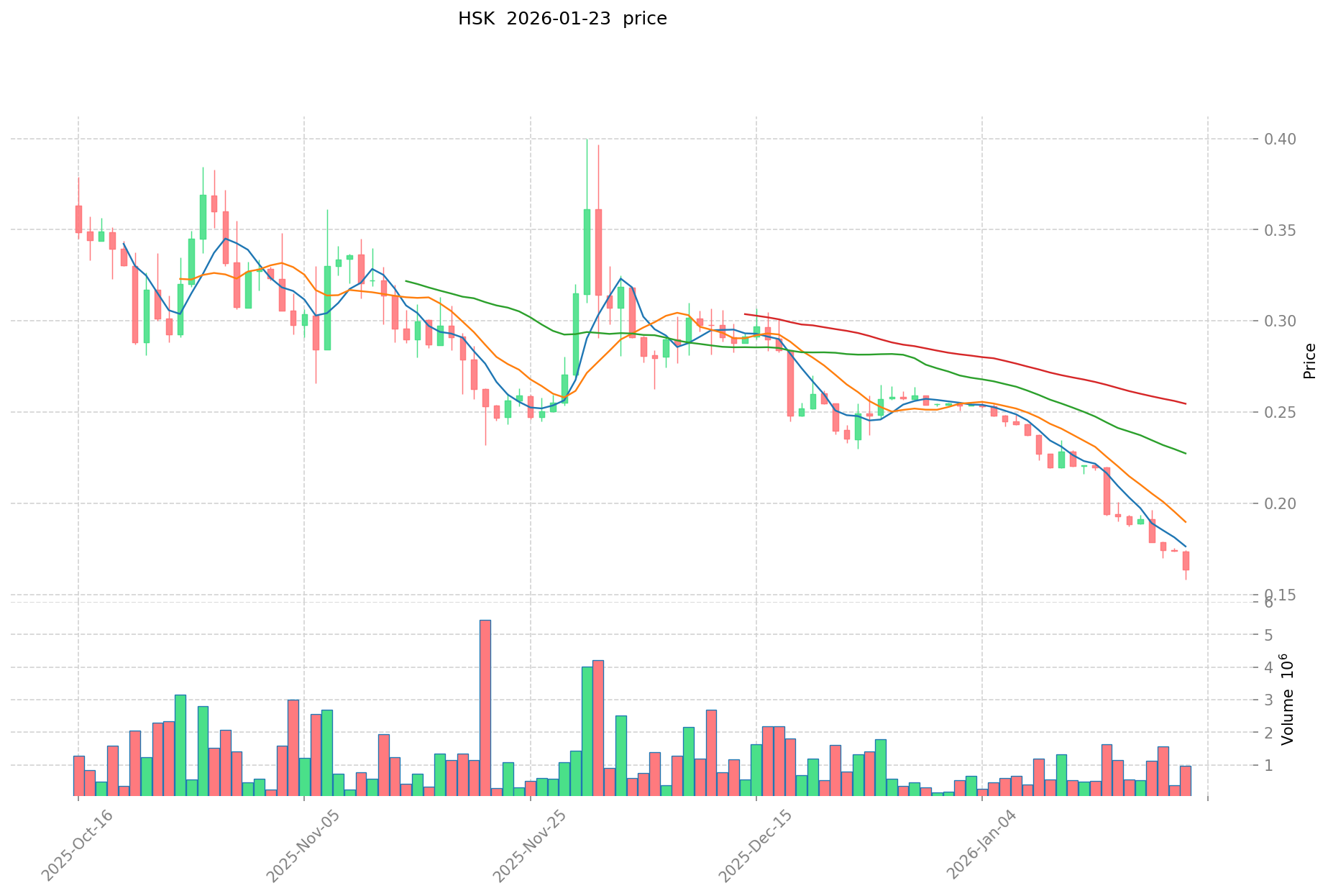
- January 2026: HSK experienced a substantial correction during the market cycle, with the price declining from previous highs to approximately $0.1581 on January 22, 2026.
HSK Current Market Dynamics
As of January 24, 2026, HSK is trading at $0.16, reflecting current market conditions. The token has demonstrated notable volatility across multiple timeframes, with a decrease of 0.92% over the past hour and a 7.13% decline in the last 24 hours. The weekly performance shows an 18.61% reduction, while the 30-day period reflects a 30.59% decrease. Over the past year, the token has experienced an 88% decline from its higher price levels.
The 24-hour trading range has been established between $0.1581 and $0.1727. The current trading volume stands at approximately $234,418.42 over the past 24 hours, indicating active market participation.
HSK maintains a circulating supply of 110 million tokens out of a maximum supply of 1 billion tokens, representing an 11% circulation ratio. The current market capitalization is approximately $17.6 million, while the fully diluted market capitalization stands at $160 million. The token holds approximately 0.0050% market dominance within the broader cryptocurrency ecosystem and is currently ranked 927th by market capitalization.
The token is held by approximately 4,173 addresses and is available for trading on 10 different exchanges. HSK operates on the Ethereum network as an ERC-20 token, with its contract address verified on Etherscan. Additionally, HSK functions as both the native token and gas token for HashKey Chain, an L2 public blockchain infrastructure.
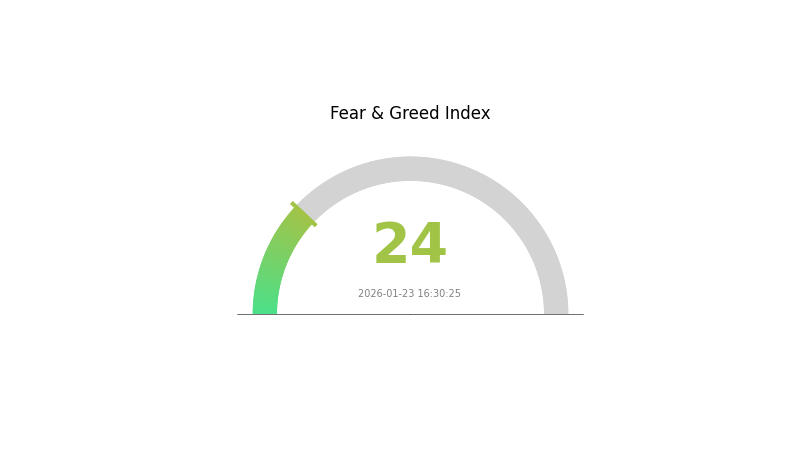
The cryptocurrency market sentiment indicator currently shows a reading of 24 on the Volatility Index, which corresponds to an "Extreme Fear" classification, suggesting heightened caution among market participants during this period.
Click to view current HSK market price
HSK Market Sentiment Indicator
2026-01-23 Fear and Greed Index: 24 (Extreme Fear)
Click to view the current Fear & Greed Index
The cryptocurrency market is currently experiencing extreme fear, with the Fear and Greed Index at 24. This indicates heightened market anxiety and pessimism among investors. Such extreme fear readings typically present contrarian opportunities, as markets often stabilize or recover when sentiment reaches these low levels. Investors should exercise caution while remaining alert to potential entry points during periods of maximum market stress.
HSK Holding Distribution
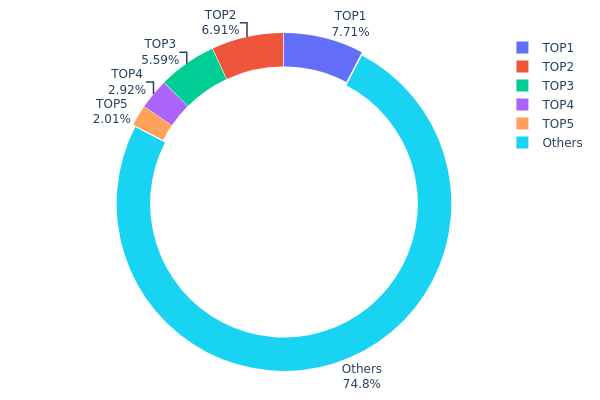
The holding distribution chart reflects the concentration of token holdings across different addresses on the blockchain. By analyzing the proportion of tokens held by top addresses versus the broader holder base, this metric provides crucial insights into the decentralization level and potential market manipulation risks of a cryptocurrency project.
Based on the current data, HSK exhibits a moderately concentrated holding structure. The top 5 addresses collectively control approximately 25.13% of the total token supply, with the largest single address holding 7.71% (77,137.36K tokens). The second and third-largest holders possess 6.90% and 5.59% respectively, while the remaining 74.87% of tokens are distributed among other addresses. This distribution pattern indicates that while major holders maintain significant influence, the majority of tokens remain relatively dispersed across the broader community.
From a market structure perspective, this holding concentration level presents a balanced risk-reward scenario. The presence of several large holders may contribute to price volatility during periods of significant buying or selling activity. However, the fact that nearly 75% of tokens are held by smaller addresses suggests a reasonably healthy level of decentralization, which can help mitigate the risk of single-entity market manipulation. The current on-chain structure demonstrates moderate stability, with sufficient distribution to support organic market development while maintaining core stakeholder commitment to the project's long-term vision.
Click to view current HSK Holding Distribution
| Top |
Address |
Holding Qty |
Holding (%) |
| 1 |
0x6c6c...8ead52 |
77137.36K |
7.71% |
| 2 |
0xe7aa...da8bd3 |
69077.11K |
6.90% |
| 3 |
0x5569...67c7a9 |
55947.24K |
5.59% |
| 4 |
0x866d...4afe01 |
29247.76K |
2.92% |
| 5 |
0xc882...84f071 |
20147.32K |
2.01% |
| - |
Others |
748443.21K |
74.87% |
II. Core Factors Affecting HSK's Future Price
Based on the available information, there is insufficient data to analyze the core factors affecting HSK's future price. The provided materials do not contain specific information regarding HSK's supply mechanisms, institutional dynamics, macroeconomic correlations, or technical developments.
To conduct a comprehensive price analysis, detailed information would be needed about HSK's tokenomics, adoption metrics, technological roadmap, and market positioning. Readers interested in HSK should conduct thorough research using official project documentation and verified data sources before making any investment decisions.
III. 2026-2031 HSK Price Forecast
2026 Outlook
- Conservative Forecast: $0.12952 - $0.1599
- Neutral Forecast: approximately $0.1599
- Optimistic Forecast: up to $0.18868 (subject to favorable market conditions and increased adoption)
2027-2029 Mid-term Outlook
- Market Stage Expectation: The token may enter a gradual accumulation and growth phase, with price volatility potentially stabilizing as market participants gain clearer understanding of the project's fundamentals
- Price Range Forecast:
- 2027: $0.13943 - $0.24924, with average around $0.17429
- 2028: $0.12071 - $0.26894, with average around $0.21176
- 2029: $0.18026 - $0.274, with average around $0.24035
- Key Catalysts: Projected price changes show an 8% increase in 2027, accelerating to 32% in 2028 and 50% in 2029, suggesting potential positive momentum from ecosystem development and broader market recovery
2030-2031 Long-term Outlook
- Baseline Scenario: $0.20317 - $0.29318 by 2030 (assuming steady ecosystem growth and moderate market conditions)
- Optimistic Scenario: $0.17611 - $0.35223 by 2031 (conditional on sustained development progress and favorable regulatory environment)
- Transformative Scenario: potential to exceed $0.35223 (requires breakthrough adoption, strategic partnerships, or significant market expansion)
- 2026-01-24: HSK trading within the predicted range of $0.12952 - $0.18868 (early stage of forecast period)
| Year |
Predicted High Price |
Predicted Average Price |
Predicted Low Price |
Price Change |
| 2026 |
0.18868 |
0.1599 |
0.12952 |
0 |
| 2027 |
0.24924 |
0.17429 |
0.13943 |
8 |
| 2028 |
0.26894 |
0.21176 |
0.12071 |
32 |
| 2029 |
0.274 |
0.24035 |
0.18026 |
50 |
| 2030 |
0.29318 |
0.25718 |
0.20317 |
60 |
| 2031 |
0.35223 |
0.27518 |
0.17611 |
71 |
IV. HSK Professional Investment Strategy and Risk Management
HSK Investment Methodology
(1) Long-term Holding Strategy
- Suitable for: Investors who believe in the long-term development of HashKey Group's ecosystem and HashKey Chain
- Operational Recommendations:
- Consider accumulating positions during market corrections, as HSK has shown significant volatility with a 30-day decline of 30.59%
- Monitor the development progress of HashKey Chain and the expansion of HashKey Group's business scenarios
- Recommended storage solution: Gate Web3 Wallet, which provides secure storage for ERC-20 tokens
(2) Active Trading Strategy
- Technical Analysis Tools:
- Volume Analysis: Monitor the 24-hour trading volume of $234,418.42 to identify potential trend reversals
- Support and Resistance Levels: Track the 24-hour range between $0.1581 (recent low) and $0.1727 (24h high)
- Swing Trading Points:
- Pay attention to the token's volatility, as HSK has experienced significant price movements with a 7-day decline of 18.61%
- Consider the low circulating supply ratio of 11% which may contribute to price volatility
HSK Risk Management Framework
(1) Asset Allocation Principles
- Conservative investors: 1-3% of cryptocurrency portfolio
- Aggressive investors: 3-5% of cryptocurrency portfolio
- Professional investors: 5-10% of cryptocurrency portfolio, with dynamic adjustment based on market conditions
(2) Risk Hedging Strategies
- Diversification Strategy: Balance HSK holdings with other Layer 2 ecosystem tokens and established cryptocurrencies
- Position Management: Implement stop-loss orders considering HSK's current volatility patterns
(3) Secure Storage Solutions
- Hot Wallet Recommendation: Gate Web3 Wallet for convenient trading and ecosystem participation
- Cold Storage Option: Hardware wallets for long-term holdings, suitable for investors with significant positions
- Security Considerations: Enable two-factor authentication, regularly update security protocols, and never share private keys or seed phrases
V. HSK Potential Risks and Challenges
HSK Market Risks
- High Volatility: HSK has experienced substantial price fluctuations, with a 1-year decline of 88% from its all-time high of $2.5936
- Low Circulating Supply: With only 11% of total supply in circulation (110 million out of 1 billion tokens), future token unlocks may create selling pressure
- Limited Exchange Availability: Currently listed on 10 exchanges, which may affect liquidity compared to more widely available tokens
HSK Regulatory Risks
- Jurisdictional Uncertainty: As HashKey Group operates across multiple jurisdictions with licensed exchanges, regulatory changes in key markets could impact token utility
- Compliance Requirements: Future regulatory frameworks for exchange tokens and Layer 2 networks may impose additional compliance obligations
- Token Classification: Evolving regulatory perspectives on utility tokens and ecosystem tokens may affect HSK's operational model
HSK Technical Risks
- Smart Contract Risk: As an ERC-20 token, HSK is subject to potential vulnerabilities in its smart contract code
- Layer 2 Dependency: HSK's role as the native and gas token for HashKey Chain ties its utility to the success and adoption of the Layer 2 network
- Network Security: The security and stability of HashKey Chain's infrastructure are critical factors affecting HSK's long-term viability
VI. Conclusion and Action Recommendations
HSK Investment Value Assessment
HSK presents an investment opportunity tied to the HashKey Group ecosystem and HashKey Chain's Layer 2 infrastructure. The token's long-term value proposition depends on the expansion of HashKey Group's business across licensed exchanges, investment management, and tokenization services. However, investors should note the significant short-term risks, including high volatility (88% decline over one year), low circulating supply, and the token's relatively recent market entry. The dual utility as both an ecosystem token and Layer 2 native gas token provides fundamental use cases, but adoption rates and ecosystem growth remain key factors to monitor.
HSK Investment Recommendations
✅ Beginners: Start with a minimal allocation (1-2% of crypto portfolio) to gain exposure while learning about the HashKey ecosystem. Focus on understanding the token's utility before increasing position size
✅ Experienced Investors: Consider a moderate allocation (3-5% of crypto portfolio) with a focus on monitoring HashKey Chain's development milestones and HashKey Group's business expansion. Implement a dollar-cost averaging strategy to mitigate volatility risks
✅ Institutional Investors: Evaluate HSK within a broader Layer 2 ecosystem strategy, considering the token's low market capitalization ($17.6 million) and limited liquidity. Conduct thorough due diligence on HashKey Group's business model and regulatory standing
HSK Trading Participation Methods
- Spot Trading: Purchase HSK directly on Gate.com and other supported exchanges to benefit from potential ecosystem growth
- Strategic Accumulation: Consider accumulating positions during market downturns, given the current price of $0.16 is close to the all-time low of $0.1581
- Ecosystem Participation: Explore using HSK within the HashKey Chain ecosystem to understand its utility and potential value drivers
Cryptocurrency investment carries high risks, and this article does not constitute investment advice. Investors should make prudent decisions based on their own risk tolerance and are advised to consult professional financial advisors. Never invest more than you can afford to lose.
FAQ
What is the HSK exam registration fee? Are there price differences for different levels?
HSK exam registration fees vary by level. Generally, lower levels(HSK 1-2)cost around 150-200 CNY, while higher levels(HSK 3-6)range from 200-300 CNY. Specific fees depend on test centers and regions. Check official HSK guidelines for exact current pricing.
Have HSK exam fees increased in recent years? Is further price increase expected in the future?
HSK exam fees have shown an upward trend over the past few years due to increased operational costs and improved services. Based on current market conditions and demand, modest price increases are anticipated to continue in the foreseeable future.
What are the differences in HSK exam registration fees across different countries/regions?
HSK registration fees vary by country and region based on local test centers. Fees typically range from $20-60 USD depending on location. Check your local Confucius Institute or authorized test center for specific pricing in your area.
What are the overall costs of HSK exam including registration fee, training fee, and materials?
HSK exam costs typically include registration fees (varies by level, usually 150-250 RMB), optional training courses (500-2000 RMB), and study materials (100-300 RMB). Total investment ranges from 750-2500 RMB depending on your preparation choices.
How does HSK exam fee compare with other Chinese language tests such as HSKK and YCT?
HSK exam fees are generally competitive among Chinese proficiency tests. Standard HSK levels typically cost between 150-250 CNY per attempt, while HSKK speaking tests range 200-300 CNY and YCT varies by level. Exact pricing depends on test centers and regions, but HSK remains an affordable and widely recognized certification option for Chinese language learners globally.
Do I need additional preparation costs to take the HSK exam? How can I control total investment?
HSK exam registration fees are minimal. Basic preparation can be free using online resources. Control costs by using free study materials, setting a fixed budget for optional courses, and studying consistently. Most candidates spend moderately through self-study or affordable online platforms.
* The information is not intended to be and does not constitute financial advice or any other recommendation of any sort offered or endorsed by Gate.