This comprehensive analysis examines NODE token's investment potential through 2031, positioning it within the decentralized physical infrastructure (DePIN) sector as a Vercel-like platform for blockchain deployment. The article evaluates NODE's current market metrics—trading at $0.01383 with a $1.84M market cap—alongside price predictions ranging from $0.00817 to $0.03537 across different scenarios through 2031. Key factors influencing NODE's trajectory include ecosystem expansion (700K+ users, $150M+ AUM), supply mechanics, institutional backing, and macroeconomic conditions. The guide presents tailored investment strategies for beginners through institutional investors, emphasizing dollar-cost averaging and secure storage via Gate Web3 Wallet. Critical risks include extreme price volatility (85.17% year-over-year decline), regulatory uncertainty in DePIN operations, and concentrated token distribution among top holders. Investors are advised to treat NODE as high-risk exposure suitable only for risk-tolera
Introduction: NODE's Market Position and Investment Value
NodeOps (NODE), as a verifiable computation platform supporting GPU/CPU orchestration and RPC-as-a-service, has achieved remarkable growth since its emergence in 2025. As of February 2026, NODE maintains a market capitalization of approximately $1.84 million, with a circulating supply of around 133.39 million tokens and a price hovering near $0.01383. This platform, serving as a "Vercel-like infrastructure for decentralized deployment," is playing an increasingly vital role in the blockchain infrastructure and DePIN ecosystem.
This article will comprehensively analyze NODE's price trajectory from 2026 to 2031, examining historical patterns, market supply-demand dynamics, ecosystem development, and macroeconomic conditions to provide investors with professional price forecasts and practical investment strategies.
I. NODE Price History Review and Market Status
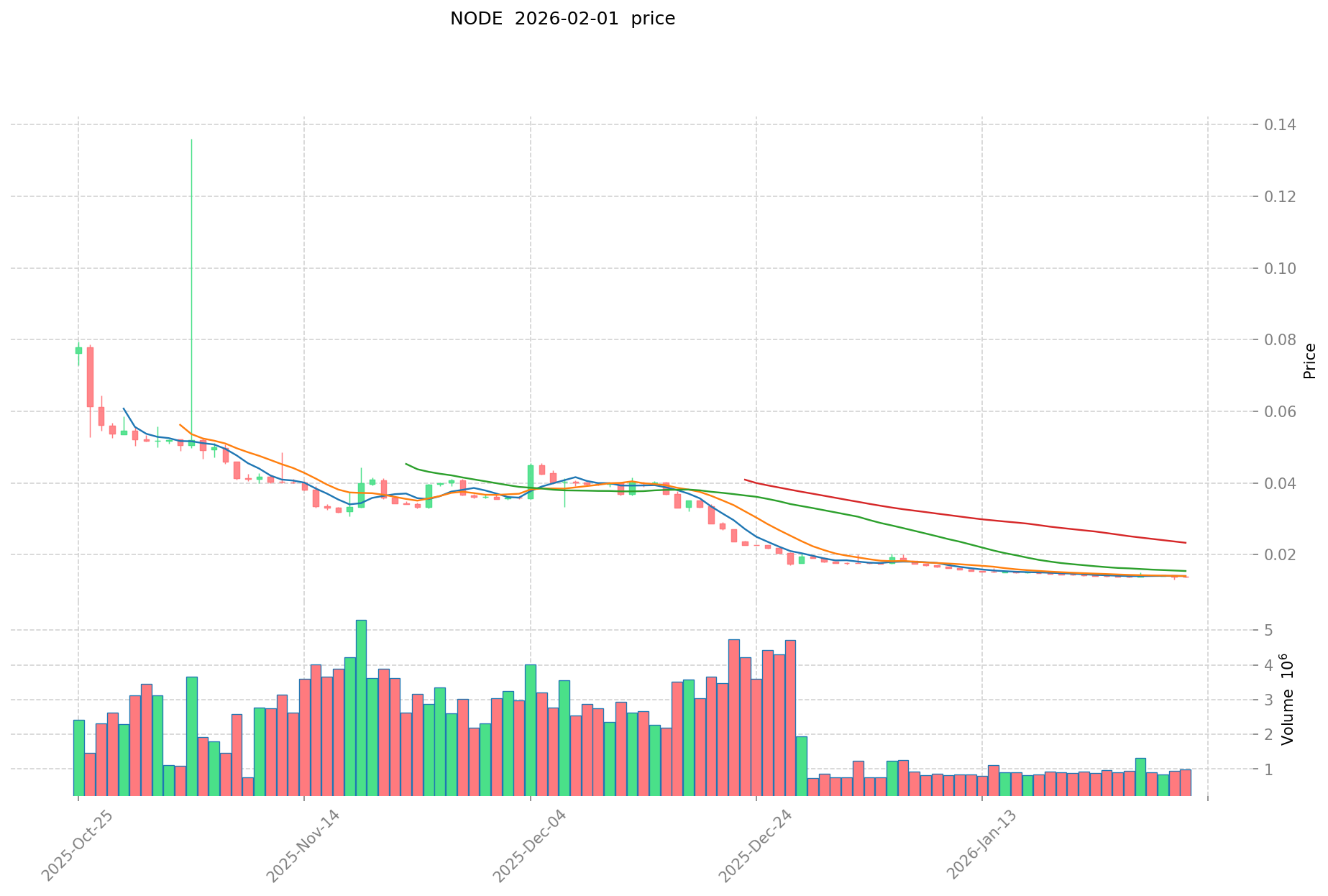
NODE Historical Price Evolution Trajectory
- 2025: NODE token launched in the market on October 14, experiencing early adoption phase. Price reached a notable level of $0.14897 during this period.
- 2026: Market entered a correction phase in January, with price adjusting to around $0.013 on January 30, reflecting broader market sentiment shifts.
NODE Current Market Situation
As of February 1, 2026, NODE is trading at $0.01383, showing modest short-term recovery with a 0.65% increase over the past 24 hours and 0.29% gain in the last hour. The token has experienced notable volatility, with 24-hour trading ranging between $0.01368 and $0.0139.
The broader timeframe presents a more challenging picture, with the token declining 1.069% over the past week and 30.28% over the past month. The one-year performance shows a significant correction of 85.17% from its higher levels during the initial trading period.
NODE currently maintains a market capitalization of approximately $1.84 million, with a fully diluted valuation of $13.83 million. The circulating supply stands at 133.39 million tokens, representing 13.34% of the total supply of 1 billion tokens. Daily trading volume is recorded at around $14,152.
The token's market dominance is positioned at 0.00050%, ranking at #2103 among tracked cryptocurrencies. With 543 holders and availability on 10 exchanges, NODE maintains a developing presence in the decentralized physical infrastructure network (DePIN) sector.
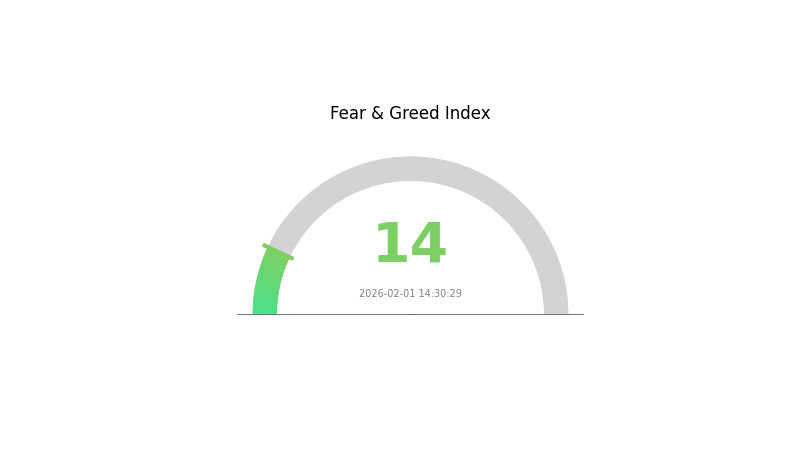
The current market sentiment index indicates a reading of 14, suggesting an extreme fear environment in the broader cryptocurrency market, which may be influencing NODE's price action alongside sector-specific factors.
Click to view current NODE market price
NODE Market Sentiment Index
2026-02-01 Fear and Greed Index: 14 (Extreme Fear)
Click to view current Fear & Greed Index
The cryptocurrency market is experiencing extreme fear, with the index reading at 14. This exceptionally low sentiment indicates investors are highly risk-averse, presenting potential opportunities for contrarian investors. When fear reaches such extremes, it often signals capitulation and potential market bottoms. Traders should consider this heightened fear environment when making investment decisions on Gate.com, as such conditions may precede significant market reversals. Monitor market developments carefully during this period of extreme pessimism.
NODE Holder Distribution
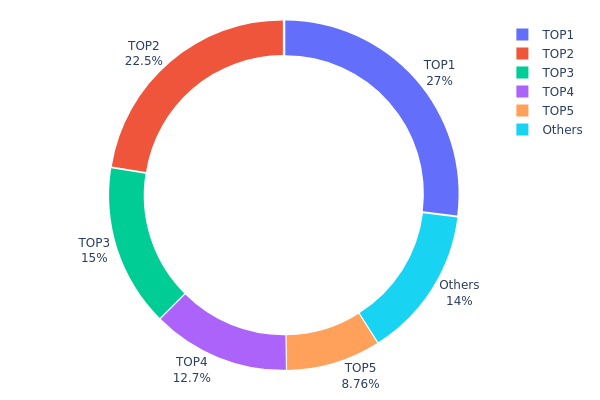
The holder distribution chart illustrates the percentage of total token supply held by top addresses, serving as a key indicator of token concentration and decentralization level. For NODE, the current distribution reveals a highly concentrated ownership structure that warrants careful examination.
According to the latest on-chain data, the top 5 addresses collectively control approximately 85.96% of NODE's total circulating supply. Specifically, the largest holder (0xcdfc...79f7b2) accounts for 26.99%, followed by the second-largest address (0x750a...9be278) at 22.49%, and the third (0xc9b1...ce8125) at 14.99%. The fourth and fifth positions hold 12.74% and 8.75% respectively. This concentration pattern indicates significant centralization, with more than four-fifths of tokens controlled by merely five addresses, leaving only 14.04% distributed among all other holders.
Such extreme concentration presents notable implications for market dynamics and price stability. The dominance of top holders creates potential single-point risk, where large-scale sell-offs from any major address could trigger substantial price volatility. Additionally, this structure raises concerns regarding potential market manipulation, as coordinated actions among these top addresses could significantly influence trading patterns and price discovery mechanisms. From a decentralization perspective, NODE's current distribution suggests limited token dispersion across the broader community, which may affect governance participation and network resilience. While concentrated holdings are common during early project stages or when institutional investors hold significant positions, investors should monitor whether this distribution evolves toward greater decentralization over time.
Click to view current NODE Holder Distribution
| Top |
Address |
Holding Qty |
Holding (%) |
| 1 |
0xcdfc...79f7b2 |
183285.11K |
26.99% |
| 2 |
0x750a...9be278 |
152737.59K |
22.49% |
| 3 |
0xc9b1...ce8125 |
101825.06K |
14.99% |
| 4 |
0x1bce...3ed090 |
86551.30K |
12.74% |
| 5 |
0xa516...1a970a |
59448.15K |
8.75% |
| - |
Others |
95156.92K |
14.04% |
II. Core Factors Influencing NODE's Future Price
Supply Mechanism
- Token Supply Dynamics: The core supply metrics include maximum supply (the upper limit set by code), circulating supply (tokens currently in circulation, influenced by development teams and release schedules), and tokenomics design. These fundamental parameters directly impact market availability and scarcity perception.
- Historical Patterns: Token supply management has historically played a decisive role in price formation. Changes in circulating supply, particularly during unlock events or emission schedule adjustments, have created notable market responses across similar projects.
- Current Impact: Current supply dynamics remain subject to development team decisions and programmed release mechanisms. Market participants should monitor unlock schedules and any announced changes to emission rates, as these factors can significantly influence near-term price action.
Institutional and Major Holder Dynamics
- Institutional Positioning: The concentration of holdings among development teams and early investors represents a critical factor. Token distribution patterns and vesting schedules affect market depth and potential selling pressure.
- Market Structure Considerations: The degree of decentralization in token holdings influences price stability. Projects with more distributed ownership typically exhibit different volatility characteristics compared to those with concentrated holdings.
- Regulatory Landscape: Policy frameworks continue evolving globally. Various jurisdictions have implemented differing approaches to digital asset regulation, ranging from supportive frameworks to restrictive measures, creating an environment of ongoing policy uncertainty.
Macroeconomic Environment
- Monetary Policy Influence: Central bank policies, particularly regarding interest rates and quantitative measures, establish broader market conditions. Economic stability, inflation trends, and policy shifts create the backdrop against which digital assets trade.
- Economic Uncertainty Response: During periods of macroeconomic instability or heightened uncertainty, risk asset behavior typically reflects changing investor sentiment and capital allocation patterns.
- Geopolitical Considerations: International tensions, trade dynamics, and political developments contribute to overall market sentiment and risk appetite, indirectly affecting digital asset valuations through their impact on global capital flows.
Technology Development and Ecosystem Construction
- Infrastructure Enhancement: Ongoing technological improvements in blockchain architecture, including advances in consensus mechanisms and processing efficiency, represent important developmental trajectories. Industry-wide innovations in areas such as sparse attention mechanisms and algorithmic optimization continue reshaping technical capabilities.
- Application Integration: The expansion of practical use cases and real-world implementations determines long-term value proposition. Projects that successfully integrate into existing workflows and solve tangible problems tend to demonstrate more sustainable adoption patterns.
- Ecosystem Maturation: Development of supporting infrastructure, including data availability, interoperability solutions, and developer tooling, contributes to overall ecosystem health. The evolution from proof-of-concept to production-ready applications marks important milestones in project maturation.
III. 2026-2031 NODE Price Prediction
2026 Outlook
- Conservative prediction: $0.00817 - $0.01385
- Neutral prediction: $0.01385 (average market conditions)
- Optimistic prediction: $0.01801 (requires favorable market sentiment and increased adoption)
2027-2029 Outlook
- Market stage expectation: The token is anticipated to enter a gradual growth phase, with progressive price appreciation as the ecosystem matures and user base expands.
- Price range predictions:
- 2027: $0.01449 - $0.01832 (approximately 15% increase)
- 2028: $0.01438 - $0.02397 (approximately 23% increase)
- 2029: $0.01582 - $0.02527 (approximately 48% increase)
- Key catalysts: Network expansion, enhanced utility within the ecosystem, and broader market recovery could serve as primary drivers for price appreciation during this period.
2030-2031 Long-term Outlook
- Baseline scenario: $0.01237 - $0.02291 in 2030 (assuming steady ecosystem development)
- Optimistic scenario: $0.03368 in 2030 (approximately 65% increase with accelerated adoption)
- Transformative scenario: $0.03537 in 2031 (104% increase under exceptional market conditions with significant platform breakthroughs)
- 2026-02-01: NODE trading within the predicted range of $0.00817 - $0.01801 (initial phase of the forecast period)
| Year |
Predicted High Price |
Predicted Average Price |
Predicted Low Price |
Price Change |
| 2026 |
0.01801 |
0.01385 |
0.00817 |
0 |
| 2027 |
0.01832 |
0.01593 |
0.01449 |
15 |
| 2028 |
0.02397 |
0.01712 |
0.01438 |
23 |
| 2029 |
0.02527 |
0.02055 |
0.01582 |
48 |
| 2030 |
0.03368 |
0.02291 |
0.01237 |
65 |
| 2031 |
0.03537 |
0.02829 |
0.01613 |
104 |
IV. NODE Professional Investment Strategies and Risk Management
NODE Investment Methodology
(I) Long-term Holding Strategy
- Suitable for: Investors with medium to high risk tolerance who believe in the DePIN infrastructure narrative and decentralized computing networks
- Operational Recommendations:
- Consider accumulating NODE during market corrections when the price approaches support levels
- Monitor platform metrics such as user growth (currently 700K+ users), machine connections (89K+ machines), and revenue trends ($4.1M+ generated) as indicators of ecosystem health
- Implement a phased investment approach rather than lump-sum allocation given the token's high volatility
- Storage Solutions: Utilize Gate Web3 Wallet for secure self-custody with support for ERC-20 tokens on Ethereum mainnet
(II) Active Trading Strategy
- Technical Analysis Tools:
- Volume Analysis: Monitor the 24-hour trading volume ($14,151.65) relative to market cap to identify potential breakout or breakdown scenarios
- Support and Resistance Levels: Track historical price ranges, noting the recent low at $0.013 and evaluating price action around key psychological levels
- Swing Trading Considerations:
- Exercise caution given the significant 30-day decline of 30.28%, which may indicate continued downward pressure or potential reversal zones
- Consider the limited circulating supply ratio (13.34% of max supply), which may contribute to price volatility during demand surges
NODE Risk Management Framework
(I) Asset Allocation Principles
- Conservative Investors: 1-3% of crypto portfolio allocation
- Aggressive Investors: 5-10% of crypto portfolio allocation
- Professional Investors: Up to 15% with active hedging strategies
(II) Risk Hedging Approaches
- Position Sizing: Limit NODE exposure relative to total portfolio value, accounting for its current ranking (#2103) and market dominance (0.00050%)
- Diversification Strategy: Balance NODE holdings with established layer-1 protocols and other DePIN projects to reduce concentration risk
(III) Secure Storage Solutions
- Self-Custody Recommendation: Gate Web3 Wallet supports ERC-20 tokens including NODE, offering secure key management and transaction signing
- Multi-Signature Approach: For larger holdings, consider implementing multi-signature wallet configurations for enhanced security
- Security Precautions: Never share private keys or seed phrases; verify contract address (0x2f714d7b9a035d4ce24af8d9b6091c07e37f43fb) on Etherscan before transactions; be vigilant against phishing attempts
V. NODE Potential Risks and Challenges
NODE Market Risks
- High Volatility: The token has experienced an 85.17% decline over the past year, with a 30.28% drop in the last 30 days, indicating substantial price instability
- Limited Trading Venues: With availability on 10 exchanges, liquidity may be concentrated, potentially leading to slippage during large transactions
- Low Market Dominance: At 0.00050% market share, NODE remains susceptible to broader crypto market movements and sector-specific downturns in the DePIN space
NODE Regulatory Risks
- Decentralized Infrastructure Scrutiny: As regulatory frameworks evolve around decentralized physical infrastructure networks, operational models involving distributed computing resources may face compliance requirements
- Token Classification Uncertainty: The regulatory status of utility tokens supporting infrastructure services remains subject to interpretation across different jurisdictions
- Cross-Border Operations: With global machine providers (24K+ providers) and multi-chain deployment capabilities (60+ blockchains), NodeOps may encounter varied regulatory approaches in different regions
NODE Technical Risks
- Smart Contract Dependencies: As an ERC-20 token on Ethereum, NODE inherits risks associated with smart contract vulnerabilities and network congestion
- Platform Execution Risk: The project's ability to maintain revenue growth trajectory and expand its current metrics (70万+ users, $150M+ AUM) depends on continued technical development and market adoption
- Token Distribution Concentration: With only 13.34% of max supply currently circulating and 543 holders, future unlocks or vesting schedules could create selling pressure
VI. Conclusion and Action Recommendations
NODE Investment Value Assessment
NodeOps presents a compelling narrative within the decentralized physical infrastructure (DePIN) sector, particularly given its positioning as a "Vercel-like platform" for blockchain deployment and verifiable computing. The project has demonstrated traction with 700K+ users, $150M+ in assets under management, and consistent placement among top 5 DePIN projects by revenue growth. However, the investment case is tempered by significant headwinds: an 85.17% year-over-year price decline, current trading near historical lows ($0.01383 vs. ATL of $0.013), and a market cap of approximately $1.84M with relatively low circulation (13.34% of max supply).
The backing from notable investors including L1D, BFF, Finality Capital, and angels like Sandeep Nailwal (Polygon co-founder) suggests institutional confidence in the project's long-term vision. The platform's revenue generation ($4.1M+) and extensive provider network (24K+ providers, 89K+ machines) provide tangible metrics of operational activity beyond speculative token dynamics. Nevertheless, prospective investors must weigh these fundamentals against substantial execution risk, market volatility, and the competitive landscape within the rapidly evolving DePIN sector.
NODE Investment Recommendations
✅ Beginners: Consider NODE only as a small allocation (1-2%) within a diversified crypto portfolio after thoroughly researching DePIN fundamentals; avoid entering positions during periods of high volatility; prioritize learning about the technology and use cases before investing
✅ Experienced Investors: May allocate 3-7% for medium-term exposure with a focus on monitoring platform metrics such as user growth, revenue trends, and machine network expansion; implement stop-loss strategies given recent price weakness; consider accumulation strategies during consolidation phases
✅ Institutional Investors: Conduct comprehensive due diligence on tokenomics, vesting schedules, and governance structures; evaluate NODE as part of a thematic DePIN basket rather than concentrated exposure; engage with the project team regarding roadmap execution and partnership developments
NODE Trading Participation Methods
- Spot Trading: Purchase NODE tokens through Gate.com spot markets with support for multiple trading pairs; suitable for investors seeking straightforward exposure without leverage
- Dollar-Cost Averaging: Implement systematic periodic purchases to mitigate timing risk, particularly relevant given current price levels near historical lows
- Secure Storage: After acquisition, transfer NODE tokens to Gate Web3 Wallet for self-custody, ensuring control over private keys while maintaining flexibility for future transactions
Cryptocurrency investment carries extremely high risks, and this article does not constitute investment advice. Investors should make prudent decisions based on their own risk tolerance and are advised to consult professional financial advisors. Never invest more than you can afford to lose.
FAQ
What is the current price of NODE token? What are its all-time high and all-time low prices?
NODE token is currently trading at approximately 85.42% below its all-time high of US$0.1208. The all-time low price is US$0.01729, with current price 1.83% above this historic low.
What are the main factors affecting NODE price?
NODE price is primarily influenced by market sentiment and news, government regulation and legal clarity, technology development progress, trading volume and market liquidity, and overall cryptocurrency market trends. These factors combined drive price volatility and long-term value.
How to conduct NODE token price prediction and technical analysis?
NODE price prediction relies on market trends, trading volume, and historical price data. Key indicators include market cap, supply metrics, and chart patterns. Use technical analysis tools to identify trends and support/resistance levels for forecasting.
NODE token operates independently within its own ecosystem and is not directly correlated with major cryptocurrencies like Bitcoin or Ethereum. Its value is driven by platform utility and governance functions rather than broader market movements of mainstream digital assets.
What is the market liquidity and trading volume of NODE tokens?
NODE tokens demonstrate strong market liquidity with substantial daily trading volume. The token maintains consistent trading activity across multiple liquidity pools, enabling efficient price discovery and smooth transactions for traders of all sizes.
What are the risks to pay attention to when investing in NODE tokens?
NODE token investments face market volatility, regulatory changes, and technological risks. Cryptocurrency markets are highly unpredictable. Investors should conduct thorough research, diversify portfolios, and only invest amounts they can afford to lose. Technology updates and market sentiment can significantly impact token value.
* The information is not intended to be and does not constitute financial advice or any other recommendation of any sort offered or endorsed by Gate.