This comprehensive analysis examines Numbers Protocol (NUM) token's price dynamics and investment potential through 2031. Trading at $0.008481 with a $7.44 million market cap, NUM serves as a blockchain-based digital media authentication protocol. The article synthesizes historical price patterns, supply mechanisms, macroeconomic factors, and ecosystem developments to project NUM reaching $0.01187-0.02533 by 2031 across multiple scenarios. Key drivers include institutional adoption, regulatory clarity, technological upgrades, and market sentiment shifts. The analysis provides actionable investment strategies for diverse investor profiles—from conservative dollar-cost averaging to active trading approaches—alongside comprehensive risk management frameworks addressing liquidity constraints, regulatory uncertainties, and technical vulnerabilities. Investors are advised to conduct thorough due diligence and maintain prudent position sizing given NUM's volatility and $47,471 daily trading volume on Gate exchange.
Introduction: NUM's Market Position and Investment Value
Numbers Protocol (NUM), positioning itself as a decentralized photo network protocol designed to create community, value, and trust for digital media, has been establishing its presence in the blockchain space since its inception. As of 2026, NUM has achieved a market capitalization of approximately $7.44 million, with a circulating supply of around 877.5 million tokens, maintaining a current price level near $0.008481. This asset, characterized as a digital media copyright and authentication protocol token, is playing an increasingly vital role in the areas of decentralized image and video registration, copyright management, and digital media verification.
This article will comprehensively analyze NUM's price trends from 2026 to 2031, combining historical patterns, market supply and demand dynamics, ecosystem development, and macroeconomic environmental factors to provide investors with professional price forecasts and practical investment strategies.
I. NUM Price History Review and Current Market Status
NUM Historical Price Evolution Trajectory
- 2021: NUM reached its all-time high of $2.52 on November 28, 2021, marking a significant milestone during the broader crypto market bull run
- 2025: The token experienced substantial downward pressure, hitting its all-time low of $0.00532095 on December 8, 2025, representing a decline of approximately 99.79% from its peak
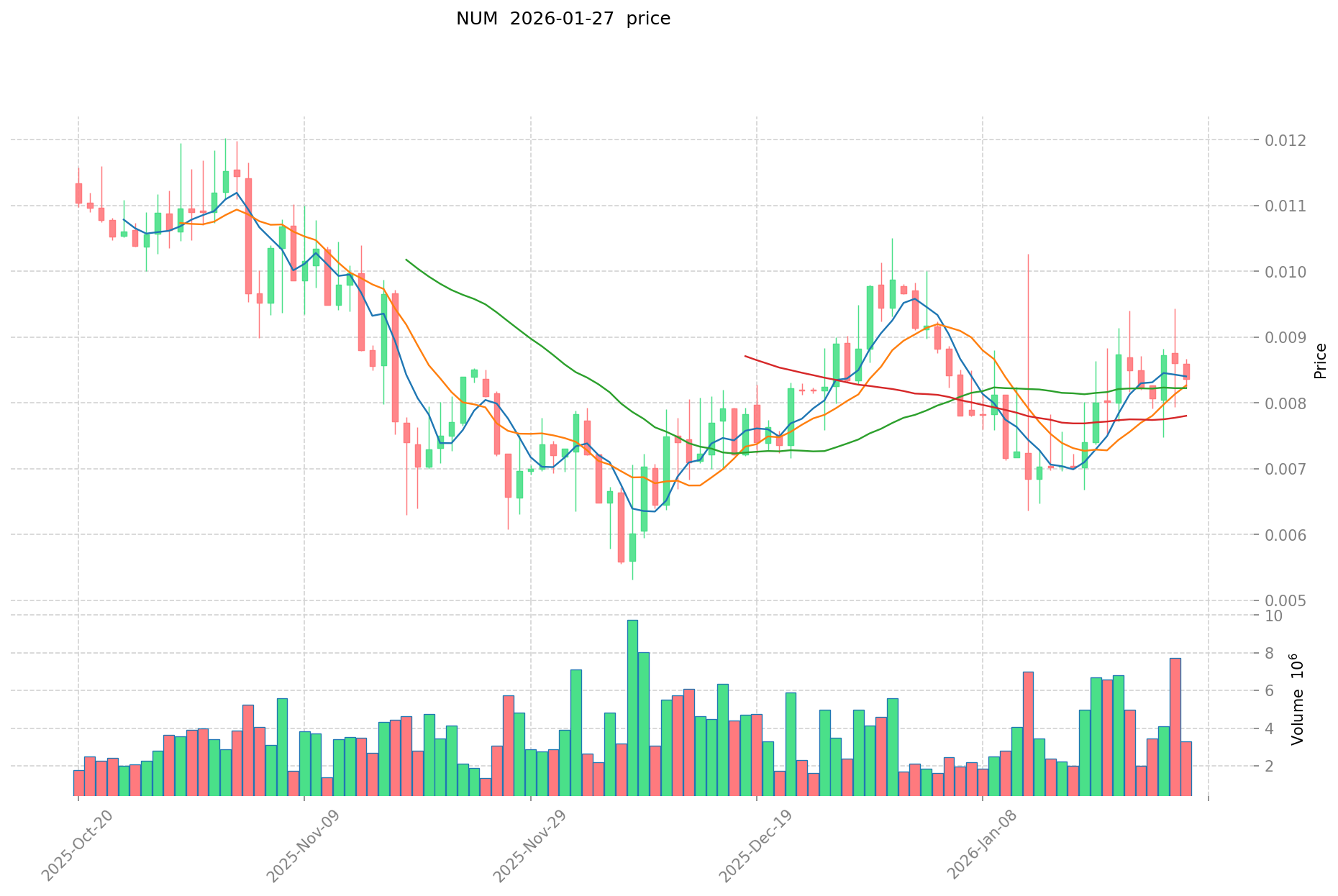
- Recent Period: Despite the challenging market conditions, NUM has shown some recovery signs with a 7-day price increase of 8.01%
As of January 27, 2026, NUM is trading at $0.008481, positioning itself at rank 1344 in the cryptocurrency market. The token has experienced a slight decline of 0.84% over the past 24 hours, with trading volume reaching $47,471.43. Within the 24-hour period, the price has fluctuated between a low of $0.008233 and a high of $0.009351.
The market capitalization stands at approximately $7.44 million, with a circulating supply of 877,495,317 NUM tokens, representing 87.75% of the maximum supply of 1 billion tokens. The fully diluted valuation aligns closely with the current market cap at $7.44 million, indicating limited additional supply pressure. NUM maintains a market dominance of 0.00023%.
Looking at the broader price trends, the token has demonstrated mixed performance across different timeframes. While the 1-hour chart shows a minor decrease of 0.41%, and the 24-hour period reflects a 0.84% decline, the 7-day performance reveals an encouraging 8.01% gain. The 30-day chart indicates a modest increase of 1.06%. However, the 1-year performance shows a significant decline of 79.16%, reflecting the challenging market conditions throughout 2025.
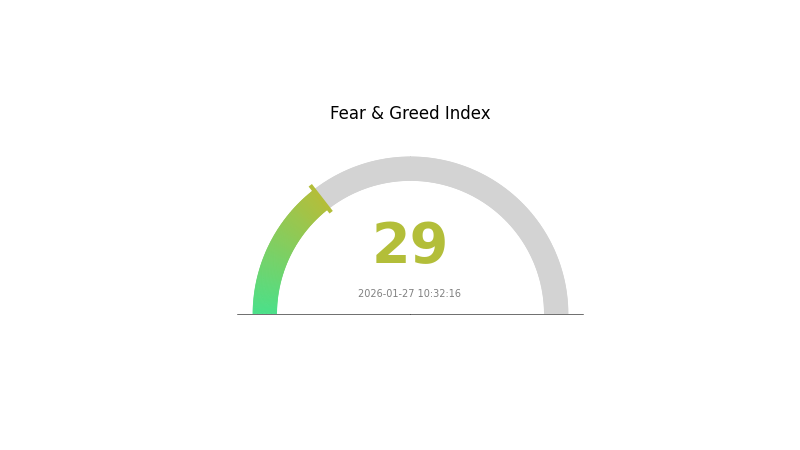
The current Fear & Greed Index stands at 29, indicating a "Fear" sentiment in the broader cryptocurrency market, which may be influencing NUM's price movements and trading activity.
Click to check the current NUM market price
I Market Sentiment Indicator
2026-01-27 Fear and Greed Index: 29 (Fear)
Click to view the current Fear & Greed Index
Today's cryptocurrency market is experiencing significant fear sentiment with an index reading of 29. This fear level indicates heightened market anxiety and risk aversion among investors. Such conditions typically present opportunities for contrarian traders and long-term investors to accumulate assets at lower valuations. Market participants are advised to exercise caution and conduct thorough research before making investment decisions. Understanding the current fear sentiment can help inform portfolio positioning strategies during periods of market uncertainty.
NUM Holdings Distribution
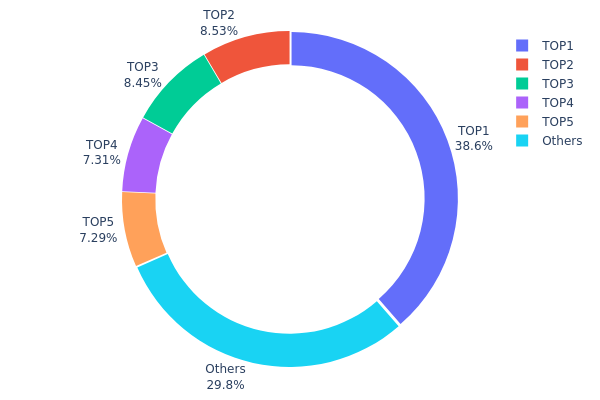
The holdings distribution chart illustrates the concentration of NUM tokens across different wallet addresses, providing insights into the decentralization level and market structure of the token. By analyzing the top holders and their respective shares, we can assess potential risks related to market manipulation and price volatility.
According to the current data, the top five addresses collectively hold approximately 70.17% of the total NUM supply, indicating a relatively high concentration level. The largest holder controls 38.62% (91,438.04K tokens), while the second and third largest addresses hold 8.53% and 8.44% respectively. The remaining addresses outside the top five account for only 29.83% of the total supply. This concentration pattern suggests that a significant portion of NUM tokens is held by a small number of entities, which could pose risks to market stability.
Such high concentration raises concerns about potential price manipulation and increased volatility. Large holders possess substantial influence over market dynamics and could trigger significant price swings through coordinated selling or buying activities. Additionally, this distribution structure indicates a lower degree of decentralization compared to more evenly distributed tokens, which may affect long-term market confidence and liquidity. However, it is worth noting that some of these addresses might belong to exchanges, project treasury wallets, or institutional investors, which could partially explain the concentration pattern.
Click to view current NUM Holdings Distribution
| Top |
Address |
Holding Qty |
Holding (%) |
| 1 |
0x7b8f...16ea19 |
91438.04K |
38.62% |
| 2 |
0x99c2...c78399 |
20200.02K |
8.53% |
| 3 |
0x2c42...907380 |
20000.00K |
8.44% |
| 4 |
0x9642...2f5d4e |
17303.48K |
7.30% |
| 5 |
0xca9a...499a46 |
17249.56K |
7.28% |
| - |
Others |
70533.41K |
29.83% |
II. Core Factors Influencing NUM's Future Price
Supply Mechanism
- Limited Supply Model: Many cryptocurrencies employ capped supply mechanisms to create scarcity. When demand increases while supply remains constrained, prices tend to rise. Conversely, excessive token releases can lead to oversupply and price declines.
- Historical Patterns: Supply dynamics have consistently played a crucial role in cryptocurrency valuation. Token distribution schedules, vesting periods, and burn mechanisms directly impact circulating supply and market pressure.
- Current Impact: The balance between token emissions and demand-side adoption will remain a key price determinant. Projects with well-designed tokenomics that align supply releases with ecosystem growth typically demonstrate more sustainable price trajectories.
Institutional and Major Holder Dynamics
- Institutional Positioning: Institutional adoption of digital assets has accelerated in recent years. Major financial institutions, asset managers, and corporations allocating capital to cryptocurrencies can significantly impact market sentiment and price levels.
- Corporate Adoption: Enterprise integration of blockchain technology and digital assets continues to expand across various sectors, including finance, supply chain, and technology companies.
- National Policies: Regulatory frameworks vary considerably across jurisdictions. Supportive policies can catalyze market growth, while restrictive measures may create headwinds. The evolving regulatory landscape remains a critical consideration for long-term price trajectories.
Macroeconomic Environment
- Monetary Policy Impact: Central bank policies, including interest rate decisions and quantitative easing measures, influence risk asset valuations. Lower interest rates and expansionary policies have historically correlated with increased cryptocurrency demand as investors seek alternative stores of value.
- Inflation Hedge Characteristics: Digital assets with fixed supply caps are increasingly viewed as potential hedges against currency debasement. In environments of elevated inflation, demand for scarce digital assets may increase as investors diversify away from traditional fiat currencies.
- Geopolitical Factors: International tensions, economic sanctions, and cross-border payment restrictions can drive demand for decentralized financial systems. Global events that undermine confidence in traditional financial infrastructure may accelerate cryptocurrency adoption.
Technological Development and Ecosystem Building
- Protocol Upgrades: Technological enhancements that improve scalability, security, and functionality can strengthen network fundamentals and attract developers and users. Successful implementation of technical roadmaps typically supports long-term value appreciation.
- Infrastructure Improvements: Advances in layer-2 solutions, cross-chain interoperability, and user experience refinements expand addressable markets and use cases. Enhanced infrastructure reduces friction for mainstream adoption.
- Ecosystem Applications: The breadth and depth of decentralized applications, DeFi protocols, NFT platforms, and other ecosystem projects built on blockchain networks directly correlate with network utility and token demand. Vibrant developer communities and diverse application landscapes strengthen long-term value propositions.
III. 2026-2031 NUM Price Prediction
2026 Outlook
- Conservative prediction: $0.00806 - $0.00848
- Neutral prediction: Around $0.00848
- Optimistic prediction: Up to $0.01187 (requires favorable market conditions)
2027-2029 Outlook
- Market stage expectation: NUM may experience gradual growth during this period, potentially benefiting from broader cryptocurrency market developments and increased adoption
- Price range prediction:
- 2027: $0.00845 - $0.01425
- 2028: $0.00647 - $0.01563
- 2029: $0.01002 - $0.01573
- Key catalysts: Market sentiment improvements, technological developments in the ecosystem, and potential regulatory clarity could serve as primary drivers
2030-2031 Long-term Outlook
- Baseline scenario: $0.00845 - $0.02135 (assuming steady market growth and maintained project development)
- Optimistic scenario: $0.01501 - $0.02533 (contingent on significant adoption increases and positive market cycles)
- Transformative scenario: Beyond $0.02533 (requires exceptional market conditions, mainstream adoption, and favorable regulatory environment)
- 2026-01-27: NUM trading around baseline levels with potential for gradual appreciation over the forecast period
| Year |
Predicted High Price |
Predicted Average Price |
Predicted Low Price |
Price Change |
| 2026 |
0.01187 |
0.00848 |
0.00806 |
0 |
| 2027 |
0.01425 |
0.01018 |
0.00845 |
20 |
| 2028 |
0.01563 |
0.01221 |
0.00647 |
44 |
| 2029 |
0.01573 |
0.01392 |
0.01002 |
64 |
| 2030 |
0.02135 |
0.01483 |
0.00845 |
74 |
| 2031 |
0.02533 |
0.01809 |
0.01501 |
113 |
IV. NUM Professional Investment Strategy and Risk Management
NUM Investment Methodology
(1) Long-Term Holding Strategy
- Suitable for: Investors seeking exposure to decentralized digital media infrastructure with a belief in the long-term value of blockchain-based content verification
- Operational Recommendations:
- Accumulate positions during market corrections when NUM trades near support levels around $0.008-0.009
- Monitor project developments in digital media authentication and community growth indicators
- Storage solution: Consider Gate Web3 Wallet for secure self-custody with multi-chain support for BSC and ETH networks
(2) Active Trading Strategy
- Technical Analysis Tools:
- Moving Averages: Utilize 20-day and 50-day moving averages to identify trend reversals, as NUM showed an 8.01% weekly gain suggesting potential momentum
- Volume Analysis: Track trading volume patterns against the current 24-hour volume of $47,471 to identify accumulation or distribution phases
- Swing Trading Points:
- Entry consideration: Near 24-hour low of $0.008233 with confirmation from volume increase
- Risk management: Set stop-loss 5-8% below entry point given NUM's historical volatility
NUM Risk Management Framework
(1) Asset Allocation Principles
- Conservative Investors: 1-2% of crypto portfolio allocation
- Moderate Investors: 3-5% of crypto portfolio allocation
- Aggressive Investors: 5-10% of crypto portfolio allocation
(2) Risk Hedging Solutions
- Portfolio Diversification: Balance NUM holdings with larger-cap digital assets to reduce concentration risk
- Position Sizing: Scale positions based on market cap ranking (#1344) and liquidity considerations
(3) Secure Storage Solutions
- Software Wallet Recommendation: Gate Web3 Wallet supports NUM's BSC and ETH contract addresses with user-friendly interface
- Multi-signature Options: For larger holdings, implement multi-signature security protocols
- Security Considerations: Never share private keys, enable two-factor authentication, and regularly update wallet software
V. NUM Potential Risks and Challenges
NUM Market Risks
- Liquidity Constraints: With relatively modest 24-hour trading volume of $47,471, large orders may experience significant slippage
- High Volatility: NUM demonstrated a 79.16% decline over one year, indicating substantial price fluctuation risk
- Limited Exchange Availability: Trading on only 4 exchanges may restrict market access and price discovery efficiency
NUM Regulatory Risks
- Digital Content Regulation: Evolving frameworks for blockchain-based content verification could impact protocol operations
- Token Classification Uncertainty: Regulatory treatment of utility tokens in various jurisdictions remains subject to change
- Cross-Border Compliance: Operations spanning multiple blockchain networks may face complex regulatory requirements
NUM Technical Risks
- Smart Contract Vulnerabilities: Dual-chain deployment (BSC and ETH) increases potential attack surfaces
- Network Dependency: Protocol reliance on underlying blockchain infrastructure exposes it to network-specific risks
- Adoption Challenges: Success depends on mainstream acceptance of blockchain-based digital media authentication
VI. Conclusion and Action Recommendations
NUM Investment Value Assessment
NUM represents exposure to the emerging sector of blockchain-based digital media verification and content authentication. With a market cap of approximately $7.44 million and circulation of 87.75% of maximum supply, the token maintains reasonable tokenomics structure. The project targets a specific use case in creating trust for digital media assets. However, investors should note the token's historical performance showing a 79.16% annual decline, modest trading volume, and ranking outside the top 1,000 cryptocurrencies. The 8.01% weekly gain suggests potential short-term momentum, though this should be evaluated against broader market conditions and project-specific developments.
NUM Investment Recommendations
✅ Beginners: Consider starting with small allocations (1-2% of crypto portfolio) and focus on understanding the digital media authentication use case before increasing exposure
✅ Experienced Investors: Monitor technical indicators and project development milestones, considering NUM as a speculative position within a diversified portfolio
✅ Institutional Investors: Conduct thorough due diligence on protocol economics, team background, and competitive positioning within the digital content verification space
NUM Trading Participation Methods
- Spot Trading: Purchase NUM directly on Gate.com with support for both USDT and other trading pairs
- Dollar-Cost Averaging: Implement systematic purchase plans to mitigate timing risk and reduce volatility impact
- Portfolio Rebalancing: Periodically adjust NUM allocation based on performance relative to overall portfolio targets
Cryptocurrency investment carries extremely high risks, and this article does not constitute investment advice. Investors should make prudent decisions based on their own risk tolerance and are advised to consult professional financial advisors. Never invest more than you can afford to lose.
FAQ
What is NUM token? What are its uses and value?
NUM token is a digital asset designed for specific blockchain applications and services. It serves as a utility token enabling transactions, governance participation, and access to platform features. Its value derives from market demand, adoption rate, and the underlying utility it provides within its ecosystem.
What is NUM's historical price trend? What is the price change over the past year?
NUM has experienced significant volatility over the past year, reaching a high of $2.54 and dropping to $0.008. As of January 27, 2026, NUM trades between $0.008 and $0.008319, reflecting current market conditions and investor sentiment in the market.
What are the main factors affecting NUM price?
NUM price is influenced by market demand and supply dynamics, trading volume, network adoption rate, regulatory policies, macroeconomic conditions, and overall crypto market sentiment. Increased adoption and positive sentiment typically drive prices higher, while regulatory concerns may create downward pressure.
How will NUM price predictions develop in 2024-2025?
NUM price is predicted to average around $0.089 in 2025, with potential upside if market trends continue. Price movements will depend on overall market conditions and NUM adoption growth during this period.
What risks should be noted when investing in NUM tokens?
NUM token investments carry market volatility risks, regulatory changes, and platform security concerns. Price fluctuations can be significant. Conduct thorough research before investing and only commit capital you can afford to lose.
What are the advantages and disadvantages of NUM compared to other mainstream cryptocurrencies?
NUM offers faster transaction speeds and efficient processing. However, it faces challenges with energy consumption and potential centralization issues. Its innovation features remain limited compared to leading cryptocurrencies like Bitcoin and Ethereum.
* The information is not intended to be and does not constitute financial advice or any other recommendation of any sort offered or endorsed by Gate.