This comprehensive analysis examines Numbers Protocol (NUM) token's market trajectory and investment potential through 2031. As of January 2026, NUM trades at $0.008118 with a $7.12 million market cap, down 80% year-over-year despite serving the growing digital media authentication sector. The article projects NUM could reach $0.01207-$0.01885 by 2030 and $0.01053-$0.02422 by 2031, contingent on ecosystem adoption and market conditions. Core analysis covers historical price movements, key influencing factors including supply mechanisms and macroeconomic forces, and professional investment strategies spanning long-term holding to active trading approaches. The guide addresses risk management frameworks, regulatory challenges, and technical vulnerabilities while providing actionable recommendations for investors at different experience levels. Spot trading on Gate.com enables direct participation with systematic dollar-cost averaging approaches recommended for position building.
Introduction: NUM's Market Position and Investment Value
Numbers Protocol (NUM), positioned as a decentralized photo network creating community, value, and trust for digital media, has evolved significantly since its inception. As of January 2026, NUM maintains a market capitalization of approximately $7.12 million, with a circulating supply of around 877.5 million tokens, trading at approximately $0.008118. This digital asset, serving as the native token for decentralized photo networks, enables users to buy, transfer, register copyrights, and perform various operations with their images and videos.
Despite experiencing considerable volatility over the past year with an 80.09% decline, NUM continues to develop its ecosystem within the digital media authentication and copyright management space. Currently ranked #1364 in the cryptocurrency market with a dominance of 0.00022%, the token demonstrates a fully diluted valuation ratio of 87.75%, indicating that most of its maximum supply of 1 billion tokens is already in circulation.
This article provides a comprehensive analysis of NUM's price trajectory from 2026 to 2031, examining historical patterns, market dynamics, ecosystem development, and macroeconomic factors to deliver professional price forecasts and practical investment strategies for interested participants in the digital media authentication sector.
I. NUM Price History Review and Market Status
NUM Historical Price Evolution Trajectory
- 2021: NUM reached a notable peak on November 28, with the price touching $2.52
- 2025: The token experienced significant downward pressure, reaching $0.00532095 on December 8, marking a historically low level
- 2026: As of January 28, NUM is trading at $0.008118, showing a recovery of approximately 52.6% from its historical low point
NUM Current Market Dynamics
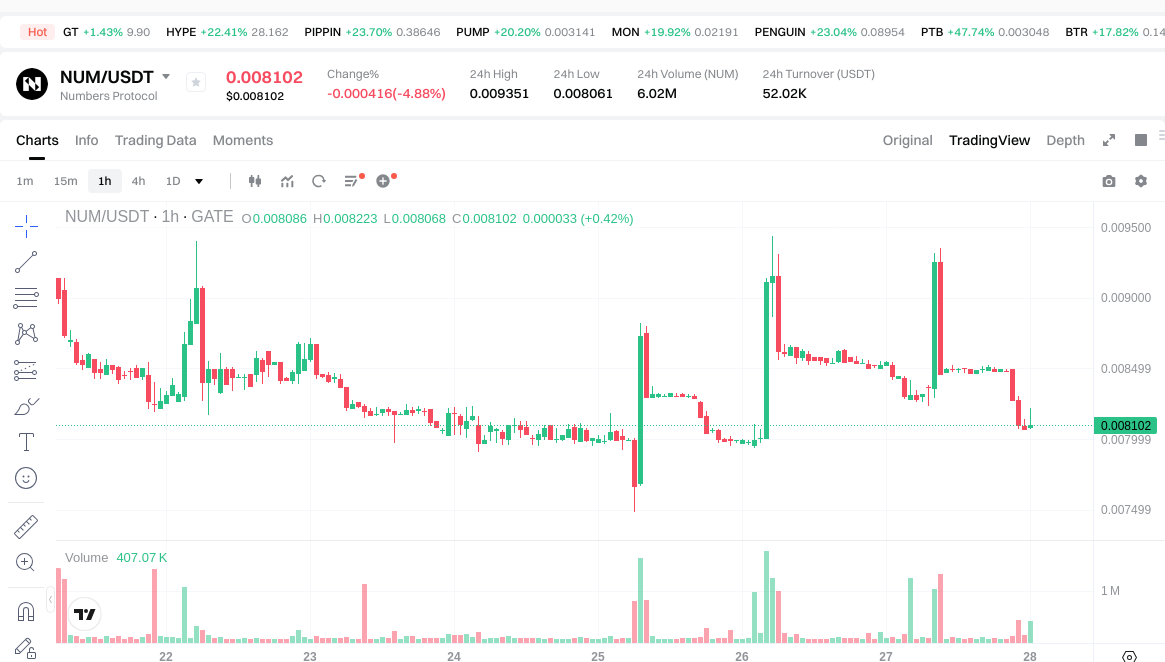
As of January 28, 2026, NUM is priced at $0.008118, representing a 4.66% decrease over the past 24 hours. The token has demonstrated mixed short-term performance, with a 3.26% gain over the past week, while experiencing a 2.33% decline over the past 30 days. The annual performance shows an 80.089% decrease, reflecting the broader market challenges faced by the token.
The current 24-hour trading volume stands at $49,064.70, with the price fluctuating between $0.008061 (low) and $0.009351 (high) during this period. NUM's market capitalization is $7,123,506.98, with a circulating supply of 877,495,317 tokens out of a maximum supply of 1,000,000,000, representing an 87.75% circulation ratio. The token currently ranks #1364 in the cryptocurrency market, holding a 0.00022% market dominance.
Numbers Protocol operates as a decentralized photo network aimed at creating community, value, and trust for digital media. NUM serves as the native token for this ecosystem, enabling users to purchase, transfer, register copyrights, and perform various operations related to their images and videos. The project has attracted 1,832 holders and is listed on 4 exchanges. The current market sentiment index stands at 29, indicating a "Fear" level in the crypto market environment.
Click to view current NUM market price
I Market Sentiment Indicator
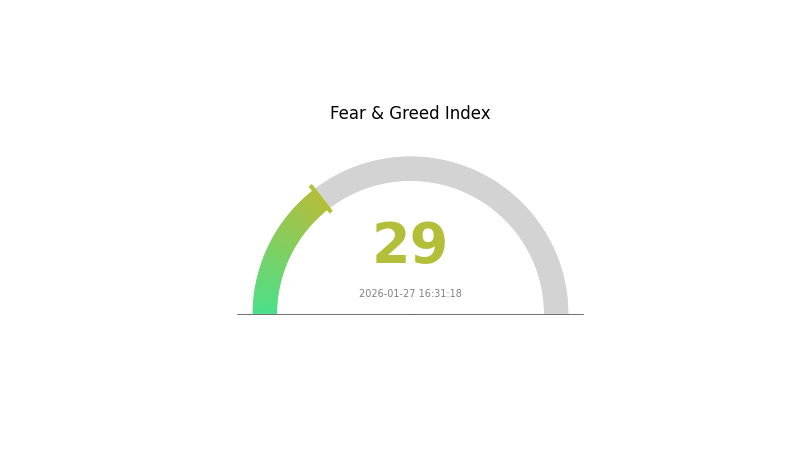
2026-01-27 Fear and Greed Index: 29 (Fear)
Click to view current Fear & Greed Index
The cryptocurrency market is currently experiencing a fear sentiment with an index reading of 29. This indicates heightened anxiety among investors, suggesting potential market caution and defensive positioning. Such fear conditions often present opportunities for contrarian investors, as extreme fear typically precedes market reversals. Traders should monitor key support levels and market fundamentals closely during this period to identify potential entry points or risk management strategies.
NUM Holdings Distribution
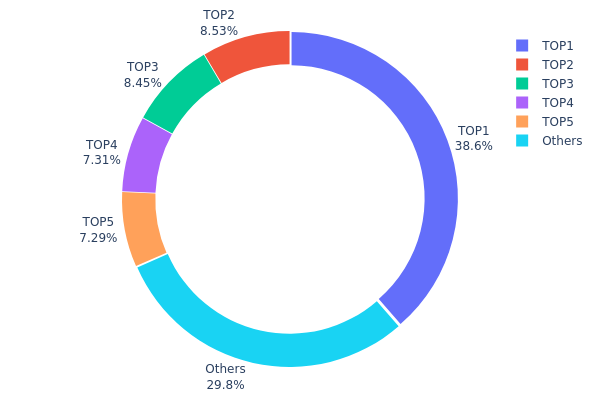
The holdings distribution chart illustrates the percentage of total token supply controlled by different wallet addresses, providing insight into the concentration of token ownership within the network. This metric is crucial for evaluating the degree of decentralization and potential market manipulation risks.
Based on the current data, NUM demonstrates a moderately concentrated holdings structure. The top address (0x7b8f...16ea19) controls approximately 38.62% of the total supply with 91.44 million tokens, representing a significant concentration of ownership. The top five addresses collectively hold 161.19 million NUM tokens, accounting for 68.17% of the total supply. Notably, the second and third largest holders maintain relatively balanced positions at 8.53% and 8.44% respectively, while the remaining addresses outside the top five collectively control only 29.83% of the supply. This distribution pattern indicates that a small number of major stakeholders possess substantial influence over the token's market dynamics.
This concentration level presents both opportunities and risks for market participants. The dominance of top holders may lead to increased price volatility, as large-scale selling or accumulation activities could significantly impact market liquidity and price action. Additionally, the relatively limited distribution among smaller holders suggests potential centralization risks, where major stakeholders could exert disproportionate influence over governance decisions or market sentiment. However, the presence of a stable top-tier holder group may also provide a foundation for long-term price stability, assuming these addresses represent committed institutional investors or project treasury reserves rather than speculative traders.
Click to view current NUM Holdings Distribution
| Top |
Address |
Holding Qty |
Holding (%) |
| 1 |
0x7b8f...16ea19 |
91438.04K |
38.62% |
| 2 |
0x99c2...c78399 |
20200.02K |
8.53% |
| 3 |
0x2c42...907380 |
20000.00K |
8.44% |
| 4 |
0x9642...2f5d4e |
17303.48K |
7.30% |
| 5 |
0xca9a...499a46 |
17249.56K |
7.28% |
| - |
Others |
70533.41K |
29.83% |
II. Core Factors Influencing NUM's Future Price
Supply Mechanism
- Token Distribution Model: NUM operates under a tokenomics framework where supply dynamics play a crucial role in price determination. The distribution mechanism affects circulating supply and market availability.
- Historical Patterns: Cryptocurrency supply constraints have historically driven price appreciation during periods of increased demand. Supply-side dynamics, combined with market sentiment, have demonstrated significant price impact across digital assets.
- Current Impact: Supply-demand equilibrium remains a fundamental driver of NUM price movements. When market demand intensifies while supply remains limited, upward price pressure typically follows this basic economic principle.
Institutional and Whale Activity
- Institutional Holdings: Large-scale holders and institutional participants can significantly influence market dynamics through their trading activities and long-term positioning strategies.
- Corporate Adoption: Growing institutional interest in digital assets has become an important factor in cryptocurrency valuation, as corporate treasury adoption and enterprise use cases expand.
- National Policies: Regulatory frameworks and government approaches to digital assets continue to shape market confidence and institutional participation levels.
Macroeconomic Environment
- Monetary Policy Influence: Central bank policies, interest rate decisions, and quantitative measures affect risk asset allocation, including cryptocurrency markets. Accommodative monetary policies have historically supported digital asset valuations.
- Inflation Hedge Characteristics: Digital assets have demonstrated varying degrees of correlation with inflation trends, with some investors viewing them as potential hedges against currency debasement.
- Geopolitical Factors: Global economic uncertainty and shifting regulatory landscapes across major economies can influence investor sentiment and capital flows within cryptocurrency markets.
Technology Development and Ecosystem Building
- Protocol Enhancements: Technical improvements and network upgrades contribute to functionality, scalability, and user experience, potentially enhancing adoption and utility.
- Infrastructure Evolution: Ongoing development work on core protocols and layer-2 solutions aims to address scalability challenges and improve transaction efficiency.
- Ecosystem Applications: The growth of decentralized applications, DeFi protocols, and other use cases built on or integrated with the platform can drive network activity and token utility demand.
III. 2026-2031 NUM Price Prediction
2026 Outlook
- Conservative prediction: $0.00762 - $0.0081
- Neutral prediction: $0.0081
- Optimistic prediction: $0.01207 (requires favorable market conditions)
Based on the 2026 forecast data, NUM is expected to trade within a relatively narrow range during the initial year. The conservative scenario places the token between $0.00762 and $0.0081, while the optimistic case could see prices reaching up to $0.01207. The average trading price is projected to stabilize around $0.0081, with a price change of 0% compared to the baseline period, suggesting a consolidation phase for the token.
2027-2029 Medium-term Outlook
- Market stage expectation: Gradual recovery and growth phase with increasing adoption
- Price range predictions:
- 2027: $0.00706 - $0.01241 (average $0.01009)
- 2028: $0.00787 - $0.01653 (average $0.01125)
- 2029: $0.0082 - $0.01861 (average $0.01389)
- Key catalysts: Market maturation and ecosystem development
The medium-term outlook shows progressive growth momentum. By 2027, NUM could experience a 24% price increase compared to 2026, with prices ranging from $0.00706 to $0.01241. This upward trend is expected to continue through 2028, potentially achieving a 38% increase with prices between $0.00787 and $0.01653. The most significant growth in this period may occur in 2029, with a projected 71% increase and prices ranging from $0.0082 to $0.01861. The expanding price ranges suggest increasing market volatility alongside growth potential.
2030-2031 Long-term Outlook
- Baseline scenario: $0.01121 - $0.01885 (assumes steady market development and adoption)
- Optimistic scenario: $0.01625 - $0.02422 (assumes enhanced ecosystem growth and broader market acceptance)
- Transformational scenario: Up to $0.02422 (requires exceptional market conditions and widespread adoption)
The long-term projections indicate substantial growth potential for NUM. By 2030, the token could achieve a 100% increase compared to 2026 levels, with prices ranging from $0.01121 to $0.01885 and an average price of $0.01625. The forecast extends into 2031 with even more optimistic projections, showing potential prices between $0.01053 and $0.02422, representing a 116% increase. The average price for 2031 is estimated at $0.01755, suggesting continued upward momentum. These projections reflect a multi-year growth trajectory, though actual performance will depend on various market factors and ecosystem developments.
| Year |
Predicted High Price |
Predicted Average Price |
Predicted Low Price |
Price Change |
| 2026 |
0.01207 |
0.0081 |
0.00762 |
0 |
| 2027 |
0.01241 |
0.01009 |
0.00706 |
24 |
| 2028 |
0.01653 |
0.01125 |
0.00787 |
38 |
| 2029 |
0.01861 |
0.01389 |
0.0082 |
71 |
| 2030 |
0.01885 |
0.01625 |
0.01121 |
100 |
| 2031 |
0.02422 |
0.01755 |
0.01053 |
116 |
IV. NUM Professional Investment Strategy and Risk Management
NUM Investment Methodology
(1) Long-term Holding Strategy
- Suitable for: Investors who believe in the long-term potential of decentralized digital media networks and content authentication systems
- Operational Recommendations:
- Consider accumulating NUM tokens gradually during market corrections to build a position aligned with your risk tolerance
- Monitor project development milestones, partnerships, and adoption metrics within the digital media ecosystem
- Implement a secure storage solution using Gate Web3 Wallet for convenient management while maintaining security best practices
(2) Active Trading Strategy
- Technical Analysis Tools:
- Moving Averages: Use the 50-day and 200-day moving averages to identify potential trend reversals and momentum shifts
- Volume Analysis: Monitor trading volume patterns to confirm price movements and identify potential breakout opportunities
- Swing Trading Key Points:
- Given NUM's relatively low market cap and circulating supply, be aware of potential volatility during trading sessions
- Set clear entry and exit points based on technical levels, maintaining disciplined risk-reward ratios
NUM Risk Management Framework
(1) Asset Allocation Principles
- Conservative Investors: 1-2% of crypto portfolio allocation
- Aggressive Investors: 3-5% of crypto portfolio allocation
- Professional Investors: Up to 5-8% based on comprehensive due diligence and risk assessment
(2) Risk Hedging Solutions
- Diversification Strategy: Combine NUM holdings with other established digital media or infrastructure tokens to spread sector-specific risk
- Position Sizing: Implement gradual position building rather than single large entries to average out cost basis
(3) Secure Storage Solutions
- Hot Wallet Recommendation: Gate Web3 Wallet for active trading and regular transactions with built-in security features
- Cold Storage Solution: For long-term holdings exceeding your active trading needs, consider transferring to hardware wallet solutions
- Security Precautions: Never share private keys, enable two-factor authentication, verify contract addresses before transactions, and be vigilant against phishing attempts
V. NUM Potential Risks and Challenges
NUM Market Risks
- High Volatility: NUM has experienced significant price fluctuations, with a 1-year decline of approximately 80.09%, indicating substantial market volatility
- Low Liquidity: With a 24-hour trading volume of approximately $49,064 and ranking at 1364 by market cap, NUM may face liquidity constraints during large transactions
- Limited Market Depth: Trading on only 4 exchanges may result in price discrepancies and difficulty executing large orders without significant slippage
NUM Regulatory Risks
- Digital Content Regulation: Evolving regulations around digital media ownership, copyright, and decentralized content networks may impact the protocol's operational framework
- Token Classification Uncertainty: Regulatory clarity regarding utility tokens in the digital media space remains evolving across different jurisdictions
- Cross-border Compliance: As a global digital media network, Numbers Protocol may face varying regulatory requirements across different markets
NUM Technical Risks
- Smart Contract Vulnerabilities: As NUM operates on multiple chains (BSC and ETH), there are inherent smart contract risks associated with cross-chain operations
- Network Dependencies: The protocol's reliance on underlying blockchain infrastructure means technical issues or congestion on host networks could affect functionality
- Adoption Uncertainty: The success of the decentralized photo network depends on widespread adoption by content creators and platforms, which remains uncertain
VI. Conclusion and Action Recommendations
NUM Investment Value Assessment
Numbers Protocol presents an interesting proposition in the decentralized digital media authentication space, addressing genuine needs around content provenance and creator rights. However, the project faces significant challenges including limited market liquidity, substantial price volatility as evidenced by the 80% decline over the past year, and uncertain adoption trajectory. The relatively small market cap of approximately $7.12 million and circulating supply of 877.5 million NUM (87.75% of max supply) suggest a project still in early stages. While the fundamental concept of decentralized media authentication has merit, investors should approach with caution given the high-risk profile and limited trading infrastructure.
NUM Investment Recommendations
✅ Beginners: Consider observing the project's development and ecosystem growth before committing significant capital; if participating, limit exposure to less than 1% of total portfolio and use only funds you can afford to lose completely
✅ Experienced Investors: Suitable for small speculative allocations (2-3% of crypto portfolio) with clear stop-loss levels; monitor project milestones, partnership announcements, and adoption metrics closely
✅ Institutional Investors: Conduct comprehensive due diligence on protocol architecture, team background, and competitive positioning; consider pilot allocation only after thorough risk assessment and with appropriate hedging strategies
NUM Trading Participation Methods
- Spot Trading: Purchase NUM tokens on Gate.com through spot markets, allowing for straightforward ownership and storage in Gate Web3 Wallet
- Dollar-Cost Averaging: Implement systematic periodic purchases to mitigate timing risk and build positions gradually during different market conditions
- Limit Orders: Given lower liquidity, use limit orders rather than market orders to achieve better execution prices and avoid unnecessary slippage
Cryptocurrency investment carries extremely high risk, and this article does not constitute investment advice. Investors should make prudent decisions based on their own risk tolerance and are advised to consult professional financial advisors. Never invest more than you can afford to lose.
FAQ
What is NUM token and what are its uses and application scenarios?
NUM is a utility token in Numbers Protocol ecosystem used for paying service fees, rewarding validators, and incentivizing network operators. It serves as the core incentive mechanism unifying the entire ecosystem.
NUM has experienced significant volatility over the past years with strong recent performance. Current price stands above most historical peaks, driven by increased market demand and positive momentum. Market trading volume remains robust, indicating healthy investor interest and market activity.
What are the total supply and circulating supply of NUM tokens?
NUM token has a total supply of 857.47M. The circulating supply information is not currently available. Data as of January 27, 2026.
What are the main factors affecting NUM price and how to conduct fundamental analysis?
NUM price is primarily influenced by network activity, transaction volume, developer adoption, and market sentiment. Fundamental analysis evaluates tokenomics, project updates, and ecosystem growth to assess long-term value potential.
What are the differences and advantages of NUM compared to other mainstream cryptocurrencies?
NUM offers innovative blockchain architecture with enhanced scalability and lower transaction costs. It features faster settlement times, improved energy efficiency, and stronger community governance mechanisms compared to traditional cryptocurrencies, positioning it as a next-generation digital asset.
What are the investment risks of NUM tokens and how should I evaluate investment prospects?
NUM token risks include market volatility and supply unlock schedules. Evaluate prospects by monitoring total supply, circulating volume, and vesting timelines. Excessive supply releases may create selling pressure and price decline risks.
* The information is not intended to be and does not constitute financial advice or any other recommendation of any sort offered or endorsed by Gate.