This comprehensive analysis examines PAAL AI token's investment potential through 2031, providing expert price forecasts and actionable strategies for investors. Currently trading at $0.03816 with $38.11 million market cap, PAAL operates as an AI-powered blockchain ecosystem featuring advanced chatbots and automated trading capabilities. The article details historical price performance, current market status showing recent 30-day gains of 162.95%, and predictive models forecasting gradual growth from $0.0393 average in 2026 to $0.07111 by 2031. Key sections cover ecosystem developments, tokenomics analysis, holder distribution, and comparative market positioning. Professional investment strategies include dollar-cost averaging for long-term holders and technical analysis for active traders, complemented by comprehensive risk management frameworks addressing volatility, liquidity constraints, and regulatory uncertainties. The analysis serves investors seeking exposure to AI-crypto convergence while navigating
Introduction: PAAL's Market Position and Investment Value
PAAL AI (PAAL), positioned as an advanced AI-powered ecosystem with chatbots built on artificial intelligence and machine learning technologies, has been making strides in streamlining complex tasks since its launch in 2023. As of January 20, 2026, PAAL maintains a market capitalization of approximately $38.11 million, with a circulating supply of around 998.65 million tokens and a current price hovering around $0.03816. This asset, recognized for its innovative approach to natural language understanding, decision-making, and automated trading, is playing an increasingly vital role in the AI and blockchain convergence space.
This article will comprehensively analyze PAAL's price trajectory from 2026 to 2031, combining historical patterns, market supply and demand dynamics, ecosystem development, and macroeconomic conditions to provide investors with professional price forecasts and practical investment strategies.
I. PAAL Price History Review and Market Status
PAAL Historical Price Evolution Trajectory
- 2023: Project launched in June with an initial offering price of $0.00008, experiencing significant growth throughout the year. The token reached its all-time low of $0.0088 in September 2023 as the project established its market presence.
- 2024: PAAL demonstrated strong momentum in the first quarter, achieving its all-time high of $0.88 in March 2024. This represented substantial appreciation from its launch price, driven by expanding ecosystem adoption and AI technology integration.
- 2024-2025: The token entered a correction phase following its peak, experiencing significant downward pressure. Price declined from the March 2024 high, reflecting broader market consolidation and crypto sector adjustments.
- 2025-2026: The asset showed recovery signs with notable volatility. In the 30-day period leading to January 20, 2026, PAAL gained approximately 163%, while the 7-day performance showed a 39.6% increase, indicating renewed market interest.
PAAL Current Market Situation
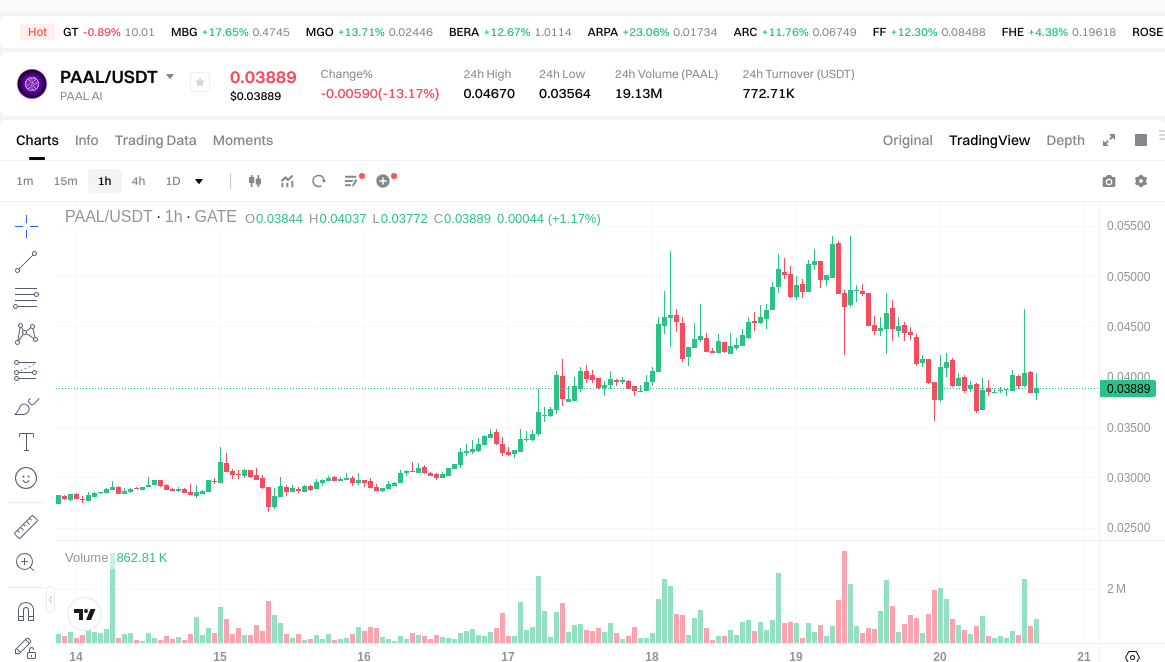
As of January 20, 2026, PAAL is trading at $0.03816, positioning it at rank 620 among cryptocurrencies by market capitalization. The token's 24-hour trading activity shows a decline of 14.82%, with prices fluctuating between $0.03564 and $0.0467 during this period. The 24-hour trading volume stands at approximately $754,744.
The circulating supply comprises 998,652,231 tokens, representing 99.87% of the maximum supply of 1 billion tokens. This results in a market capitalization of approximately $38.11 million and a fully diluted valuation of $38.16 million. The close alignment between market cap and fully diluted valuation indicates minimal additional token unlock pressure.
PAAL maintains a market dominance of 0.0011% within the broader cryptocurrency ecosystem. The token is listed on 12 exchanges, with Gate.com among the trading platforms. The project has attracted 56,925 holders, suggesting a distributed ownership structure across the community.
From a longer-term perspective, PAAL shows mixed performance indicators. While the 30-day gain of 162.95% and 7-day increase of 39.6% demonstrate recent positive momentum, the 1-year performance reflects an 88.63% decline from prior levels. The current price remains significantly below the all-time high of $0.88 recorded in March 2024.
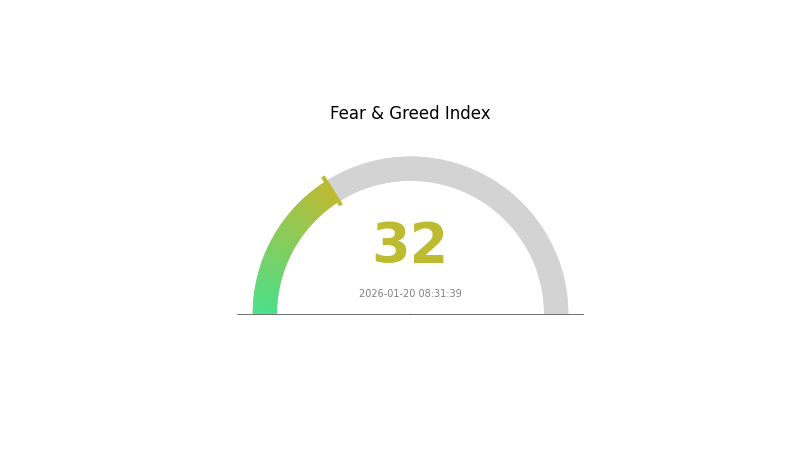
The cryptocurrency market sentiment index currently registers at 32, indicating a "Fear" reading, which may influence short-term trading dynamics for PAAL and related assets. The token operates primarily on the Ethereum network, with its contract address verified on Etherscan.
Click to view current PAAL market price
PAAL Market Sentiment Index
2026-01-20 Fear and Greed Index: 32 (Fear)
Click to view current Fear & Greed Index
The cryptocurrency market is currently experiencing a fear sentiment with an index reading of 32. This indicates heightened market anxiety and pessimistic investor behavior. During periods of fear, risk-averse traders often reduce positions and seek safer assets. However, experienced investors recognize that extreme fear can present buying opportunities for long-term portfolios. Market participants should exercise caution while monitoring fundamental developments. Consider dollar-cost averaging strategies during such volatility. Stay informed through Gate.com's comprehensive market data tools to make better-informed trading decisions amid current market conditions.
PAAL Holder Distribution
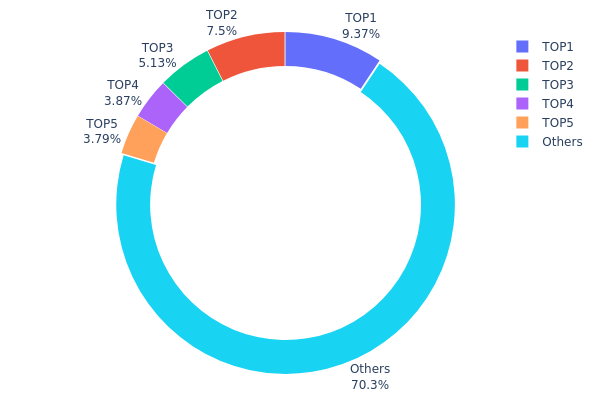
Address holder distribution chart illustrates the allocation of tokens across different wallet addresses, revealing the degree of token concentration among major holders versus the broader community. This metric serves as a crucial indicator for assessing decentralization levels and potential market manipulation risks.
According to the current data, PAAL exhibits a moderately concentrated holder structure. The top five addresses collectively hold 293,618.85K tokens, representing approximately 29.64% of the total supply, while the remaining 70.36% is distributed among other addresses. The largest single holder controls 93,736.85K tokens (9.37%), followed by the second-largest with 75,000.00K tokens (7.50%). This distribution pattern suggests that while no single entity possesses absolute control over the token supply, a relatively small group of major holders maintains significant influence over market dynamics.
This concentration level presents a dual-edged scenario for PAAL's market structure. On one hand, the fact that over 70% of tokens remain distributed across numerous smaller addresses demonstrates reasonable decentralization and indicates broader community participation. On the other hand, the cumulative holdings of top-tier addresses approaching 30% creates potential vulnerability to coordinated large-scale transactions, which could trigger substantial price volatility. The current distribution structure reflects a transitional phase between centralized control and widespread distribution, typical of projects in their growth stage. This holder composition requires continued monitoring, as significant movements by major holders could materially impact market liquidity and price stability.
Click to view current PAAL Holder Distribution
| Top |
Address |
Holding Qty |
Holding (%) |
| 1 |
0x8431...80894f |
93736.85K |
9.37% |
| 2 |
0xe8e3...626ca1 |
75000.00K |
7.50% |
| 3 |
0x6522...837e90 |
51261.80K |
5.12% |
| 4 |
0x3cc9...aecf18 |
38688.18K |
3.86% |
| 5 |
0x2a6c...a9259f |
37932.02K |
3.79% |
| - |
Others |
703381.15K |
70.36% |
II. Core Factors Influencing PAAL's Future Price
Based on the available information, there is insufficient data to provide a comprehensive analysis of the core factors that may influence PAAL's future price. The reference materials do not contain specific details regarding supply mechanisms, institutional dynamics, macroeconomic considerations, or technical developments related to PAAL.
Investors interested in PAAL should conduct independent research and consult multiple sources to understand the project's fundamentals, tokenomics, and market positioning before making investment decisions.
III. 2026-2031 PAAL Price Prediction
2026 Outlook
- Conservative prediction: $0.03419 - $0.0393
- Neutral prediction: $0.0393
- Optimistic prediction: $0.04913 (requires favorable market conditions and positive sentiment)
2027-2029 Outlook
- Market stage expectation: Gradual growth phase with increasing adoption and market maturity
- Price range prediction:
- 2027: $0.02564 - $0.0619
- 2028: $0.04563 - $0.0695
- 2029: $0.04964 - $0.06802
- Key catalysts: Technology development progress, ecosystem expansion, and broader market acceptance of AI-focused crypto projects
2030-2031 Long-term Outlook
- Baseline scenario: $0.04525 - $0.07758 (assuming stable market development and continued project evolution)
- Optimistic scenario: $0.06329 - $0.07467 (assuming accelerated adoption and favorable regulatory environment)
- Transformative scenario: Potential to reach upper ranges if significant breakthroughs in AI integration and widespread institutional adoption occur
- 2026-01-20: PAAL shows potential for modest growth with predicted average price around $0.0393 in 2026, representing approximately 2% change from baseline
| Year |
Predicted High Price |
Predicted Average Price |
Predicted Low Price |
Price Change |
| 2026 |
0.04913 |
0.0393 |
0.03419 |
2 |
| 2027 |
0.0619 |
0.04421 |
0.02564 |
15 |
| 2028 |
0.0695 |
0.05306 |
0.04563 |
39 |
| 2029 |
0.06802 |
0.06128 |
0.04964 |
60 |
| 2030 |
0.07758 |
0.06465 |
0.04525 |
69 |
| 2031 |
0.07467 |
0.07111 |
0.06329 |
86 |
IV. PAAL Professional Investment Strategies and Risk Management
PAAL Investment Methodology
(I) Long-term Holding Strategy
- Suitable for: Investors who believe in AI-driven blockchain solutions and have a tolerance for high volatility
- Operational Recommendations:
- Consider dollar-cost averaging to mitigate entry risk given PAAL's significant price fluctuations (historical range: $0.0088 - $0.88)
- Monitor developments in PAAL AI's chatbot ecosystem and natural language processing capabilities as key value drivers
- Storage Solution: Use Gate Web3 Wallet for secure long-term custody with private key control
(II) Active Trading Strategy
- Technical Analysis Tools:
- Moving Averages: Track 7-day and 30-day trends to identify momentum shifts (recent 7D: +39.6%, 30D: +162.95%)
- Volume Analysis: Monitor the 24-hour trading volume ($754,744) relative to market cap to assess liquidity conditions
- Swing Trading Considerations:
- Set stop-loss orders due to high intraday volatility (24H range: $0.03564 - $0.0467)
- Take partial profits during sharp upward movements given the token's historical volatility patterns
PAAL Risk Management Framework
(I) Asset Allocation Principles
- Conservative Investors: 1-3% of crypto portfolio allocation
- Aggressive Investors: 5-10% of crypto portfolio allocation
- Professional Investors: Up to 15% with active hedging strategies
(II) Risk Hedging Solutions
- Diversification: Balance PAAL holdings with established cryptocurrencies and stablecoins
- Position Sizing: Limit single-position exposure given PAAL's market cap dominance of only 0.0011%
(III) Secure Storage Solutions
- Hot Wallet Recommendation: Gate Web3 Wallet for convenient trading access and security features
- Cold Storage Option: Hardware wallet solutions for long-term holdings exceeding $10,000
- Security Precautions: Never share private keys, enable two-factor authentication, and verify contract address (0x14feE680690900BA0ccCfC76AD70Fd1b95D10e16) before transactions
V. PAAL Potential Risks and Challenges
PAAL Market Risks
- Extreme Volatility: 1-year performance shows -88.63% decline from peak, indicating substantial downside risk
- Limited Liquidity: With a market cap of approximately $38.1 million and 0.0011% market dominance, large trades may face slippage
- Concentration Risk: Nearly 100% token circulation (99.87%) limits future supply dynamics that could support price appreciation
PAAL Regulatory Risks
- AI Regulation Uncertainty: Evolving global frameworks around AI technologies may impact PAAL AI's operational model
- Securities Classification: AI-driven tokens face uncertain regulatory classification across different jurisdictions
- Compliance Requirements: Increasing scrutiny on AI applications in financial services may necessitate costly adaptations
PAAL Technical Risks
- Smart Contract Vulnerabilities: As an ERC-20 token on Ethereum, potential exploits in the contract code could affect token security
- Competition Risk: The AI chatbot and trading assistant space faces intense competition from both crypto-native and traditional tech companies
- Adoption Challenges: Success depends on achieving meaningful user adoption of PAAL AI's chatbot ecosystem, which remains unproven at scale
VI. Conclusion and Action Recommendations
PAAL Investment Value Assessment
PAAL presents a high-risk, high-reward proposition in the emerging AI-crypto intersection. While the recent 30-day surge of +162.95% demonstrates significant market interest in AI-driven blockchain solutions, the token's -88.63% decline over the past year highlights extreme volatility. The project's focus on AI chatbots for natural language understanding and trading assistance addresses real market needs, but faces intense competition and adoption challenges. With a relatively small market cap and limited liquidity, PAAL is suitable primarily for speculative positions within diversified portfolios.
PAAL Investment Recommendations
✅ Beginners: Limit exposure to 1-2% of total crypto portfolio; use dollar-cost averaging over 3-6 months; prioritize learning about AI blockchain applications before investing
✅ Experienced Investors: Consider 3-7% allocation with active monitoring of AI ecosystem developments; employ technical analysis for entry/exit timing; set strict stop-loss levels at 15-20% below entry
✅ Institutional Investors: Evaluate PAAL as part of a broader AI-crypto thesis; conduct thorough due diligence on technology stack and team credentials; implement risk-adjusted position sizing with hedging strategies
PAAL Trading Participation Methods
- Spot Trading: Purchase PAAL tokens on Gate.com with USDT or other trading pairs for straightforward exposure
- Fractional Investment: Start with smaller amounts to test strategy effectiveness given the token's volatility profile
- Portfolio Rebalancing: Periodically adjust PAAL allocation based on performance relative to other AI and DeFi holdings
Cryptocurrency investment carries extremely high risks, and this article does not constitute investment advice. Investors should make prudent decisions based on their own risk tolerance and are advised to consult professional financial advisors. Never invest more than you can afford to lose.
FAQ
What is PAAL token? What are its main uses and application scenarios?
PAAL is a utility token powering an AI-driven platform for decentralized prediction markets and data analytics. It serves as the primary medium for transaction fees, governance participation, and staking rewards, enabling users to access premium features and earn yields across DeFi protocols.
What is the price prediction for PAAL tokens in 2024? What factors might influence its price movement?
PAAL's 2024 price was influenced by ecosystem adoption, AI integration progress, market sentiment, and trading volume. Key drivers include developer activity, partnership announcements, and overall crypto market conditions. Factors affecting price include technological upgrades, regulatory changes, and user growth metrics.
What are the risks of investing in PAAL tokens? How should I evaluate its investment value?
PAAL token risks include market volatility, liquidity fluctuations, and regulatory changes. Evaluate value by analyzing trading volume, community engagement, technological development, and tokenomics. Monitor price trends and adoption metrics for informed investment decisions.
PAAL excels in specialized AI prediction capabilities and community-driven development. Advantages include innovative tokenomics and strong utility. Disadvantages may include smaller market capitalization and lower trading volume compared to established AI tokens like NVIDIA or larger platforms.
How is PAAL's technical team and project background? What is the project's development roadmap?
PAAL is backed by experienced Web3 developers focused on AI integration. The roadmap includes enhanced prediction models, ecosystem expansion, and strategic partnerships. The team continues advancing core technology for better accuracy and user experience.
PAAL has shown volatility with key support near $0.08 and resistance at $0.15. Historical highs reached $0.22 in 2025, while lows touched $0.05. Trading volume peaked during major ecosystem developments, indicating strong market interest in AI-driven prediction features.
* The information is not intended to be and does not constitute financial advice or any other recommendation of any sort offered or endorsed by Gate.