This comprehensive analysis examines PAAL AI token's market position and investment potential through 2031, positioning it as an innovative solution in the AI-blockchain convergence space. As of January 2026, PAAL trades at $0.034 with a $33.9 million market cap, demonstrating 140.61% growth over 30 days despite a 90% annual decline from its 2024 peak. The article combines historical price trajectory analysis, current market sentiment (fear index: 32), and holding distribution insights to forecast price movements across conservative ($0.03352), neutral, and optimistic scenarios. Structured investment strategies address different investor profiles, from dollar-cost averaging for beginners to strategic accumulation for experienced traders, while comprehensive risk management protocols emphasize diversification and secure storage through Gate.com platforms. Long-term projections indicate potential growth to $0.0559 by 2031, contingent upon ecosystem expansion, AI technology adoption, and favorable market conditi
Introduction: PAAL's Market Position and Investment Value
PAAL AI (PAAL), positioned as an advanced AI-powered ecosystem with intelligent chatbots designed to streamline natural language understanding, decision-making, and trading tasks, has demonstrated notable growth since its inception in 2023. As of 2026, PAAL has achieved a market capitalization of approximately $33.9 million, with a circulating supply of around 998.65 million tokens, and its price hovering around $0.034. This asset, recognized as an innovative solution in the AI and cryptocurrency convergence space, is playing an increasingly vital role in automating complex tasks that traditionally require human intelligence.
This article will comprehensively analyze PAAL's price trajectory from 2026 to 2031, combining historical patterns, market supply-demand dynamics, ecosystem development, and macroeconomic conditions to provide investors with professional price forecasts and practical investment strategies.
I. PAAL Price History Review and Market Overview
PAAL Historical Price Evolution Trajectory
- 2023: PAAL launched in June with an initial price of $0.00008, marking its entry into the market. In September, the token reached its all-time low of $0.0088, reflecting early-stage market discovery and volatility.
- 2024: The token experienced significant appreciation, reaching its all-time high of $0.88 in March, representing substantial growth from its launch price. This period marked a peak in market interest and valuation.
- 2025-2026: Following the March 2024 peak, PAAL entered a correction phase. Over the past year, the price declined by approximately 90%, reflecting broader market adjustments and evolving project dynamics.
PAAL Current Market Status
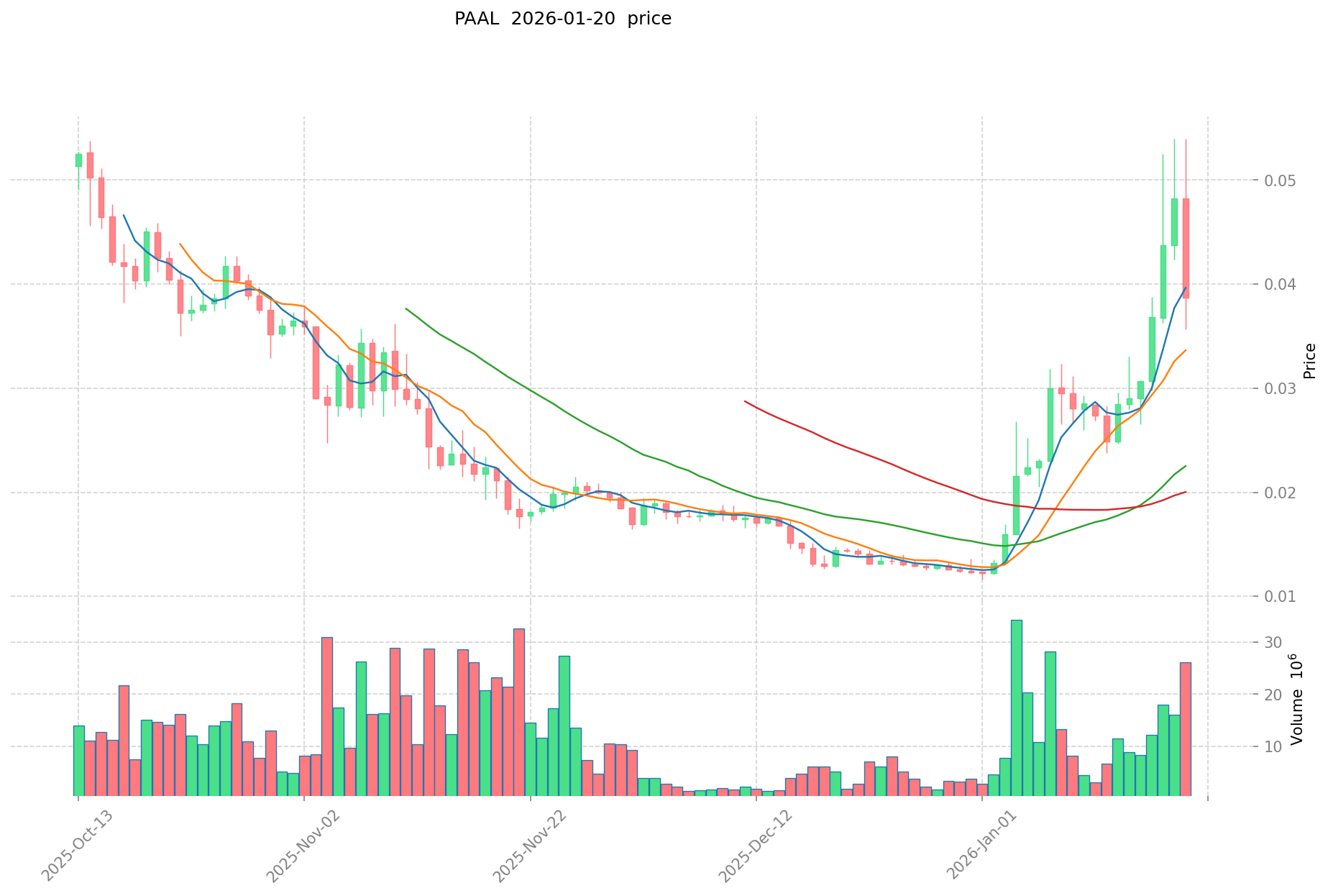
As of January 21, 2026, PAAL is trading at $0.03395, positioning it at rank 659 in the cryptocurrency market. The token has demonstrated mixed short-term performance, with a 7-day increase of approximately 21% and a 30-day surge of around 141%, indicating renewed market interest. However, the 24-hour period shows a decline of about 16%, suggesting short-term volatility.
The circulating supply stands at approximately 999 million tokens out of a maximum supply of 1 billion, representing a circulation rate of nearly 100%. The market capitalization is approximately $33.9 million, with the fully diluted valuation closely aligned at $34 million. The 24-hour trading volume of approximately $757,000 suggests moderate market liquidity.
PAAL is currently trading significantly below its all-time high of $0.88 recorded in March 2024, but well above its all-time low of $0.0088 from September 2023. The token maintains a presence across 12 exchanges and has approximately 56,925 holders, indicating a distributed community base. The current market sentiment index reflects a fear level at 32, suggesting cautious investor positioning.
Click to view current PAAL market price
PAAL Market Sentiment Indicator
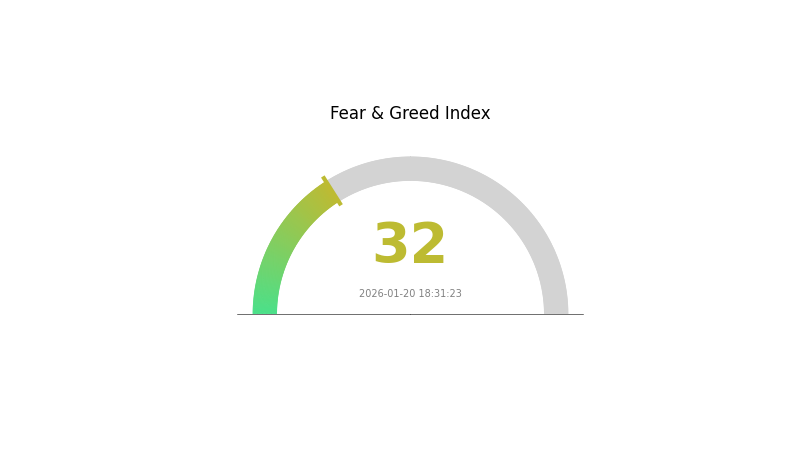
2026-01-20 Fear and Greed Index: 32 (Fear)
Click to view current Fear & Greed Index
The cryptocurrency market is currently experiencing a fear sentiment with an index reading of 32. This indicates heightened market anxiety and risk aversion among investors. During periods of fear, market participants tend to adopt a cautious stance, leading to potential selling pressure and price volatility. However, such sentiment extremes often present opportunities for long-term investors. Historically, fear-driven markets have preceded recovery phases. Traders should exercise prudent risk management while monitoring key support levels. Consider positioning strategically as market conditions may shift as fear gradually subsides.
PAAL Holding Distribution
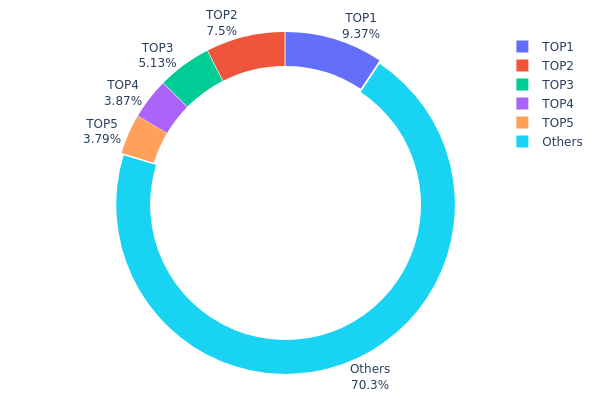
The holding distribution chart illustrates how PAAL tokens are allocated across different wallet addresses, revealing the level of concentration among major holders. This metric serves as a crucial indicator of decentralization and potential market manipulation risks within the token ecosystem.
Based on the current data, PAAL exhibits a moderately concentrated holding structure. The top five addresses collectively control approximately 29.64% of the total token supply, with the largest single holder possessing 9.37% (93.74 million tokens). The remaining 70.36% is distributed among numerous smaller addresses, suggesting a relatively broad retail participation base. While the top holder's 9.37% stake represents significant influence, it falls below the typical threshold (15-20%) that would indicate severe concentration risk. The gradual decline in holding percentages from the first to fifth position (9.37% to 3.79%) demonstrates a relatively balanced distribution among major stakeholders.
This distribution pattern presents both stability factors and potential concerns. The moderate concentration level suggests that PAAL maintains reasonable decentralization, reducing the likelihood of single-entity price manipulation. However, the combined holdings of top addresses still represent nearly 30% of supply, which could generate notable price volatility if these major holders decide to execute large-scale transactions simultaneously. The substantial 70.36% held by smaller addresses indicates healthy community participation, potentially providing liquidity depth and reducing vulnerability to coordinated sell-offs. For investors, this distribution structure suggests a market environment with moderate centralization risks, where price movements are likely influenced by both whale activities and broader market sentiment rather than being dominated by a single entity.
Click to view current PAAL Holding Distribution
| Top |
Address |
Holding Qty |
Holding (%) |
| 1 |
0x8431...80894f |
93736.85K |
9.37% |
| 2 |
0xe8e3...626ca1 |
75000.00K |
7.50% |
| 3 |
0x6522...837e90 |
51261.80K |
5.12% |
| 4 |
0x3cc9...aecf18 |
38688.18K |
3.86% |
| 5 |
0x2a6c...a9259f |
37932.02K |
3.79% |
| - |
Others |
703381.15K |
70.36% |
II. Core Factors Influencing PAAL's Future Price
Based on the available information, specific details regarding PAAL's supply mechanisms, institutional dynamics, macroeconomic positioning, and technical developments are not currently documented in the provided materials. As market conditions evolve and more data becomes available, these factors will play increasingly important roles in shaping PAAL's price trajectory.
Investors interested in PAAL should monitor official project announcements, on-chain metrics, and broader cryptocurrency market trends through reliable platforms such as Gate.com to stay informed about developments that may impact the token's valuation.
III. 2026-2031 PAAL Price Prediction
2026 Outlook
- Conservative prediction: $0.02983 - $0.03352
- Neutral prediction: Around $0.03352
- Optimistic prediction: Up to $0.03453 (requiring favorable market sentiment and adoption momentum)
2027-2029 Outlook
- Market stage expectation: Potential transition from consolidation to gradual recovery phase, with increasing volatility as the crypto market matures
- Price range prediction:
- 2027: $0.03266 - $0.04321
- 2028: $0.01969 - $0.05213
- 2029: $0.02586 - $0.05490
- Key catalysts: AI technology integration developments, expanding ecosystem partnerships, broader cryptocurrency market recovery trends, and potential regulatory clarity
2030-2031 Long-term Outlook
- Baseline scenario: $0.03159 - $0.06167 (assuming steady adoption growth and stable market conditions)
- Optimistic scenario: $0.04975 - $0.07044 (requiring significant ecosystem expansion, increased institutional interest, and favorable AI sector developments)
- Transformative scenario: Potential to exceed $0.07044 (contingent upon breakthrough technological innovations, mass market adoption, and exceptional bull market conditions)
- 2031-01-21: PAAL could potentially reach the $0.05590 average price level, representing a substantial growth trajectory from current levels
| Year |
Predicted High Price |
Predicted Average Price |
Predicted Low Price |
Price Change |
| 2026 |
0.03453 |
0.03352 |
0.02983 |
-1 |
| 2027 |
0.04321 |
0.03402 |
0.03266 |
0 |
| 2028 |
0.05213 |
0.03862 |
0.01969 |
13 |
| 2029 |
0.0549 |
0.04537 |
0.02586 |
33 |
| 2030 |
0.06167 |
0.05014 |
0.03159 |
47 |
| 2031 |
0.07044 |
0.0559 |
0.04975 |
64 |
IV. PAAL Professional Investment Strategies and Risk Management
PAAL Investment Methodology
(I) Long-term Holding Strategy
- Suitable for: Investors with a long-term vision who believe in AI-driven blockchain ecosystems
- Operational Recommendations:
- Consider accumulating PAAL during market corrections when price volatility increases
- Monitor project developments and technology upgrades through official channels (https://paalai.io/, https://www.paal.ai/)
- Storage Solution: Utilize Gate Web3 Wallet for secure storage, or consider hardware wallets for larger holdings
(II) Active Trading Strategy
- Technical Analysis Tools:
- Volume Analysis: Monitor the 24-hour trading volume (currently $756,709) to identify potential trend reversals
- Price Range Indicators: Track 24-hour price fluctuations (low: $0.03351, high: $0.0467) to determine entry and exit points
- Swing Trading Key Points:
- Pay attention to short-term price movements; recent data shows -2.55% (1H) and -16.34% (24H) changes
- Consider the 7-day upward trend of 20.96% and 30-day surge of 140.61% when planning medium-term positions
PAAL Risk Management Framework
(I) Asset Allocation Principles
- Conservative Investors: 1-3% of crypto portfolio
- Aggressive Investors: 5-10% of crypto portfolio
- Professional Investors: Up to 15% based on comprehensive market analysis and risk tolerance
(II) Risk Hedging Solutions
- Diversification Strategy: Combine PAAL with established cryptocurrencies to balance portfolio volatility
- Position Sizing: Implement gradual accumulation strategies rather than lump-sum investments given the token's historical volatility
(III) Secure Storage Solutions
- Hot Wallet Recommendation: Gate Web3 Wallet for convenient trading and moderate holdings
- Cold Storage Solution: Hardware wallets for long-term holdings exceeding individual risk thresholds
- Security Precautions: Never share private keys, enable two-factor authentication, and verify contract address (0x14feE680690900BA0ccCfC76AD70Fd1b95D10e16) before transactions
V. PAAL Potential Risks and Challenges
PAAL Market Risks
- High Volatility: The token experienced a -90.01% decline over the past year, indicating significant price instability
- Limited Market Depth: With a market cap of approximately $33.9 million and ranking #659, liquidity may be constrained during major market movements
- Trading Volume Fluctuations: Relatively modest 24-hour trading volume may lead to slippage during large transactions
PAAL Regulatory Risks
- AI Technology Regulation: Evolving regulatory frameworks for AI-driven projects may impact operational models
- Token Classification: Potential regulatory changes regarding utility token classifications could affect market accessibility
- Compliance Requirements: Increasing global regulatory scrutiny on cryptocurrency projects may necessitate operational adjustments
PAAL Technical Risks
- Smart Contract Vulnerabilities: As an ERC-20 token on Ethereum, potential smart contract exploits remain a concern
- Competition: The AI and blockchain integration space is increasingly competitive with numerous emerging projects
- Adoption Challenges: The project's success depends on widespread adoption of its AI-powered chatbot ecosystem, which remains uncertain
VI. Conclusion and Action Recommendations
PAAL Investment Value Assessment
PAAL AI presents an interesting proposition in the AI-blockchain convergence space with its chatbot ecosystem designed to streamline complex tasks. The 30-day price surge of 140.61% demonstrates strong recent market interest, while the circulating supply represents 99.87% of total supply, indicating minimal future dilution concerns. However, the substantial year-over-year decline of -90.01% highlights the significant risks associated with this investment. The project's relatively small market cap and moderate trading volume suggest it remains in early development stages. Investors should carefully weigh the innovative potential of AI-driven blockchain applications against the inherent volatility and risks of emerging cryptocurrency projects.
PAAL Investment Recommendations
✅ Beginners: Allocate only a minimal portion (1-2%) of your cryptocurrency portfolio after thoroughly researching the project through official documentation (https://docs.paal.ai/). Start with small positions to understand price dynamics
✅ Experienced Investors: Consider strategic accumulation during market corrections while maintaining strict risk management protocols. Monitor technical indicators and project development milestones
✅ Institutional Investors: Conduct comprehensive due diligence on the project's technology stack, team credentials, and competitive positioning. Consider pilot allocations with defined risk parameters
PAAL Trading Participation Methods
- Spot Trading: Purchase PAAL on Gate.com with support for direct trading pairs
- Dollar-Cost Averaging: Implement systematic investment plans to mitigate timing risks
- Portfolio Rebalancing: Periodically adjust PAAL holdings based on predetermined portfolio allocation targets
Cryptocurrency investment carries extremely high risks, and this article does not constitute investment advice. Investors should make prudent decisions based on their own risk tolerance and are advised to consult professional financial advisors. Never invest more than you can afford to lose.
FAQ
What is PAAL? What are its main uses and functions?
PAAL is an AI-powered prediction and analytics platform leveraging machine learning for cryptocurrency market insights. Its primary functions include real-time price prediction, market trend analysis, trading signal generation, and portfolio optimization tools for digital asset investors.
How has PAAL token performed historically in price? What are the main factors affecting its price?
PAAL token has shown volatility typical of emerging AI utility tokens. Price drivers include adoption metrics, AI infrastructure developments, trading volume, market sentiment, and broader crypto market cycles. Strong fundamentals and ecosystem growth typically support upward momentum.
What is the PAAL price prediction for 2024? What are the possible price targets in the future?
Based on market analysis, PAAL demonstrated strong growth potential through 2024. Conservative estimates suggest prices could reach $0.50-$1.20, while bullish scenarios project targets up to $2.00+ by year-end. Long-term predictions through 2025-2026 indicate further upside potential driven by ecosystem adoption and utility expansion.
What risks exist in investing in PAAL? How should I evaluate its investment value?
PAAL presents moderate volatility typical of emerging AI tokens. Evaluate by analyzing developer activity, community growth, and AI technology adoption rates. Strong fundamentals and increasing transaction volume indicate positive momentum. Consider your risk tolerance and investment horizon carefully.
PAAL offers superior AI integration capabilities with real-time prediction models and lower transaction costs. Its community-driven governance and transparent tokenomics provide competitive advantages. However, newer entrants may have larger market capitalization and higher trading volume, though PAAL's focused AI specialization gives it stronger long-term growth potential in the emerging AI token sector.
* The information is not intended to be and does not constitute financial advice or any other recommendation of any sort offered or endorsed by Gate.