This comprehensive article analyzes PALM token's price trajectory from 2026 to 2031, providing professional forecasts and investment strategies for cryptocurrency investors. PALM, a Google AI-powered chatbot token, currently trades at $0.04256 with a $3.28 million market cap. The analysis combines historical price patterns, supply-demand dynamics, and ecosystem development to deliver three scenario forecasts: conservative projections expect slight 2026 decline to $0.02916-$0.0454, while optimistic long-term scenarios suggest 77% growth by 2031 reaching $0.07537 average price. The article addresses core investment methodologies including long-term holding and active trading strategies on Gate exchange, presents comprehensive risk management frameworks for different investor profiles, and highlights critical challenges including high volatility, limited liquidity, and regulatory uncertainties. Suitable for both beginner and experienced crypto investors seeking data-driven PALM investment guidance.
Introduction: PALM's Market Position and Investment Value
PaLM AI (PALM), positioned as a multi-platform AI chatbot leveraging Google's AI technology for conversations, coding, and image generation, has been developing its ecosystem since its launch in November 2023. As of January 2026, PALM maintains a market capitalization of approximately $3.28 million, with a circulating supply of around 77.13 million tokens, and the price hovering around $0.04256. This AI-focused digital asset is playing an increasingly important role in the accessible artificial intelligence and revenue-sharing sectors.
This article will comprehensively analyze PALM's price trends from 2026 to 2031, combining historical patterns, market supply and demand dynamics, ecosystem development, and macroeconomic conditions to provide investors with professional price forecasts and practical investment strategies.
I. PALM Price History Review and Market Status
PALM Historical Price Evolution
- 2024: Project launched in November 2023 with token deployment on Ethereum, experiencing initial market exploration phase
- 2024: Reached historical high of $1.81 in December during market expansion period
- 2024-2025: Price correction phase, declining from peak of $1.81 to lower range
PALM Current Market Dynamics
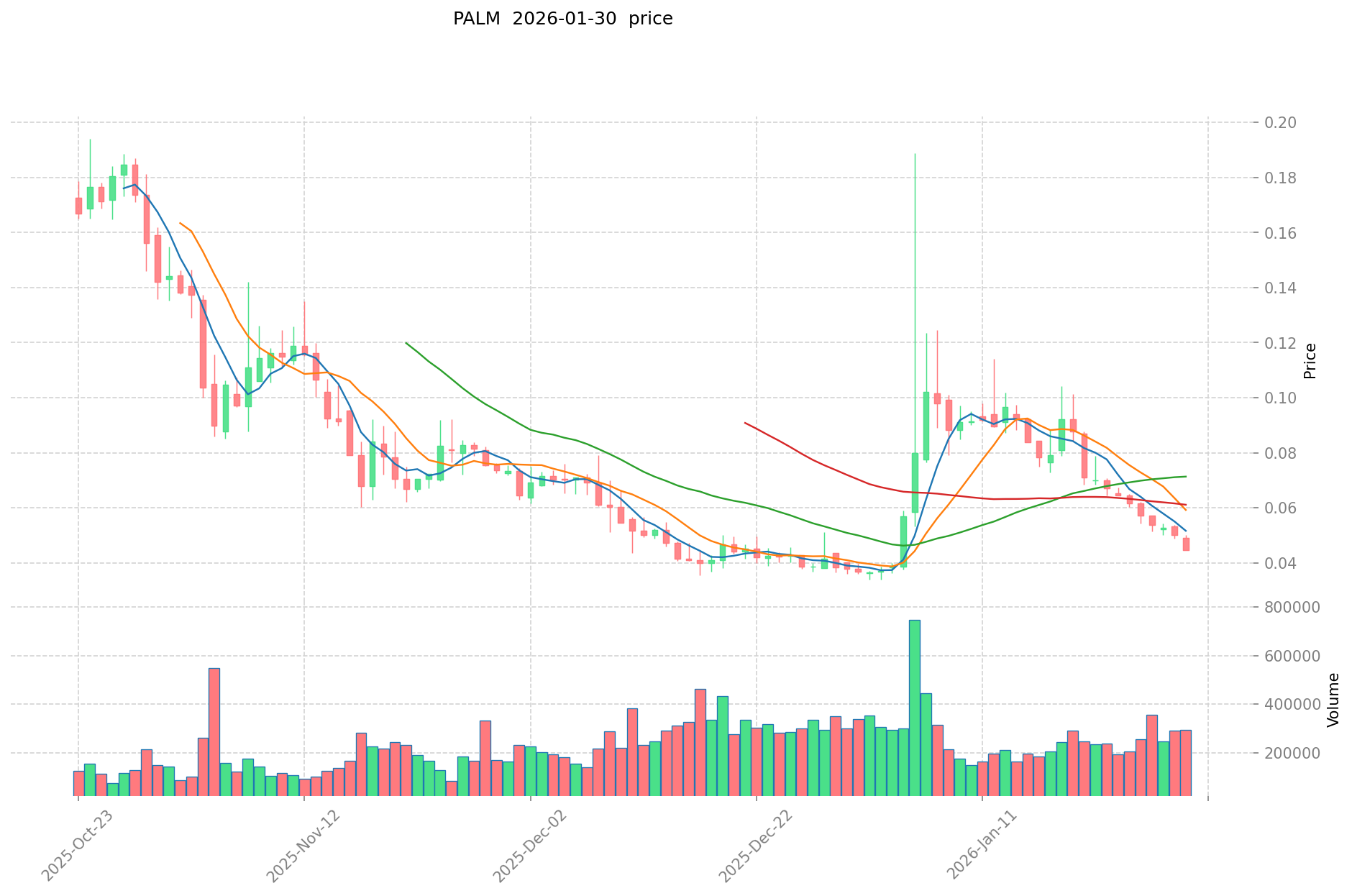
As of January 31, 2026, PALM is trading at $0.04256, showing mixed short-term performance across different timeframes. The token has experienced a 2.52% decrease over the past hour and a 6.89% decline in the 24-hour period, with the price fluctuating between $0.04131 and $0.05071 during the day.
Looking at extended timeframes, PALM demonstrates notable volatility. The 7-day performance shows a 34.78% decrease, while the 30-day period reflects a 9.37% gain, indicating recent market fluctuations. Over the past year, the token has experienced substantial correction.
Market capitalization stands at approximately $3.28 million, with a 24-hour trading volume of $14,370.89. The circulating supply represents 77.13% of the total supply, with 77,129,726 PALM tokens in circulation out of a total supply of 77,500,000 tokens. The maximum supply is capped at 100,000,000 tokens. PALM holds a market dominance of 0.00011%.
The token has recorded a historical high of $1.81 on December 1, 2024, and a historical low of $0.0099 on April 12, 2024. Currently, PALM is trading approximately 97.65% below its all-time high. The project maintains a holder base of 16,110 addresses, with trading activity on 2 exchanges.
PaLM AI operates as a multi-platform chatbot utilizing Google's AI technology for conversations, coding, and image generation, with a focus on accessible AI and revenue sharing mechanisms. The token is deployed on the Ethereum network.
Click to view current PALM market price
PALM Market Sentiment Index
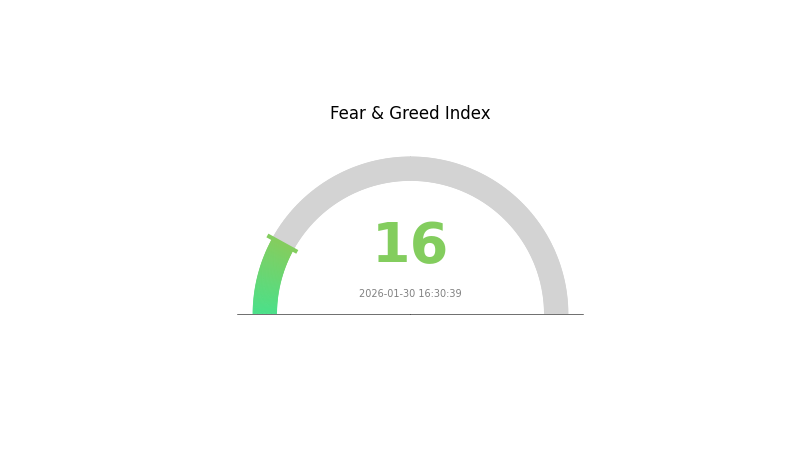
2026-01-30 Fear & Greed Index: 16 (Extreme Fear)
Click to view current Fear & Greed Index
The cryptocurrency market is currently experiencing extreme fear, with the Fear & Greed Index dropping to 16. This exceptionally low reading indicates significant market pessimism and widespread investor anxiety. During such periods, prices tend to be heavily discounted as sellers dominate the market. However, extreme fear historically presents opportunities for contrarian investors, as assets often become oversold. Market participants should remain cautious but vigilant for potential entry points as sentiment begins to stabilize.
PALM Holding Distribution
The holding distribution chart reflects the concentration of token holdings across different addresses on the blockchain, providing insights into the decentralization level and potential market control risks. By analyzing the distribution of PALM tokens among top holders and the broader address base, we can assess the structural stability of the token's ecosystem and evaluate potential risks associated with concentrated holdings.
Based on the current data, PALM exhibits a moderately high concentration level. The top holder, address 0x0000...00dead (likely a burn address), holds 22.87% of the total supply, effectively removing these tokens from circulation. The second and third largest holders control 6.73% and 6.28% respectively, while the top five addresses collectively account for 43.21% of the total supply. The remaining 56.79% is distributed among other addresses, suggesting a relatively dispersed ownership structure beyond the top holders. This distribution pattern indicates that while there is notable concentration among major holders, the token maintains a reasonable degree of decentralization compared to projects with more extreme concentration ratios.
The current holding distribution presents both opportunities and considerations for market dynamics. The presence of a significant burn address reduces circulating supply, potentially creating deflationary pressure that could support price stability. However, the combined influence of the top non-burn addresses (approximately 20% of supply) means that coordinated movements by these holders could generate substantial price volatility. The relatively healthy distribution among smaller holders (56.79%) provides a buffer against manipulation and suggests organic community participation. This structure reflects a maturing token economy with established whale positions alongside broader retail adoption, contributing to a moderately stable on-chain structure with manageable concentration risk.
Click to view current PALM Holding Distribution

| Top |
Address |
Holding Qty |
Holding (%) |
| 1 |
0x0000...00dead |
22870.27K |
22.87% |
| 2 |
0x9131...902a0d |
6731.16K |
6.73% |
| 3 |
0x3cc9...aecf18 |
6286.74K |
6.28% |
| 4 |
0x051e...fb0b9f |
3837.11K |
3.83% |
| 5 |
0x9642...2f5d4e |
3502.96K |
3.50% |
| - |
Others |
56771.76K |
56.79% |
II. Core Factors Influencing PALM's Future Price
Supply Mechanism
-
Production and Inventory Dynamics: Palm oil supply is primarily determined by production levels in major Southeast Asian producing countries (Malaysia and Indonesia) and global inventory levels. Weather conditions, labor supply availability, and agricultural cycles directly affect production output. According to market analysis, Malaysia's palm oil production is expected to decline significantly in January, which has become a key factor driving short-term supply tightening expectations.
-
Historical Patterns: Historical data shows that palm oil prices are highly sensitive to supply fluctuations. When major producing regions experience adverse weather (such as drought caused by El Niño) or labor shortages, production decreases typically lead to price increases. Conversely, when supply is abundant and inventory levels remain high, prices face downward pressure.
-
Current Impact: Current market data reveals a contradictory situation - while Malaysia's palm oil export volumes showed significant growth in the first half of January (up 17.5% to 18.6% month-over-month), high inventory levels continue to suppress market sentiment. This structural contradiction between improving demand and persistent supply pressure has become a key factor affecting short-term price movements.
Institutional and Major Player Dynamics
-
Policy Adjustments: Indonesian government policies have a profound impact on the palm oil market. The government's decision to abandon the B50 biodiesel blending plan and maintain the current B40 standard has altered market expectations regarding demand growth. This policy adjustment reflects technical and financial considerations while also impacting palm oil's role as a biofuel feedstock.
-
Export Structure Changes: Export data shows significant structural changes in demand across different regions. Exports to the EU increased from 102,482 tons to 141,750 tons, while exports to China declined sharply from 85,320 tons to 18,425 tons during the same period. These changes may reflect adjustments in procurement rhythms or destination shifts across different markets.
Macroeconomic Environment
-
Energy Price Impact: International crude oil prices are a key external variable affecting palm oil. Oil price fluctuations influence palm oil prices through two channels: the economic viability of biodiesel production and overall global macroeconomic sentiment. When crude oil prices strengthen, palm oil's attractiveness as a biofuel feedstock increases; conversely, falling oil prices reduce its cost competitiveness.
-
Geopolitical Factors: Geopolitical situation changes affect palm oil prices by influencing energy markets and trade policies. Recent easing of geopolitical tensions has led to over 2% declines in crude oil prices, indirectly putting pressure on palm oil prices. Trade policies and tariff measures implemented by producing and importing countries also impact supply chain costs and market access.
-
Currency Exchange Rate Effects: The Malaysian ringgit's exchange rate against the US dollar affects palm oil's international competitiveness. A weaker ringgit theoretically makes palm oil more price-attractive to overseas buyers, though this positive effect may be offset by other bearish factors in actual market conditions.
Technical Development and Ecosystem Construction
-
Competing Vegetable Oils Price Trends: Price movements of competing oils (such as soybean oil and sunflower oil) serve as important reference variables for palm oil. Synchronized weakness in these related markets creates direct pressure on palm oil prices. Price trends at the Chicago Board of Trade (CBOT) for soybean oil and China's Dalian Commodity Exchange for vegetable oils continue to influence the palm oil market.
-
Technical Analysis Perspectives: From a technical standpoint, palm oil prices have broken below an upward trendline and may test the January 5 low of 3,967 ringgit per ton. Market analysts indicate that crude palm oil futures have near-term support at 3,900 ringgit per ton and resistance at 4,150 ringgit per ton. These technical levels provide important reference points for market participants.
-
Market Focus Areas: Looking ahead, market attention will concentrate on several aspects: whether Malaysia's full-month January export data can maintain the strong momentum from the first half of the month will be key to validating the quality of demand recovery. Additionally, the market needs to continuously monitor Indonesia's B40 program implementation and whether new energy policies emerge. The balance between export growth sustainability and inventory pressure relief will determine whether the market can establish a solid foundation and regain momentum.
III. 2026-2031 PALM Price Forecast
2026 Outlook
- Conservative forecast: $0.02916 - $0.0454
- Neutral forecast: Around $0.04165
- Optimistic forecast: Up to $0.0454 (requires favorable market conditions)
Based on the analytical data, PALM is projected to experience a slight decline of approximately 2% in 2026, with price movement expected between $0.02916 and $0.0454. The average trading range is anticipated to stabilize around $0.04165, reflecting a period of market consolidation and adjustment.
2027-2029 Outlook
- Market stage expectation: Recovery and gradual growth phase
- Price range forecast:
- 2027: $0.02394 - $0.0605
- 2028: $0.04681 - $0.06709
- 2029: $0.05538 - $0.07504
- Key catalysts: Market recovery momentum, potential ecosystem expansion, and increased adoption rates
During this mid-term period, PALM is expected to demonstrate progressive growth patterns. The 2027 forecast indicates a potential 2% increase, followed by more substantial gains of 22% in 2028 and 39% in 2029. This upward trajectory suggests strengthening market fundamentals and growing investor confidence in the token's utility and value proposition.
2030-2031 Long-term Outlook
- Baseline scenario: $0.04509 - $0.08345 (assuming stable market conditions)
- Optimistic scenario: $0.04748 - $0.08818 (with enhanced ecosystem development)
- Transformative scenario: Potential to reach upper price bands (contingent on breakthrough adoption and favorable regulatory environment)
The long-term projections for 2030 and 2031 present encouraging growth potential, with forecasted increases of 58% and 77% respectively. The 2030 price range is estimated between $0.04509 and $0.08345, with an average price around $0.0673. By 2031, the forecast extends to a range of $0.04748 to $0.08818, with an average price of approximately $0.07537. These projections reflect the cumulative effect of market maturation, technological advancement, and potential mainstream acceptance of the PALM ecosystem over the extended timeframe.
| Year |
Predicted High Price |
Predicted Average Price |
Predicted Low Price |
Price Change |
| 2026 |
0.0454 |
0.04165 |
0.02916 |
-2 |
| 2027 |
0.0605 |
0.04352 |
0.02394 |
2 |
| 2028 |
0.06709 |
0.05201 |
0.04681 |
22 |
| 2029 |
0.07504 |
0.05955 |
0.05538 |
39 |
| 2030 |
0.08345 |
0.0673 |
0.04509 |
58 |
| 2031 |
0.08818 |
0.07537 |
0.04748 |
77 |
IV. PALM Professional Investment Strategy and Risk Management
PALM Investment Methodology
(1) Long-term Holding Strategy
- Suitable for: Investors who believe in AI technology integration and long-term value creation
- Operational Recommendations:
- Consider accumulating positions during market pullbacks, given the token's current 93.87% decline from its all-time high
- Monitor developments in Google's PaLM AI technology and its integration into the project
- Store assets in secure wallets like Gate Web3 Wallet for enhanced security
(2) Active Trading Strategy
- Technical Analysis Tools:
- Volume Analysis: Monitor the current 24-hour trading volume of $14,370.88 to identify liquidity patterns
- Price Range Trading: Utilize the 24-hour range of $0.04131 to $0.05071 for short-term trading opportunities
- Swing Trading Points:
- Watch for price reactions near the $0.04-0.05 support and resistance levels
- Consider the recent 7-day decline of 34.78% as a potential oversold signal
PALM Risk Management Framework
(1) Asset Allocation Principles
- Conservative investors: 1-2% of crypto portfolio
- Aggressive investors: 3-5% of crypto portfolio
- Professional investors: 5-10% of crypto portfolio
(2) Risk Hedging Solutions
- Diversification: Spread investments across multiple AI-focused tokens to reduce single-asset exposure
- Stop-loss implementation: Set stop-loss orders at 10-15% below entry points to limit downside risk
(3) Secure Storage Solutions
- Web3 Wallet recommendation: Gate Web3 Wallet for convenient and secure storage
- Hardware wallet solution: Consider cold storage for larger holdings to minimize online security risks
- Security precautions: Never share private keys, enable two-factor authentication, and regularly update security settings
V. PALM Potential Risks and Challenges
PALM Market Risks
- High volatility: The token has experienced a 93.87% decline over the past year, indicating significant price instability
- Limited liquidity: With only 2 exchanges listing the token and relatively low 24-hour volume, liquidity constraints may impact trading execution
- Market concentration: The relatively small market cap of approximately $3.28 million makes the token susceptible to price manipulation
PALM Regulatory Risks
- AI technology regulation: Potential regulatory scrutiny of AI-powered services may impact project operations
- Token classification uncertainty: Evolving regulatory frameworks for utility tokens may affect PALM's legal status
- Compliance requirements: Changes in crypto asset regulations across jurisdictions could impact token accessibility
PALM Technical Risks
- Smart contract vulnerabilities: The ERC20 token contract may be subject to security exploits if not properly audited
- Dependency on external technology: Reliance on Google's AI technology creates potential risks if partnership terms change
- Platform integration challenges: Multi-platform functionality may face technical difficulties affecting user experience
VI. Conclusion and Action Recommendations
PALM Investment Value Assessment
PALM represents a speculative investment in AI-powered chatbot technology with revenue-sharing mechanisms. While the project leverages Google's AI technology and focuses on accessible AI solutions, the token has experienced significant price volatility, declining 93.87% from its peak. The relatively small market cap of $3.28 million and limited exchange listings present both opportunities for growth and risks of liquidity constraints. Long-term value depends on successful technology integration and adoption, while short-term risks remain elevated due to market volatility and limited liquidity.
PALM Investment Recommendations
✅ Beginners: Start with minimal allocation (1-2% of crypto portfolio) and focus on education about AI tokens before making significant commitments
✅ Experienced investors: Consider strategic accumulation during market dips, but maintain strict risk management with stop-loss orders
✅ Institutional investors: Conduct thorough due diligence on technology partnerships and revenue models before considering larger positions
PALM Trading Participation Methods
- Spot trading: Purchase PALM directly through Gate.com for straightforward exposure to price movements
- Dollar-cost averaging: Implement periodic purchases to mitigate timing risk and build positions gradually
- Limit orders: Use limit orders to execute trades at desired price levels, particularly given the token's volatility
Cryptocurrency investment carries extremely high risks, and this article does not constitute investment advice. Investors should make careful decisions based on their own risk tolerance and are advised to consult professional financial advisors. Never invest more than you can afford to lose.
FAQ
What is the historical price trend of PALM token? What are the past price change patterns?
PALM token has experienced significant volatility, with historical highs at $0.001691 and recent 24-hour trading ranges between $0.000358-$0.000362. Price fluctuations show cyclical patterns driven by market sentiment and trading volume dynamics.
What are the main factors affecting PALM price?
PALM price is primarily influenced by market demand, token supply dynamics, ecosystem development progress, community sentiment, and overall cryptocurrency market trends. Trading volume and Bitcoin market movements also significantly impact PALM's price performance.
Use technical analysis and fundamental analysis for PALM price forecasting. Key tools include TradingView, MetaTrader, and data providers like Twelve Data, CoinMarketCap, and Polygon.io. Monitor trading volume, market trends, and on-chain metrics for accurate predictions.
What are the future prospects and development potential of PALM tokens?
PALM features limited maximum supply and low inflation rate, positioning it for long-term price appreciation potential. Transparent token distribution enhances project credibility and reduces centralization risks, supporting strong market outlook.
What are the risks to pay attention to when investing in PALM tokens?
PALM token investments carry price volatility risks and potential capital loss. Investors assume full responsibility for their decisions and may not recover their entire investment. Market risks are unpredictable.
What are the advantages and disadvantages of PALM compared to similar tokens?
PALM excels in computational efficiency and scalability with superior benchmark performance. It offers faster transaction processing and lower resource consumption than competitors. Main disadvantage: higher initial infrastructure requirements for optimal performance.
* The information is not intended to be and does not constitute financial advice or any other recommendation of any sort offered or endorsed by Gate.