This comprehensive analysis examines Pitbull (PIT), a community-driven cryptocurrency, providing professional price forecasts and investment strategies through 2031. The article evaluates PIT's current market position at $0.0000000002159 with 38.8 trillion circulating tokens and $8.38 million market cap, then reviews its price history since 2021 inception. The 2026-2031 forecast projects incremental growth with 23% increase in 2027, accelerating to 112% by 2031 under optimistic scenarios. Key analysis covers supply mechanisms, macroeconomic factors, and holding distribution patterns. The guide offers tailored investment methodologies for beginners, experienced traders, and institutional investors, with detailed risk management frameworks and secure storage solutions via Gate Web3 Wallet. Risk sections address market volatility, regulatory uncertainties, and technical dependencies. Comprehensive FAQ and trading participation methods on Gate.com complete this professional resource for informed decision-making i
Introduction: PIT's Market Position and Investment Value
Pitbull (PIT), positioned as a community-driven cryptocurrency with reflection mechanics, has been evolving since its inception in 2021. As of 2026, PIT maintains a market capitalization of approximately $8.38 million, with a circulating supply of around 38.8 trillion tokens, and its price stabilizes at approximately $0.0000000002159. This asset, recognized as a "100% community-governed token," is playing an increasingly significant role in the decentralized finance ecosystem through its unique holder reward mechanism.
This article will comprehensively analyze PIT's price trajectory from 2026 to 2031, combining historical patterns, market supply-demand dynamics, ecosystem development, and macroeconomic conditions to provide investors with professional price forecasts and practical investment strategies.
I. PIT Price History Review and Market Status
PIT Historical Price Evolution Trajectory
- 2021: Pitbull project launched on Binance Smart Chain on March 17, price started from initial offering
- 2021: Price reached peak level of $0.000000150393 in August, demonstrating strong market interest in the community-driven token
- 2021-2026: Price experienced significant volatility, declining from the August 2021 peak to current levels around $0.0000000002159
PIT Current Market Status
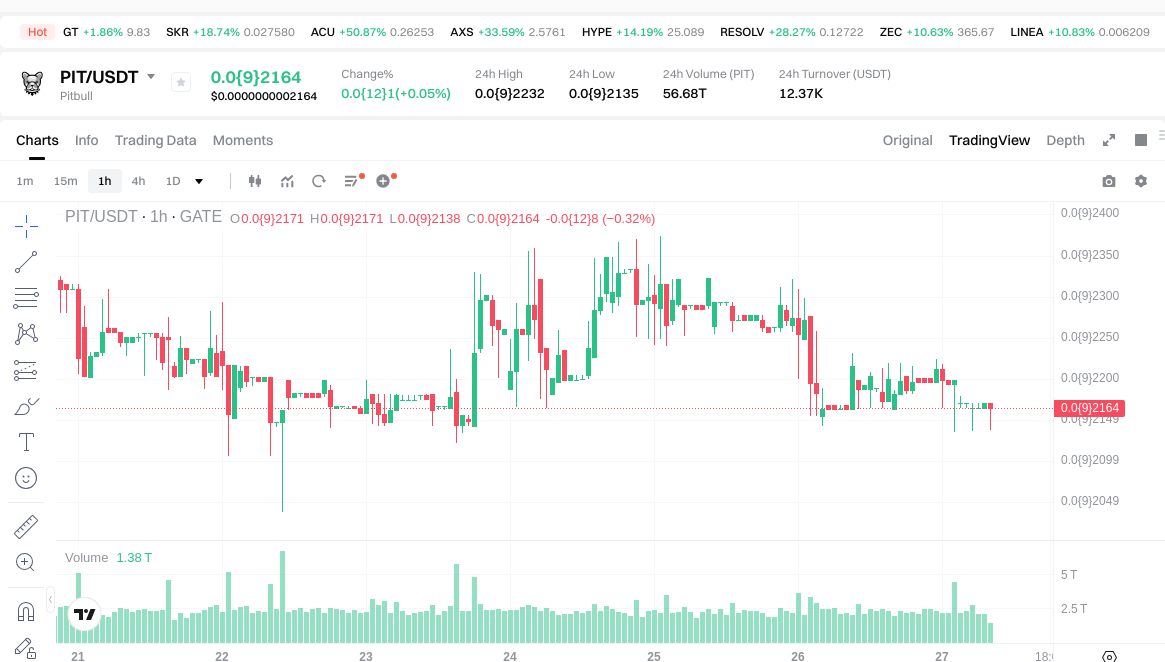
As of January 27, 2026, PIT is trading at $0.0000000002159, representing a 0.18% decrease over the past 24 hours. The token has shown recent weakness with a 7.96% decline over the past week and a 27.88% drop over the past year.
The current 24-hour trading volume stands at approximately $12,361.90, with the price fluctuating between $0.0000000002135 and $0.0000000002232 during this period. The total market capitalization is approximately $8.38 million, with PIT ranking at position 1,292 in the overall cryptocurrency market.
PIT maintains a circulating supply of approximately 38.8 trillion tokens out of a maximum supply of 100 quadrillion tokens, representing a circulation ratio of 38.8%. The token has attracted a substantial holder base of over 525,809 addresses, reflecting its community-driven nature.
The market capitalization to fully diluted valuation ratio stands at 38.8%, indicating a significant portion of tokens remains outside current circulation. PIT's market dominance is 0.00026% of the total cryptocurrency market.
Click to view current PIT market price
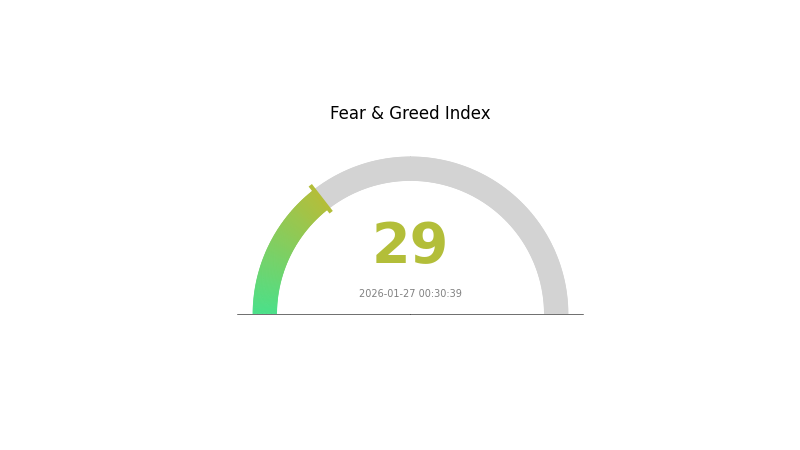
PIT Market Sentiment Index
2026-01-27 Fear and Greed Index: 29 (Fear)
Click to view the current Fear & Greed Index
The crypto market is currently experiencing significant fear sentiment with an index reading of 29. This low reading indicates widespread investor caution and pessimism in the market. When fear dominates, volatility typically increases as participants become risk-averse. Experienced traders often view extreme fear as a potential buying opportunity, as markets frequently recover from such depths. However, it's crucial to conduct thorough research and risk assessment before making investment decisions during periods of heightened market fear. Monitor market developments closely and consider your risk tolerance.
PIT Holding Distribution
The holding distribution chart reflects the concentration of token holdings across different wallet addresses on the blockchain, serving as a critical indicator for assessing market structure and decentralization. Based on the current data, PIT exhibits an extremely high concentration pattern that warrants significant attention from market participants.
The top address (0x0000...00dead) holds approximately 61.20% of the total supply, which appears to be a burn address based on its structure. The second-largest holder (0xb450...d09bf5) controls 15.05% of tokens, while the third address holds 4.74%. Combined, the top three addresses account for 81% of the total supply, with the remaining 18.27% distributed among other holders. This distribution reveals a highly centralized token structure, where a small number of addresses control the vast majority of circulating supply.
Such extreme concentration poses considerable implications for market dynamics. The significant holdings in the burn address suggest an active deflationary mechanism, which could theoretically support long-term value appreciation. However, the substantial position held by the second-largest address creates potential vulnerability to market manipulation, as large-scale selling could trigger significant price volatility. The limited distribution among retail holders indicates relatively weak organic demand and community participation, potentially constraining liquidity depth and increasing susceptibility to sharp price movements. This concentration pattern reflects a market structure with limited decentralization, where on-chain stability heavily depends on the behavior of major holders. Investors should carefully monitor any significant movements from these top addresses, as they could signal important shifts in market sentiment or project fundamentals.
Click to view current PIT Holding Distribution

| Top |
Address |
Holding Qty |
Holding (%) |
| 1 |
0x0000...00dead |
61201691839492.95K |
61.20% |
| 2 |
0xb450...d09bf5 |
15057073765829.63K |
15.05% |
| 3 |
0x4982...6e89cb |
4746448772249.06K |
4.74% |
| 4 |
0xa042...a77da3 |
380749335982.32K |
0.38% |
| 5 |
0x0d07...b492fe |
360053861469.44K |
0.36% |
| - |
Others |
18253982424977.00K |
18.27% |
II. Core Factors Influencing PIT's Future Price
Supply Mechanism
-
Tax Policy Framework: PIT operates within a dual-track taxation system where policy adjustments significantly impact revenue generation. The current framework features low tax rates and high exemptions, with the actual exemption threshold approximately 120,000 RMB annually, resulting in most workers being exempt from taxation.
-
Historical Patterns: Tax policy reforms have historically shown that adjustments to exemption thresholds and deduction provisions directly influence revenue capacity. Multiple increases in exemption levels and extensive special deductions have notably eroded the tax base over time.
-
Current Implications: The limited coverage and low effective rates currently restrict PIT revenue to approximately 1.1% of GDP, substantially below the OECD average of over 8%. This suggests potential for significant policy adjustments that could reshape the revenue landscape.
Institutional and Major Stakeholder Dynamics
-
Government Policy Position: Chinese fiscal authorities have identified PIT reform as a critical component of the broader fiscal reform agenda, with 2029 set as a reform milestone. The focus centers on expanding the tax base through lower exemption thresholds and simplified deduction structures.
-
Reform Implementation: The upcoming 15th Five-Year Plan (2026-2030) prioritizes expenditure efficiency and tax system improvements as core pillars for economic growth, indicating institutional commitment to substantive changes.
-
International Benchmarking: Policy discussions increasingly reference international standards, particularly OECD practices, suggesting alignment toward more comprehensive taxation frameworks that could enhance fiscal capacity.
Macroeconomic Environment
-
Fiscal Policy Impact: China's fiscal trajectory depends critically on revenue mobilization amid rising social expenditure pressures. The tax revenue-to-GDP ratio has declined from 18.4% in 2012 to approximately 12.5% in 2025, creating urgency for reform measures that could affect PIT's role in public finance.
-
Economic Rebalancing Context: The ongoing shift from investment-driven to consumption-led growth requires corresponding adjustments in revenue structures. PIT reform serves as a mechanism to support household income distribution while strengthening fiscal sustainability.
-
Inflation and Growth Dynamics: With core CPI growth around 0.7% and moderate inflation pressures, the policy environment favors gradual adjustments rather than disruptive changes, suggesting measured implementation of tax reforms.
Technical Development and Structural Construction
-
Progressive Tax Structure Enhancement: Potential reforms include integrating labor income, business income, and capital income into a more consistent progressive framework, which would broaden the effective tax base without necessarily raising statutory rates.
-
Administrative Capacity Improvement: The reform discussion emphasizes not征管 capability deficiencies but rather structural design optimization, indicating technical readiness for implementing more sophisticated tax collection mechanisms.
-
Coordination with VAT Reform: PIT adjustments occur alongside considerations for Value-Added Tax modifications, creating an integrated fiscal reform ecosystem where changes in one tax category influence others within the broader revenue framework.
III. 2026-2031 PIT Price Forecast
2026 Outlook
Based on available data, PIT is projected to experience modest movement in 2026. While specific price ranges are not available in the reference materials, market participants should monitor fundamental developments and broader crypto market conditions that could influence valuation.
2027-2029 Mid-term Outlook
- Market Stage Expectation: PIT may enter a gradual growth phase during this period, with projected price changes of approximately 23% in 2027, 29% in 2028, and 40% in 2029 relative to baseline levels.
- Price Range Forecast:
- 2027: Expected year-over-year change around 23%
- 2028: Anticipated year-over-year change around 29%
- 2029: Projected year-over-year change reaching approximately 40%
- Key Catalysts: Growth during this period may be driven by ecosystem expansion, increased adoption metrics, and favorable market sentiment in the broader digital asset space.
2030-2031 Long-term Outlook
- Baseline Scenario: Price changes could reach approximately 73% by 2030 (assuming continued project development and stable market conditions)
- Optimistic Scenario: By 2031, price appreciation may approach 112% from baseline levels (contingent on significant ecosystem breakthroughs and sustained bull market momentum)
- Transformative Scenario: Under exceptionally favorable conditions including widespread adoption, strategic partnerships, and positive regulatory developments, PIT could experience substantial appreciation beyond baseline projections
Note: All forecasts are subject to significant uncertainty and depend on numerous unpredictable factors including regulatory changes, technological developments, and overall cryptocurrency market dynamics. Investors should conduct thorough research and consider their risk tolerance before making investment decisions.
| Year |
Predicted High Price |
Predicted Average Price |
Predicted Low Price |
Price Change |
| 2026 |
0 |
0 |
0 |
0 |
| 2027 |
0 |
0 |
0 |
23 |
| 2028 |
0 |
0 |
0 |
29 |
| 2029 |
0 |
0 |
0 |
40 |
| 2030 |
0 |
0 |
0 |
73 |
| 2031 |
0 |
0 |
0 |
112 |
IV. PIT Professional Investment Strategy and Risk Management
PIT Investment Methodology
(1) Long-term Holding Strategy
- Suitable for: Community-oriented investors seeking passive income through holding rewards
- Operational recommendations:
- Establish a position during periods of reduced volatility, considering the token's community-driven nature
- Monitor community development progress and volunteer-driven initiatives that may impact long-term value
- Storage solution: Utilize Gate Web3 Wallet for secure asset management, ensuring private key control and compatibility with BSC network
(2) Active Trading Strategy
- Technical analysis tools:
- Moving averages: Apply 7-day and 30-day moving averages to identify trend reversals, noting PIT's recent 7-day decline of 7.96%
- Volume analysis: Monitor the 24-hour trading volume of $12,361.90 to assess market participation levels
- Swing trading considerations:
- Pay attention to the 24-hour price range ($0.0000000002135 - $0.0000000002232) to establish entry and exit zones
- Consider the token's holding rewards mechanism when calculating holding period returns
PIT Risk Management Framework
(1) Asset Allocation Principles
- Conservative investors: 1-2% of crypto portfolio
- Aggressive investors: 3-5% of crypto portfolio
- Professional investors: Up to 5-8% with active monitoring
(2) Risk Hedging Solutions
- Portfolio diversification: Balance PIT holdings with established cryptocurrencies to offset volatility
- Position sizing: Limit single-position exposure considering PIT's market cap of $8.38 million and ranking of 1292
(3) Secure Storage Solutions
- Hot wallet recommendation: Gate Web3 Wallet for convenient trading and BSC network compatibility
- Cold storage option: Consider hardware wallet solutions for long-term holdings exceeding personal risk thresholds
- Security precautions: Verify the official contract address (0xA57ac35CE91Ee92CaEfAA8dc04140C8e232c2E50) on BSCScan before any transaction, enable two-factor authentication, and never share private keys
V. PIT Potential Risks and Challenges
PIT Market Risks
- High volatility: Recent performance shows a 1-year decline of 27.88%, indicating substantial price fluctuation potential
- Limited liquidity: With 24-hour trading volume of $12,361.90 and listing on only 4 exchanges, liquidity constraints may impact large transactions
- Low market share: At 0.00026% market dominance, PIT remains susceptible to broader market movements and sentiment shifts
PIT Regulatory Risks
- Community governance uncertainty: As a fully community-driven project without central ownership, regulatory classification may evolve
- Cross-border compliance: Operating on BSC with a global community may face varying regulatory frameworks across jurisdictions
- Token classification ambiguity: The holding rewards mechanism may attract regulatory scrutiny regarding securities classification in certain regions
PIT Technical Risks
- Smart contract dependency: Although ownership was transferred to the community at inception, any undiscovered vulnerabilities could impact token functionality
- Network reliance: Complete dependence on BSC network means any chain-level issues directly affect PIT operations
- Volunteer development model: Reliance on community volunteers for ongoing development may result in slower implementation of technical upgrades compared to funded projects
VI. Conclusion and Action Recommendations
PIT Investment Value Assessment
Pitbull (PIT) represents a community-driven cryptocurrency experiment with a unique ownership structure and holding rewards mechanism. Since launching in March 2021, the project has maintained a dedicated community of over 525,809 holders. However, investors should note the significant volatility indicated by the 27.88% annual decline and the token's distance from its all-time high of $0.000000150393 reached in August 2021. The circulating supply of 38.8 quadrillion tokens against a maximum supply of 100 quadrillion suggests potential dilution considerations. Short-term risks include limited liquidity, narrow exchange availability, and continued price pressure as evidenced by recent weekly declines.
PIT Investment Recommendations
✅ Beginners: Allocate only a minimal portion of your portfolio (under 2%) and thoroughly research the community-driven governance model before participating. Start with small test transactions to understand the holding rewards mechanism.
✅ Experienced investors: Consider PIT as a speculative allocation within a diversified meme/community token segment. Monitor community development activities and volunteer contributions as indicators of project vitality. Utilize technical analysis given the token's established price history since 2021.
✅ Institutional investors: Given the limited market capitalization of $8.38 million and low daily trading volume, institutional-scale positions may face significant liquidity challenges. Any participation should be treated as venture-stage exposure with appropriate position sizing.
PIT Trading Participation Methods
- Spot trading: Trade PIT on Gate.com with access to real-time pricing and order book depth
- Direct wallet interaction: Use Gate Web3 Wallet to interact with the BSC contract address for decentralized holding and earning rewards
- Community engagement: Participate in the community through official channels (Twitter: @BscPitbull, Reddit: r/pitbulltoken) to stay informed about project developments before making trading decisions
Cryptocurrency investments carry extremely high risks, and this article does not constitute investment advice. Investors should make cautious decisions based on their own risk tolerance and are advised to consult professional financial advisors. Never invest more than you can afford to lose.
FAQ
What is the historical price trend of PIT and what is its current price level?
PIT has fluctuated between $0.0000000002255 and $0.0000000002387 in the past 24 hours. Its all-time high stands at $0.00000001 with an all-time low at $0. Currently, PIT is trading around $0.0000000002300, showing steady consolidation in the ultra-micro cap range.
PIT price prediction utilizes technical analysis tools such as RSI indicators. Based on market analysis, PIT is projected to experience significant growth, potentially reaching $0.0000000033 by 2036 in optimal conditions. Combine RSI signals with trading volume analysis for comprehensive price forecasting.
What are the main factors affecting PIT price fluctuations?
PIT price fluctuations are primarily driven by market deleveraging, private credit risks, seasonal volatility periods, trading volume changes, and overall market sentiment in the crypto sector.
What are the risks and limitations in PIT price predictions?
PIT price predictions have inherent limitations. Simulated results don't reflect actual trading performance. Predictions may underestimate or overcompensate for market factors like insufficient liquidity. Past performance doesn't guarantee future results.
What are the price predictions for PIT from professional institutions or analysts?
Professional analysts predict PIT's price will be influenced by supply dynamics, market adoption trends, and overall crypto sentiment. Specific forecasts vary, but many expect growth potential based on tokenomics and increasing market interest in the asset.
PIT demonstrates relatively stable price performance with lower market volatility compared to other cryptocurrencies. Its strong hashrate ratio and accessibility to regular participants through mining mechanisms distinguish it from typical tokens, offering more consistent value dynamics in the market.
* The information is not intended to be and does not constitute financial advice or any other recommendation of any sort offered or endorsed by Gate.