This comprehensive analysis explores POOL token's price dynamics and investment opportunities from 2026 to 2031. Currently trading at $1.0141 with a $7.27 million market cap, POOL represents an innovative no-loss lottery protocol in DeFi. The article examines historical price evolution, market sentiment indicators, and token distribution patterns before presenting detailed price forecasts ranging from $0.70 to $3.56 across different scenarios. Key analysis covers supply mechanisms, institutional dynamics, macroeconomic factors, and ecosystem development. Professional investment strategies are detailed for different investor profiles, including long-term holding and active trading approaches. Critical risk assessments address market volatility, liquidity constraints, regulatory uncertainties, and technical vulnerabilities. Practical recommendations guide beginners, experienced, and institutional investors through spot trading and DeFi participation methods on Gate, enabling informed decision-making in this eme
Introduction: POOL's Market Position and Investment Value
PoolTogether (POOL), as a pioneering no-loss lottery protocol in the DeFi ecosystem, has been reshaping how users interact with decentralized finance since its launch in 2021. By depositing funds to purchase lottery tickets, users' principal is allocated to DeFi platforms like Compound to generate interest, with winners receiving the accumulated yield while all participants retain their initial deposits. As of January 2026, POOL maintains a market capitalization of approximately $7.27 million, with a circulating supply of around 7.17 million tokens, and the price hovering near $1.01. This asset, recognized as an innovative approach to combining gaming mechanics with yield generation, continues to play an evolving role in the decentralized finance landscape.
This article will comprehensively analyze POOL's price trajectory from 2026 to 2031, integrating historical patterns, market supply-demand dynamics, ecosystem developments, and macroeconomic conditions to provide investors with professional price forecasts and practical investment strategies.
I. POOL Price History Review and Market Status
POOL Historical Price Evolution Trajectory
- 2021: Platform launched with initial trading, price started from $8.00 at listing in February
- 2021: Reached peak valuation in February, with price climbing to all-time high of $53.98 on February 20
- 2022-2024: Experienced prolonged market correction period, price declined significantly from previous highs
- 2025: Continued downward pressure, price touched all-time low of $0.067717 on December 29
POOL Current Market Situation
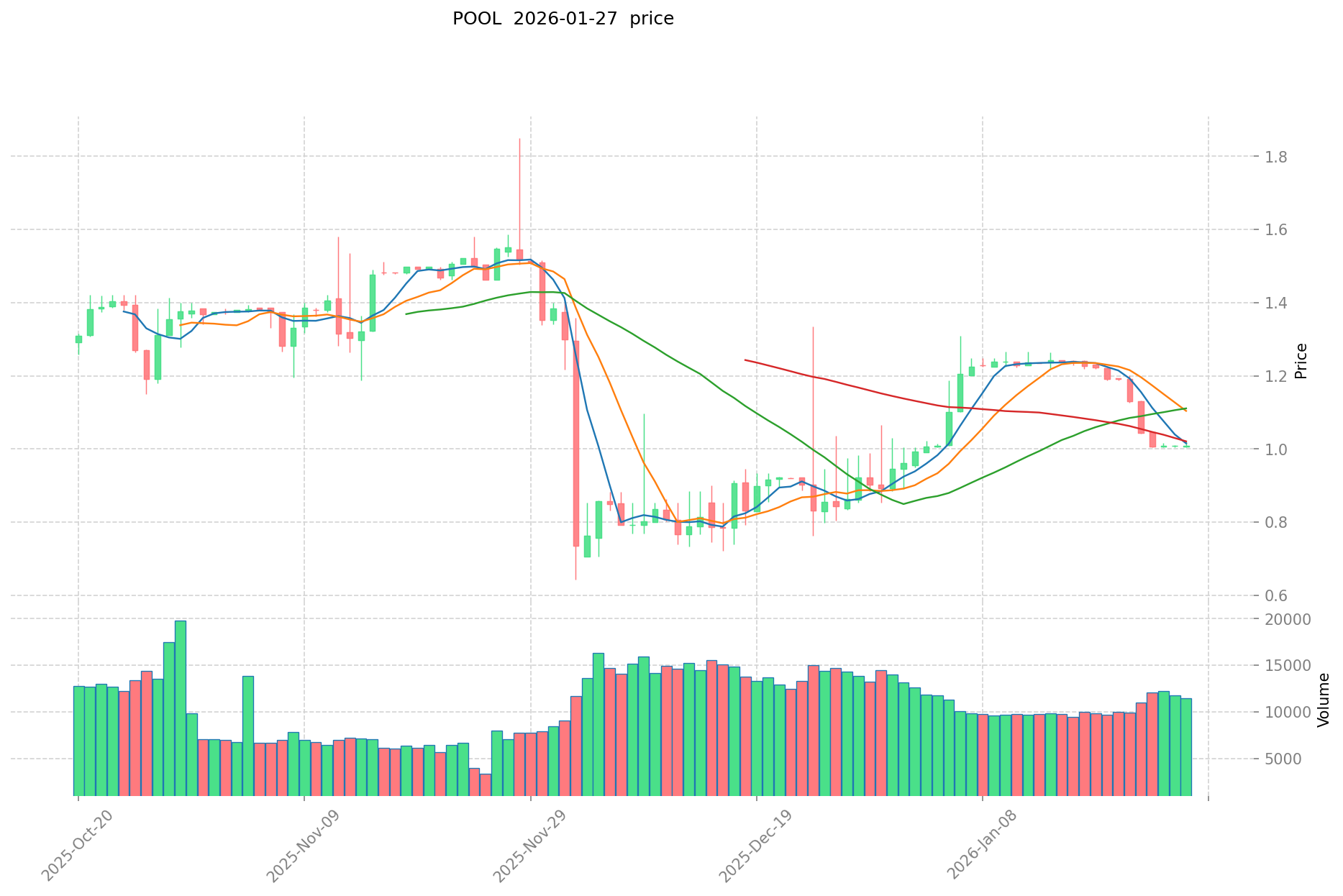
As of January 27, 2026, POOL is trading at $1.0141, showing a modest 24-hour increase of 0.47%. The token experienced intraday volatility with a high of $1.0611 and a low of $0.9754. Recent price action indicates mixed short-term momentum, with a 1-hour decline of 0.98% contrasting the daily gain.
Over the past week, POOL has decreased by 14.82%, while the 30-day performance shows a recovery with an 18.23% increase. The annual perspective reveals a 45.21% decline, reflecting the challenging market conditions faced over the past year.
The current market capitalization stands at approximately $7.27 million, with a 24-hour trading volume of $12,117. The circulating supply represents 71.72% of the maximum supply of 10 million tokens, with 7,172,434 POOL currently in circulation. The fully diluted market cap is calculated at $10.14 million.
PoolTogether maintains a market share of 0.00032% within the broader cryptocurrency ecosystem. The platform has attracted 8,621 token holders as of the latest data. The project trades on Gate.com, providing liquidity for users interested in participating in the protocol.
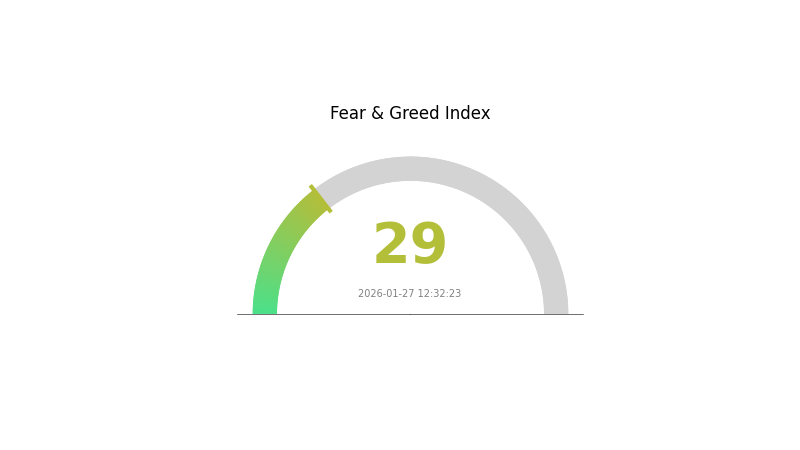
The current market sentiment indicator reflects a fear level of 29, suggesting cautious investor positioning in the broader crypto market environment.
Click to view current POOL market price
POOL Market Sentiment Index
2026-01-27 Fear and Greed Index: 29 (Fear)
Click to view current Fear & Greed Index
Market Analysis:
The Fear and Greed Index currently stands at 29, signaling significant market fear. This reading indicates heightened investor anxiety and risk aversion in the cryptocurrency market. When the index is this low, market participants are typically more cautious, potentially creating opportunities for long-term investors to accumulate assets at discounted prices. However, traders should remain vigilant and implement proper risk management strategies during periods of elevated fear. Monitor market developments closely to identify potential trend reversals and position entries accordingly through Gate.com's trading platform.
POOL持仓Distribution
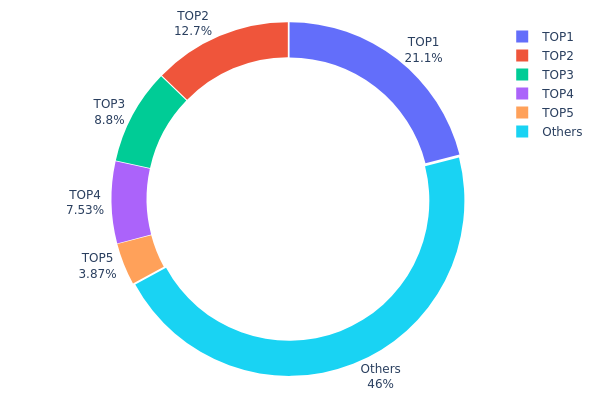
The holding distribution chart illustrates the concentration of token ownership across different wallet addresses, providing insights into the decentralization level and potential market dynamics of POOL. According to the latest on-chain data, the top address holds 2.105 million POOL tokens, accounting for 21.05% of the total supply, while the top 5 addresses collectively control 54.97% of the circulating tokens. This distribution pattern reveals a moderate to high concentration level that warrants careful analysis.
The current holding structure demonstrates notable centralization characteristics. The largest holder controls over one-fifth of the supply, with the second-largest address holding 12.74% (1.274 million tokens). Combined with the third through fifth largest holders—ranging from 8.79% to 3.86%—the aggregate concentration exceeds the majority threshold. While the "Others" category comprises 46.03%, representing more dispersed retail participation, the dominance of top addresses suggests institutional or whale accumulation patterns. This concentration level poses potential risks for sudden price movements, as large holders possess sufficient power to influence market liquidity and price discovery mechanisms.
From a market structure perspective, such distribution creates asymmetric risk exposure. The concentrated holdings may provide price stability during bullish phases when large holders maintain positions, but conversely amplifies volatility risk if major addresses initiate selling pressure. The relatively high concentration coefficient indicates limited decentralization compared to mature cryptocurrencies, potentially making POOL susceptible to coordinated movements or manipulation. However, the presence of nearly half the supply distributed among numerous smaller addresses suggests a growing community base, which could gradually dilute concentration over time as the project matures and adoption expands.
Click to view current POOL Holdings Distribution
| Top |
Address |
Holding Qty |
Holding (%) |
| 1 |
0x99c9...884be1 |
2105.33K |
21.05% |
| 2 |
0x3154...0f2c35 |
1274.69K |
12.74% |
| 3 |
0x68a1...c2f18b |
879.51K |
8.79% |
| 4 |
0xff2b...cebfee |
753.28K |
7.53% |
| 5 |
0xbe1a...97016f |
386.71K |
3.86% |
| - |
Others |
4600.48K |
46.03% |
II. Core Factors Influencing POOL's Future Price
Supply Mechanism
-
Market Demand and Network Effects: POOL's price performance is closely tied to market demand dynamics and the adoption of its underlying protocol by major brands and platforms. The network effect serves as a critical driver, where increased adoption by established entities can create positive momentum for token valuation.
-
Historical Patterns: Historical data suggests that tokens with strong ecosystem partnerships tend to demonstrate more resilient price action during market cycles. The correlation between enterprise adoption and token appreciation has been observed across similar DeFi protocols.
-
Current Impact: The present market environment shows that POOL's supply dynamics are influenced by its role within the decentralized finance landscape, where demand from institutional participants and protocol users creates natural buying pressure.
Institutional and Major Holder Dynamics
-
Institutional Positioning: While specific institutional holding data for POOL is limited in the provided materials, the broader DeFi sector has witnessed growing institutional interest, particularly from entities seeking exposure to yield-generating protocols and liquidity solutions.
-
Enterprise Adoption: The materials reference major brand adoption in related ecosystems (such as Starbucks, Adidas, Prada, and Disney in the Polygon network), which demonstrates the growing acceptance of blockchain-based protocols by mainstream companies. Similar enterprise integration trends could positively influence POOL's utility and demand.
-
National Policy Framework: The regulatory landscape for cryptocurrency continues to evolve globally. Policy developments regarding DeFi protocols, staking mechanisms, and token classifications may impact POOL's operational framework and market accessibility.
Macroeconomic Environment
-
Monetary Policy Impact: Central bank policy decisions, particularly regarding interest rates and quantitative measures, influence risk asset valuations including cryptocurrency tokens. The current monetary environment's transition toward normalized rates affects liquidity conditions in crypto markets.
-
Inflation Hedge Characteristics: Digital assets have demonstrated mixed performance as inflation hedges. POOL's value proposition within the DeFi ecosystem may provide some protection against currency devaluation, though this relationship varies based on broader market conditions and specific protocol fundamentals.
-
Geopolitical Factors: International economic tensions and policy shifts can drive capital flows toward or away from cryptocurrency assets. Market participants often reassess risk allocations during periods of geopolitical uncertainty, which may create volatility in POOL's trading patterns.
Technology Development and Ecosystem Building
-
Protocol Infrastructure: POOL's technical foundation and its integration within the Ethereum ecosystem provide the structural basis for its functionality. Ongoing developments in layer-2 scaling solutions and cross-chain interoperability may enhance the protocol's efficiency and attractiveness.
-
Network Partnerships: Strategic collaborations with other DeFi protocols and blockchain networks can expand POOL's utility and user base. The strength of these partnerships contributes to the token's long-term value proposition.
-
Ecosystem Applications: The diversity and quality of applications built around or integrated with POOL's underlying protocol influence its adoption trajectory. Active development communities and robust dApp ecosystems typically correlate with sustained token demand and price stability.
III. 2026-2031 POOL Price Prediction
2026 Outlook
- Conservative prediction: $0.69973 - $1.0141
- Neutral prediction: $1.0141
- Optimistic prediction: $1.4096 (requires favorable market conditions and sustained adoption)
2027-2029 Outlook
- Market stage expectation: Gradual growth phase with increasing institutional interest and ecosystem expansion
- Price range predictions:
- 2027: $0.67864 - $1.53905
- 2028: $1.29292 - $1.96689
- 2029: $1.58761 - $2.37306
- Key catalysts: Platform development milestones, strategic partnerships, and broader DeFi market expansion
2030-2031 Long-term Outlook
- Baseline scenario: $1.63791 - $2.79052 (assuming steady ecosystem growth and market stability)
- Optimistic scenario: $2.02212 - $3.56135 (requires significant protocol upgrades and increased market share)
- Transformative scenario: Potential to reach $3.56135+ (under highly favorable conditions including mainstream DeFi adoption and enhanced utility)
- 2026-01-27: POOL trading within projected ranges as the token enters a critical growth phase
| Year |
Predicted High Price |
Predicted Average Price |
Predicted Low Price |
Price Change |
| 2026 |
1.4096 |
1.0141 |
0.69973 |
0 |
| 2027 |
1.53905 |
1.21185 |
0.67864 |
19 |
| 2028 |
1.96689 |
1.37545 |
1.29292 |
35 |
| 2029 |
2.37306 |
1.67117 |
1.58761 |
64 |
| 2030 |
2.79052 |
2.02212 |
1.63791 |
99 |
| 2031 |
3.56135 |
2.40632 |
1.78068 |
137 |
IV. POOL Professional Investment Strategy and Risk Management
POOL Investment Methodology
(I) Long-term Holding Strategy
- Suitable for: DeFi enthusiasts and investors who believe in no-loss lottery protocols
- Operational Recommendations:
- Consider accumulating positions during market downturns when POOL trades below major support levels
- Monitor the protocol's Total Value Locked (TVL) and weekly prize distribution growth as fundamental indicators
- Utilize Gate Web3 Wallet for secure storage of POOL tokens with multi-signature protection
(II) Active Trading Strategy
- Technical Analysis Tools:
- Moving Averages: Use 50-day and 200-day moving averages to identify trend directions and potential entry/exit points
- Relative Strength Index (RSI): Monitor overbought (above 70) and oversold (below 30) conditions for swing trading opportunities
- Swing Trading Key Points:
- Pay attention to POOL's 24-hour trading volume fluctuations, as current volume stands at approximately $12,117
- Set stop-loss orders 5-8% below entry price to manage downside risk
POOL Risk Management Framework
(I) Asset Allocation Principles
- Conservative Investors: 1-3% of crypto portfolio
- Aggressive Investors: 5-8% of crypto portfolio
- Professional Investors: 8-12% of crypto portfolio with hedging strategies
(II) Risk Hedging Solutions
- Diversification Strategy: Combine POOL holdings with established DeFi blue-chip tokens to reduce protocol-specific risk
- Stablecoin Pairing: Maintain 30-40% positions in stablecoins to quickly capitalize on buying opportunities during volatility
(III) Secure Storage Solutions
- Hardware Wallet Recommendation: Gate Web3 Wallet provides multi-chain support for POOL tokens with enhanced security features
- Cold Storage Option: For long-term holders, consider transferring POOL to offline storage after major accumulation phases
- Security Precautions: Always verify contract addresses (0x0cec1a9154ff802e7934fc916ed7ca50bde6844e on Ethereum) before transactions, enable two-factor authentication, and never share private keys
V. POOL Potential Risks and Challenges
POOL Market Risks
- High Volatility: POOL has experienced significant price fluctuations, with a 14.82% decline over the past 7 days, reflecting typical DeFi token volatility
- Liquidity Concerns: Current 24-hour trading volume of approximately $12,117 indicates relatively limited liquidity, which may result in wider spreads and slippage
- Competition Risk: The no-loss lottery space faces competition from emerging protocols, potentially impacting POOL's market share and token value
POOL Regulatory Risks
- Lottery Classification Uncertainty: Regulatory authorities in various jurisdictions may classify no-loss lottery protocols differently, potentially affecting operations
- DeFi Regulation Evolution: Ongoing development of DeFi regulations globally could impose compliance requirements on PoolTogether protocol
- Tax Treatment Ambiguity: Prize distributions and token rewards may face varying tax treatments across different jurisdictions
POOL Technical Risks
- Smart Contract Vulnerabilities: Despite audits, the protocol's smart contracts carry inherent risks of bugs or exploits that could affect token value
- Integration Dependencies: PoolTogether's reliance on external DeFi protocols like Compound creates additional points of failure
- Network Congestion: As an Ethereum-based protocol, POOL transactions may face high gas fees during network congestion periods
VI. Conclusion and Action Recommendations
POOL Investment Value Assessment
POOL represents an innovative approach to combining savings with prize-linked accounts in the DeFi ecosystem. With a current price of $1.0141 and market capitalization of approximately $7.27 million, the token trades substantially below its all-time high of $53.98 (February 2021), suggesting potential upside for long-term believers in the protocol's value proposition. However, the recent 14.82% seven-day decline and 45.21% one-year decline indicate significant headwinds. The protocol's circulating supply of 7.17 million POOL (71.72% of maximum supply) provides reasonable transparency on token economics. Short-term risks include market volatility, limited liquidity, and evolving regulatory landscape for lottery-style protocols.
POOL Investment Recommendations
✅ Beginners: Start with a small allocation (1-2% of crypto portfolio), use dollar-cost averaging to build positions gradually, and prioritize learning about no-loss lottery mechanics before committing significant capital
✅ Experienced Investors: Consider POOL as a tactical DeFi portfolio addition with 3-5% allocation, monitor protocol TVL and user growth metrics, and implement stop-loss strategies to protect against downside volatility
✅ Institutional Investors: Evaluate POOL within broader DeFi innovation thesis with appropriate position sizing (2-4% of DeFi allocation), conduct thorough due diligence on protocol security and governance, and consider hedging strategies using correlated DeFi assets
POOL Trading Participation Methods
- Spot Trading: Purchase POOL directly on Gate.com with major trading pairs, offering straightforward exposure to token price movements
- DeFi Participation: Acquire POOL tokens and participate in PoolTogether protocol governance while potentially earning protocol rewards
- Portfolio Integration: Incorporate POOL as part of a diversified DeFi portfolio strategy alongside other protocol tokens
Cryptocurrency investment carries extremely high risks, and this article does not constitute investment advice. Investors should make prudent decisions based on their own risk tolerance and are advised to consult professional financial advisors. Never invest more than you can afford to lose.
FAQ
What is POOL token? What is the function of Pooltogether protocol?
POOL is the native token of PoolTogether protocol, enabling participation in no-loss prize savings. The protocol allows users to deposit cryptocurrency and win prizes without risking their principal amount.
What is the historical price trend of POOL token? What price level is it currently at?
POOL token reached an all-time high of ¥499.26 historically. Currently, it trades around ¥1.20, with 24-hour range between ¥1.10 and ¥1.23. The token shows significant long-term depreciation from its peak.
What are the main factors affecting POOL token price?
POOL token price is primarily influenced by supply mechanics, Ethereum ecosystem development, market demand, institutional adoption, and macroeconomic conditions. Trading volume and network activity also play significant roles in price movements.
How to conduct technical analysis and fundamental analysis on POOL tokens?
Analyze POOL tokens by examining market trends, price movements, and trading volume for technical indicators. For fundamental analysis, review the project's whitepaper, team credentials, partnerships, and practical use case. Monitor liquidity conditions and assess the underlying asset value supporting the token.
How is the price prediction and market outlook for POOL tokens in 2024-2025?
POOL token is projected to trade between $0.000651 and $0.000835 in 2025. Market prospects depend on overall crypto market performance and ecosystem adoption. Long-term growth potential remains tied to DeFi liquidity pool developments.
What are the risks to pay attention to when investing in POOL tokens?
POOL token investments carry market volatility risk, regulatory uncertainty, and smart contract technical risks. Crypto market fluctuations can significantly impact token value. Investors should conduct thorough research and risk assessment before investing.
What are the advantages and disadvantages of POOL token compared with other DeFi governance tokens such as AAVE and COMP?
POOL's advantage lies in its unique liquidity mining mechanism offering higher yields than AAVE and COMP. Its disadvantage is lower market capitalization and relatively less adoption in the DeFi ecosystem compared to established competitors.
* The information is not intended to be and does not constitute financial advice or any other recommendation of any sort offered or endorsed by Gate.