ROA CORE (ROA) operates as a Web3 ecosystem transforming lifestyle activities into blockchain-based rewards. Trading at $0.0061 as of January 2026 with a $4.09 million market cap, ROA has experienced significant volatility since its 2023 launch. This comprehensive analysis examines ROA's price trajectory from 2026 to 2031, incorporating historical patterns, supply mechanics, ecosystem development, and macroeconomic factors. Expert predictions range from conservative scenarios ($0.00475-$0.00609 in 2026) to optimistic outlooks reaching $0.01784 by 2031, representing potential 110% growth. The article provides actionable investment strategies for beginners through institutional investors, including long-term holding and active trading approaches on Gate and other platforms. Critical risk factors include extreme token concentration (70.58% held by top two addresses), modest liquidity, regulatory uncertainty, and Web3 sector volatility. Investors should carefully assess their risk tolerance and conduct thorough e
Introduction: ROA's Market Position and Investment Value
ROA CORE (ROA), as a Web3 ecosystem that transforms everyday behaviors—walking, cultural experiences, and digital engagement—into data-driven value, has been making strides since its inception in 2023. As of January 2026, ROA maintains a market capitalization of approximately $4.09 million, with a circulating supply of around 670 million tokens, and the price hovering around $0.0061. This asset, often characterized as a bridge between real-world activities and on-chain assets, is playing an increasingly important role in the integration of physical lifestyle data with blockchain-based reward mechanisms.
This article will comprehensively analyze ROA's price trajectory from 2026 to 2031, combining historical patterns, market supply and demand dynamics, ecosystem development, and macroeconomic factors to provide investors with professional price predictions and practical investment strategies.
I. ROA Price History Review and Current Market Status
ROA Historical Price Evolution Trajectory
- 2023: ROA CORE token was officially launched in March 2023 with a publish price of $2.19, marking the project's entry into the cryptocurrency market
- December 2023: The token reached its all-time high (ATH) of $0.1785 on December 22, 2023, representing significant early market enthusiasm for the ROACORE ecosystem
- 2024-2025: Following the market peak, ROA experienced considerable price adjustment, declining from the ATH level through various market cycles
- December 2025: The token hit its all-time low (ATL) of $0.005711 on December 17, 2025, reflecting broader market corrections and ecosystem development phases
ROA Current Market Situation
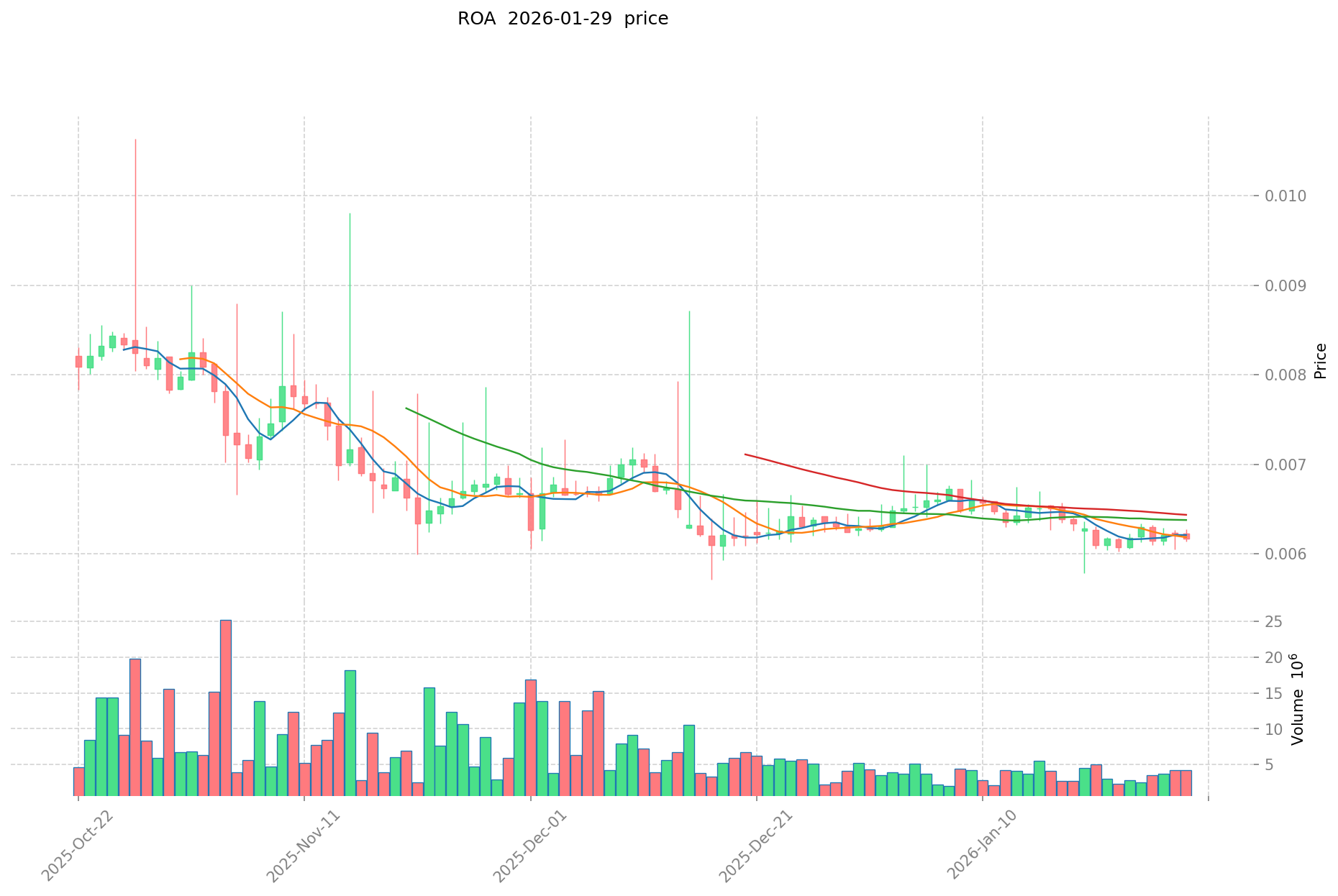
As of January 30, 2026, ROA is trading at $0.0061, positioning the token near its historical low territory. The current market capitalization stands at approximately $4.09 million, with a fully diluted valuation of $5.79 million. The circulating supply represents 670 million tokens, accounting for 67% of the total supply of 949.99 million ROA tokens.
The token's 24-hour trading volume is recorded at $19,940.95, indicating moderate market activity. Recent price performance shows a decline of 2.26% over the past 24 hours, while the 7-day trend demonstrates a slight recovery of 0.43%. However, the 30-day performance reflects a decrease of 3.04%, and the annual comparison reveals a substantial decline of 65.4% from the previous year.
The current market sentiment index stands at 26, classified in the "Fear" zone, suggesting cautious investor positioning. ROA maintains a market dominance of 0.00019%, ranking at position 1632 among cryptocurrencies. The token operates on the Solana blockchain with the contract address 5tB5D6DGJMxxHYmNkfJNG237x6pZGEwTzGpUUh62yQJ7, and is held by approximately 36,996 wallet addresses.
The market cap to fully diluted valuation ratio of 67% indicates a significant portion of tokens already in circulation. The 24-hour price range has oscillated between $0.00608 and $0.006259, demonstrating relatively contained volatility within the daily trading session.
Click to view the current ROA market price
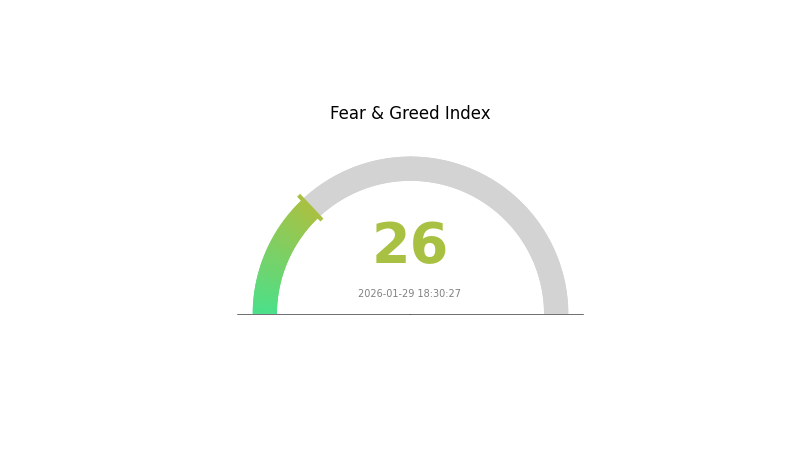
ROA Market Sentiment Index
2026-01-29 Fear and Greed Index: 26 (Fear)
Click to view current Fear & Greed Index
Market Analysis:
The cryptocurrency market is currently experiencing a fear sentiment with an index reading of 26, indicating elevated market anxiety. Investors are showing cautious behavior as uncertainty dominates trading activity. This fear-driven environment typically presents opportunities for contrarian investors, though risk management remains crucial. Monitor key support levels and maintain diversified positions during periods of market pessimism. Such conditions often precede significant market movements, making it essential to stay informed and prepared for potential shifts in market sentiment.
ROA Holding Distribution
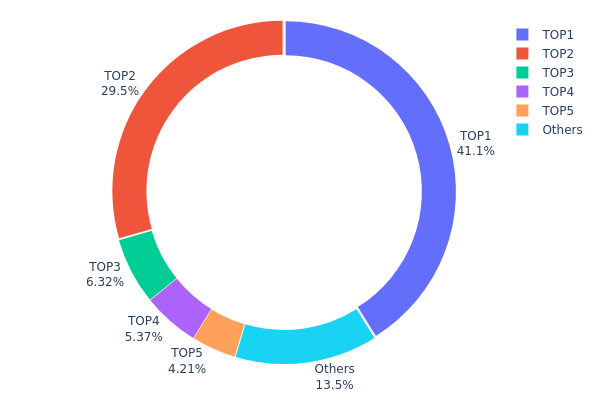
The holding distribution chart illustrates the concentration of token ownership across different wallet addresses, providing insights into the decentralization level and potential market manipulation risks. By analyzing the proportion of tokens held by top addresses versus smaller holders, investors can assess the structural stability and governance characteristics of the token ecosystem.
According to current on-chain data, ROA exhibits a highly concentrated holding pattern. The top address controls 390,309.28K tokens (41.10%), while the second-largest holder possesses 280,000.00K tokens (29.48%). Combined, these two addresses account for approximately 70.58% of the total supply, indicating significant centralization. The top five addresses collectively hold 821,309.28K tokens (86.47%), leaving only 13.53% distributed among remaining market participants. This concentration level substantially exceeds typical decentralization benchmarks observed in mature crypto assets.
Such extreme concentration presents multiple structural concerns. First, the dominance of top holders creates asymmetric market power, potentially enabling coordinated price manipulation or creating substantial selling pressure if major holders decide to liquidate positions. Second, the limited circulation among broader market participants may result in reduced liquidity depth and heightened volatility during significant market movements. Third, this distribution pattern suggests limited community participation and governance decentralization, which could impact long-term project credibility and ecosystem development. Investors should exercise heightened caution regarding sudden price fluctuations driven by whale activities, while monitoring whether the project team implements token distribution optimization strategies to gradually improve decentralization metrics.
Click to view current ROA Holding Distribution
| Top |
Address |
Holding Qty |
Holding (%) |
| 1 |
8Mm46C...zrMZQH |
390309.28K |
41.10% |
| 2 |
EPrUqR...kBG42k |
280000.00K |
29.48% |
| 3 |
AqeSBe...pygp31 |
60000.00K |
6.31% |
| 4 |
3td3om...eEpLVv |
51000.00K |
5.37% |
| 5 |
6cp6Fy...x9FZ3X |
40000.00K |
4.21% |
| - |
Others |
128202.42K |
13.53% |
II. Core Factors Influencing ROA's Future Price
Supply Mechanism
- Halving Mechanism: ROA undergoes periodic halving events, reducing block rewards by half during each cycle.
- Historical Patterns: Previous halving events have typically led to price appreciation as supply contraction creates upward pressure on market valuations.
- Current Impact: The anticipated upcoming halving is expected to generate supply-side constraints that may support price momentum.
Macroeconomic Environment
- Monetary Policy Impact: Central bank policy directions and interest rate environments continue to shape broader cryptocurrency market sentiment and capital flows.
- Inflation Hedge Characteristics: Digital assets may demonstrate varying performance characteristics during different inflation cycles and economic conditions.
- Geopolitical Factors: International economic developments and regulatory landscapes contribute to overall market dynamics.
Technology Development and Ecosystem Building
- Technical Innovation: Ongoing technological advancements and protocol improvements may enhance network capabilities and user adoption potential.
- Ecosystem Applications: The development of decentralized applications and platform integrations represents a key factor in expanding utility and market reach.
III. 2026-2031 ROA Price Prediction
2026 Outlook
- Conservative prediction: $0.00475 - $0.00609
- Neutral prediction: $0.00609 (average price level)
- Optimistic prediction: $0.00846 (requires favorable market conditions and increased adoption)
2027-2029 Outlook
- Market stage expectation: Gradual growth phase with moderate volatility
- Price range prediction:
- 2027: $0.00648 - $0.00924 (approximately 19% growth)
- 2028: $0.00644 - $0.01198 (approximately 35% growth)
- 2029: $0.00556 - $0.01093 (approximately 65% growth)
- Key catalysts: Market maturation, potential ecosystem expansion, and broader crypto market trends
2030-2031 Long-term Outlook
- Baseline scenario: $0.00663 - $0.01052 (assuming steady market development)
- Optimistic scenario: $0.01052 - $0.01515 (with enhanced utility and increased demand)
- Transformative scenario: $0.00693 - $0.01784 (under highly favorable conditions including mainstream adoption and significant ecosystem growth)
- 2031-01-30: ROA could potentially reach an average price of $0.01284, representing approximately 110% growth from 2026 levels
| Year |
Predicted High Price |
Predicted Average Price |
Predicted Low Price |
Price Change |
| 2026 |
0.00846 |
0.00609 |
0.00475 |
0 |
| 2027 |
0.00924 |
0.00728 |
0.00648 |
19 |
| 2028 |
0.01198 |
0.00826 |
0.00644 |
35 |
| 2029 |
0.01093 |
0.01012 |
0.00556 |
65 |
| 2030 |
0.01515 |
0.01052 |
0.00663 |
72 |
| 2031 |
0.01784 |
0.01284 |
0.00693 |
110 |
IV. ROA Professional Investment Strategies and Risk Management
ROA Investment Methodology
(1) Long-Term Holding Strategy
- Suitable for: Investors seeking exposure to Web3 ecosystem tokens with real-world utility integration
- Operational Recommendations:
- Consider accumulating positions during market consolidation phases, particularly when ROA trades near support levels
- Monitor ecosystem development milestones including DOGDOG, MODA Gallery, and ROA STORE user adoption metrics
- Utilize Gate Web3 Wallet for secure storage with multi-signature protection and regular backup practices
(2) Active Trading Strategy
- Technical Analysis Tools:
- Volume Analysis: Track the 24-hour trading volume ($19,940.95) relative to market cap to identify liquidity patterns and potential breakout signals
- Support/Resistance Levels: Monitor the 24-hour range ($0.00608-$0.006259) and historical price boundaries for entry/exit timing
- Swing Trading Considerations:
- Watch for volatility patterns within the 24-hour price fluctuation range to capitalize on short-term movements
- Set stop-loss orders below recent support levels to manage downside risk during active trading periods
ROA Risk Management Framework
(1) Asset Allocation Principles
- Conservative Investors: 1-3% of crypto portfolio allocation
- Aggressive Investors: 5-10% of crypto portfolio allocation
- Professional Investors: Up to 15% with active hedging strategies
(2) Risk Hedging Strategies
- Diversification Approach: Balance ROA holdings with established blockchain assets to mitigate ecosystem-specific risks
- Position Sizing: Implement gradual entry strategies rather than full position deployment to manage timing risk
(3) Secure Storage Solutions
- Hot Wallet Recommendation: Gate Web3 Wallet for active trading positions with daily transaction needs
- Cold Storage Approach: Transfer long-term holdings to hardware wallets with offline private key storage
- Security Precautions: Enable two-factor authentication, maintain secure backup phrases, and never share private keys or seed phrases with third parties
V. ROA Potential Risks and Challenges
ROA Market Risks
- Price Volatility: ROA has experienced significant drawdowns, with annual decline reaching 65.4%, indicating substantial price fluctuation potential
- Liquidity Constraints: With a market cap of approximately $4.09 million and limited exchange listings (4 exchanges), liquidity may be insufficient during high-volatility periods
- Market Sentiment Dependency: As a Web3 ecosystem token, ROA's valuation is closely tied to broader market sentiment toward utility-focused blockchain projects
ROA Regulatory Risks
- Web3 Classification Uncertainty: Evolving regulatory frameworks for tokens integrating real-world activities may impact ROA's operational model
- Geographic Restrictions: Jurisdictional differences in cryptocurrency regulations may limit ecosystem accessibility in certain regions
- Compliance Evolution: Future regulatory requirements for AI-driven reward systems and user data utilization could necessitate protocol adjustments
ROA Technical Risks
- Smart Contract Dependencies: As a Solana-based token, ROA inherits network-level risks including potential congestion or protocol vulnerabilities
- Ecosystem Integration Complexity: Technical challenges in seamlessly connecting DOGDOG, MODA Gallery, and ROA STORE may affect user experience and adoption
- AI System Reliability: The accuracy and fairness of AI-driven reward distribution mechanisms require ongoing monitoring and refinement
VI. Conclusion and Action Recommendations
ROA Investment Value Assessment
ROA CORE presents a distinctive value proposition by bridging real-world activities with blockchain-based rewards through its Web3 ecosystem. The integration of walking tracking (DOGDOG), cultural experiences (MODA Gallery), and utility redemption (ROA STORE) addresses practical use cases beyond speculative trading. However, the token faces significant headwinds including substantial year-over-year price decline (65.4%), relatively modest market capitalization ($4.09 million), and execution risks inherent in multi-platform ecosystem development. Long-term value depends on successful user adoption, AI system refinement, and sustained ecosystem engagement, while short-term risks include market volatility, liquidity constraints, and broader Web3 sector sentiment.
ROA Investment Recommendations
✅ Beginners: Start with minimal exposure (1-2% of crypto portfolio) after thoroughly researching the ROACORE ecosystem and understanding Web3 utility token mechanics
✅ Experienced Investors: Consider strategic accumulation during market weakness with position limits of 3-7%, combining fundamental ecosystem analysis with technical entry timing
✅ Institutional Investors: Conduct comprehensive due diligence on ecosystem traction metrics, evaluate smart contract audits, and implement structured entry strategies with defined risk parameters
ROA Trading Participation Methods
- Spot Trading: Execute buy/sell orders on Gate.com and other supporting exchanges with attention to liquidity depth
- Dollar-Cost Averaging: Establish regular small purchases to smooth entry price volatility over extended periods
- Ecosystem Participation: Engage with DOGDOG, MODA Gallery, or ROA STORE to understand value proposition firsthand before significant investment
Cryptocurrency investment carries extremely high risk, and this article does not constitute investment advice. Investors should make prudent decisions based on their own risk tolerance and are advised to consult professional financial advisors. Never invest more than you can afford to lose.
FAQ
What is ROA and how does it impact asset or crypto asset price prediction?
ROA(Return on Assets)measures how efficiently assets generate profits. Higher ROA indicates better asset utilization efficiency, boosting investor confidence and potentially driving crypto asset prices upward. Strong ROA performance signals positive fundamentals for price appreciation.
How to use ROA indicators to predict price trends, and what prediction models are available?
Use linear regression models correlating ROA with financial indicators like trading volume and net assets. Key models include linear regression analysis and time series forecasting to predict future price movements.
What are the main factors affecting the accuracy of ROA price predictions?
ROA price prediction accuracy is primarily influenced by asset value, net revenue, economic conditions, market sentiment, regulatory changes, and ecosystem adoption rates.
What are the risks and limitations of ROA price prediction?
ROA price prediction risks include overlooking asset quality, susceptibility to accounting policy changes, and inability to reflect growth potential. Market volatility and historical data may not accurately forecast future performance.
What is the difference between ROA and other financial indicators such as PE and PB in price prediction?
ROA measures asset return efficiency, while PE and PB focus on price-to-earnings and price-to-book ratios. ROA reflects operational profitability relative to assets, enabling better assessment of fundamental value for accurate price prediction.
* The information is not intended to be and does not constitute financial advice or any other recommendation of any sort offered or endorsed by Gate.