This comprehensive analysis examines Seamless Protocol (SEAM), the first native DeFi lending protocol on Base, currently trading at $0.1289 as of January 2026. The article provides expert price predictions spanning 2026-2031, ranging from conservative forecasts of $0.076-$0.129 in 2026 to potential growth scenarios reaching $0.326 by 2031. Key sections cover SEAM's historical performance showing an 80.74% annual decline, market position with $5.94M market cap, and critical factors influencing price including supply dynamics, ecosystem development, and macroeconomic conditions. The guide offers professional investment strategies tailored for different investor profiles, comprehensive risk management frameworks, and secure storage solutions via Gate. Essential for evaluating SEAM's long-term DeFi lending potential against significant volatility and liquidity constraints.
Introduction: SEAM's Market Position and Investment Value
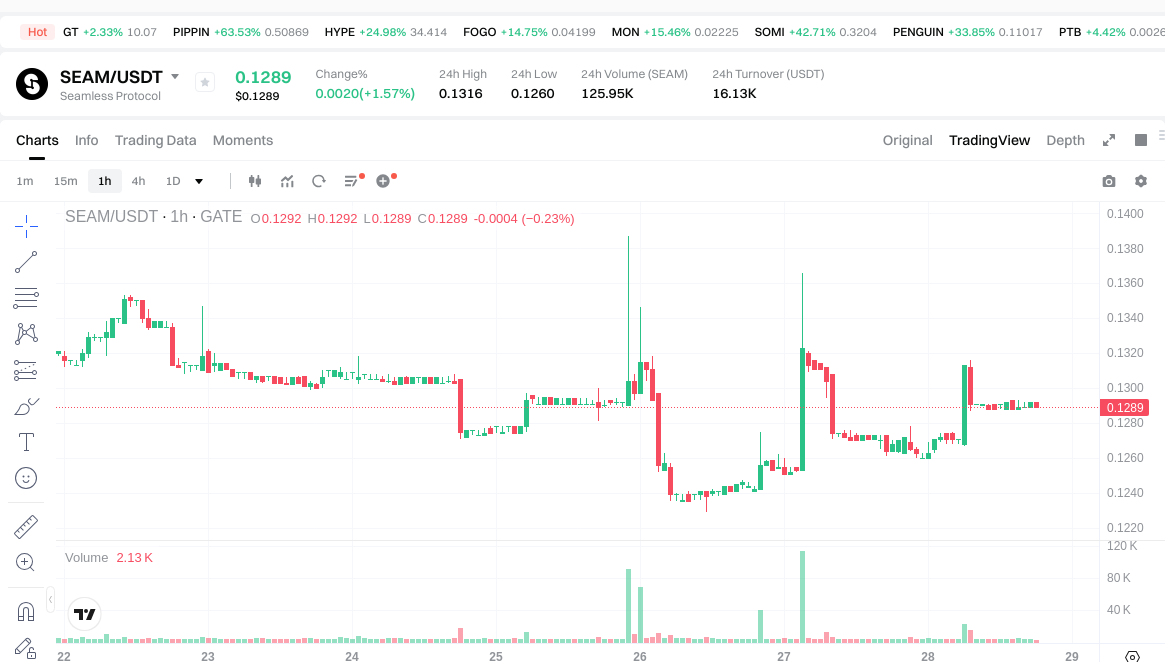
Seamless Protocol (SEAM), positioned as the first native decentralized lending and borrowing protocol on Base, has been contributing to the DeFi ecosystem since its launch in 2023. As of January 28, 2026, SEAM maintains a market capitalization of approximately $5.94 million, with a circulating supply of around 46.09 million tokens, and the price holding at approximately $0.1289. This asset, recognized as a utility governance token for modern DeFi infrastructure, is playing an increasingly important role in the decentralized lending sector with its focus on lower-collateral borrowing and enhanced user experience.
This article will comprehensively analyze SEAM's price trends from 2026 to 2031, combining historical patterns, market supply and demand dynamics, ecosystem development, and macroeconomic environment factors to provide investors with professional price forecasts and practical investment strategies.
I. SEAM Price History Review and Market Status
SEAM Historical Price Evolution Trajectory
- 2023: Seamless Protocol launched on Base as the first native decentralized lending and borrowing protocol, with SEAM token debuting at a publish price of $12.5 in December, followed by a peak of $15.39
- 2024: Market underwent consolidation as the token experienced significant price adjustments during broader market cycles
- 2025: Price declined to $0.0988 in December, reflecting challenging market conditions and sector-wide corrections
SEAM Current Market Status
As of January 28, 2026, SEAM is trading at $0.1289, representing a modest 24-hour increase of 1.57%. The token demonstrates mixed short-term performance, with a 1-hour decline of 0.084% and a 7-day decrease of 2.27%. However, the 30-day performance shows positive momentum with a 10.63% gain.
The circulating supply stands at 46.09 million SEAM tokens out of a maximum supply of 100 million, resulting in a circulating supply ratio of 46.09%. The market capitalization is approximately $5.94 million, with a fully diluted market cap of $12.89 million. The 24-hour trading volume registers at $16,106, indicating relatively modest trading activity.
SEAM ranks at position 1442 in the broader cryptocurrency market, with a market dominance of 0.0004%. The token is listed on 5 exchanges and has approximately 1,600 holders. The market cap to fully diluted valuation ratio stands at 46.09%, suggesting that less than half of the total token supply is currently in circulation.
The current crypto market sentiment indicator shows a Fear index reading of 29, reflecting cautious investor sentiment across the digital asset ecosystem. SEAM's annual performance shows an 80.74% decline, consistent with broader challenges in the DeFi lending sector throughout 2025.
Click to view current SEAM market price
SEAM Market Sentiment Index
2026-01-28 Fear and Greed Index: 29 (Fear)
Click to view the current Fear & Greed Index
The cryptocurrency market is currently experiencing significant fear sentiment with an index reading of 29. This indicates heightened investor anxiety and risk aversion in the digital asset space. During such periods, market volatility typically increases as traders reassess positions and reduce exposure. The fear-driven environment may present contrarian opportunities for long-term investors with high risk tolerance. However, caution is recommended when entering the market. Monitor key support levels and consider dollar-cost averaging strategies to mitigate timing risks. Market sentiment can shift rapidly, so stay informed through Gate.com's comprehensive market data tools for real-time analysis and sentiment tracking.

SEAM Holding Distribution
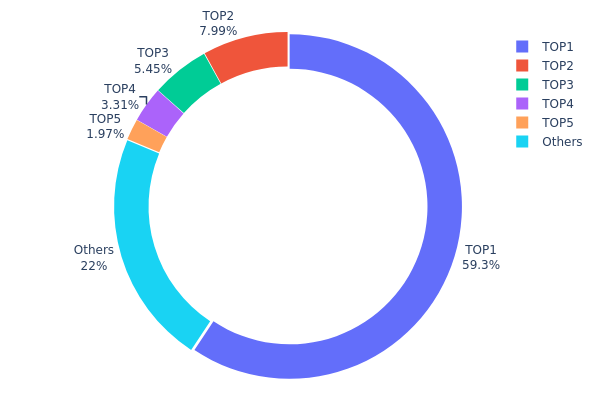
The holding distribution chart reveals the allocation of SEAM tokens across different wallet addresses, serving as a critical indicator of decentralization and potential market manipulation risks. According to the latest on-chain data, the top holder controls 3.725 million SEAM, representing 59.31% of the total supply, while the top five addresses collectively hold 87.01% of all tokens. This significant concentration pattern suggests a highly centralized distribution structure that deviates from the decentralized ethos typically associated with blockchain projects.
Such concentrated holdings present considerable implications for market stability and price dynamics. The dominant position of the largest holder grants substantial influence over token liquidity and price movements, potentially enabling coordinated actions that could trigger artificial volatility. The second through fifth largest holders, controlling between 1.96% and 7.99% each, form a secondary tier that, while more distributed than the primary holder, still represents significant concentration when viewed collectively. The remaining 21.99% distributed among other addresses provides limited counterbalance to the top holders' market power.
From a structural perspective, this distribution pattern indicates that SEAM currently operates within a centralized on-chain framework where a small number of entities possess decisive control over token economics. This concentration may limit organic price discovery mechanisms and increase susceptibility to coordinated market activities. Investors should remain cognizant of the inherent risks associated with such skewed distribution, particularly regarding potential large-scale transfers or liquidations that could generate disproportionate market impact.
Click to view current SEAM Holding Distribution
| Top |
Address |
Holding Qty |
Holding (%) |
| 1 |
0x976a...94ed33 |
3725.89K |
59.31% |
| 2 |
0xbc2e...a71e3d |
501.90K |
7.99% |
| 3 |
0x58ed...a36a51 |
342.25K |
5.44% |
| 4 |
0x9642...2f5d4e |
208.03K |
3.31% |
| 5 |
0x0d07...b492fe |
123.55K |
1.96% |
| - |
Others |
1379.42K |
21.99% |
II. Core Factors Influencing SEAM's Future Price
Supply Mechanism
- Growth Rate Projection: Market analysts suggest a potential annual growth rate of approximately 5% for SEAM, reflecting gradual expansion in token circulation and ecosystem development.
- Historical Pattern: Past supply dynamics have shown correlation with adoption trends, where increased token availability aligned with ecosystem growth phases.
- Current Impact: The projected steady growth rate indicates a balanced supply strategy that may support price stability while accommodating ecosystem expansion.
Institutional and Major Holder Dynamics
- Institutional Participation: Broader economic factors and institutional involvement play a role in shaping SEAM's price trajectory, though specific institutional positions require further market transparency.
- Adoption Trends: The token's integration within DeFi cross-chain ecosystems reflects growing interest in decentralized finance solutions.
Macroeconomic Environment
- Economic Factors: SEAM's price outlook is influenced by wider economic conditions, including monetary policy shifts and global financial market sentiment.
- Market Demand: General cryptocurrency market demand patterns and risk appetite among investors contribute to price movements.
Technical Development and Ecosystem Building
- DeFi Integration: SEAM operates within the Seamless Protocol framework, focusing on DeFi applications and cross-chain functionality.
- Ecosystem Diversity: Recent developments have shown SEAM's involvement in Base ecosystem activities, with historical performance indicating periodic growth phases.
- Market Sentiment: Community engagement and ecosystem development remain key drivers, with market sentiment playing a significant role in short-term price dynamics.
III. 2026-2031 SEAM Price Prediction
2026 Outlook
- Conservative Forecast: $0.076 - $0.129
- Neutral Forecast: $0.129 (average trading level)
- Optimistic Forecast: $0.170 (requires favorable market conditions and increased adoption)
2027-2029 Mid-term Outlook
- Market Stage Expectation: Potential gradual growth phase with increasing market recognition
- Price Range Forecast:
- 2027: $0.141 - $0.202 (approximately 16% change from 2026)
- 2028: $0.158 - $0.239 (approximately 36% change from 2026)
- 2029: $0.112 - $0.303 (approximately 60% change from 2026)
- Key Catalysts: Progressive market expansion and enhanced ecosystem development
2030-2031 Long-term Outlook
- Baseline Scenario: $0.184 - $0.255 (assuming steady market growth)
- Optimistic Scenario: $0.298 (based on positive market momentum in 2030)
- Growth Scenario: $0.277 - $0.326 (with sustained ecosystem advancement by 2031)
- 2026-01-28: SEAM currently positioned in early prediction phase
| Year |
Predicted High Price |
Predicted Average Price |
Predicted Low Price |
Price Change |
| 2026 |
0.17015 |
0.1289 |
0.07605 |
0 |
| 2027 |
0.20186 |
0.14952 |
0.14055 |
16 |
| 2028 |
0.23894 |
0.17569 |
0.15812 |
36 |
| 2029 |
0.30268 |
0.20732 |
0.11195 |
60 |
| 2030 |
0.29835 |
0.255 |
0.1836 |
97 |
| 2031 |
0.32647 |
0.27667 |
0.18814 |
114 |
IV. SEAM Professional Investment Strategy and Risk Management
SEAM Investment Methodology
(1) Long-term Holding Strategy
- Suitable for: Investors who believe in the long-term development of DeFi lending protocols and the Base ecosystem, with moderate to high risk tolerance
- Operational Recommendations:
- Consider accumulating positions during market corrections when SEAM trades below $0.13
- Monitor protocol TVL growth and user adoption metrics as key indicators
- Implement dollar-cost averaging to reduce timing risk
- Storage Solution: Use Gate Web3 Wallet for secure custody with multi-signature protection
(2) Active Trading Strategy
- Technical Analysis Tools:
- Volume Analysis: Monitor 24-hour trading volume ($16,106 as of January 28, 2026) for liquidity assessment
- Support/Resistance Levels: Key support at $0.126 (24H low), resistance at $0.1316 (24H high)
- Swing Trading Key Points:
- Trade within the established range of $0.126-$0.1316 for short-term opportunities
- Watch for breakout patterns above $0.1316 or breakdown below $0.126
- Consider taking partial profits during 5-10% price movements
SEAM Risk Management Framework
(1) Asset Allocation Principles
- Conservative Investors: 1-3% of crypto portfolio
- Aggressive Investors: 5-8% of crypto portfolio
- Professional Investors: Up to 10-15% of crypto portfolio with active management
(2) Risk Hedging Solutions
- Portfolio Diversification: Balance SEAM holdings with established DeFi tokens and stablecoins
- Stop-Loss Implementation: Set stop-loss orders 8-10% below entry price to limit downside risk
(3) Secure Storage Solutions
- Hot Wallet Recommended: Gate Web3 Wallet for convenient trading and protocol interaction
- Cold Storage Solution: Consider hardware wallet solutions for long-term holdings exceeding $10,000
- Security Precautions: Enable two-factor authentication, never share private keys, verify contract addresses before transactions, and be cautious of phishing attempts
V. SEAM Potential Risks and Challenges
SEAM Market Risks
- High Volatility: SEAM has experienced significant price decline of 80.74% over the past year, indicating substantial volatility
- Liquidity Risk: With 24-hour trading volume of only $16,106 and listing on 5 exchanges, liquidity may be limited during market stress
- Low Market Capitalization: Market cap of approximately $5.94 million represents higher risk compared to established DeFi projects
SEAM Regulatory Risks
- DeFi Regulation Uncertainty: Evolving regulatory frameworks for decentralized lending protocols may impact operations
- Base Network Compliance: Regulatory scrutiny of Layer 2 solutions and their associated protocols could affect SEAM
- Token Classification Risk: Potential classification changes for governance tokens may affect SEAM's utility and value
SEAM Technical Risks
- Smart Contract Vulnerabilities: Despite contributor backgrounds from established projects, lending protocols face inherent smart contract risks
- Base Network Dependency: SEAM's performance is directly tied to Base network stability and adoption
- Competition Risk: Established lending protocols like Aave may limit SEAM's market share growth despite being first on Base
VI. Conclusion and Action Recommendations
SEAM Investment Value Assessment
Seamless Protocol represents an early-stage DeFi lending protocol with both opportunities and risks. As the first native decentralized lending protocol on Base, SEAM benefits from potential Base ecosystem growth. The team's background from established DeFi projects provides credibility. However, the token has experienced severe price decline (-80.74% year-over-year) from its all-time high of $15.39 to current levels around $0.13, reflecting significant market challenges. With limited liquidity and a relatively small market cap, SEAM carries substantial short-term volatility risk. Long-term value depends on protocol adoption, Base ecosystem development, and the team's ability to execute their vision for lower-collateral borrowing.
SEAM Investment Recommendations
✅ Beginners: Avoid or allocate only a minimal amount (less than 1% of portfolio) due to high volatility and complexity. Focus on understanding DeFi lending mechanics before investing
✅ Experienced Investors: Consider small speculative positions (2-5% of crypto portfolio) with strict risk management. Dollar-cost averaging during market weakness may reduce timing risk
✅ Institutional Investors: Conduct thorough due diligence on protocol security, team capabilities, and Base ecosystem growth potential. Consider strategic positions with active monitoring and clear exit strategies
SEAM Trading Participation Methods
- Spot Trading: Purchase SEAM on Gate.com and other supported exchanges for direct exposure
- Protocol Participation: Use SEAM for governance voting and potential protocol rewards through the Seamless Protocol platform
- Portfolio Strategy: Combine SEAM holdings with other Base ecosystem tokens to diversify exposure while maintaining sector focus
Cryptocurrency investment carries extremely high risks, and this article does not constitute investment advice. Investors should make careful decisions based on their own risk tolerance and are advised to consult professional financial advisors. Never invest more than you can afford to lose.
FAQ
SEAM reached its peak at initial listing in 2021, followed by significant decline. Major recovery occurred in late 2023 and early 2024. Key events include the 2021 launch and 2023 market resurgence, with trading volume showing increased market activity.
What are the main factors affecting SEAM price?
SEAM price is primarily influenced by market sentiment and investor confidence, trading volume and liquidity, overall cryptocurrency market trends, project development progress and partnerships, tokenomics including supply mechanisms, and regulatory news affecting DeFi.
How to conduct fundamental and technical analysis on SEAM tokens to predict prices?
Analyze price action through candlestick patterns and technical indicators like MACD, RSI, and Bollinger Bands. For fundamentals, examine project development, tokenomics, partnerships, and trading volume. Historical patterns often repeat, helping forecast SEAM price movements.
SEAM代币的未来发展前景和生态建设进展如何?
SEAM代币发展前景看好,生态建设持续推进。项目原生性强,钱包体验优秀,生态扩充迅速,项目质量不错,具有长期投资价值。
What are the main risks of investing in SEAM tokens? How should I hedge against them?
Main risks include market volatility and liquidity fluctuations. Mitigation strategies: conduct thorough research, diversify your portfolio, invest only what you can afford to lose, and monitor market trends regularly.
* The information is not intended to be and does not constitute financial advice or any other recommendation of any sort offered or endorsed by Gate.