This comprehensive analysis examines Suilend's SEND token price trajectories from 2026 through 2031, providing investors with professional forecasts and strategic guidance. The article reviews SEND's market position, tracing its dramatic volatility from a $150 ATH to current levels of $0.1469 as of January 2026. Key analysis encompasses supply mechanisms, institutional dynamics, macroeconomic influences, and Sui ecosystem development impacting SEND's utility in decentralized lending infrastructure. Price predictions range from $0.10695-$0.19631 in 2026, escalating to $0.22819-$0.38349 by 2031 under various scenarios. The guide details investment methodologies including long-term holding and active trading strategies, risk management frameworks appropriate for different investor profiles, and secure storage solutions via Gate.com. Critical risk factors including high volatility, low market capitalization, regulatory uncertainties, and smart contract vulnerabilities are thoroughly examined. Suitable for investo
Introduction: SEND's Market Position and Investment Value
Suilend (SEND), as a lending and borrowing platform on Sui, has been establishing its presence in the decentralized finance ecosystem since its launch in December 2024. As of January 28, 2026, SEND has a market capitalization of approximately $7.16 million, with a circulating supply of around 48.72 million tokens, and the price is maintained at approximately $0.1469. This asset, which serves as a key component in the Sui ecosystem's lending infrastructure, is playing an increasingly important role in facilitating decentralized lending and borrowing activities.
This article will comprehensively analyze SEND's price trends from 2026 to 2031, combining historical patterns, market supply and demand dynamics, ecosystem development, and macroeconomic environment factors to provide investors with professional price forecasts and practical investment strategies.
I. SEND Price History Review and Market Status
SEND Historical Price Evolution
- December 2024: SEND launched on December 11, 2024, with an initial offering price of $1.00, reaching an all-time high of $150.00 on December 12, 2024
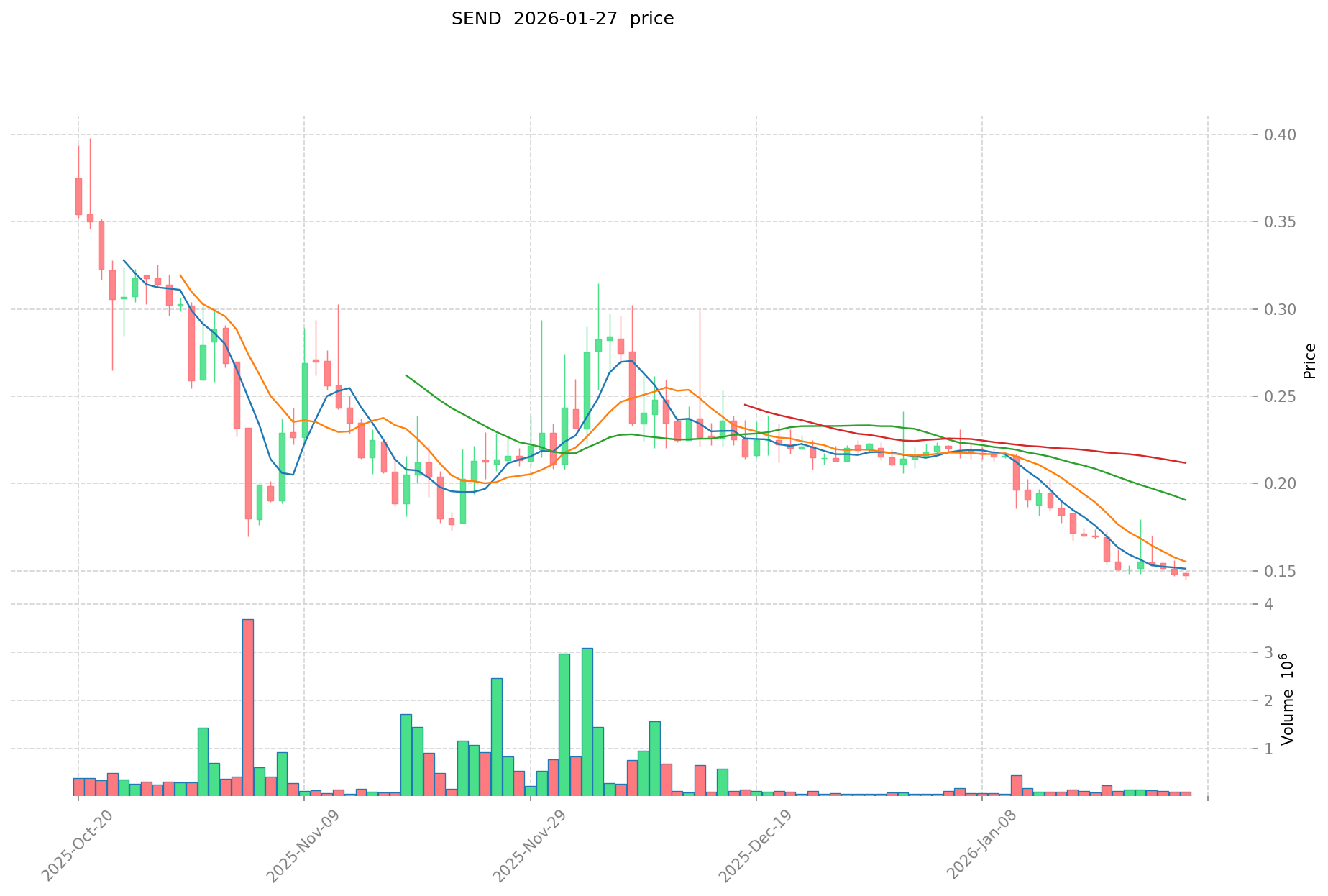
- January 2026: Price experienced significant correction, dropping to an all-time low of $0.1446 on January 27, 2026
SEND Current Market Dynamics
As of January 28, 2026, SEND is trading at $0.1469, showing a slight recovery of 0.13% in the past hour. The token has demonstrated notable volatility in recent periods, with a 24-hour decline of 0.27% and a 7-day decrease of 3.81%. Over the past 30 days, SEND has declined by 33.11%, while the 1-year performance shows a substantial decrease of 91.67% from its initial price point.
The token maintains a market capitalization of approximately $7.16 million, with 48.72 million SEND tokens currently in circulation out of a maximum supply of 100 million tokens. This represents 48.72% of the total token supply. The fully diluted market cap stands at $14.69 million, with a 24-hour trading volume of $15,959.65. SEND holds a market dominance of 0.00046% and is currently ranked #1363 in the cryptocurrency market.
The token is supported by 7,557 holders and is available for trading on 7 exchanges. According to market sentiment indicators, the current Volatility Index (VIX) stands at 29, reflecting a "Fear" sentiment in the broader market environment.
Click to view current SEND market price
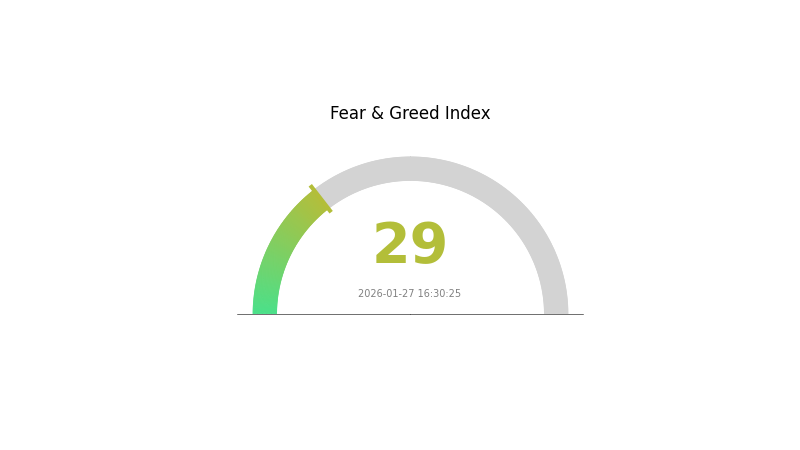
SEND Market Sentiment Index
2026-01-27 Fear and Greed Index: 29 (Fear)
Click to view current Fear & Greed Index
The cryptocurrency market is currently experiencing a fearful sentiment with an index reading of 29, indicating significant risk aversion among investors. This level suggests heightened market anxiety and caution. During periods of fear, market participants tend to reduce positions and seek safer assets. This presents potential opportunities for contrarian investors who believe in long-term market fundamentals. Monitor market developments closely and consider your risk tolerance before making investment decisions on Gate.com.
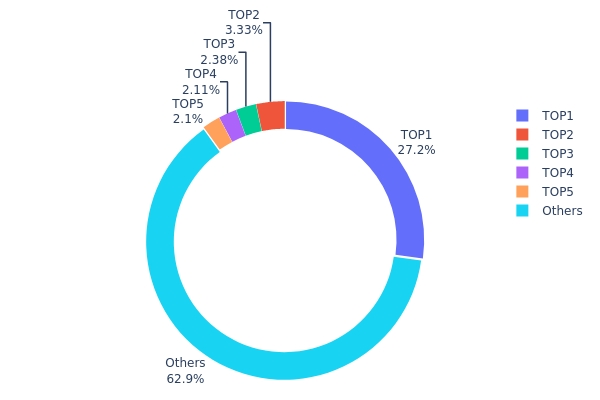
SEND Holding Distribution
The holding distribution chart represents the concentration of token ownership across different wallet addresses, providing insights into how SEND tokens are distributed among holders. This metric is crucial for assessing the degree of decentralization and potential market manipulation risks within the ecosystem.
Based on the current data, SEND exhibits a moderately concentrated holding structure. The top address controls 27.17% of the total supply (27,178.48K tokens), which represents a significant but not excessive concentration. The top five addresses collectively hold 36.07% of the total supply, while the remaining 62.93% is distributed among other holders. This distribution pattern suggests a relatively balanced structure compared to many newly launched tokens, where top holders often control over 50% of the supply.
From a market structure perspective, this holding distribution presents both stability and risk factors. The relatively large holding by the top address could introduce price volatility if that entity decides to liquidate positions. However, the fact that nearly 63% of tokens are distributed among other addresses indicates reasonable market participation and reduces the likelihood of single-entity price manipulation. This distribution pattern suggests a maturing market structure with moderate decentralization, though investors should remain aware that the top holder maintains substantial influence over potential price movements.
Click to view current SEND Holding Distribution
| Top |
Address |
Holding Qty |
Holding (%) |
| 1 |
0xb1ff...783c25 |
27178.48K |
27.17% |
| 2 |
0xc118...cd6097 |
3333.33K |
3.33% |
| 3 |
0x708d...051edf |
2379.86K |
2.37% |
| 4 |
0x7729...e340c5 |
2110.29K |
2.11% |
| 5 |
0x53a7...b00b24 |
2095.90K |
2.09% |
| - |
Others |
62902.13K |
62.93% |
II. Core Factors Influencing SEND's Future Price
Supply Mechanism
-
Token Distribution Model: SEND operates within the Suilend protocol on the Sui blockchain, where its supply dynamics are governed by tokenomics designed to balance ecosystem growth with value preservation. The token's distribution includes allocations for community incentives, platform development, and liquidity provision.
-
Historical Context: In DeFi lending protocols, controlled token release schedules have historically helped maintain price stability during early growth phases. Projects implementing vesting periods for team and investor allocations typically experience reduced selling pressure during critical development stages.
-
Current Impact: The supply release schedule for SEND incorporates mechanisms to prevent market oversaturation. As the Suilend platform expands its lending and borrowing activities, the token's utility in governance and fee discounts creates organic demand that may counterbalance new token emissions.
Institutional and Major Holder Dynamics
-
Institutional Participation: The Sui ecosystem has attracted attention from blockchain infrastructure investors interested in high-performance Layer 1 solutions. While specific institutional holdings in SEND are not publicly disclosed in the provided materials, the broader Sui network's institutional backing provides foundational support for ecosystem tokens.
-
Platform Adoption: Suilend's position as a lending protocol within the Sui DeFi ecosystem connects it to the network's growing developer community and decentralized application landscape. The platform's adoption rate directly correlates with SEND's utility value.
-
Regulatory Environment: The evolving regulatory framework for DeFi lending protocols across major jurisdictions continues to shape operational parameters. Compliance-focused developments within decentralized lending may influence long-term platform sustainability and token value.
Macroeconomic Environment
-
Monetary Policy Influence: Global central bank policies regarding interest rates affect risk appetite in cryptocurrency markets. Accommodative monetary conditions have historically supported growth in DeFi protocols, while tightening cycles may create headwinds for speculative assets.
-
Market Sentiment: Broader cryptocurrency market trends significantly impact individual token performance. Correlation with major digital assets like Bitcoin and Ethereum often determines short-term price movements, while protocol-specific developments drive longer-term differentiation.
-
Economic Uncertainty: Periods of traditional financial market volatility have produced mixed effects on DeFi tokens. Some investors view decentralized lending protocols as alternatives to conventional financial systems, while others reduce exposure to all risk assets during turbulent periods.
Technical Development and Ecosystem Building
-
Sui Blockchain Performance: The underlying Sui network's technical capabilities—including transaction speed, finality, and scalability—directly impact the user experience of protocols like Suilend. Network upgrades that enhance performance can improve platform competitiveness.
-
Protocol Enhancement: Ongoing development of Suilend's lending and borrowing mechanisms, including potential additions of new collateral types, interest rate models, and cross-chain functionality, may expand the platform's addressable market and SEND's utility scope.
-
Ecosystem Applications: The growth of complementary DeFi protocols within the Sui ecosystem, including decentralized exchanges and yield optimization platforms, creates network effects that can benefit established lending protocols. Integration opportunities with other Sui-based applications may enhance SEND's role in the broader ecosystem.
-
Security Infrastructure: The implementation of robust security measures, including smart contract audits and risk management frameworks, influences user confidence in the platform. Security track records significantly impact long-term adoption in the DeFi lending sector.
III. 2026-2031 SEND Price Prediction
2026 Outlook
- Conservative Forecast: $0.10695 - $0.1465
- Neutral Forecast: $0.1465
- Optimistic Forecast: $0.19631 (contingent on favorable market conditions and increased adoption)
2027-2029 Outlook
- Market Stage Expectation: SEND is anticipated to enter a gradual growth phase, with price appreciation driven by ecosystem expansion and broader market recovery.
- Price Range Predictions:
- 2027: $0.0977 - $0.22283
- 2028: $0.15966 - $0.27399
- 2029: $0.19786 - $0.30622
- Key Catalysts: The primary drivers include potential technological developments, strategic partnerships, and overall cryptocurrency market sentiment improvements. A projected 16% change by 2027, expanding to 60% by 2029, suggests progressive market confidence.
2030-2031 Long-term Outlook
- Baseline Scenario: $0.23296 - $0.27089 (assuming steady adoption and stable market conditions)
- Optimistic Scenario: $0.31694 - $0.36299 (contingent on accelerated ecosystem growth and favorable regulatory environment)
- Transformative Scenario: $0.38349 (under exceptionally favorable conditions with significant technological breakthroughs and mass adoption)
- 2026-01-28: SEND trading within projected initial range, establishing foundation for potential multi-year growth trajectory with anticipated 115% cumulative change by 2031.
| Year |
Predicted High Price |
Predicted Average Price |
Predicted Low Price |
Price Change |
| 2026 |
0.19631 |
0.1465 |
0.10695 |
0 |
| 2027 |
0.22283 |
0.17141 |
0.0977 |
16 |
| 2028 |
0.27399 |
0.19712 |
0.15966 |
34 |
| 2029 |
0.30622 |
0.23555 |
0.19786 |
60 |
| 2030 |
0.36299 |
0.27089 |
0.23296 |
84 |
| 2031 |
0.38349 |
0.31694 |
0.22819 |
115 |
IV. SEND Professional Investment Strategy and Risk Management
SEND Investment Methodology
(I) Long-Term Holding Strategy
- Suitable for: Investors with long-term perspective on DeFi lending protocols and Sui ecosystem development
- Operational Recommendations:
- Establish positions during market corrections when price approaches support levels (current ATL: $0.1446)
- Consider dollar-cost averaging given the current downtrend (-33.11% over 30 days)
- Storage Solution: Utilize Gate Web3 Wallet for secure custody with multi-signature protection
(II) Active Trading Strategy
- Technical Analysis Tools:
- Moving Averages: Monitor 7-day and 30-day trends to identify potential reversal patterns from current downtrend
- Volume Analysis: Current 24H volume of $15,959.65 provides liquidity indicators for entry/exit timing
- Swing Trading Points:
- Watch for bounces from recent low ($0.1446) with confirmation of volume increase
- Set stop-loss orders below ATL to manage downside risk
SEND Risk Management Framework
(I) Asset Allocation Principles
- Conservative Investors: 1-2% of crypto portfolio
- Aggressive Investors: 3-5% of crypto portfolio
- Professional Investors: Up to 8% with active hedging strategies
(II) Risk Hedging Solutions
- Portfolio Diversification: Balance SEND exposure with other Sui ecosystem assets and established DeFi tokens
- Position Sizing: Limit individual position size given high volatility (-91.67% from ATH)
(III) Secure Storage Solutions
- Hot Wallet Recommendation: Gate Web3 Wallet for active trading with convenient access
- Cold Storage Solution: Hardware wallet integration for long-term holdings exceeding $5,000
- Security Precautions: Enable two-factor authentication, regularly backup recovery phrases, and verify contract addresses (0xb45fcfcc2cc07ce0702cc2d229621e046c906ef14d9b25e8e4d25f6e8763fef7::send::SEND) before transactions
V. SEND Potential Risks and Challenges
SEND Market Risks
- High Volatility: SEND has experienced significant price decline from ATH of $150 to current price of $0.1469, representing 99.9% decline
- Low Market Capitalization: With circulating market cap of approximately $7.16 million (0.00046% market dominance), SEND faces liquidity risks
- Limited Trading Volume: 24-hour trading volume of $15,959.65 indicates relatively low market activity which may impact execution prices
SEND Regulatory Risks
- DeFi Protocol Scrutiny: Lending and borrowing platforms face increasing regulatory attention globally regarding consumer protection
- Token Classification Uncertainty: Evolving regulatory frameworks may impact SEND's legal status in different jurisdictions
- Compliance Requirements: Future regulatory demands may require protocol modifications affecting token economics
SEND Technical Risks
- Smart Contract Vulnerabilities: As a lending platform, Suilend's smart contracts present potential security risks including exploits or bugs
- Network Dependency: Performance and security rely entirely on Sui blockchain infrastructure
- Low Circulating Supply: Only 48.72% of total supply is circulating, creating potential dilution risk from future token releases
VI. Conclusion and Action Recommendations
SEND Investment Value Assessment
SEND represents a high-risk, speculative opportunity within the Sui ecosystem's DeFi sector. While Suilend provides essential lending infrastructure on Sui, the token has experienced substantial depreciation from its launch price. The project's long-term value depends on adoption of the Suilend protocol, growth of the Sui ecosystem, and successful execution of the lending platform's roadmap. Short-term risks include continued price pressure, low liquidity, and market uncertainty. The significant gap between current price and ATH suggests substantial risk for short-term positions.
SEND Investment Recommendations
✅ Beginners: Exercise extreme caution - consider observing the project's development before committing capital; if investing, allocate minimal portfolio percentage (under 1%) and use only funds you can afford to lose completely
✅ Experienced Investors: May consider small speculative positions with strict risk controls; employ dollar-cost averaging during market weakness and maintain stop-loss disciplines
✅ Institutional Investors: Evaluate as part of broader Sui ecosystem thesis; consider position sizing appropriate for venture-stage DeFi protocols with emphasis on due diligence regarding protocol security and adoption metrics
SEND Trading Participation Methods
- Spot Trading: Purchase SEND on Gate.com with immediate settlement and full ownership
- Gradual Accumulation: Implement systematic investment plans to average entry costs over time during current downtrend
- Risk-Limited Entry: Start with minimal position sizes while monitoring protocol development and ecosystem growth
Cryptocurrency investments carry extremely high risks, and this article does not constitute investment advice. Investors should make careful decisions based on their own risk tolerance and are advised to consult professional financial advisors. Never invest more than you can afford to lose.
FAQ
What is SEND token? What are its main uses and application scenarios?
SEND is a community token within the Blink ecosystem designed to incentivize user participation and platform adoption. It powers various digital services and transactions across Blink, serving as the primary utility token for ecosystem engagement and reward distribution.
SEND reached an all-time high of $4.10 and a low of $0.15. The token has experienced significant volatility, currently trading between $0.1462-$0.15 in recent periods, showing strong recovery potential from historical lows.
SEND price prediction uses technical analysis and trend evaluation. Key tools include moving averages, RSI indicators, and trading volume analysis. Combine historical data with market sentiment for comprehensive forecasting.
What are the main factors affecting SEND token price?
SEND token price is influenced by market demand, transaction volume, network adoption, mining competition, technological developments, investor sentiment, and regulatory policies. Changes in these factors drive price fluctuations in the market.
What risks should I pay attention to when investing in SEND tokens?
SEND token investments carry market volatility risk, liquidity risk, regulatory uncertainty, and smart contract vulnerabilities. Conduct thorough research, diversify your portfolio, only invest what you can afford to lose, and stay informed about project developments and market trends.
What are the advantages and disadvantages of SEND token compared to similar tokens?
SEND token features multi-layer verification enhancing security and fault tolerance, but increases complexity and transaction costs. Its flexibility and reliability exceed single-verification systems, though management overhead may be higher.
What is the circulating supply and total supply of SEND tokens?
SEND token has a total supply of 100 million tokens. The circulating supply changes dynamically. As of January 27, 2026, specific circulating supply data requires checking the latest market information for real-time updates.
Where can SEND tokens be purchased and traded?
SEND tokens can be traded on decentralized exchanges, with Aerodrome (Base) being the most active platform. The primary trading pair is SEND/USDC, which generates significant daily trading volume.
* The information is not intended to be and does not constitute financial advice or any other recommendation of any sort offered or endorsed by Gate.