This comprehensive article analyzes SQUID token's price trajectory from 2026 to 2031, combining historical market data, supply-demand dynamics, and ecosystem development. SQUID, a BSC-based meme token, currently trades at $0.003568 with a $2.85M market cap and 101,813 holders. The analysis projects conservative to optimistic price ranges: 2026 ($0.00221-$0.00384), 2027-2029 gradual growth phase ($0.00248-$0.00506), and 2030-2031 potential appreciation ($0.00270-$0.00696). Key factors influencing price include NFT burn mechanisms, macroeconomic sentiment, and community engagement. The article provides professional investment strategies for different investor profiles on Gate, detailed risk management frameworks addressing volatility and regulatory uncertainties, and actionable recommendations. Essential for traders seeking data-driven SQUID forecasts and strategic crypto portfolio allocation guidance.
Introduction: SQUID's Market Position and Investment Value
Squid Game (SQUID), as a meme token on the Binance Smart Chain (BSC) inspired by the popular Netflix series, has experienced significant market volatility since its launch in October 2021. As of January 31, 2026, SQUID maintains a market capitalization of approximately $2.85 million, with a circulating supply of 800 million tokens and a current price around $0.003568. This BSC-based asset, originally conceived as a play-to-earn gaming token, has undergone community-led restructuring and continues to attract attention within the meme token sector.
This article will comprehensively analyze SQUID's price trajectory from 2026 to 2031, combining historical patterns, market supply-demand dynamics, ecosystem development, and macroeconomic conditions to provide investors with professional price forecasts and practical investment strategies. With over 101,000 holders and recent 30-day gains of 6.38%, SQUID represents a case study in community-driven token recovery and meme coin market dynamics.
I. SQUID Price History Review and Market Status
SQUID Historical Price Evolution Trajectory
- 2021: Token launch in October with an initial price of $0.01306, followed by a dramatic surge to an all-time high of $0.251228 on November 19, representing a significant increase from the launch price
- 2022-2024: Extended bearish period with substantial price decline from previous peaks, reflecting broader market corrections and project-specific challenges
- 2025: Price reached an all-time low of $0.00000896 on March 24, marking the lowest valuation point in the token's history
SQUID Current Market Dynamics
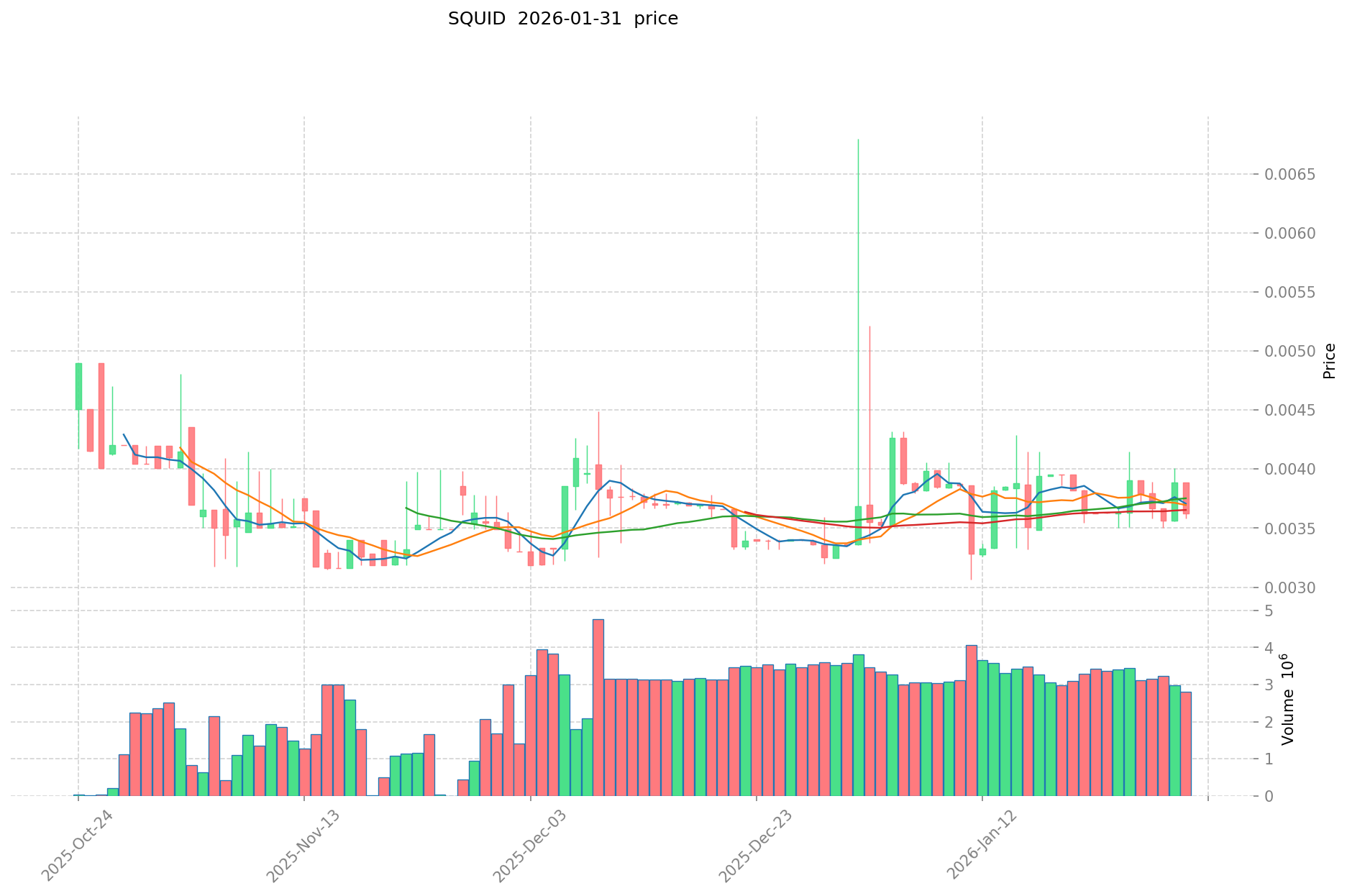
As of January 31, 2026, SQUID is trading at $0.003568, showing mixed short-term performance indicators. The token has experienced an 8.25% decline over the past 24 hours, with the price fluctuating between a 24-hour high of $0.003889 and a low of $0.003546. The hourly chart reflects a 1.56% decrease, indicating continued downward pressure in recent trading sessions.
On a weekly basis, SQUID has declined by 1.56%, while the 30-day performance shows a modest recovery of 6.38%, suggesting some stabilization attempts. However, the one-year performance remains negative at 25.67%, indicating ongoing challenges in sustained value appreciation.
The token maintains a market capitalization of approximately $2.85 million, with a total trading volume of $10,680.08 over the past 24 hours. SQUID holds a market ranking of 1855 and accounts for 0.000096% of the total cryptocurrency market share. With a circulating supply of 800 million tokens matching the maximum supply, the token has achieved 100% circulation, and the market cap to fully diluted valuation ratio stands at 100%.
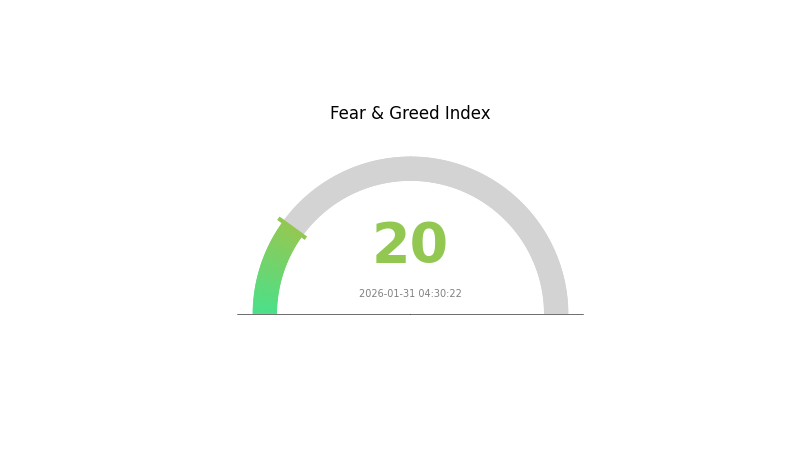
The token operates on the Binance Smart Chain (BSC) using the BEP-20 standard, with over 101,813 holders. Current market sentiment indicators show an extreme fear reading of 20 on the volatility index, reflecting cautious investor attitudes toward risk assets in the broader cryptocurrency market.
Click to view current SQUID market price
SQUID Market Sentiment Index
2026-01-31 Fear and Greed Index: 20 (Extreme Fear)
Click to view current Fear & Greed Index
The cryptocurrency market is experiencing extreme fear, with the index plummeting to 20. This indicates investors are highly cautious and risk-averse, reflecting significant market pessimism. During such periods, panic selling often dominates, creating downward pressure on asset prices. However, historically, extreme fear can present contrarian opportunities for long-term investors seeking favorable entry points. Market participants should remain vigilant, conduct thorough research, and avoid emotional decision-making. Consider diversifying your portfolio and maintaining a balanced strategy aligned with your risk tolerance on Gate.com.
SQUID Holding Distribution
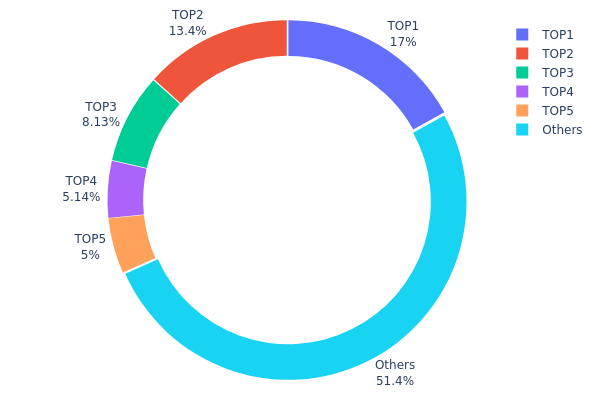
The holding distribution chart illustrates the allocation of SQUID tokens across different wallet addresses, providing insights into the token's ownership concentration and market structure. According to the current on-chain data, the top 5 addresses collectively hold approximately 48.57% of the total supply, while the remaining 51.43% is distributed among other holders.
The concentration pattern reveals a moderately centralized structure. The largest holder controls 16.96% of supply at address 0x4b6d...b5a500, followed by 13.35% at 0x683c...a8b718. Notably, the burn address (0x0000...00dead) ranks fourth with 5.14%, representing permanently removed tokens. This concentration level suggests that major holders possess significant influence over market liquidity and price dynamics, particularly during periods of reduced trading volume.
From a market structure perspective, this distribution pattern creates both opportunities and risks. The substantial holdings among top addresses could potentially lead to increased price volatility if these entities execute large-scale transactions. However, the fact that over half of the supply remains distributed among numerous smaller holders indicates a reasonable degree of decentralization, which helps maintain market stability and reduces the likelihood of coordinated manipulation. The presence of burned tokens also demonstrates a deflationary mechanism that could support long-term value retention.
Click to view current SQUID Holding Distribution
| Top |
Address |
Holding Qty |
Holding (%) |
| 1 |
0x4b6d...b5a500 |
135755.78K |
16.96% |
| 2 |
0x683c...a8b718 |
106856.91K |
13.35% |
| 3 |
0x77df...7107b7 |
65001.10K |
8.12% |
| 4 |
0x0000...00dead |
41128.98K |
5.14% |
| 5 |
0x3440...e7f0aa |
40001.01K |
5.00% |
| - |
Others |
411256.22K |
51.43% |
II. Core Factors Influencing SQUID's Future Price
Supply Mechanism
- NFT Burn Mechanism: SQUID employs a burn mechanism integrated with NFT functionality to create scarcity in the secondary market. This mechanism aims to reduce token supply systematically, potentially supporting price appreciation through decreased availability.
- Historical Pattern: Projects utilizing similar deflationary token economics have experienced periods of speculative interest, though sustainability depends on genuine utility rather than scarcity alone.
- Current Impact: The effectiveness of the burn mechanism will likely depend on sustained NFT market engagement and the project's ability to maintain user participation beyond initial speculation.
Institutional and Major Holder Dynamics
- Market Participation: SQUID gained attention as part of a broader meme coin investment trend, attracting speculative capital from retail investors seeking high-volatility opportunities.
- Investment Trends: The token's price movement appears closely tied to cyclical waves of speculation common in meme coin markets, where sentiment shifts rapidly based on social media trends and community engagement.
Macroeconomic Environment
- Market Sentiment: Cryptocurrency markets, including meme tokens like SQUID, remain sensitive to overall risk appetite in financial markets. Periods of risk-on sentiment tend to favor speculative assets.
- Competition Dynamics: SQUID operates in a highly competitive meme coin landscape where market share depends heavily on community momentum, viral marketing effectiveness, and sustained social media engagement.
Technology Development and Ecosystem Building
- Market Positioning: SQUID positions itself within the intersection of meme culture and NFT integration, attempting to differentiate through its burn mechanism tied to NFT activity.
- Regional Market Trends: Success in cryptocurrency projects often correlates with adoption patterns across key production and consumption regions, where technological infrastructure and regulatory frameworks support digital asset adoption.
III. 2026-2031 SQUID Price Prediction
2026 Outlook
- Conservative Prediction: $0.00221 - $0.00280
- Neutral Prediction: $0.00280 - $0.00356
- Optimistic Prediction: $0.00356 - $0.00384 (requires sustained market momentum and increased adoption)
Mid-term 2027-2029 Outlook
- Market Stage Expectation: SQUID may enter a gradual growth phase with moderate volatility as the project matures and expands its ecosystem
- Price Range Predictions:
- 2027: $0.00248 - $0.00466
- 2028: $0.00402 - $0.00506
- 2029: $0.00374 - $0.00504
- Key Catalysts: Technology development progress, community engagement expansion, and broader market sentiment shifts could serve as primary drivers
Long-term 2030-2031 Outlook
- Baseline Scenario: $0.00270 - $0.00483 (assuming steady ecosystem development and stable market conditions)
- Optimistic Scenario: $0.00483 - $0.00541 (with accelerated adoption and favorable regulatory environment)
- Transformative Scenario: $0.00541 - $0.00696 (under exceptional circumstances including breakthrough partnerships and significant market expansion)
- 2026-01-31: SQUID projected average price $0.00356 (early consolidation phase with potential upside momentum)
| Year |
Predicted High Price |
Predicted Average Price |
Predicted Low Price |
Price Change |
| 2026 |
0.00384 |
0.00356 |
0.00221 |
0 |
| 2027 |
0.00466 |
0.0037 |
0.00248 |
3 |
| 2028 |
0.00506 |
0.00418 |
0.00402 |
17 |
| 2029 |
0.00504 |
0.00462 |
0.00374 |
29 |
| 2030 |
0.00541 |
0.00483 |
0.0027 |
35 |
| 2031 |
0.00696 |
0.00512 |
0.00317 |
43 |
IV. SQUID Professional Investment Strategy and Risk Management
SQUID Investment Methodology
(1) Long-term Holding Strategy
- Target investors: Risk-tolerant investors with extended investment horizons who believe in the meme token ecosystem development
- Operational recommendations:
- Accumulate positions gradually during market downturns, avoiding concentrated purchases at single price points
- Monitor community developments and holder distribution trends (current holder count: 101,813)
- Storage solution: Use Gate Web3 Wallet for secure custody with multi-signature protection enabled
(2) Active Trading Strategy
- Technical analysis tools:
- Moving averages: Apply 20-day and 50-day moving averages to identify short-term trend reversals given recent volatility (-8.25% in 24h)
- Volume indicators: Monitor trading volume (current 24h volume: $10,680) relative to historical averages to gauge market sentiment
- Swing trading key points:
- Set stop-loss orders at 5-8% below entry points due to high volatility characteristics
- Consider taking partial profits when price approaches resistance levels, as demonstrated by 24h high of $0.003889
SQUID Risk Management Framework
(1) Asset Allocation Principles
- Conservative investors: 1-2% of crypto portfolio allocation maximum
- Aggressive investors: 3-5% allocation with strict stop-loss discipline
- Professional investors: Up to 5-8% with active hedging strategies deployed
(2) Risk Hedging Solutions
- Diversification approach: Balance SQUID holdings with stablecoins or established crypto assets to reduce concentrated exposure
- Position sizing: Implement scaled entry and exit strategies rather than all-in positions given the token's historical price fluctuations
(3) Security Storage Solutions
- Hot wallet recommendation: Gate Web3 Wallet for convenient trading access with adequate security features
- Cold storage option: Transfer majority holdings to hardware wallet solutions for long-term storage exceeding 30 days
- Security precautions: Enable two-factor authentication, verify contract addresses (0x87230146E138d3F296a9a77e497A2A83012e9Bc5 on BSC), and never share private keys
V. SQUID Potential Risks and Challenges
SQUID Market Risks
- High volatility exposure: SQUID has experienced significant price fluctuations with historical high of $0.251228 and low of $0.00000896, indicating substantial downside potential
- Limited liquidity risk: With 24-hour trading volume of $10,680, large orders may experience considerable slippage impacting execution prices
- Market sentiment dependency: As a meme token, SQUID's price is heavily influenced by social media trends and community activity rather than fundamental value metrics
SQUID Regulatory Risks
- Meme token classification uncertainty: Evolving regulatory frameworks may impose restrictions on meme-based tokens affecting trading availability
- Exchange listing risk: Limited exchange presence (trading on 1 exchange) may reduce accessibility if delisting occurs
- Compliance evolution: Regulatory authorities may introduce stricter requirements for token projects lacking clear utility functions
SQUID Technical Risks
- Smart contract vulnerability: Although deployed on BSC (BEP-20 standard), contract code requires ongoing security audits to prevent potential exploits
- Network dependency: Token functionality relies entirely on BSC network stability and security
- Historical precedent concerns: Given the project's association with previous controversial events in the meme token space, technical trust remains a consideration
VI. Conclusion and Action Recommendations
SQUID Investment Value Assessment
SQUID represents a speculative meme token within the BSC ecosystem with significant volatility characteristics. While the project maintains an active holder base of over 100,000 participants and has shown recent 30-day positive momentum (+6.38%), investors should recognize the inherently risky nature of meme token investments. The token's market capitalization of $2.85M and full circulation (100% of max supply) provide transparency, yet limited exchange presence and high price volatility present considerable challenges for risk-averse participants. Long-term value proposition remains uncertain given the meme-driven nature without clearly defined utility expansion.
SQUID Investment Recommendations
✅ Beginners: Start with minimal allocation (under 1% of portfolio), prioritize learning about meme token dynamics, and use Gate.com platform for secure trading with educational resources
✅ Experienced investors: Consider small speculative positions (2-3% allocation) with defined exit strategies, employ technical analysis for entry/exit timing, and maintain strict risk management protocols
✅ Institutional investors: Approach with extreme caution given liquidity constraints, conduct thorough due diligence on contract security, and implement hedged strategies if pursuing exposure to meme token market segment
SQUID Trading Participation Methods
- Spot trading: Execute direct buy/sell orders on Gate.com with real-time market pricing
- Dollar-cost averaging: Implement systematic purchase plans to mitigate timing risk across volatile price cycles
- Portfolio integration: Include SQUID as minor speculative component within diversified crypto portfolio strategy
Cryptocurrency investment carries extreme risk, and this article does not constitute investment advice. Investors should make prudent decisions based on their own risk tolerance and are advised to consult professional financial advisors. Never invest more than you can afford to lose.
FAQ
What is the current price of SQUID token? What are its all-time high and low prices?
SQUID token's current price fluctuates in real-time markets. Historical all-time high: ¥5.867000, all-time low: ¥0.017894. Monitor live price movements for latest trading data.
What is the expected price movement of SQUID over the next 6 months?
SQUID price is projected to fluctuate between 0.0259 and 0.03102 CNY over the next 6 months. Based on 2026 forecast data, the average price is expected around 0.02698 CNY. Actual movements will depend on market dynamics and trading volume trends.
What are the main factors affecting SQUID token price?
SQUID token price is primarily influenced by market demand, trading volume, overall market trends, investor sentiment, and project development progress. These factors collectively drive price movements in the crypto market.
How does SQUID's price correlation compare with mainstream cryptocurrencies like BTC and ETH?
SQUID shows moderate correlation with BTC and ETH, but with higher volatility. As a smaller market cap token, SQUID typically follows broader market trends during bull runs, yet experiences more dramatic price swings. Its correlation strengthens during major market movements but can decouple during altseason rallies.
How is the fundamental value of the SQUID project? How to evaluate the team background and technical strength?
SQUID boasts a strong team with solid technical expertise and clear whitepaper logic. The project demonstrates strong execution capabilities and well-defined use cases, supported by experienced industry professionals and proven technical implementation.
What are the main risks of investing in SQUID tokens?
SQUID tokens carry significant risks including potential rug pulls by issuers and extreme price volatility. Historical data shows the token price crashed 99.99%. Investors should exercise extreme caution and conduct thorough research before investing.
How is SQUID's market liquidity and trading volume? On which exchanges can it be traded?
SQUID has relatively limited liquidity and trading volume, available on select exchanges. The market remains niche with concentrated trading activity. For current exchange listings and real-time volume data, check major cryptocurrency tracking platforms for the most up-to-date information.
* The information is not intended to be and does not constitute financial advice or any other recommendation of any sort offered or endorsed by Gate.