This comprehensive article analyzes STARL token's price trajectory from 2026 to 2031, combining historical patterns and market dynamics. Currently trading at $0.0000001916 with a $1.91M market cap, STARL serves as the governance token for the Star Link metaverse and NFT ecosystem. The analysis projects potential price changes of 13% (2027) to 77% (2031), driven by ecosystem adoption and metaverse sector growth. The article provides professional investment strategies including long-term holding and active trading approaches, alongside critical risk management frameworks for conservative, aggressive, and professional investors. Key considerations include high volatility, low liquidity, and regulatory uncertainties. Access STARL spot trading on Gate.com to participate in this emerging metaverse project while carefully assessing your risk tolerance.
Introduction: STARL's Market Position and Investment Value
STARLINK (STARL), positioned as a decentralized virtual space metaverse and NFT ecosystem project, has been making strides in the blockchain space since its launch in 2021. As of 2026, STARL maintains a market capitalization of approximately $1.91 million, with a circulating supply of around 9.98 trillion tokens, and the price hovering around $0.0000001916. This community-owned asset, operating as the sole governance token of the Star Link metaverse ecosystem, is playing an increasingly important role in bridging centralized and decentralized search capabilities, virtual space gaming, and NFT transactions.
This article will comprehensively analyze STARL's price trends from 2026 to 2031, combining historical patterns, market supply and demand dynamics, ecosystem development, and macroeconomic conditions to provide investors with professional price forecasts and practical investment strategies.
I. STARL Price History Review and Current Market Status
STARL Historical Price Evolution Trajectory
- 2021: Token launched in February with initial deployment on Ethereum network, experiencing significant volatility in early trading months
- 2021: Reached price peak in November at $0.00008821, demonstrating strong market interest during the broader cryptocurrency market rally
- 2021-2026: Entered extended consolidation phase, with price declining from historical high to current levels around $0.0000001916
STARL Current Market Landscape
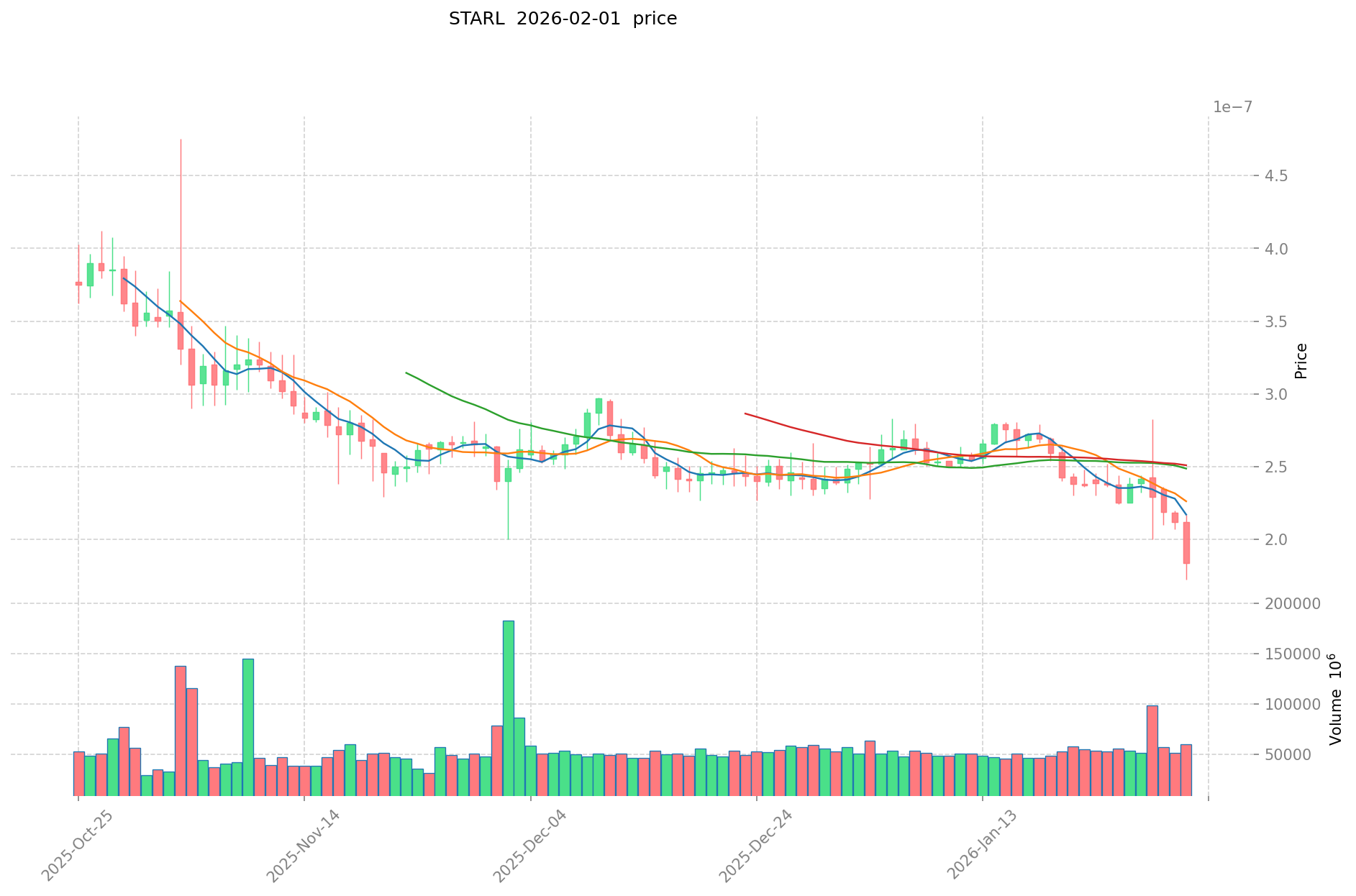
As of February 1, 2026, STARL is trading at $0.0000001916, representing a 9.98% decrease over the past 24 hours. The token has experienced notable price pressure across multiple timeframes, with a 18.47% decline over the past week and a 20.7% decrease over the past 30 days. The annual performance shows a 74.92% reduction from levels observed one year prior.
The 24-hour trading range spans from $0.0000001722 to $0.0000002151, with total trading volume reaching $11,916.06. The circulating supply stands at approximately 9.98 trillion tokens, representing 99.79% of the maximum supply of 10 trillion tokens. The current market capitalization is approximately $1.91 million, with the fully diluted valuation matching closely at $1.916 million, indicating minimal difference between circulating and total supply.
STARL maintains a presence across 2 exchanges and holds a token holder base of 39,536 addresses. The market capitalization to fully diluted valuation ratio stands at 99.79%, suggesting limited additional supply pressure from unreleased tokens. Market dominance remains at 0.000068% of the total cryptocurrency market.
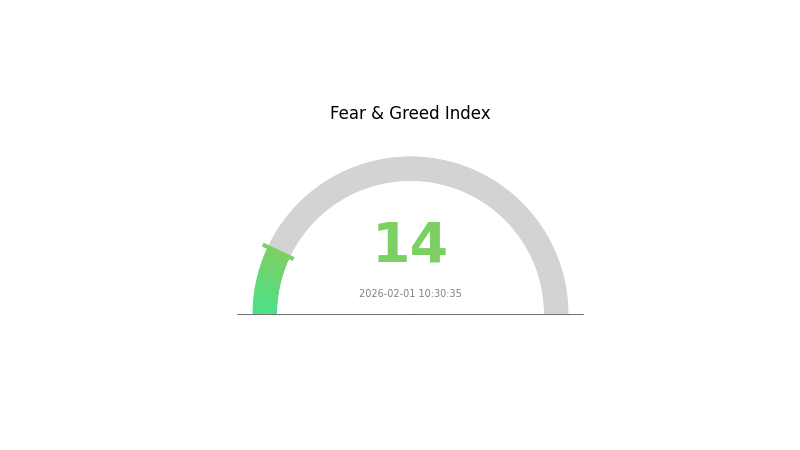
The broader market sentiment indicator reflects an "Extreme Fear" reading of 14 on the VIX scale, suggesting cautious market conditions across the cryptocurrency sector.
Click to view current STARL market price
STARL Market Sentiment Index
2026-02-01 Fear and Greed Index: 14 (Extreme Fear)
Click to view current Fear & Greed Index
The cryptocurrency market is currently experiencing extreme fear sentiment, with the index reading at 14. This exceptionally low level indicates heightened market pessimism and risk aversion among investors. During such periods of extreme fear, opportunities often emerge for contrarian investors who maintain conviction in long-term market fundamentals. However, extreme fear can also signal potential capitulation phases, making it crucial for traders to exercise caution and conduct thorough analysis. Market participants should monitor key support levels and consider defensive positioning strategies until sentiment stabilizes.
STARL Holding Distribution
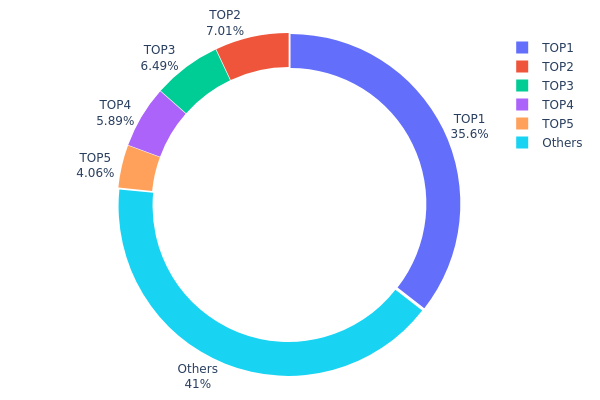
The holding distribution chart illustrates how STARL tokens are allocated across different wallet addresses, providing crucial insights into the token's ownership structure and concentration levels. By examining the percentage of supply held by top addresses versus smaller holders, analysts can assess the degree of decentralization and potential risks associated with concentrated ownership.
Based on the current data, STARL exhibits a moderately concentrated holding pattern. The top address holds approximately 35.55% of the total supply (3.56 trillion tokens), representing significant concentration in a single wallet. The top five addresses collectively control 58.98% of the circulating supply, while the remaining 41.02% is distributed among other holders. This concentration level suggests that a relatively small number of entities maintain substantial control over the token's supply, which could influence market dynamics and price movements.
Such a distribution structure carries both implications and risks for market stability. The dominant position of the largest holder introduces potential vulnerability to sudden large-scale sell-offs, which could trigger significant price volatility. Additionally, the concentrated ownership raises concerns about potential market manipulation, as major holders possess sufficient tokens to impact liquidity and price discovery mechanisms. However, the fact that over 40% remains distributed among smaller holders provides some cushion against complete centralization, maintaining a degree of market participation from the broader community.
Click to view the current STARL Holding Distribution
| Top |
Address |
Holding Qty |
Holding (%) |
| 1 |
0xa5e9...0d6b5e |
3555503138.23K |
35.55% |
| 2 |
0x91d4...c8debe |
700683290.34K |
7.00% |
| 3 |
0xb9e1...317231 |
648549158.40K |
6.48% |
| 4 |
0x1c4b...bb558c |
589205192.14K |
5.89% |
| 5 |
0x0d07...b492fe |
406195511.44K |
4.06% |
| - |
Others |
4099863709.44K |
41.02% |
II. Core Factors Influencing STARL Future Price Trends
Supply Mechanism
-
Market Demand and Adoption Trends: The price outlook of STARL is significantly influenced by market demand and the rate at which the token is adopted across various platforms and use cases. As adoption increases, demand for STARL typically rises, potentially driving price appreciation.
-
Historical Patterns: Historical data suggests that short-term price movements directly affect trading volumes. When prices rise, the quantity of tokens exchanged in transactions tends to increase correspondingly, reflecting heightened market activity and investor interest.
-
Current Impact: Long-term price stability and growth depend heavily on broader market development and regulatory policies. The evolving regulatory landscape and sustained ecosystem expansion will play crucial roles in determining STARL's future valuation trajectory.
Institutional and Major Holder Dynamics
Available materials do not provide specific information regarding institutional holdings, enterprise adoption, or national-level policies directly related to STARL.
Macroeconomic Environment
-
Monetary Policy Impact: Broader economic factors, including central bank monetary policies and interest rate adjustments, influence risk appetite in cryptocurrency markets. These macroeconomic conditions can indirectly affect STARL's price by shaping overall market sentiment and liquidity conditions.
-
Inflation Hedge Characteristics: While the provided materials do not specifically address STARL's performance as an inflation hedge, general market analysis indicates that macroeconomic factors contribute to cryptocurrency valuation dynamics.
-
Geopolitical Factors: International economic developments and geopolitical tensions may impact global financial markets, including cryptocurrency assets like STARL, though specific details were not available in the reference materials.
Technical Development and Ecosystem Building
The reference materials do not contain detailed information about specific technical upgrades, ecosystem applications, or DApp developments directly related to STARL.
III. 2026-2031 STARL Price Prediction
2026 Outlook
Based on the current market dynamics and technical indicators, STARL price predictions for 2026 remain uncertain due to limited historical data and market volatility. The token's performance will largely depend on broader market conditions and project-specific developments throughout the year.
2027-2029 Outlook
- Market Stage Expectation: The medium-term period may witness gradual market maturation as the metaverse and gaming sectors continue to evolve. STARL's growth trajectory will be influenced by its ecosystem expansion and user adoption rates.
- Price Range Predictions:
- 2027: Market data suggests potential price changes around 13% from baseline levels
- 2028: Projected movements indicate approximately 23% variation
- 2029: Analysis points to potential fluctuations near 39% range
- Key Catalysts: Ecosystem development, strategic partnerships within the metaverse space, and overall cryptocurrency market sentiment will serve as primary drivers for price movement during this period.
2030-2031 Long-term Outlook
- Baseline Scenario: Price changes may reach approximately 65% by 2030, assuming steady adoption of metaverse technologies and sustained interest in virtual space projects
- Optimistic Scenario: By 2031, projections suggest potential changes around 77% under favorable conditions including increased mainstream adoption of metaverse platforms and enhanced utility within the STARL ecosystem
- Transformative Scenario: Should breakthrough developments occur in virtual reality integration and significant institutional interest emerge, price performance could exceed current projections
Note: These predictions are based on available market analysis and should not be considered as financial advice. Cryptocurrency investments carry substantial risk, and actual prices may vary significantly from projections.
| Year |
Predicted High Price |
Predicted Average Price |
Predicted Low Price |
Price Change |
| 2026 |
0 |
0 |
0 |
0 |
| 2027 |
0 |
0 |
0 |
13 |
| 2028 |
0 |
0 |
0 |
23 |
| 2029 |
0 |
0 |
0 |
39 |
| 2030 |
0 |
0 |
0 |
65 |
| 2031 |
0 |
0 |
0 |
77 |
IV. STARL Professional Investment Strategy and Risk Management
STARL Investment Methodology
(1) Long-Term Holding Strategy
- Suitable for: Investors who believe in the metaverse and NFT ecosystem development with moderate to high risk tolerance
- Operation Recommendations:
- Consider gradual position building during market corrections to reduce average cost
- Set clear investment horizons (12-24 months minimum) given the metaverse sector's volatility
- Store assets in secure wallets like Gate Web3 Wallet for enhanced security
(2) Active Trading Strategy
- Technical Analysis Tools:
- Volume analysis: Monitor the 24-hour trading volume ($11,916) relative to market cap to identify liquidity patterns
- Support and resistance levels: Track key price levels based on 24H high ($0.0000002151) and low ($0.0000001722)
- Swing Trading Considerations:
- Monitor short-term volatility indicators given recent 24H decline of 9.98%
- Set stop-loss orders to manage downside risk in volatile market conditions
STARL Risk Management Framework
(1) Asset Allocation Principles
- Conservative investors: 1-2% of cryptocurrency portfolio
- Aggressive investors: 3-5% of cryptocurrency portfolio
- Professional investors: up to 8% with active monitoring and hedging strategies
(2) Risk Hedging Approaches
- Portfolio diversification: Balance STARL holdings with established cryptocurrencies and stablecoins
- Position sizing discipline: Limit individual position exposure based on market volatility
(3) Secure Storage Solutions
- Hot wallet recommendation: Gate Web3 Wallet for convenient trading and staking access
- Cold storage approach: Consider hardware wallet solutions for long-term holdings exceeding 5% of portfolio
- Security precautions: Enable two-factor authentication, regularly update wallet software, and never share private keys
V. STARL Potential Risks and Challenges
STARL Market Risks
- High volatility: Recent price performance shows -74.92% decline over 1 year, indicating significant market volatility
- Low liquidity: With 24H trading volume of approximately $11,916 and market cap around $1.91M, liquidity constraints may impact order execution
- Market sentiment dependency: Price performance closely tied to broader metaverse and NFT sector trends
STARL Regulatory Risks
- Metaverse token classification: Evolving regulatory frameworks may impact how metaverse tokens are classified and traded
- Cross-border compliance: Virtual asset projects may face varying regulatory requirements across different jurisdictions
- NFT-related regulations: Potential regulatory developments affecting NFT trading and gaming tokens
STARL Technical Risks
- Smart contract vulnerabilities: As an Ethereum-based token (contract address: 0x8e6cd950ad6ba651f6dd608dc70e5886b1aa6b24), exposure to potential smart contract bugs
- Network congestion: Dependency on Ethereum network performance may affect transaction speeds and costs
- Project execution risk: Success depends on continued development and adoption of the StarLink metaverse ecosystem
VI. Conclusion and Action Recommendations
STARL Investment Value Assessment
STARL represents a community-owned metaverse and NFT project with governance token utility within its ecosystem. While the project offers exposure to the metaverse sector, investors should note the significant price decline of 74.92% over the past year and current low liquidity profile. The token's value proposition centers on virtual space gaming, NFT auctions, and decentralized metaverse exploration. However, the highly competitive metaverse landscape and current market conditions present considerable short-term risks. Long-term value depends on successful ecosystem development and sustained user adoption.
STARL Investment Recommendations
✅ Beginners: Avoid or limit exposure to micro-cap positions; consider starting with more established cryptocurrencies
✅ Experienced investors: If interested, limit allocation to 1-3% of crypto portfolio and conduct thorough due diligence on project developments
✅ Institutional investors: Consider as a speculative allocation within metaverse-focused portfolios with proper risk controls
STARL Trading Participation Methods
- Spot trading: Available on Gate.com with ETH trading pairs for direct token purchase
- DeFi platforms: Access decentralized exchanges supporting the token's Ethereum contract
- Portfolio tracking: Monitor position performance using Gate.com's portfolio management tools
Cryptocurrency investment carries high risks, and this article does not constitute investment advice. Investors should make prudent decisions based on their own risk tolerance and are advised to consult professional financial advisors. Never invest more than you can afford to lose.
FAQ
What is STARL? What are its practical applications?
STARL is an upgraded metaverse platform with diverse applications spanning gaming, NFTs, music, virtual space tourism, and virtual reality conferences across entertainment, culture, commerce, and education sectors.
What is the historical price trend of STARL token? What stage is it currently in?
STARL token is currently trading at 0.0000002387 USD with a market cap of 2.34M USD and 24-hour trading volume of 4,051,571,920.5 USD. The token is in an early accumulation stage with significant growth potential ahead.
What is the STARL price prediction for 2024-2025? What factors are based on?
STARL price prediction for 2024-2025 is based on market trends, supply-demand dynamics, and ecosystem development. Predictions vary due to market volatility. Specific price targets depend on adoption rate, trading volume, and overall crypto market conditions.
What are the main factors affecting STARL price?
STARL price is primarily influenced by halving events, Ethereum upgrades, whale fund movements, ETF approvals, and exchange listings. These factors directly drive STARL price volatility and market movements.
What are the risks of investing in STARL tokens and what should I pay attention to?
STARL token investments involve market volatility and potential losses. Assess your risk tolerance carefully and make rational investment decisions based on your financial situation and goals.
What are STARL's advantages and disadvantages compared to similar tokens?
STARL offers fast transaction speeds and low fees, but has lower market recognition and liquidity. Its ecosystem is still developing compared to mainstream tokens.
What is the team background and roadmap of the STARL project?
STARL is led by seasoned executives and technical experts from renowned companies like Google, Morgan Stanley, Facebook, and PayPal. The project has a clear development roadmap with multiple launched applications and plans for continuous expansion in the future.
* The information is not intended to be and does not constitute financial advice or any other recommendation of any sort offered or endorsed by Gate.