This comprehensive analysis examines Taraxa (TARA), an IoT-focused blockchain platform with Block-DAG topology, exploring its market trajectory from 2026 to 2031. Currently trading at $0.0003185 with extreme fear sentiment (index: 14), TARA faces significant challenges including 94.19% annual decline and concentrated token holdings. The article projects price ranges from $0.00029-$0.00035 in 2026 to $0.00035-$0.00092 by 2031, contingent on ecosystem adoption and favorable market conditions. Strategic guidance covers long-term holding and active trading approaches through Gate.com, alongside essential risk management frameworks including conservative portfolio allocation of 1-10% and diversification strategies. Investors face substantial volatility and liquidity risks requiring careful due diligence and risk tolerance assessment before participation.
Introduction: TARA's Market Position and Investment Value
Taraxa (TARA), positioned as a fast and scalable IoT-device-friendly public ledger, has been working to enhance the credibility, anonymity, and value of the IoT ecosystem since its launch in 2021. As of 2026, TARA maintains a market capitalization of approximately $1.92 million, with a circulating supply of around 6.02 billion tokens and a current price hovering near $0.0003185. This asset, recognized for its innovative Block-DAG topology and concurrent VM processing capabilities, is playing an increasingly important role in enabling secure device-to-device services and transactions within the Internet of Things space.
This article will comprehensively analyze TARA's price trends from 2026 to 2031, combining historical patterns, market supply and demand dynamics, ecosystem development, and macroeconomic conditions to provide investors with professional price forecasts and practical investment strategies.
I. TARA Price History Review and Market Status
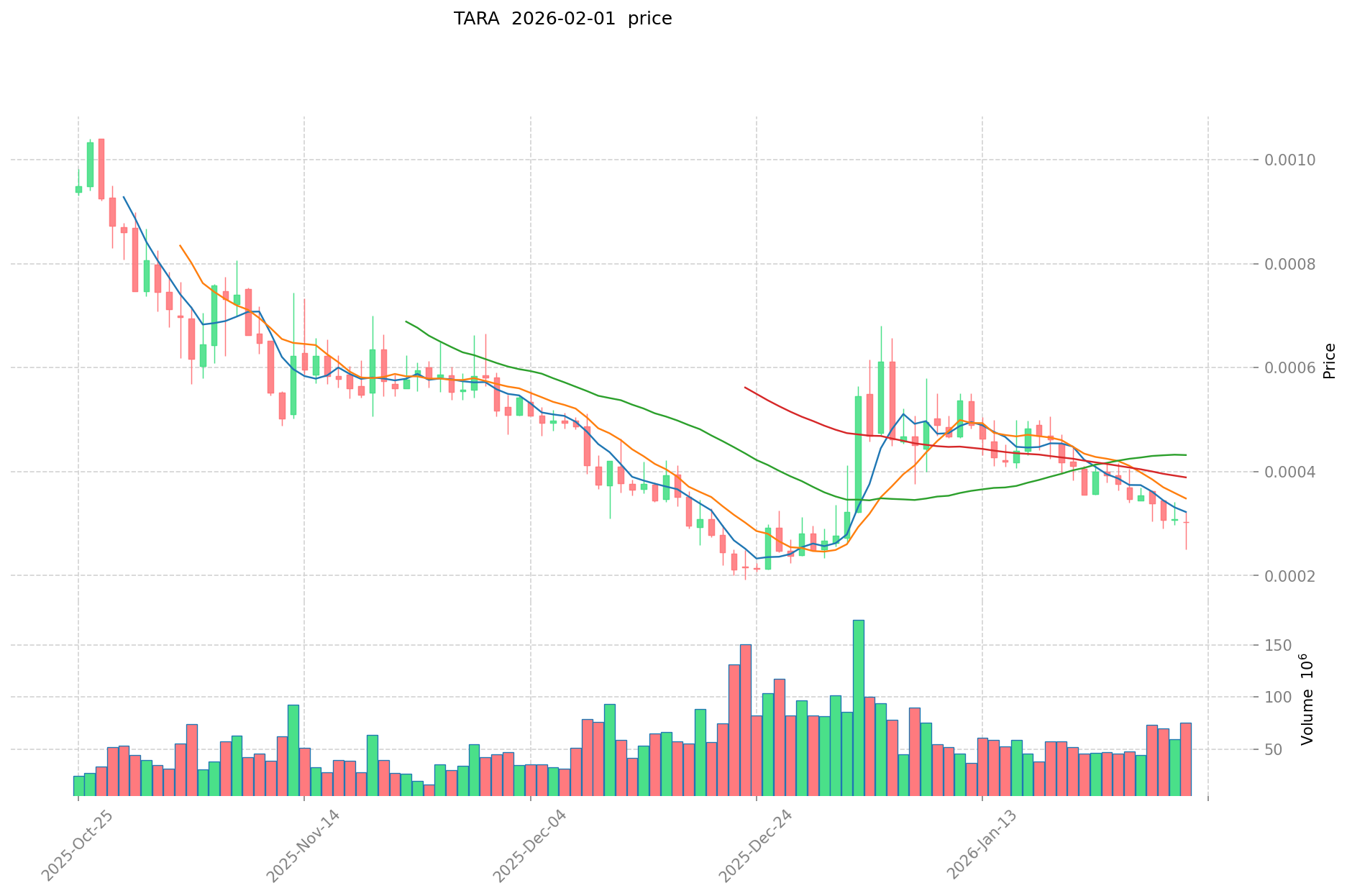
TARA Historical Price Evolution Trajectory
- 2021: TARA launched on exchanges in March, with the price reaching a peak of $0.07045 on March 22, marking an early high point in its trading history.
- 2025: The token experienced significant volatility throughout the year, with the price declining to a recorded low of $0.00019902 on December 23, reflecting broader market pressures.
- 2026: As of early February, TARA is trading at $0.0003185, showing a recovery of approximately 60% from the December 2025 low, though still substantially below historical peaks.
TARA Current Market Status
As of February 1, 2026, TARA is priced at $0.0003185, with a 24-hour trading volume of $23,839.68. The token has demonstrated mixed short-term performance, with a 3.79% increase over the past 24 hours, contrasting with a decline of 5.29% in the past hour. The 24-hour price range spans from $0.00025 to $0.0003402, indicating notable intraday volatility.
The broader trend shows downward pressure, with TARA declining 20.27% over the past week and 26.72% over the past month. The annual performance reflects a decline of 94.19% from year-ago levels, highlighting the challenges faced by the token in the current market environment.
TARA's market capitalization stands at approximately $1.92 million, with a circulating supply of 6.02 billion tokens representing 50.2% of the total supply of 10.96 billion tokens. The fully diluted market cap is estimated at $3.49 million based on a maximum supply of 12 billion tokens. The token maintains a market dominance of 0.00012%, ranking at position 2077 in the broader cryptocurrency market.
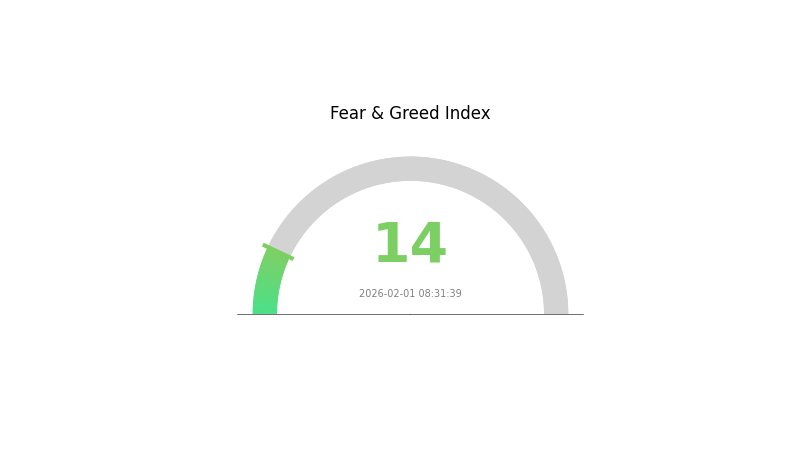
The current market sentiment index indicates a reading of 14, characterized as "Extreme Fear," reflecting cautious investor attitudes in the cryptocurrency sector. TARA is currently traded on three exchanges, with Gate.com providing access to the token for interested participants.
Click to view the current TARA market price
TARA Market Sentiment Index
2026-02-01 Fear and Greed Index: 14 (Extreme Fear)
Click to view the current Fear & Greed Index
The market is currently experiencing extreme fear, with the Fear and Greed Index at 14. This indicates significant investor anxiety and pessimism in the cryptocurrency market. Such extreme fear conditions often present buying opportunities for contrarian investors, as panic selling may create undervalued assets. However, caution is advised, as further market deterioration remains possible. Monitor key support levels closely and consider your risk tolerance carefully before making any trading decisions during this volatile period.
TARA Position Distribution
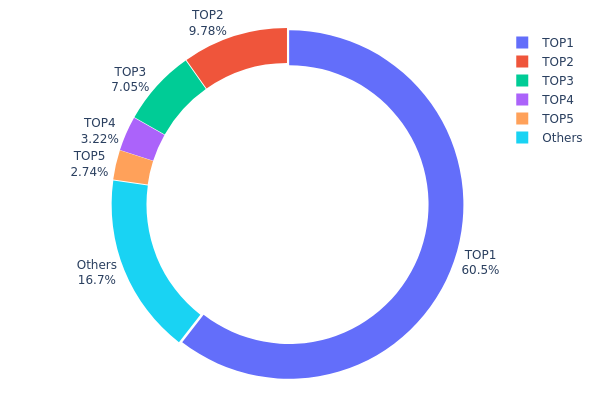
The position distribution chart illustrates the concentration of token holdings across different wallet addresses, serving as a critical metric for assessing decentralization and potential market manipulation risks. By analyzing how tokens are distributed among top holders versus the broader community, investors can gauge the health of the project's on-chain structure and the likelihood of coordinated price movements.
Based on current data, TARA exhibits a highly concentrated holding pattern with the top address controlling 60.51% of the total supply (6,123,883.20K tokens). The top five addresses collectively hold 83.29% of all circulating tokens, leaving only 16.71% distributed among other participants. This extreme concentration, particularly the dominant position of the largest holder, creates significant centralization concerns and heightens vulnerability to single-entity price manipulation.
Such concentration levels pose substantial risks to market stability. The dominant holder possesses sufficient supply to materially impact liquidity and price discovery, potentially executing large-scale sell-offs that could trigger cascading liquidations. Additionally, this distribution pattern suggests limited genuine decentralization, as decision-making power and market influence remain concentrated within a narrow group of stakeholders. For prospective investors, this concentration profile warrants careful consideration, as price movements may be more susceptible to insider actions rather than organic market dynamics.
Click to view current TARA Position Distribution
| Top |
Address |
Holding Qty |
Holding (%) |
| 1 |
0x7233...080a1b |
6123883.20K |
60.51% |
| 2 |
0xd621...d19a2c |
990141.17K |
9.78% |
| 3 |
0x7af5...61995b |
713555.81K |
7.05% |
| 4 |
0x0d07...b492fe |
326166.58K |
3.22% |
| 5 |
0x7d97...c17367 |
277194.91K |
2.73% |
| - |
Others |
1688857.92K |
16.71% |
II. Core Factors Influencing TARA's Future Price
Market Sentiment and Overall Conditions
- Market Sentiment Impact: TARA's price trajectory is significantly influenced by prevailing market sentiment within the cryptocurrency sector. Positive sentiment across broader digital asset markets tends to support price appreciation, while negative sentiment can exert downward pressure.
- Overall Market Conditions: The token's performance remains closely tied to macroeconomic trends and general cryptocurrency market dynamics. Market-wide movements often correlate with TARA's price action, as investor risk appetite fluctuates in response to broader economic indicators.
- Investor Confidence: The level of confidence among investors plays a crucial role in determining TARA's valuation. Strong investor conviction, driven by project developments or positive market conditions, can support sustained price growth.
Technological Advancements
- Technology Development: Ongoing technological innovation represents a core element affecting TARA's value proposition. Advances in the project's underlying technology could enhance its utility and attractiveness to users and investors.
- Security and Transparency: Improvements in security protocols and transparency mechanisms may strengthen the platform's credibility and user trust, potentially supporting price stability and growth.
Regulatory Environment
- Regulatory Changes: Shifts in regulatory frameworks across different jurisdictions can significantly impact TARA's market dynamics. Favorable regulatory developments may encourage adoption, while restrictive measures could present headwinds.
- Compliance Factors: The project's ability to adapt to evolving regulatory requirements may influence its long-term viability and market positioning.
Competitive Landscape
- Sector Competition: TARA operates within a competitive environment where numerous projects vie for market share and user adoption. The project's ability to differentiate itself and maintain competitive advantages will be crucial for its price performance.
- Market Positioning: TARA's relative positioning within its sector, including its technological capabilities and ecosystem development, influences investor perception and valuation.
III. 2026-2031 TARA Price Forecast
2026 Outlook
- Conservative Forecast: $0.00029 - $0.00032
- Neutral Forecast: $0.00032 (average)
- Optimistic Forecast: $0.00035 (requiring favorable market conditions and sustained momentum)
2027-2029 Mid-term Outlook
- Market Stage Expectation: The token may experience gradual accumulation and development phase, with potential volatility as the project matures and expands its ecosystem.
- Price Range Forecast:
- 2027: $0.00028 - $0.00042
- 2028: $0.00022 - $0.00055
- 2029: $0.00037 - $0.00057
- Key Catalysts: Broader adoption, ecosystem expansion, potential technological improvements, and overall crypto market sentiment may serve as primary drivers.
2030-2031 Long-term Outlook
- Baseline Scenario: $0.00029 - $0.00075 (assuming steady growth and moderate market conditions)
- Optimistic Scenario: $0.00052 - $0.00092 (assuming enhanced adoption, strong partnerships, and favorable regulatory environment)
- Transformative Scenario: Up to $0.00092 (under exceptionally favorable conditions including mainstream adoption and significant technological breakthroughs)
- 2031-12-31: TARA could potentially reach $0.00092 (representing substantial growth from current levels)
| Year |
Predicted High Price |
Predicted Average Price |
Predicted Low Price |
Price Change |
| 2026 |
0.00035 |
0.00032 |
0.00029 |
1 |
| 2027 |
0.00042 |
0.00034 |
0.00028 |
5 |
| 2028 |
0.00055 |
0.00038 |
0.00022 |
19 |
| 2029 |
0.00057 |
0.00046 |
0.00037 |
45 |
| 2030 |
0.00075 |
0.00052 |
0.00029 |
61 |
| 2031 |
0.00092 |
0.00063 |
0.00035 |
99 |
IV. TARA Professional Investment Strategy and Risk Management
TARA Investment Methodology
(1) Long-term Holding Strategy
- Suitable for: Investors interested in IoT blockchain infrastructure with higher risk tolerance
- Operational Recommendations:
- Consider accumulating positions during market downturns, given the token's current distance from its historical high
- Monitor project developments in IoT ecosystem partnerships and technological advancements
- Utilize secure storage solutions such as Gate Web3 Wallet for long-term holdings
(2) Active Trading Strategy
- Technical Analysis Tools:
- Volume Analysis: Monitor the 24-hour trading volume of approximately $23,839 to gauge market liquidity and trading interest
- Price Range Trading: Utilize the 24-hour range between $0.00025 and $0.0003402 to identify potential entry and exit points
- Swing Trading Considerations:
- Be aware of recent price volatility, with a 7-day decline of 20.27% and 30-day decline of 26.72%
- Set appropriate stop-loss levels to manage downside risk in volatile market conditions
TARA Risk Management Framework
(1) Asset Allocation Principles
- Conservative Investors: 1-2% of crypto portfolio allocation
- Active Investors: 3-5% of crypto portfolio allocation
- Professional Investors: Up to 8-10% with active monitoring and risk management protocols
(2) Risk Hedging Solutions
- Diversification Strategy: Balance TARA holdings with more established cryptocurrencies and stablecoins
- Position Sizing: Limit exposure based on the token's market capitalization of approximately $1.92 million and ranking of 2077
(3) Secure Storage Solutions
- Software Wallet Recommendation: Gate Web3 Wallet for convenient access and trading
- Multi-signature Solutions: Consider multi-signature wallets for larger holdings
- Security Precautions: Enable two-factor authentication, maintain backup recovery phrases in secure offline locations, and never share private keys
V. TARA Potential Risks and Challenges
TARA Market Risks
- High Volatility: The token has experienced significant price fluctuations, with a one-year decline of 94.19% from previous levels
- Limited Liquidity: With a relatively low 24-hour trading volume and market capitalization, the token may experience liquidity constraints
- Low Market Share: TARA holds only 0.00012% market dominance, indicating limited market recognition and adoption
TARA Regulatory Risks
- IoT Sector Regulations: Evolving regulations regarding IoT data privacy and blockchain integration may impact project development
- Compliance Requirements: Potential regulatory changes in jurisdictions where the project operates could affect token utility and value
- Cross-border Considerations: International regulatory frameworks for blockchain-based IoT solutions remain uncertain
TARA Technical Risks
- Adoption Challenges: The success of Taraxa's IoT-focused blockchain depends on widespread adoption by device manufacturers and ecosystem participants
- Competition: Facing competition from other blockchain platforms targeting the IoT sector
- Technology Complexity: The implementation of Block-DAG topology and concurrent processing VM requires continuous development and testing
VI. Conclusion and Action Recommendations
TARA Investment Value Assessment
Taraxa presents an innovative approach to IoT blockchain infrastructure with its Block-DAG topology and device-friendly design. However, the token faces significant challenges, including substantial price decline over the past year, limited market capitalization, and relatively low liquidity. The project's long-term value proposition depends on successful IoT ecosystem adoption and technological advancement. Short-term risks include continued market volatility and low trading volume, which may impact price stability and liquidity.
TARA Investment Recommendations
✅ Beginners: Consider waiting for more market stability and project maturity before allocation; if investing, limit exposure to 1-2% of total crypto portfolio
✅ Experienced Investors: May consider small speculative positions (3-5% allocation) with strict risk management protocols and active monitoring of project developments
✅ Institutional Investors: Conduct thorough due diligence on technology implementation, team credentials, and partnership developments before considering any allocation
TARA Trading Participation Methods
- Spot Trading: Purchase TARA tokens through Gate.com spot markets for direct ownership
- Dollar-cost Averaging: Gradually accumulate positions over time to mitigate timing risk
- Strategic Position Building: Monitor project announcements and ecosystem developments for potential accumulation opportunities
Cryptocurrency investment carries extremely high risks, and this article does not constitute investment advice. Investors should make cautious decisions based on their own risk tolerance and are advised to consult professional financial advisors. Never invest more than you can afford to lose.
FAQ
What is the future price prediction for TARA token?
TARA token price predictions are uncertain, but historically reached a peak of $0.077282. Given market volatility and adoption growth, analysts suggest potential upside towards $0.05-$0.15 range, though outcomes remain highly speculative and market-dependent.
What are the main factors affecting TARA price?
TARA price is primarily influenced by market supply and demand dynamics, protocol upgrades, macroeconomic changes such as interest rates and inflation, and regulatory policy shifts including ETF approvals.
What is the current market cap and circulating supply of TARA token?
TARA's market cap is approximately $2,296,918 with a circulating supply of 6,035,734,680 tokens. The maximum supply is 12 billion TARA tokens.
What are the technical advantages and application scenarios of the Taraxa project?
Taraxa offers high-speed, scalable blockchain technology optimized for enterprise decision-making and data management. Its device-friendly protocol enhances stakeholder efficiency through decentralized consensus mechanisms suitable for business applications.
What are the risks to pay attention to when investing in TARA tokens?
TARA token investment carries volatility risk with potential principal loss. Market uncertainty and price fluctuations are inherent. Investors assume full responsibility for investment decisions in this high-risk asset class.
What are the differences between TARA and other public chain tokens?
TARA has a total supply of 10 billion tokens designed for network transactions and node verification. Holders use TARA to pay transaction fees, which become node rewards. Unlike other public chain tokens, TARA's primary focus is network transaction efficiency and validator incentives.
What is the price trend prediction for TARA in 2024-2025?
TARA's predicted price range for 2024-2025 is between $0.000176 and $0.000224, based on market analysis and trends. Actual prices may vary depending on market conditions and adoption growth.
What is the liquidity of TARA on mainstream exchanges?
TARA has relatively limited liquidity on mainstream exchanges with only a few listing platforms. The 24-hour trading volume is not particularly significant, indicating moderate liquidity levels in the current market.
* The information is not intended to be and does not constitute financial advice or any other recommendation of any sort offered or endorsed by Gate.