This article provides comprehensive analysis of Ultra (UOS), a blockchain gaming distribution platform with current market cap of $4.47 million trading at $0.008854. As of January 2026, UOS presents a high-risk investment opportunity in the $140 billion gaming industry. The analysis combines historical price data, market dynamics, and macroeconomic conditions to forecast price movements through 2031, projecting ranges from $0.00752-$0.01295 in 2026 to $0.01063-$0.02598 by 2031. The article examines core influencing factors including macroeconomic conditions, supply mechanisms, and ecosystem development while addressing significant risks including high volatility, limited liquidity, and regulatory uncertainties. Professional investment strategies on Gate exchange include long-term holding and active trading approaches with detailed risk management frameworks. Suitable for investors seeking blockchain gaming exposure, though beginners should limit allocation to under 1% portfolio. Cryptocurrency investment carr
Introduction: UOS Market Position and Investment Value
Ultra (UOS), positioned as a blockchain-powered gaming distribution platform challenging traditional industry giants, has been making strides in the gaming sector since its launch in 2019. As of January 29, 2026, UOS maintains a market capitalization of approximately $4.47 million, with a circulating supply of around 504.5 million tokens, and a current price hovering near $0.008854. This asset, designed to revolutionize the $140 billion gaming industry, is playing an increasingly important role in decentralized gaming distribution and virtual goods trading.
This article will comprehensively analyze UOS price movements from 2026 to 2031, combining historical patterns, market supply and demand dynamics, ecosystem development, and macroeconomic conditions to provide investors with professional price forecasts and practical investment strategies.
I. UOS Price History Review and Market Status
UOS Historical Price Evolution Trajectory
- 2019: Ultra platform launched in public beta in October, with initial offering price at $0.05
- 2021: Price reached all-time high of $2.49 on November 25, representing significant growth from launch price
- 2025: Market experienced substantial correction, with price dropping to all-time low of $0.00773489 on December 17
UOS Current Market Status
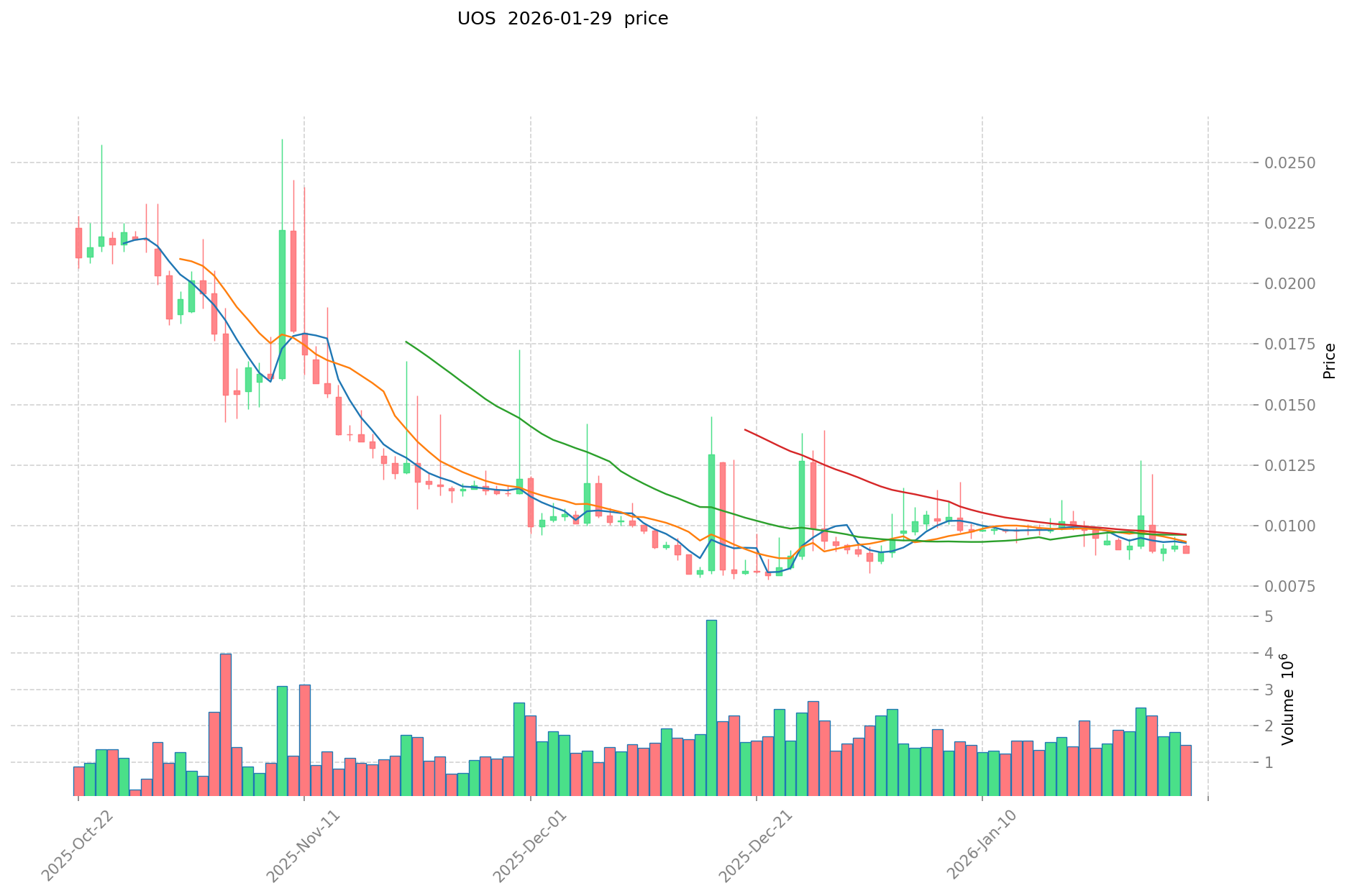
As of January 29, 2026, UOS is trading at $0.008854, showing slight recovery from its December 2025 low. The token has experienced mixed short-term performance, with a modest increase of 0.05% over the past hour, while facing downward pressure with a 2.13% decline over 24 hours and 4.38% decrease over the past week.
The current market capitalization stands at approximately $4.47 million, with 504.5 million UOS tokens in circulation, representing 50.45% of the maximum supply of 1 billion tokens. The fully diluted market cap is calculated at $8.85 million. Trading volume over the past 24 hours reached $12,814.94, indicating relatively moderate market activity.
UOS currently ranks #1601 in the cryptocurrency market, with a market dominance of 0.00028%. The token is trading significantly below its all-time high, down 90.86% over the past year. The 24-hour price range has been between $0.008738 and $0.009232.
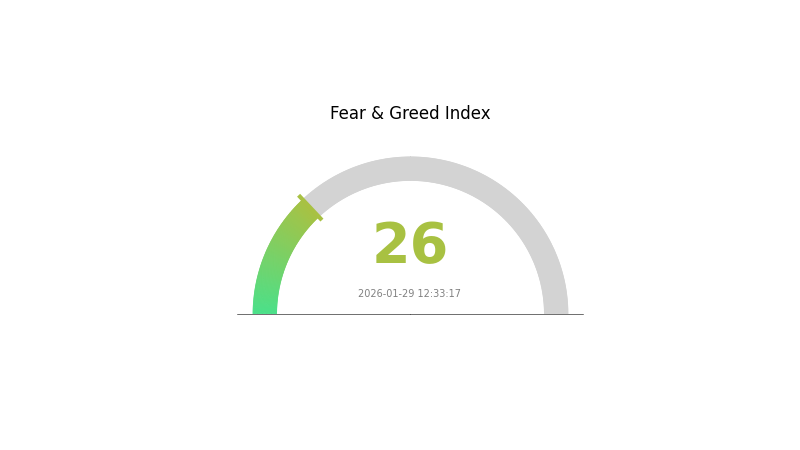
The token's current price represents a 99.64% decline from its November 2021 peak, while showing approximately 14.49% recovery from its all-time low recorded in December 2025. The market sentiment index indicates a fear level of 26, suggesting cautious investor sentiment in the broader market.
Click to view current UOS market price
UOS Market Sentiment Indicator
2026-01-29 Fear and Greed Index: 26 (Fear)
Click to view the current Fear & Greed Index
The cryptocurrency market is currently experiencing fear sentiment with an index reading of 26. This indicates heightened market anxiety and risk aversion among investors. When the Fear and Greed Index falls into the fear zone, it typically reflects increased market volatility and pessimistic sentiment. Investors may be reconsidering their positions as uncertainty rises. This environment often presents opportunities for contrarian investors, though cautious risk management remains essential during periods of elevated market fear.
UOS Holding Distribution
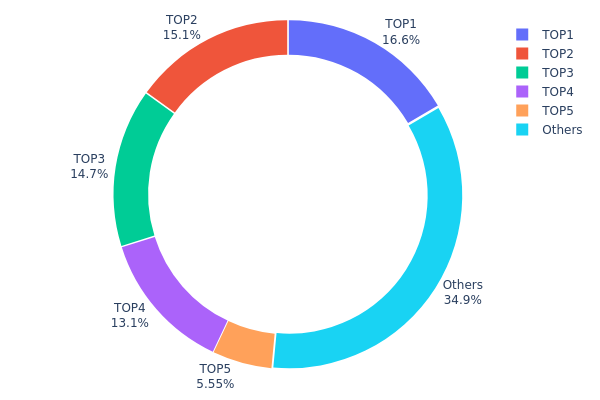
The holding distribution chart illustrates the concentration of UOS tokens across different wallet addresses, providing insights into the decentralization level and potential market control dynamics. By examining the percentage of total supply held by top addresses versus smaller holders, this metric helps assess the risk of price manipulation and the overall health of token distribution.
Based on the current data, UOS exhibits a notably high concentration pattern. The top five addresses collectively hold approximately 64.05% of the total supply, with the largest single address controlling 16.55% (165,523.20K UOS). The second and third largest holders possess 15.10% and 14.73% respectively, while the fourth address accounts for 13.13%. Only 34.95% of tokens are distributed among other addresses, indicating a relatively centralized holding structure.
This concentration level presents several implications for market dynamics. The dominance of top holders suggests potential vulnerability to large-scale sell pressure if major addresses decide to liquidate positions. Such concentrated ownership typically correlates with higher price volatility, as significant transactions from whale addresses can dramatically impact market liquidity and price stability. Additionally, the current distribution pattern may limit the project's decentralization objectives and increase susceptibility to coordinated market movements. From a structural perspective, this holding concentration warrants careful monitoring, as shifts in major holder behavior could signal important changes in market sentiment and project fundamentals.
Click to view current UOS Holding Distribution
| Top |
Address |
Holding Qty |
Holding (%) |
| 1 |
0xca5f...fbbc26 |
165523.20K |
16.55% |
| 2 |
0xa353...e1ecf1 |
151036.66K |
15.10% |
| 3 |
0x7b5d...2cf8b1 |
147300.00K |
14.73% |
| 4 |
0xd13c...ab5c8c |
131301.19K |
13.13% |
| 5 |
0xc9e8...5e87ca |
55478.11K |
5.54% |
| - |
Others |
349360.84K |
34.95% |
II. Core Factors Influencing UOS Future Price
Supply Mechanism
Based on available information, specific supply mechanism details for UOS are not provided in the reference materials. The token's supply dynamics would typically influence price through factors such as emission schedules, staking mechanisms, or burn protocols, though concrete data regarding UOS's particular approach remains unavailable for detailed analysis.
Institutional and Major Holder Dynamics
The reference materials do not contain specific information regarding institutional holdings, corporate adoption patterns, or national-level policies directly related to UOS. Institutional participation and corporate integration typically serve as significant price catalysts in cryptocurrency markets, though quantifiable data for UOS in this regard is not currently accessible through the provided sources.
Macroeconomic Environment
-
Monetary Policy Impact: According to market analysis, the Federal Reserve is widely expected to maintain its benchmark interest rate in the 3.50%-3.75% range during its January 27-28, 2026 meeting, with approximately 98% probability. Economists surveyed suggest rates may remain unchanged throughout the first quarter, representing a significant shift from previous expectations of potential rate cuts in March. This monetary policy stance influences the broader cryptocurrency market by affecting liquidity conditions and risk asset valuations.
-
Inflation Hedge Attributes: While specific data on UOS's performance during inflationary periods is unavailable, the broader cryptocurrency market has shown mixed responses to inflation dynamics, with investor focus shifting between traditional safe-haven assets and digital alternatives depending on macroeconomic conditions.
-
Geopolitical Factors: Recent geopolitical developments have created market volatility, with investors seeking alternatives to dollar-denominated assets. Spot silver reached historic three-digit levels, surging 7% to break through the $100 threshold for the first time, while spot gold climbed over 8% in a week—marking the largest weekly gain in nearly six years. These movements suggest heightened uncertainty driving capital into alternative assets, a dynamic that could influence cryptocurrency markets including tokens like UOS.
Technological Development and Ecosystem Building
The provided reference materials do not contain specific information regarding UOS's technological upgrades, development roadmap, or ecosystem applications. Technological advancement and ecosystem expansion typically represent critical factors in determining a cryptocurrency's long-term value proposition, though concrete details about UOS's development initiatives, DApp integration, or ecosystem projects are not available in the current data set for comprehensive analysis.
Market participants should note that cryptocurrency investments carry substantial risk, and regulatory developments—including potential U.S. crypto regulation frameworks such as the CLARITY Act being considered by the Senate Agriculture Committee—may significantly impact market dynamics. The absence of detailed project-specific information in available materials suggests investors should conduct thorough independent research before making investment decisions regarding UOS.
III. 2026-2031 UOS Price Prediction
2026 Outlook
- Conservative forecast: $0.00752 - $0.00906
- Neutral forecast: $0.00906 (average price level)
- Optimistic forecast: $0.01295 (requiring favorable market conditions and positive sentiment)
Based on the predictive model, UOS is expected to experience modest growth in 2026, with price variations ranging from $0.00752 to $0.01295. The average price is projected at $0.00906, representing approximately 2% change from baseline levels.
2027-2029 Mid-term Outlook
- Market stage expectation: Potential entry into a progressive growth phase with gradual price appreciation
- Price range predictions:
- 2027: $0.01045 - $0.01474 (24% projected change)
- 2028: $0.00888 - $0.01493 (45% projected change)
- 2029: $0.01112 - $0.01779 (57% projected change)
- Key catalysts: Sustained ecosystem development, increased adoption rates, and broader market recovery trends could serve as primary drivers for price advancement during this period.
The mid-term trajectory suggests progressive strengthening, with 2029 potentially marking a significant inflection point as the projected change reaches 57%, indicating enhanced market confidence.
2030-2031 Long-term Outlook
- Baseline scenario: $0.01585 - $0.01902 (assuming steady ecosystem growth and stable market conditions)
- Optimistic scenario: $0.02598 (assuming accelerated adoption, strategic partnerships, and favorable regulatory environment)
- Transformative scenario: Beyond $0.02598 (contingent upon breakthrough developments, mainstream integration, or exceptional market bull cycles)
By 2031, UOS could potentially reach $0.02598 in the high-end projection, representing a 96% cumulative change from the baseline period. This long-term forecast assumes continued project development, sustained community engagement, and favorable macroeconomic conditions for digital assets. The progressive price trajectory from 2026 through 2031 reflects anticipated maturation of the UOS ecosystem and potential value appreciation over a multi-year horizon.
| Year |
Predicted High Price |
Predicted Average Price |
Predicted Low Price |
Price Change |
| 2026 |
0.01295 |
0.00906 |
0.00752 |
2 |
| 2027 |
0.01474 |
0.011 |
0.01045 |
24 |
| 2028 |
0.01493 |
0.01287 |
0.00888 |
45 |
| 2029 |
0.01779 |
0.0139 |
0.01112 |
57 |
| 2030 |
0.01902 |
0.01585 |
0.00967 |
78 |
| 2031 |
0.02598 |
0.01743 |
0.01063 |
96 |
IV. UOS Professional Investment Strategy and Risk Management
UOS Investment Methodology
(1) Long-term Holding Strategy
- Target Investors: Believers in blockchain gaming infrastructure and Web3 enthusiasts seeking exposure to digital distribution platforms
- Operational Recommendations:
- Consider accumulating positions during periods of lower volatility, given UOS's significant decline from its all-time high
- Monitor Ultra platform adoption metrics and partnership announcements as key indicators for long-term value
- Storage Solution: Utilize Gate Web3 Wallet for secure custody with multi-signature protection
(2) Active Trading Strategy
- Technical Analysis Tools:
- Moving Averages: Track 50-day and 200-day moving averages to identify potential trend reversals; current price action suggests oversold conditions
- Volume Analysis: Monitor 24-hour trading volume ($12,814.94) relative to historical averages to gauge market interest and liquidity
- Swing Trading Key Points:
- Observe resistance levels near recent 24-hour high ($0.009232) and support near all-time low ($0.00773489)
- Pay attention to intraday volatility patterns, as UOS showed modest 1-hour gains (+0.05%) despite broader 24-hour decline (-2.13%)
UOS Risk Management Framework
(1) Asset Allocation Principles
- Conservative Investors: 1-2% of crypto portfolio allocation
- Aggressive Investors: 3-5% of crypto portfolio allocation
- Professional Investors: Up to 7% with active hedging strategies
(2) Risk Hedging Solutions
- Portfolio Diversification: Balance UOS exposure with established gaming tokens and major cryptocurrencies to mitigate sector-specific risks
- Stop-Loss Implementation: Set trailing stop-loss orders at 10-15% below entry price to protect against sudden downside moves
(3) Secure Storage Solutions
- Hot Wallet Recommendation: Gate Web3 Wallet offers convenient access for active trading with enhanced security features
- Cold Storage Option: Hardware wallet storage for long-term holdings exceeding 30 days
- Security Precautions: Enable two-factor authentication, regularly update wallet software, and never share private keys or seed phrases
V. UOS Potential Risks and Challenges
UOS Market Risks
- High Volatility: UOS has experienced substantial price decline of 90.86% over the past year, indicating extreme market volatility
- Liquidity Concerns: With 24-hour trading volume of approximately $12,814.94 and circulation on 8 exchanges, liquidity may be limited during market stress
- Market Capitalization: Current market cap of $4.47 million and ranking at #1601 suggests limited institutional participation and higher susceptibility to price manipulation
UOS Regulatory Risks
- Gaming Industry Regulation: Evolving regulations around blockchain gaming and virtual asset ownership may impact Ultra's business model
- Securities Classification: Potential regulatory scrutiny regarding token classification in various jurisdictions could affect trading availability
- Payment Processing: Integration with traditional payment methods like PayPal and credit cards may face regulatory compliance challenges
UOS Technical Risks
- Platform Adoption: Ultra's success depends on attracting game developers and users away from established platforms like Steam
- Competitive Landscape: Intense competition from both traditional gaming platforms and emerging blockchain gaming projects
- Smart Contract Vulnerabilities: As an ERC-20 token on Ethereum, UOS faces inherent smart contract risks despite network security
VI. Conclusion and Action Recommendations
UOS Investment Value Assessment
UOS presents a high-risk, high-reward opportunity within the blockchain gaming sector. While the project addresses a large market (estimated at $140 billion gaming industry) with innovative blockchain-based game distribution, the token's performance reflects significant market challenges. The substantial decline from its all-time high of $2.49 to current levels around $0.008854 demonstrates the volatility inherent in smaller-cap gaming tokens. Long-term value depends heavily on Ultra's ability to execute its platform vision and attract meaningful user adoption. Short-term outlook remains uncertain given current market positioning and limited trading volume.
UOS Investment Recommendations
✅ Beginners: Consider avoiding UOS until gaining more experience with established cryptocurrencies; if interested, limit exposure to less than 1% of total investment portfolio
✅ Experienced Investors: Approach with caution; allocate 2-3% for speculative positions while maintaining strict stop-loss discipline and monitoring platform development milestones
✅ Institutional Investors: Conduct thorough due diligence on Ultra's business model, partnership agreements, and competitive positioning before committing capital; consider direct platform engagement over token exposure
UOS Trading Participation Methods
- Spot Trading: Purchase UOS directly on Gate.com with USDT or other trading pairs for immediate ownership
- Dollar-Cost Averaging: Implement systematic purchase strategy over time to mitigate volatility impact and build positions gradually
- Limit Orders: Use limit orders to enter positions at predetermined price levels, taking advantage of intraday volatility
Cryptocurrency investment carries extremely high risk, and this article does not constitute investment advice. Investors should make prudent decisions based on their own risk tolerance and are advised to consult professional financial advisors. Never invest more than you can afford to lose.
FAQ
What is UOS? What are its uses and value?
UOS is a cryptocurrency token designed for decentralized applications and blockchain infrastructure. Its primary use cases include transaction settlement, smart contract execution, and ecosystem governance. The value of UOS derives from network utility, adoption growth, and market demand in the Web3 sector.
What is the historical price trend of UOS? What are the main factors affecting its price fluctuations?
UOS price has fluctuated based on market sentiment and macro factors. Key drivers include investor risk appetite, market adoption rates, regulatory developments, and broader crypto market trends. Supply and demand dynamics also significantly influence its price movements.
What is the UOS price prediction for 2024-2025? How do experts view it?
Experts predict UOS price growth in 2024-2025. Domestic operating system quality improvements and increased market demand are expected to drive price increases. The semiconductor industry's prosperity will further support UOS price appreciation.
What are the differences between UOS and other mainstream cryptocurrencies?
UOS is a decentralized digital asset built on blockchain technology with no central control, offering superior transparency and security. It features a unique distributed architecture and immutable transaction records on-chain, distinguishing it from traditional cryptocurrencies through its innovative ecosystem design.
What are the main risks to pay attention to when investing in UOS?
Main risks include high volatility, poor historical performance with 99.69% decline from peak, and potential dilution. UOS is highly speculative and not suitable for risk-averse investors.
* The information is not intended to be and does not constitute financial advice or any other recommendation of any sort offered or endorsed by Gate.