This comprehensive analysis examines USUAL's price trajectory and investment potential for 2026-2031. USUAL, a decentralized stablecoin governance token launched on Gate in December 2024, currently trades at $0.0278 with a market cap of $44.89 million. The article reviews USUAL's dramatic price history—surging to $1.66 at launch before declining 99.5%—and analyzes core factors including supply mechanisms, institutional adoption, RWA integration, and macroeconomic conditions. Professional price forecasts range from $0.02418-$0.03974 in 2026, with potential growth to $0.08038 by 2031 under favorable conditions. The guide provides tailored investment strategies for beginners through institutional investors, emphasizing risk management, portfolio allocation (1-15%), and secure storage via Gate Web3 Wallet. Key risks include market volatility, regulatory uncertainty, and concentrated token holdings requiring careful due diligence before investing.
Introduction: USUAL's Market Position and Investment Value
Usual (USUAL) serves as a secure and decentralized fiat-backed stablecoin issuer that redistributes ownership and value through its native token. Since its launch in December 2024, the project has established itself within the DeFi ecosystem by offering an innovative approach to stablecoin infrastructure. As of January 2026, USUAL has reached a market capitalization of approximately $44.89 million, with a circulating supply of around 1.61 billion tokens, and the price maintains around $0.0278. This asset, operating as a governance and value-capture mechanism for a decentralized stablecoin protocol, is playing an increasingly important role in the decentralized finance and stablecoin sectors.
This article will comprehensively analyze USUAL's price trends from 2026 to 2031, combining historical patterns, market supply and demand dynamics, ecosystem development, and macroeconomic conditions to provide investors with professional price forecasts and practical investment strategies.
I. USUAL Price History Review and Market Status
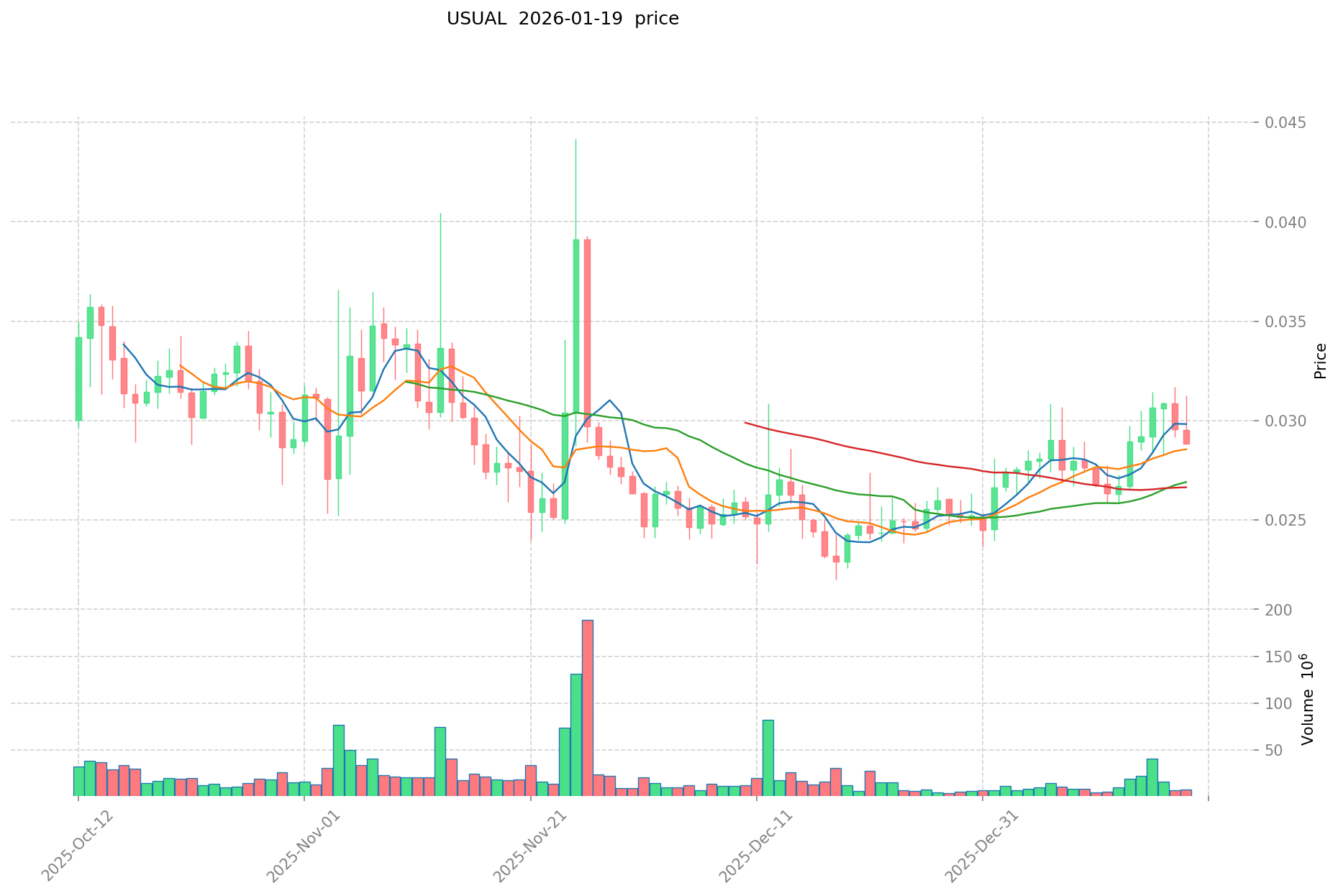
USUAL Historical Price Evolution Trajectory
-
December 2024: USUAL launched on Gate.com on December 17, 2024, experiencing significant initial volatility. The price reached its all-time high of $1.6555 on December 20, 2024, just three days after listing, demonstrating strong early market interest in this decentralized fiat-backed stablecoin issuer.
-
2025: Following the initial surge, USUAL experienced a substantial correction throughout the year. The token witnessed a prolonged downtrend, eventually reaching its all-time low of $0.00851 on October 10, 2025, representing a decline of approximately 99.5% from its peak value.
-
January 2026: The token has shown signs of recovery in recent weeks. As of January 20, 2026, USUAL has rebounded 226.7% from its all-time low, currently trading at $0.0278, though still down 98.3% from its historical high.
USUAL Current Market Status
As of January 20, 2026, USUAL is trading at $0.0278, with a 24-hour trading volume of $552,241.67. The token has experienced mixed short-term performance, showing a 0.43% increase over the past hour and a 3.42% gain over the past seven days. However, the 24-hour performance reflects a 9.27% decline, with the price fluctuating between $0.02461 and $0.0311 during this period.
The 30-day trend indicates a positive momentum with a 14.92% increase, suggesting some recovery from previous lows. Nevertheless, the one-year performance shows a substantial decline of 94.95%, reflecting the broader correction that followed the initial launch period.
USUAL currently holds a market ranking of 563, with a circulating market capitalization of approximately $44.89 million. The token has 1.61 billion USUAL in circulation, representing 40.37% of the total supply of 898.4 million tokens. With a maximum supply cap of 4 billion tokens, the current circulating supply represents only 40.37% of the maximum potential supply.
The project maintains a presence across 27 cryptocurrency exchanges and has attracted approximately 23,260 token holders. The market share stands at 0.00075% of the total cryptocurrency market capitalization. The fully diluted market capitalization equals $24.98 million, with the market cap to FDV ratio at 40.37%.
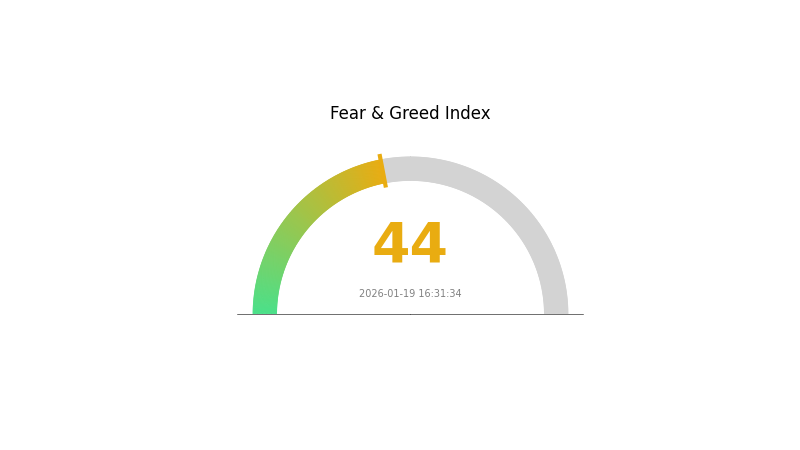
The current market sentiment indicator shows a fear index of 44, suggesting cautious investor sentiment in the broader market environment.
Click to view the current USUAL market price
USUAL Market Sentiment Index
2026-01-19 Fear and Greed Index: 44 (Fear)
Click to view current Fear & Greed Index
The cryptocurrency market is currently experiencing heightened fear sentiment with an index reading of 44. This indicates investors are exercising caution and uncertainty dominates market psychology. During periods of fear, volatility typically increases as traders become risk-averse. Such conditions often present contrasting opportunities for long-term investors who view downturns as potential entry points. Monitor market developments closely and consider your risk tolerance when making trading decisions on Gate.com.
USUAL Holding Distribution
The holding distribution chart represents the percentage allocation of USUAL tokens across different wallet addresses, providing crucial insights into the token's ownership structure and concentration levels. This metric serves as a key indicator of decentralization and potential market manipulation risks, as highly concentrated holdings can significantly impact price discovery and market stability.
Based on the current data, USUAL demonstrates a notably concentrated holding pattern. The top address controls approximately 54.74% of the total supply (885,029.19K tokens), while the second-largest holder maintains 24.03% (388,497.71K tokens). Combined, the top two addresses alone account for 78.77% of the total circulating supply. The top five addresses collectively hold 86.78% of all tokens, with the remaining 13.22% distributed among other holders. This distribution pattern indicates an extremely high concentration level, suggesting that the token's ownership structure is predominantly controlled by a small number of major entities.
Such concentrated holding distribution presents several implications for market dynamics. The dominant control by top addresses creates elevated risks of price volatility, as large-scale transactions from these major holders could significantly impact market liquidity and price movements. Additionally, this concentration level raises concerns about potential market manipulation and reduces the token's decentralization characteristics. From an on-chain structural perspective, this distribution pattern suggests that USUAL is still in an early stage of ecosystem development, where founding teams, institutional investors, or treasury reserves maintain substantial control over token supply.
Click to view current USUAL Holding Distribution

| Top |
Address |
Holding Qty |
Holding (%) |
| 1 |
0x06b9...4d4b8e |
885029.19K |
54.74% |
| 2 |
0xf977...41acec |
388497.71K |
24.03% |
| 3 |
0xe3fd...e5a03f |
70789.47K |
4.37% |
| 4 |
0x4368...26f042 |
36270.85K |
2.24% |
| 5 |
0x28c6...f21d60 |
22736.42K |
1.40% |
| - |
Others |
213226.50K |
13.22% |
II. Core Factors Influencing USUAL's Future Price
Supply Mechanism
- Staking-Based Issuance: USUAL adopts a progressive inflation model with a total supply cap of 4,000,000,000 tokens. New token issuance is linked to Total Value Locked (TVL) and liquidity contributions, encouraging long-term holding while avoiding excessive inflation. The protocol adjusts supply parameters through community governance to maintain ecosystem balance.
- Historical Pattern: Since its 2024 launch, USUAL has employed a gradual release strategy. Community distribution accounts for approximately 90% of total supply through liquidity mining rewards, staking yields, and governance participation incentives. Team tokens are subject to a 4-year linear vesting period with complete lock-up in the first year, preventing market impact.
- Current Impact: The protocol's dynamic supply adjustment mechanism ties new token generation to platform revenue. As revenue grows, tokens are moderately issued as user rewards. Simultaneously, a burn mechanism uses portions of transaction fees and revenue for token buybacks and burns, maintaining supply-demand equilibrium. This design ensures token value grows in tandem with platform development.
Institutional and Whale Dynamics
- Institutional Holdings: USUAL has garnered support from major exchanges including Coinbase and Kraken. These exchange endorsements have bolstered market confidence and provided a solid foundation for USD0 and USUAL ecosystem applications. USD0 may potentially serve as futures collateral or contract margin on exchanges, generating additional demand for USUAL.
- Enterprise Adoption: The founding team has consistently promoted USD0 as a payment instrument, with plans to develop a dedicated payment chain using USUAL as on-chain gas. If successfully implemented, this would grant USUAL system fuel value similar to ETH or BNB, establishing a significant position in payment scenarios.
- Concentration Analysis: Understanding cryptocurrency holders is crucial for comprehending price movements. Current holder statistics reveal trends in address numbers, whale activity, and large holder concentration. Increasing holder numbers may signal growing confidence, while whale sell-offs could presage price declines.
Macroeconomic Environment
- Monetary Policy Impact: USUAL token value derives substantially from RWA interest on USD reserves. Under current USD interest rates, RWA yields approximately 4% annually in stablecoins. While this return appears modest, the substantial capital pool (approximately $1.5 billion) generates considerable annual revenue of around $60 million. With current staking rates near 40% and USUAL market capitalization at $300 million, RWA yields can reach 70% annually.
- Inflation Hedge Attributes: To address potential future USD rate reductions, the project plans to expand its asset pool to encompass more stablecoin varieties, including decentralized and non-RWA stablecoins. This diversified asset expansion will further strengthen USUAL's value support, providing more robust TVL growth and ecosystem appeal.
- Regulatory Factors: USUAL faces intense DeFi competition as other projects attempt to dominate markets through RWA and payment scenarios. Additionally, as the crypto industry evolves, USUAL may encounter increased regulatory pressure, particularly regarding stablecoin compliance matters.
Technical Development and Ecosystem Building
- Dual-Token Innovation: USUAL employs a unique dual-token model comprising stablecoin USD0 and governance token USUAL. This design allows users to mint stablecoins by staking real-world assets while participating in protocol governance through USUAL tokens. The mechanism aims to provide greater transparency and security than traditional stablecoins.
- RWA Integration: The protocol's core function involves issuing USD-pegged stablecoin USD0. Users can mint USD0 stablecoins by depositing real-world assets (RWA) as collateral, including tokenized versions of traditional financial assets like U.S. Treasury bonds and corporate bonds. The protocol employs an over-collateralization mechanism ensuring each issued USD0 has adequate asset backing to maintain price stability.
- Ecosystem Applications: Following recent market challenges, USUAL promptly unveiled a new roadmap. Future development includes USD0++ vaults, with the first vault focusing on sUSDe, allowing users to deposit USD0++ and simultaneously earn both USD0++ yields and sUSDe yields, unlocking new mining opportunities. Long-term plans also include creating new synthetic assets like ETH0 and BTC0, and developing a Layer 2 specifically for USUAL use cases.
III. 2026-2031 USUAL Price Prediction
2026 Outlook
- Conservative Prediction: $0.02418 - $0.02779
- Neutral Prediction: Around $0.02779
- Optimistic Prediction: Up to $0.03974 (requires favorable market conditions and increased adoption)
2027-2029 Outlook
- Market Stage Expectations: Gradual growth phase with steady user base expansion and ecosystem development
- Price Range Predictions:
- 2027: $0.02802 - $0.04086 (21% potential increase)
- 2028: $0.02276 - $0.04626 (34% potential increase)
- 2029: $0.02424 - $0.05391 (50% potential increase)
- Key Catalysts: Platform upgrades, strategic partnerships, regulatory clarity, and broader DeFi integration
2030-2031 Long-term Outlook
- Baseline Scenario: $0.02775 - $0.06699 (assuming stable market conditions and continued project development)
- Optimistic Scenario: $0.04785 - $0.08038 (with strong ecosystem growth and mainstream adoption)
- Transformative Scenario: Potentially exceeding $0.08038 (under exceptional circumstances including major institutional adoption and significant protocol innovations)
- 2031-12-31: USUAL could reach up to $0.08038 (representing a 106% increase from 2026 baseline, contingent on sustained market momentum)
| Year |
Predicted High Price |
Predicted Average Price |
Predicted Low Price |
Price Change |
| 2026 |
0.03974 |
0.02779 |
0.02418 |
0 |
| 2027 |
0.04086 |
0.03376 |
0.02802 |
21 |
| 2028 |
0.04626 |
0.03731 |
0.02276 |
34 |
| 2029 |
0.05391 |
0.04179 |
0.02424 |
50 |
| 2030 |
0.06699 |
0.04785 |
0.02775 |
72 |
| 2031 |
0.08038 |
0.05742 |
0.05512 |
106 |
IV. USUAL Professional Investment Strategy and Risk Management
USUAL Investment Methodology
(1) Long-term Holding Strategy
- Target Audience: Investors seeking exposure to decentralized stablecoin infrastructure with risk tolerance for emerging protocols
- Operational Recommendations:
- Consider gradual accumulation during periods of market consolidation, particularly when price remains below historical highs
- Monitor the project's stablecoin adoption metrics and TVL (Total Value Locked) growth as fundamental indicators
- Implement secure storage through Gate Web3 Wallet for convenient management and potential staking opportunities
(2) Active Trading Strategy
- Technical Analysis Tools:
- Moving Averages: Observe the 50-day and 200-day moving averages to identify trend directions and potential reversal points
- Volume Analysis: Monitor 24-hour trading volume fluctuations (current volume: $552,241.66) to assess market participation and liquidity
- Key Swing Trading Considerations:
- The current 24-hour price range ($0.02461 - $0.0311) provides reference points for short-term support and resistance levels
- Given the -9.27% 24-hour change, traders should wait for stabilization signals before entering positions
USUAL Risk Management Framework
(1) Asset Allocation Principles
- Conservative Investors: 1-3% of cryptocurrency portfolio allocation
- Aggressive Investors: 5-8% of cryptocurrency portfolio allocation
- Professional Investors: Up to 10-15% with proper hedging mechanisms
(2) Risk Hedging Solutions
- Portfolio Diversification: Combine USUAL with established stablecoin assets to balance risk exposure
- Position Sizing: Implement scaled entry strategies rather than single large positions, especially given the token's circulating supply ratio of 40.37%
(3) Secure Storage Solutions
- Hot Wallet Recommendation: Gate Web3 Wallet for active trading and convenient access to DeFi features
- Multi-signature Solutions: For institutional investors managing significant holdings
- Security Precautions: Enable two-factor authentication, maintain separate wallets for different purposes, and never share private keys
V. USUAL Potential Risks and Challenges
USUAL Market Risks
- High Volatility: The token has experienced significant price fluctuations, with a 1-year decline of -94.95% from ATH of $1.66 to current levels around $0.03
- Liquidity Concerns: With a market cap of approximately $45 million and current market dominance of only 0.00075%, the token may face liquidity constraints during extreme market conditions
- Market Sentiment Dependency: As a relatively new project (launched December 2024), market perception and adoption rates significantly impact price movements
USUAL Regulatory Risks
- Stablecoin Regulatory Scrutiny: As a fiat-backed stablecoin issuer, USUAL may face increased regulatory oversight in jurisdictions implementing strict stablecoin regulations
- Compliance Requirements: Evolving regulatory frameworks for decentralized finance protocols could necessitate operational adjustments
- Geographic Restrictions: Potential limitations on service availability in certain jurisdictions due to regulatory compliance requirements
USUAL Technical Risks
- Smart Contract Vulnerabilities: As an ERC-20 token operating on Ethereum, the protocol depends on smart contract security and regular audits
- Network Dependencies: Performance and transaction costs are subject to Ethereum network congestion and gas fee fluctuations
- Protocol Maturity: As a recently launched project with 23,260 holders, the ecosystem is still developing and may face scaling challenges
VI. Conclusion and Action Recommendations
USUAL Investment Value Assessment
USUAL represents an emerging project in the decentralized stablecoin sector, attempting to redistribute value through its governance token model. The long-term value proposition centers on the growing demand for decentralized financial infrastructure and transparent stablecoin mechanisms. However, short-term risks include significant price volatility (evidenced by the -94.95% decline from ATH), limited market capitalization, and the challenges of establishing network effects in a competitive stablecoin landscape. The project's circulating supply represents only 40.37% of fully diluted valuation, suggesting potential future dilution considerations.
USUAL Investment Recommendations
✅ Beginners: Start with minimal exposure (under 2% of crypto portfolio), focus on understanding the project fundamentals and stablecoin mechanisms before increasing position size. Utilize Gate.com's spot trading features with limit orders to control entry prices.
✅ Experienced Investors: Consider a phased accumulation approach during market dips, maintaining positions between 3-5% of crypto portfolio. Monitor the project's development milestones, partnership announcements, and stablecoin adoption metrics as decision factors.
✅ Institutional Investors: Conduct comprehensive due diligence on the project's governance structure, treasury management, and regulatory compliance. Consider strategic positions with appropriate risk hedging through portfolio diversification and position sizing aligned with risk management frameworks.
USUAL Trading Participation Methods
- Spot Trading: Access USUAL/USDT trading pairs on Gate.com for direct token purchases with transparent pricing and deep liquidity
- Dollar-Cost Averaging: Implement systematic investment plans to mitigate timing risk, particularly beneficial given current market volatility
- Staking and Governance: Explore potential yield opportunities and participate in protocol governance as the ecosystem develops (verify availability through official channels)
Cryptocurrency investment carries extremely high risks, and this article does not constitute investment advice. Investors should make prudent decisions based on their risk tolerance and are advised to consult professional financial advisors. Never invest more than you can afford to lose.
FAQ
What is USUAL token and what is its use?
USUAL is a governance token for a decentralized stablecoin ecosystem. Holders vote on protocol decisions, participate in ecosystem management, and earn rewards from protocol revenues. Its primary purpose is decentralized governance of the USD0 stablecoin protocol.
What is the price trend of USUAL tokens and what are the future expectations?
USUAL tokens are expected to reach approximately 1.65 USD by 2027, with potential to reach 2.04 USD by year-end. This demonstrates a strong upward trend and sustained growth potential in the long term.
What are the risks to pay attention to when investing in USUAL tokens?
USUAL token investments carry market volatility risk, regulatory uncertainty, and smart contract risks. Monitor market dynamics and conduct thorough research before investing.
What advantages does USUAL token have compared to other DeFi tokens?
USUAL offers decentralized governance enabling community participation in protocol management. With 90% token allocation to community and only 10% to team and investors, it provides superior community control and revenue sharing benefits compared to traditional DeFi tokens.
How to obtain USUAL tokens? Which exchanges can trade them?
You can acquire USUAL tokens through major cryptocurrency exchanges that list them. These platforms offer spot trading, futures, and staking options. Check exchange listings for current availability, trading pairs, and real-time trading volume to find the best trading environment for your needs.
* The information is not intended to be and does not constitute financial advice or any other recommendation of any sort offered or endorsed by Gate.