This comprehensive article analyzes zkPass (ZKP), a privacy infrastructure token leveraging zero-knowledge proof technology, currently trading at $0.1188 with a market capitalization of $23.96 million. The guide examines ZKP's price trajectory through 2031, reviewing historical volatility, current market sentiment at extreme fear levels, and token distribution patterns showing 92.37% concentration among top holders. Key sections cover price forecasts ranging from conservative to optimistic scenarios, with average prices projected at $0.1262 (2027), $0.12936 (2028), and $0.15409 (2031), representing 6-29% potential growth across timeframes. Professional investment strategies include long-term holding approaches for Web3 believers, active trading techniques using volume analysis, and risk management frameworks tailored for conservative, aggressive, and institutional investors. The article details secure storage solutions via Gate Web3 Wallet, addresses regulatory and technical risks inherent to privacy-focused
Introduction: ZKP's Market Position and Investment Value
zkPass (ZKP), as a privacy infrastructure bridging Web 2.0 and Web 3.0 through zero-knowledge proof technology, has been advancing data sovereignty and privacy protection since its launch. As of 2026, zkPass maintains a market capitalization of approximately $23.96 million, with a circulating supply of around 201.67 million tokens, and the price hovers at $0.1188. This asset, recognized as an innovative cryptographic solution leveraging three-party TLS, MPC, and IZK technologies, is playing an increasingly important role in decentralized identity verification and private data management.
This article will comprehensively analyze ZKP's price trajectory from 2026 to 2031, combining historical patterns, market supply-demand dynamics, ecosystem development, and macroeconomic conditions to provide investors with professional price forecasts and practical investment strategies.
I. ZKP Price History Review and Current Market Status
ZKP Historical Price Evolution Trajectory
- 2026: zkPass (ZKP) experienced notable price volatility in its early trading period. The token recorded a historical high of $0.2346 and a historical low of $0.11 on January 7, 2026, demonstrating significant price fluctuations within a short timeframe.
ZKP Current Market Situation
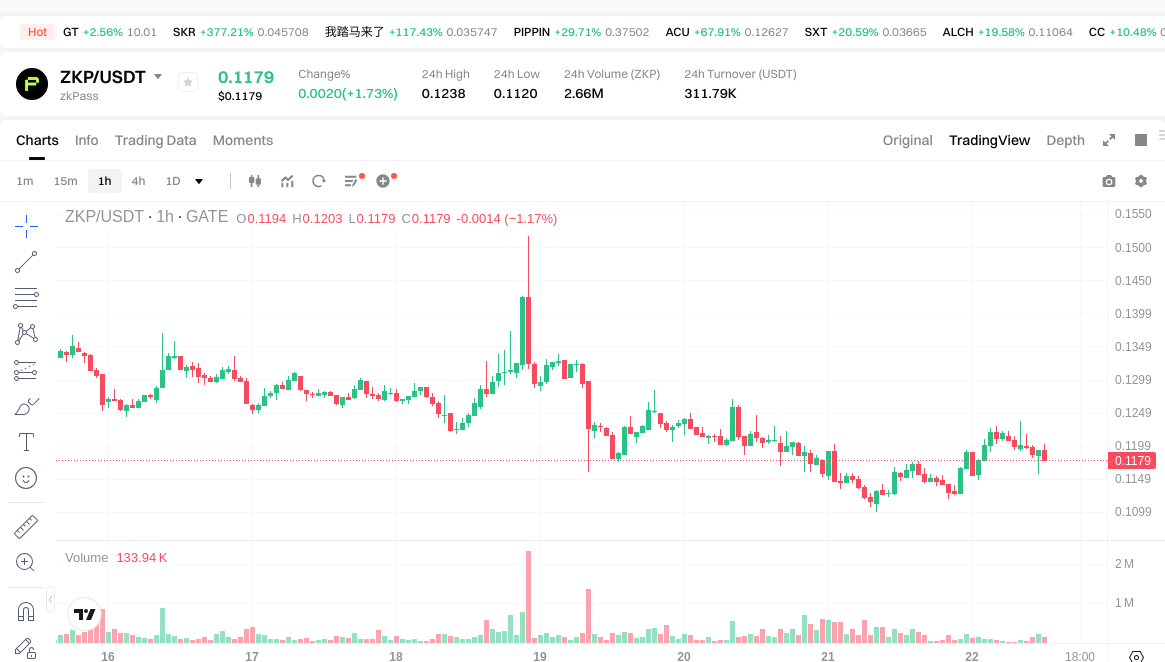
As of January 22, 2026, zkPass (ZKP) is trading at $0.1188, representing a 3.12% increase over the past 24 hours. The token's 24-hour trading range has been between $0.112 and $0.1238, with a total trading volume of $308,430.97.
From a broader perspective, ZKP has shown mixed performance across different timeframes. While the hourly chart indicates a modest gain of 0.59%, the token has experienced a decline of 9.25% over the past week and a more substantial decrease of 29.97% over the past 30 days. The one-year performance shows a decline of 50.55%, though this metric covers a limited period given the token's recent launch.
The current market capitalization stands at approximately $23.96 million, with a circulating supply of 201.67 million tokens. This represents 20.17% of the maximum supply of 1 billion tokens. The fully diluted valuation is calculated at $118.8 million. ZKP ranks 795th in the cryptocurrency market by market capitalization, holding a market dominance of 0.0037%.
zkPass is listed on 26 cryptocurrency exchanges and has attracted 27,988 token holders. The project operates through smart contracts on both Binance Smart Chain (BSC) and Ethereum networks, with verified contract addresses on each respective blockchain.
Click to view the current ZKP market price
ZKP Market Sentiment Indicator
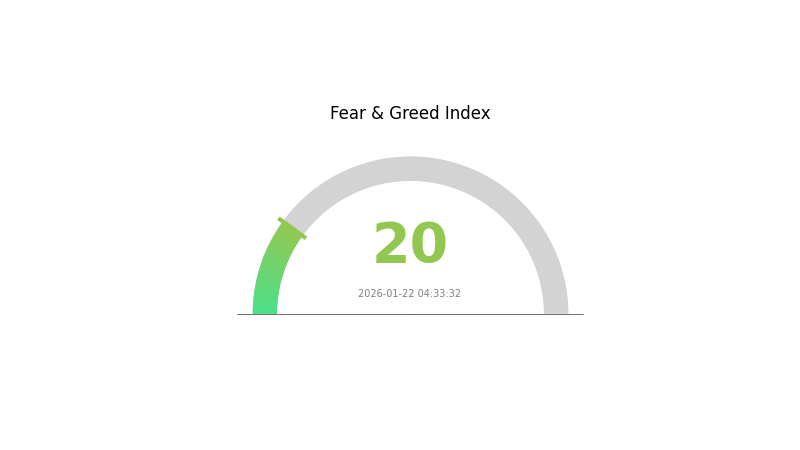
2026-01-22 Fear and Greed Index: 20 (Extreme Fear)
Click to view current Fear & Greed Index
The market is currently experiencing extreme fear, with the Fear and Greed Index standing at 20. This indicates significant investor anxiety and pessimism in the cryptocurrency market. Such extreme fear levels typically present contrarian opportunities for long-term investors, as excessive panic often precedes market recovery. However, caution is warranted as downward pressure may persist. Monitor key support levels closely and consider dollar-cost averaging strategies during this period of heightened uncertainty.
ZKP Holdings Distribution
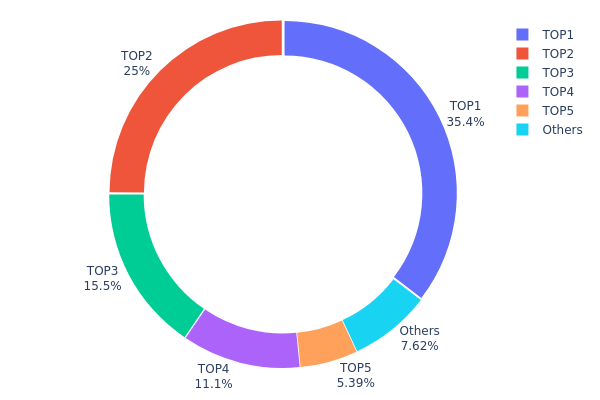
The holdings distribution chart reveals how ZKP tokens are allocated across different wallet addresses, serving as a crucial indicator of market structure and centralization risk. According to the latest on-chain data, the top 5 addresses collectively hold 833,757.92K ZKP, representing approximately 92.37% of the circulating supply, while the remaining 7.63% is distributed among other holders. This highly concentrated distribution pattern reveals significant structural imbalances in the current market.
The top address alone controls 319,133.38K tokens (35.40% of total supply), followed by the second and third addresses holding 24.96% and 15.53% respectively. Such extreme concentration creates substantial systemic risks, as price movements could be significantly influenced by the trading decisions of these major holders. This level of centralization is considerably higher than typical mature crypto assets, where healthy distribution typically sees the top 10 addresses controlling less than 50% of supply. The current structure suggests limited decentralization progress since the project's initial token distribution phase.
From a market stability perspective, this concentration pattern increases vulnerability to sudden liquidity shocks and price manipulation. Large holders possess the capability to create significant price volatility through coordinated selling or buying pressure. Additionally, the relatively small proportion held by retail participants (7.63%) indicates limited community engagement and weak organic distribution mechanisms. For potential investors, this concentrated structure warrants careful consideration, as on-chain governance and price discovery mechanisms may be dominated by a small cohort of major stakeholders, potentially compromising the project's decentralized value proposition.
Click to view current ZKP Holdings Distribution
| Top |
Address |
Holding Qty |
Holding (%) |
| 1 |
0xfc12...1ba66e |
319133.38K |
35.40% |
| 2 |
0x303a...43ccef |
225000.00K |
24.96% |
| 3 |
0xb845...0490b7 |
140000.00K |
15.53% |
| 4 |
0x7f84...007baf |
100000.00K |
11.09% |
| 5 |
0x3c0c...5e8b04 |
48624.54K |
5.39% |
| - |
Others |
68643.28K |
7.63% |
II. Core Factors Influencing ZKP's Future Price
Due to the absence of sufficient data in the provided materials and current knowledge base limitations regarding ZKP's specific mechanisms and developments, a comprehensive analysis of the core factors affecting its future price cannot be completed at this time. Key aspects such as supply mechanisms, institutional dynamics, macroeconomic environment impacts, and technical developments require verified information to ensure accuracy and reliability.
For investors interested in ZKP, it is recommended to:
- Monitor official project announcements and verified blockchain data for supply-related information
- Track institutional investment reports and regulatory developments through reputable financial news sources
- Follow technical upgrade announcements from the project's official channels
- Consider broader cryptocurrency market trends and macroeconomic indicators
As new verified information becomes available, a more detailed analysis of these price-influencing factors can be provided.
III. 2026-2031 ZKP Price Prediction
2026 Outlook
- Conservative prediction: $0.10428
- Neutral prediction: $0.1185
- Optimistic prediction: $0.13391
Based on market analysis, ZKP is expected to maintain relatively stable trading within a narrow range during 2026. The projected average price of $0.1185 suggests limited volatility in the near term, with the token potentially establishing a solid foundation for future growth.
2027-2029 Outlook
- Market stage expectation: Gradual upward momentum with moderate growth trajectory
- Price range predictions:
- 2027: $0.11358 - $0.13251, average $0.1262 (approximately 6% increase)
- 2028: $0.10737 - $0.13324, average $0.12936 (approximately 8% increase)
- 2029: $0.09191 - $0.16937, average $0.1313 (approximately 10% increase)
- Key catalysts: Progressive market adoption, technological developments, and expanding ecosystem utility may contribute to sustained price appreciation during this mid-term period.
The 2027-2029 timeframe shows consistent year-over-year growth, with price changes ranging from 6% to 10% annually. Notably, 2029 exhibits the widest price range, suggesting increased market volatility and potential breakthrough opportunities.
2030-2031 Long-term Outlook
- Baseline scenario: $0.08118 - $0.15785 (2030), average $0.15034, representing approximately 26% growth
- Optimistic scenario: $0.11865 - $0.19878 (2031), average $0.15409, representing approximately 29% cumulative growth
- Transformational scenario: If favorable market conditions align with significant technological breakthroughs and widespread adoption, ZKP could approach the upper boundary of $0.19878 by 2031
The long-term projections indicate accelerated growth potential in 2030-2031, with percentage increases rising to 26-29%. The expanding price ranges suggest that ZKP may enter a more dynamic phase, potentially influenced by broader cryptocurrency market cycles and project-specific developments. However, investors should note the considerable variance between low and high predictions, particularly in 2030-2031, indicating inherent market uncertainty over extended timeframes.
| Year |
Predicted High Price |
Predicted Average Price |
Predicted Low Price |
Price Change |
| 2026 |
0.13391 |
0.1185 |
0.10428 |
0 |
| 2027 |
0.13251 |
0.1262 |
0.11358 |
6 |
| 2028 |
0.13324 |
0.12936 |
0.10737 |
8 |
| 2029 |
0.16937 |
0.1313 |
0.09191 |
10 |
| 2030 |
0.15785 |
0.15034 |
0.08118 |
26 |
| 2031 |
0.19878 |
0.15409 |
0.11865 |
29 |
IV. ZKP Professional Investment Strategy and Risk Management
ZKP Investment Methodology
(I) Long-term Holding Strategy
- Target Investors: Believers in privacy-preserving technologies and Web3 infrastructure development
- Operational Recommendations:
- Accumulate positions during market corrections, considering ZKP's current price of $0.1188 remains substantially below its historical high
- Monitor the project's technical development milestones and partnership announcements that may influence long-term value
- Storage Solution: Utilize Gate Web3 Wallet for secure asset custody with multi-signature protection
(II) Active Trading Strategy
- Technical Analysis Tools:
- Volume Analysis: Monitor the 24-hour trading volume of $308,430.97 to identify liquidity patterns and potential breakout opportunities
- Price Action: Track key support levels around $0.112 (24h low) and resistance near $0.1238 (24h high) for entry and exit points
- Swing Trading Key Points:
- Consider the recent 7-day decline of 9.25% as potential accumulation zones for short-term positions
- Set stop-loss orders below major support levels to manage downside risk
ZKP Risk Management Framework
(I) Asset Allocation Principles
- Conservative Investors: 1-3% of crypto portfolio allocation
- Aggressive Investors: 5-10% of crypto portfolio allocation
- Professional Investors: 10-15% with active monitoring and rebalancing strategies
(II) Risk Hedging Solutions
- Diversification: Combine ZKP holdings with established privacy-focused tokens and major cryptocurrencies
- Position Sizing: Scale positions based on market volatility and personal risk tolerance
(III) Secure Storage Solutions
- Hot Wallet Option: Gate Web3 Wallet for active trading and convenient access
- Cold Storage Approach: Hardware wallet storage for long-term holdings, particularly for larger positions
- Security Considerations: Never share private keys, enable two-factor authentication, and verify contract addresses (ETH: 0xe1be424f442d0687129128c6c38aace44f8c8dbc, BSC: 0xd89b7dd376e671c124352267516bef1c2cc231a3) before transactions
V. ZKP Potential Risks and Challenges
ZKP Market Risks
- Price Volatility: ZKP has experienced a 50.55% decline over the past year, reflecting significant market volatility that may continue
- Low Market Capitalization: With a market cap of approximately $23.96 million, ZKP remains a relatively small-cap asset susceptible to larger price swings
- Limited Liquidity: Trading across 26 exchanges with moderate daily volume may result in slippage during large transactions
ZKP Regulatory Risks
- Privacy Technology Scrutiny: Zero-knowledge proof protocols may face increased regulatory attention as authorities examine privacy-preserving technologies
- Cross-jurisdiction Compliance: Operating as a bridge between Web 2.0 and Web 3.0 may require navigating multiple regulatory frameworks
- Token Classification: Ongoing regulatory developments regarding digital asset classification could impact ZKP's operational scope
ZKP Technical Risks
- Smart Contract Security: Dual-chain deployment on Ethereum and BSC networks increases potential attack surfaces
- Protocol Complexity: The integration of three-party TLS, MPC, and IZK technologies introduces sophisticated technical dependencies
- Competition: The privacy and data verification space faces competition from alternative solutions and established protocols
VI. Conclusion and Action Recommendations
ZKP Investment Value Assessment
zkPass Protocol represents an innovative approach to privacy-preserving data verification, positioning itself at the intersection of Web 2.0 and Web 3.0. With only 20.17% of total supply circulating and a holder base of 27,988, the project demonstrates early-stage characteristics. The current price of $0.1188, approximately 49.4% below the recorded high, may present opportunities for risk-tolerant investors who believe in the long-term potential of zero-knowledge proof infrastructure. However, the substantial 30-day decline of 29.97% and year-over-year performance of -50.55% underscore the speculative nature and significant risks inherent in this asset.
ZKP Investment Recommendations
✅ Beginners: Allocate no more than 1-2% of crypto portfolio; focus on education about zero-knowledge technology before investing; consider starting with small positions to understand market dynamics
✅ Experienced Investors: May consider 3-7% allocation with active monitoring of technical developments; implement dollar-cost averaging during favorable market conditions; utilize technical analysis for timing entries
✅ Institutional Investors: Conduct comprehensive due diligence on protocol architecture and team credentials; consider strategic positions of 5-10% within privacy-focused portfolio segments; establish direct communication channels with project stakeholders
ZKP Trading Participation Methods
- Spot Trading: Purchase ZKP directly on Gate.com with USD or cryptocurrency pairs for straightforward exposure
- Phased Accumulation: Implement systematic investment plans to average entry costs over time and reduce timing risk
- Portfolio Integration: Combine ZKP with complementary privacy and infrastructure tokens to create diversified thematic exposure
Cryptocurrency investment carries extremely high risks, and this article does not constitute investment advice. Investors should make prudent decisions based on their own risk tolerance and are advised to consult professional financial advisors. Never invest more than you can afford to lose.
FAQ
What is ZKP token? What are its uses and value proposition?
ZKP is a utility token powering zero-knowledge proof protocols. It enables privacy-preserving transactions, smart contract verification, and governance. The token provides network security, transaction validation incentives, and access to advanced cryptographic features, driving adoption in privacy-focused blockchain applications.
ZKP has demonstrated volatile growth patterns typical of emerging crypto assets. Historical data shows significant price fluctuations with multiple rallies and corrections. The token has experienced both bullish phases with substantial gains and bearish pullbacks. Overall trajectory reflects market sentiment shifts and ecosystem developments. Price volatility remains relatively high, presenting both opportunities and challenges for market participants tracking this asset's evolution.
How to analyze ZKP price? What technical indicators and fundamental factors should be monitored?
Monitor trading volume, market cap trends, and network activity. Key technical indicators include RSI, MACD, and moving averages. Fundamental factors: ecosystem development, protocol upgrades, developer adoption, and market sentiment. Track on-chain metrics and community engagement for comprehensive analysis.
What are the main factors affecting ZKP price predictions?
ZKP price is primarily influenced by market demand, trading volume, technological developments, regulatory changes, macroeconomic conditions, and overall sentiment in the zero-knowledge proof sector.
What are the risks of investing in ZKP tokens? How should I evaluate these risks?
ZKP token risks include market volatility, liquidity fluctuations, and technology adoption uncertainty. Evaluate by analyzing transaction volume trends, team credibility, tokenomics, and market sentiment. Monitor regulatory developments and competitive landscape shifts to make informed decisions.
What are the advantages and disadvantages of ZKP compared to other zero-knowledge proof projects?
ZKP excels in scalability and transaction efficiency with optimized proof generation. Key advantages include faster verification speeds and lower computational costs. Disadvantages involve limited ecosystem maturity compared to established competitors and smaller developer community adoption.
How to assess ZKP's future development prospects and market potential?
ZKP demonstrates strong potential driven by increasing zero-knowledge proof adoption across blockchain infrastructure. Growing demand for privacy solutions, smart contract scaling, and institutional interest positions ZKP for significant long-term value appreciation as Web3 technology matures and mainstream adoption accelerates.
What is the professional analyst's price prediction for ZKP?
Analysts project ZKP could reach $0.85-$1.20 by mid-2026, driven by increasing adoption of zero-knowledge proof technology and growing institutional interest in privacy-focused cryptographic solutions.
* The information is not intended to be and does not constitute financial advice or any other recommendation of any sort offered or endorsed by Gate.