This comprehensive analysis examines ZTC (Zenchain) price trends and investment potential from 2026 through 2031. As a Layer 1 blockchain combining Bitcoin's security with Ethereum programmability, ZTC currently trades at $0.002138 with a $10.46 million market cap and 23.3% circulation ratio. The article projects conservative 2026 price ranges of $0.00148-$0.00218, with mid-term growth accelerating to 48% by 2029 and long-term potential reaching $0.00655 by 2031. Investors receive three strategic approaches: long-term holding for believers in hybrid consensus technology, active trading leveraging volatility, and allocation guidelines from 1-15% depending on risk tolerance. Critical considerations include extreme market concentration (top 3 addresses hold 95.89%), current extreme fear sentiment (Fear & Greed Index: 25), and technical risks from AI layer integration. The analysis provides actionable investment recommendations through Gate exchange with comprehensive risk management frameworks for various invest
Introduction: ZTC's Market Position and Investment Value
Zenchain (ZTC), as a Layer 1 blockchain that combines Bitcoin's security with Ethereum's programmability, has been making strides in the crypto ecosystem since its launch in early 2025. As of January 26, 2026, ZTC has reached a market capitalization of approximately $10.46 million, with a circulating supply of around 4.89 billion tokens, and the price is maintained at approximately $0.002138. This asset, characterized by its hybrid consensus mechanism and native AI layer for fraud detection and execution optimization, is playing an increasingly critical role in enabling autonomous, intelligent decentralized applications.
This article will comprehensively analyze ZTC's price trends from 2026 to 2031, combining historical patterns, market supply and demand dynamics, ecosystem development, and macroeconomic environment considerations to provide investors with professional price forecasts and practical investment strategies.
I. ZTC Price History Review and Market Status
ZTC Historical Price Evolution Trajectory
ZTC launched on January 6, 2025, establishing its trading presence across multiple platforms. The token's price journey has been marked by significant volatility in its early trading period.
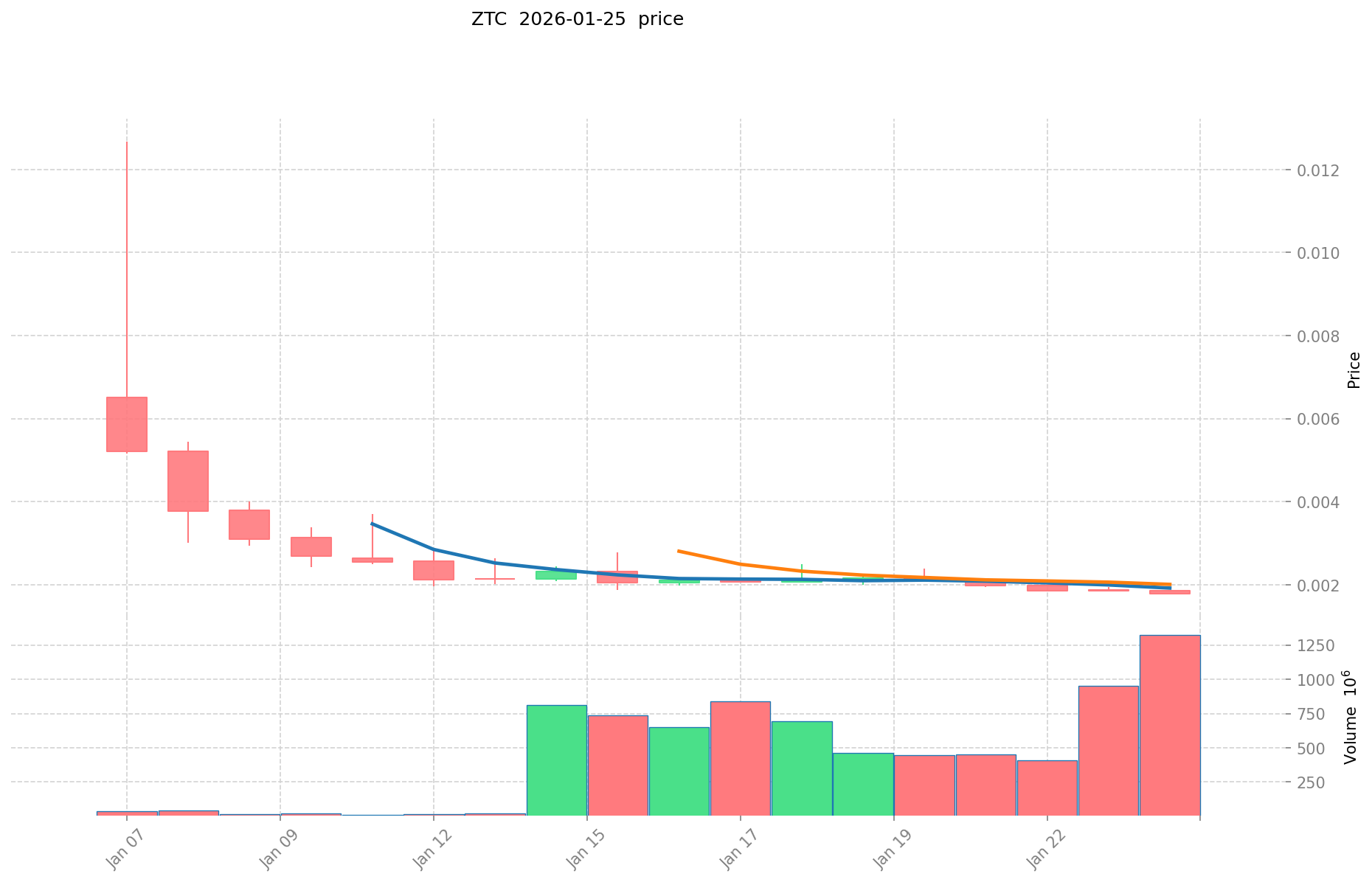
In early January 2025, ZTC experienced its initial price discovery phase. On January 7, 2025, the token reached its all-time high of $0.012675, representing the peak of early market enthusiasm. However, this high was followed by a substantial correction, as the token entered a consolidation phase over the subsequent weeks.
By late January 2025, market sentiment shifted considerably. On January 25, 2025, ZTC recorded its all-time low of $0.001742, marking an 86.25% decline from its peak. This significant retracement reflected broader market adjustments and initial trading volatility typical of newly launched tokens.
ZTC Current Market Status
As of January 26, 2025, ZTC is trading at $0.002138, showing signs of recovery with a 17.69% increase over the past 24 hours. The token has demonstrated resilience, bouncing back from its recent low point. Over the past hour, ZTC has gained 3.95%, suggesting renewed buying interest.
The token's 24-hour trading range spans from $0.001742 to $0.00344, indicating considerable intraday volatility. Trading volume over the past 24 hours reached $1,529,897, reflecting active market participation.
ZTC currently holds a market capitalization of approximately $10.46 million, with 4.893 billion tokens in circulation out of a total supply of 21 billion tokens. This represents a circulation ratio of 23.3%, with the fully diluted market cap standing at approximately $44.90 million. The token ranks 1166 in the overall cryptocurrency market, commanding a 0.0014% market share.
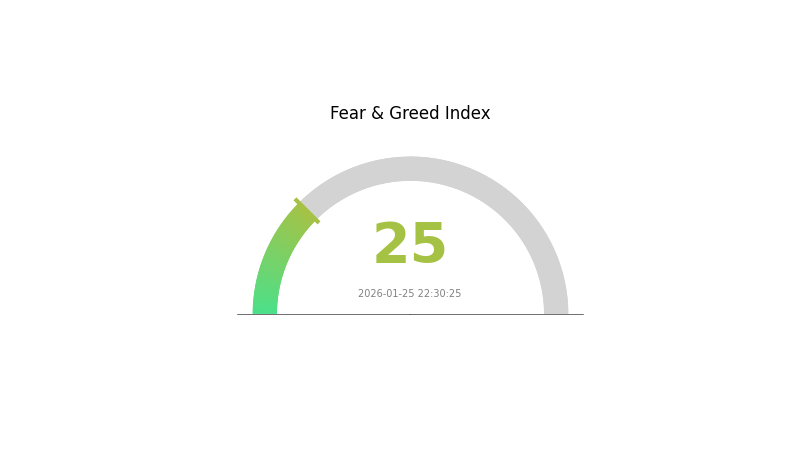
The broader market environment shows a Crypto Fear & Greed Index reading of 25, indicating "Extreme Fear" sentiment, which may be influencing ZTC's price movements alongside other digital assets.
Click to view current ZTC market price
ZTC Market Sentiment Indicator
2026-01-25 Fear and Greed Index: 25 (Extreme Fear)
Click to view current Fear & Greed Index
The crypto market is currently experiencing extreme fear, with the Fear and Greed Index at 25. This reading indicates significant market pessimism and heightened investor anxiety. During such periods, market volatility typically increases as traders react to negative sentiment and uncertainty. Investors should exercise caution and consider their risk tolerance carefully. While extreme fear can sometimes present contrarian buying opportunities for experienced traders, it also signals potential further downside risks. It is advisable to maintain a defensive portfolio positioning and avoid impulsive trading decisions driven by emotional responses to market movements.
ZTC Holdings Distribution
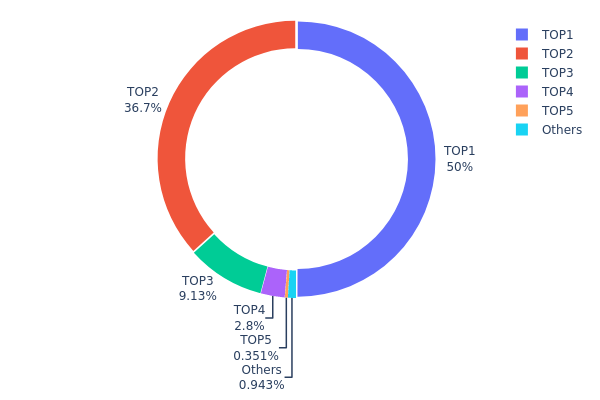
The holdings distribution chart reflects the concentration of token ownership across different addresses on the blockchain, serving as a critical indicator of decentralization and market structure. According to the current data, ZTC exhibits an extremely high concentration level, with the top three addresses collectively holding 95.89% of the total supply. Specifically, the largest address holds 50.04%, the second-largest holds 36.72%, and the third-largest holds 9.13%. This highly centralized distribution pattern reveals significant structural vulnerabilities in ZTC's market ecosystem.
Such extreme concentration poses considerable risks to market stability and price discovery mechanisms. The dominant positions held by the top two addresses grant them substantial control over supply dynamics, potentially enabling price manipulation through coordinated trading activities or sudden large-scale liquidations. The remaining addresses outside the top five collectively account for merely 0.97% of total supply, indicating an underdeveloped retail participation base and limited organic trading activity. This asymmetric distribution structure typically correlates with heightened volatility and reduced liquidity resilience during periods of market stress.
From a decentralization perspective, ZTC's current holdings distribution suggests centralized control that contradicts the fundamental principles of distributed ledger technology. The concentration metrics indicate potential custodial arrangements or early-stage tokenomics where initial allocations have not been sufficiently dispersed through market circulation. This on-chain structural characteristic warrants careful monitoring, as any significant movements from the top addresses could trigger substantial price fluctuations and impact overall market confidence in the token's long-term viability.
Click to view the current ZTC Holdings Distribution
| Top |
Address |
Holding Qty |
Holding (%) |
| 1 |
0x8703...f85187 |
10510114.76K |
50.04% |
| 2 |
0x44c6...fa9eca |
7712508.26K |
36.72% |
| 3 |
0xc051...e8140d |
1918166.61K |
9.13% |
| 4 |
0xc5a2...2a1695 |
587491.74K |
2.79% |
| 5 |
0x58ed...a36a51 |
73746.51K |
0.35% |
| - |
Others |
197972.12K |
0.97000000000001% |
II. Core Factors Influencing ZTC's Future Price
Based on the available information, there is currently insufficient data to provide a comprehensive analysis of the core factors that may influence ZTC's future price movements. The following aspects would typically be considered in such an analysis:
Supply Mechanism
Detailed information about ZTC's supply mechanism, including emission schedules, maximum supply caps, and any deflationary or inflationary characteristics, is not available in the provided materials.
Institutional and Major Holder Dynamics
Data regarding institutional holdings, corporate adoption, or national-level policies specific to ZTC has not been provided in the reference materials.
Macroeconomic Environment
While broader cryptocurrency markets are often influenced by monetary policy, inflation hedging characteristics, and geopolitical factors, specific analysis relating these factors to ZTC cannot be conducted without relevant data.
Technical Development and Ecosystem Building
Information about technical upgrades, protocol improvements, or ecosystem applications (such as DApps or projects built on ZTC) is not present in the available materials.
For a comprehensive price analysis, additional information about ZTC's fundamentals, market positioning, and development roadmap would be necessary.
III. 2026-2031 ZTC Price Prediction
2026 Outlook
- Conservative Prediction: $0.00148 - $0.00218
- Neutral Prediction: Around $0.00218
- Optimistic Prediction: Up to $0.00301 (requires favorable market conditions)
Based on the forecast data, ZTC is expected to show modest growth in 2026, with an anticipated price change of approximately 2%. The token may fluctuate within a range between $0.00148 and $0.00301, with the average trading price projected around $0.00218. Market participants should monitor key developments that could influence price momentum during this initial phase.
2027-2029 Mid-term Outlook
- Market Stage Expectation: Gradual appreciation phase with increasing volatility
- Price Range Predictions:
- 2027: $0.00236 - $0.00322 (approximately 21% growth)
- 2028: $0.00253 - $0.00340 (approximately 36% growth)
- 2029: $0.00186 - $0.00404 (approximately 48% growth)
- Key Catalysts: Progressive adoption trends, potential ecosystem expansion, and broader crypto market sentiment shifts
During the 2027-2029 period, ZTC is projected to demonstrate steady appreciation with widening price ranges, suggesting increased market activity. The forecasted growth rates show acceleration from 21% in 2027 to 48% by 2029, indicating potential strengthening fundamentals or enhanced market positioning.
2030-2031 Long-term Outlook
- Baseline Scenario: $0.00191 - $0.00525 (assuming continued ecosystem development and stable market conditions)
- Optimistic Scenario: $0.00310 - $0.00655 (with enhanced adoption and favorable regulatory environment)
- Transformative Scenario: Approaching $0.00655 (under exceptional growth conditions including significant partnerships or technological breakthroughs)
The long-term projections for 2030-2031 suggest substantial growth potential, with forecasted increases of 68% and 107% respectively. By 2031, ZTC could potentially reach a high of $0.00655, representing more than a doubling from 2026 levels. However, investors should note that longer-term predictions carry higher uncertainty and depend heavily on multiple factors including market cycles, technological developments, and overall crypto industry trends.
Traders interested in ZTC can monitor its performance and access trading opportunities on platforms like Gate.com, which provides comprehensive tools for tracking and analyzing emerging digital assets.
| Year |
Predicted High Price |
Predicted Average Price |
Predicted Low Price |
Price Change |
| 2026 |
0.00301 |
0.00218 |
0.00148 |
2 |
| 2027 |
0.00322 |
0.0026 |
0.00236 |
21 |
| 2028 |
0.0034 |
0.00291 |
0.00253 |
36 |
| 2029 |
0.00404 |
0.00316 |
0.00186 |
48 |
| 2030 |
0.00525 |
0.0036 |
0.00191 |
68 |
| 2031 |
0.00655 |
0.00442 |
0.0031 |
107 |
IV. ZTC Professional Investment Strategy and Risk Management
ZTC Investment Methodology
(1) Long-term Holding Strategy
- Suitable for: Investors who believe in the potential of Bitcoin-level security combined with EVM compatibility and have a medium to long-term investment horizon
- Operational Recommendations:
- Consider accumulating positions during market downturns, given the token's significant volatility (24-hour change of 17.69%, 30-day decline of 69.80%)
- Monitor the circulating supply ratio (currently 23.3%) as increasing token circulation may impact price dynamics
- Storage Solution: Use Gate Web3 Wallet for secure, self-custodial storage, ensuring private key protection and enabling direct interaction with the ZenChain ecosystem
(2) Active Trading Strategy
- Technical Analysis Tools:
- Moving Averages: Monitor short-term (7-day) and medium-term (30-day) trends to identify potential entry and exit points, noting the current 7-day decline of 3.27%
- Volume Analysis: Track the 24-hour trading volume of approximately $1.53 million to assess market liquidity and trading interest
- Swing Trading Key Points:
- Be aware of significant price volatility, with 24-hour price range between $0.001742 (all-time low) and $0.00344 (24-hour high)
- Consider the substantial gap between current price ($0.002138) and all-time high ($0.012675) when setting profit targets
ZTC Risk Management Framework
(1) Asset Allocation Principles
- Conservative Investors: 1-3% of cryptocurrency portfolio
- Aggressive Investors: 5-10% of cryptocurrency portfolio
- Professional Investors: Up to 15% of cryptocurrency portfolio, with dynamic rebalancing based on market conditions
(2) Risk Hedging Solutions
- Portfolio Diversification: Allocate funds across multiple Layer 1 blockchain projects to reduce concentration risk
- Position Sizing: Given the 69.80% decline over 30 days, implement strict position limits and avoid overexposure to a single asset
(3) Secure Storage Solutions
- Hot Wallet Recommendation: Gate Web3 Wallet for active trading and ecosystem participation, offering ERC-20 token support
- Cold Storage Option: For long-term holdings, consider transferring larger amounts to hardware wallets, maintaining private key backups in secure offline locations
- Security Precautions: Never share private keys, enable two-factor authentication on all accounts, and regularly verify wallet addresses before transactions
V. ZTC Potential Risks and Challenges
ZTC Market Risks
- High Volatility: The token has experienced a 69.80% decline over 30 days and significant intraday fluctuations, indicating substantial price instability
- Low Liquidity: With a market capitalization of approximately $10.46 million and ranking at 1166, the token may face liquidity constraints during large transactions
- Limited Market Depth: Trading across only 10 exchanges with 682 holders suggests relatively limited market participation and potential for sharp price movements
ZTC Regulatory Risks
- Layer 1 Blockchain Compliance: As blockchain technology evolves, regulatory frameworks for Layer 1 networks may change, potentially impacting ZenChain's operations
- EVM Compatibility Considerations: Smart contract platforms face ongoing regulatory scrutiny regarding securities laws and decentralized application governance
- Cross-jurisdictional Operations: Projects operating across multiple jurisdictions may encounter varying regulatory requirements affecting token utility and accessibility
ZTC Technical Risks
- Hybrid Consensus Mechanism Complexity: The integration of Bitcoin-level security with Ethereum programmability introduces technical challenges that require ongoing development and auditing
- AI Layer Integration: The native protocol-level AI layer for fraud detection and execution optimization represents novel technology that requires extensive testing and validation
- Smart Contract Vulnerabilities: EVM compatibility, while enabling broad functionality, also exposes the network to potential smart contract exploits and security risks
VI. Conclusion and Action Recommendations
ZTC Investment Value Assessment
ZenChain presents an innovative approach to combining Bitcoin's security model with Ethereum's programmability through its hybrid consensus mechanism and native AI layer. The project's vision of enabling autonomous, intelligent decentralized applications represents a unique value proposition in the Layer 1 blockchain space. However, investors should carefully consider the token's significant volatility, with a 69.80% decline over 30 days and substantial distance from its all-time high. The relatively small market capitalization of $10.46 million, limited exchange listings (10 exchanges), and modest holder base (682 holders) indicate an early-stage project with considerable growth potential but equally substantial risk exposure.
ZTC Investment Recommendations
✅ Beginners: Limit exposure to 1-2% of total cryptocurrency portfolio, focus on understanding the project's fundamentals before investing, and use Gate Web3 Wallet for secure storage
✅ Experienced Investors: Consider 3-5% allocation with active monitoring of technical developments and market trends, implement strict stop-loss mechanisms to manage downside risk
✅ Institutional Investors: Conduct thorough due diligence on the hybrid consensus mechanism and AI layer implementation, consider phased accumulation strategies given current volatility, and evaluate long-term positioning based on ecosystem development milestones
ZTC Trading Participation Methods
- Spot Trading: Access ZTC through Gate.com and other supported exchanges, taking advantage of market volatility for strategic entry points
- Dollar-Cost Averaging: Implement systematic periodic purchases to mitigate timing risk and reduce impact of short-term price fluctuations
- Ecosystem Participation: Monitor opportunities to engage with ZenChain's smart contract platform and decentralized applications as the ecosystem develops
Cryptocurrency investment carries extremely high risks, and this article does not constitute investment advice. Investors should make prudent decisions based on their own risk tolerance and are advised to consult professional financial advisors. Never invest more than you can afford to lose.
FAQ
ZTC demonstrated strong volatility over the past year. The highest price reached approximately $2.45 in mid-2025, while the lowest point was around $0.85 in early 2025. Overall, ZTC showed an upward trend with significant recovery momentum throughout the period.
What are the main factors affecting ZTC price?
ZTC price is primarily influenced by market demand and supply dynamics, trading volume, overall cryptocurrency market sentiment, technological developments, regulatory announcements, macroeconomic factors, and investor adoption trends.
How to predict ZTC price? What analysis methods are available?
Analyze ZTC price through technical analysis(trend lines,support/resistance),fundamental analysis(project updates,adoption metrics),market sentiment,trading volume,and on-chain data. Combine multiple indicators for comprehensive price forecasting.
What are the risks and limitations of ZTC price prediction?
ZTC price prediction involves market volatility, limited historical data, and unpredictable external factors. Predictions rely on technical analysis and trading volume trends, which may not accurately reflect future price movements due to sudden market sentiment shifts and regulatory changes.
How does ZTC's price volatility compare to other mainstream cryptocurrencies?
ZTC exhibits moderate volatility relative to mainstream cryptocurrencies. With higher trading volume and growing adoption, ZTC demonstrates more stability than emerging altcoins while maintaining greater price dynamics than Bitcoin or Ethereum. Its volatility profile makes it suitable for both conservative and active traders seeking balanced risk-reward opportunities.
* The information is not intended to be and does not constitute financial advice or any other recommendation of any sort offered or endorsed by Gate.