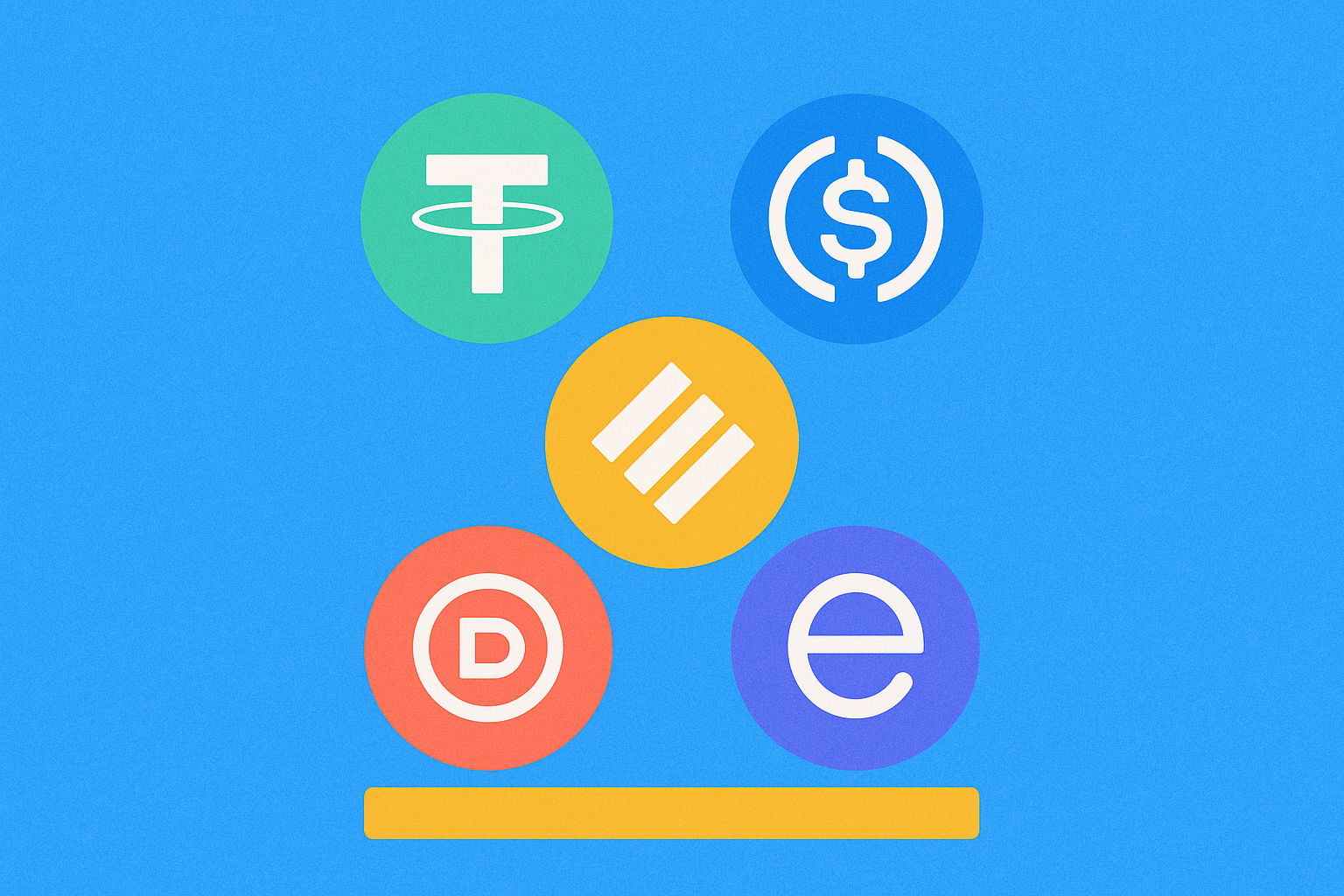
Top 10 Stablecoins for 2024: In-Depth Review of USDT, USDC, DAI, and Other Leading Stablecoins. A Comparative Analysis of Collateral Mechanisms, Associated Risks, and Key Benefits for Trading and Investment. Guidelines for Selecting a Trusted Stablecoin on Gate.
What Are Stablecoins
Stablecoins are a distinct class of cryptocurrency whose value is anchored to another currency or asset class. Most often, this peg is to a fiat currency like the US dollar or euro, but it can also be linked to commodity assets such as gold or other precious metals. This pegging mechanism delivers relative price stability for stablecoins, distinguishing them from highly volatile cryptocurrencies like Bitcoin or Ethereum.
Stablecoins are a crucial bridge between traditional fiat currencies and the cryptocurrency market. They serve multiple purposes, from hedging risk to enabling fast cross-border transactions, and are an essential component of today’s crypto trading and decentralized finance (DeFi) infrastructure.
What Are Fiat-Pegged Stablecoins
Fiat-pegged stablecoins are digital representations of real-world (fiat) currencies on the blockchain. Their issuance involves locking a certain amount of fiat currency in reserves and minting an equivalent amount of cryptocurrency via smart contracts. The locked fiat acts as collateral for the stablecoin and determines its market value.
For example, widely used stablecoins like USDC and USDT are pegged to the US dollar at a 1:1 ratio, meaning each token is backed by one dollar held in the issuer’s reserves. This approach delivers predictable pricing and builds user confidence in the asset.
Which Stablecoins Are Most Popular
USD Coin (USDC) and Tether (USDT) have the largest market capitalization among stablecoins, with their combined value far surpassing other fiat-backed coins. These two assets dominate the market due to their liquidity, broad trading platform support, and high trust from both institutional and retail investors.
It’s also notable that a leading crypto platform previously discontinued support for its native stablecoin, BUSD, reshaping the competitive landscape among stablecoins.
USDT
USDT (Tether) is a US dollar-pegged stablecoin launched by Tether Limited in 2014. Its primary purpose was to bridge traditional fiat currencies with the cryptocurrency market. Each USDT token is pegged 1:1 to the dollar, theoretically backed by one US dollar in the company’s reserves.
USDT is the most widely used stablecoin in the crypto industry. It’s available on numerous blockchains—including Ethereum, Tron, Binance Smart Chain, and others—providing high liquidity and broad usability. Traders frequently use USDT to quickly enter and exit positions without converting to fiat.
USDC (USD Coin) is a US dollar-pegged stablecoin launched in 2018 by Circle, a company specializing in peer-to-peer payments and financial services. USDC maintains a fixed $1 price through full reserve backing. The Centre consortium, established by Circle, manages USDC and collaborates with a leading crypto exchange and a Bitcoin mining company.
USDC stands out for its transparency and regular reserve audits, increasing institutional trust. It is a highly liquid stablecoin listed on most centralized exchanges and decentralized protocols, making it a go-to choice for DeFi applications.
TUSD
True USD (TUSD) is a relatively new stablecoin introduced in 2018 by TrustToken and PrimeTrust. TUSD was created to address core issues in the stablecoin sector—specifically, trust, transparency, and independent auditing of reserves.
TUSD’s key feature is that all user funds in US dollars are held in third-party escrow accounts, inaccessible to the issuing entities. This structure reduces the risk of misuse. TUSD also provides real-time verification of its underlying reserves by independent third parties, delivering maximum transparency for users.
BUSD
BUSD is a stablecoin issued through a partnership between a top crypto platform and blockchain firm Paxos Trust. BUSD is pegged to the US dollar at a 1:1 ratio. Paxos Trust oversees issuance, reserve management, token burning, and new minting upon dollar deposits.
BUSD is built on Ethereum and supports the BEP-2 token standard, ensuring compatibility across multiple blockchains. The token has regulatory approval from the New York State Department of Financial Services, which enhances its legitimacy among institutional investors.
DAI
DAI is the only fully decentralized stablecoin among the leading options. Unlike USDT and USDC, which are managed by centralized intermediaries, DAI is issued through a decentralized application (DApp) on Ethereum—the Maker protocol.
DAI was launched in 2018 by MakerDAO, a decentralized autonomous organization (DAO). The token maintains a soft 1:1 peg to the US dollar, but its collateralization mechanism differs from centralized stablecoins.
The Maker Protocol DApp mints new DAI tokens by requiring users to lock crypto collateral based on Bitcoin or Ethereum. These assets are held in Ethereum smart contracts called Maker Vaults. If collateral value drops below a set threshold, the position is automatically liquidated to keep DAI stable.
eUSD and peUSD by Lybra
Lybra Finance is a decentralized platform that gives users access to innovative liquid staking tokens (LSTs). eUSD and peUSD are interest-bearing stablecoins created by the Lybra protocol, with liquid staking tokens used as collateral.
The key advantage is that holders earn attractive passive income from staking the underlying assets while maintaining liquidity in stablecoin form. This addresses the traditional staking challenge of assets being locked for long periods without utility.
Synthetic USD
Synthetic USD is designed for users seeking US dollar stability without engaging with traditional banks. Its primary aim is to ensure a stable dollar-equivalent price via a pegging mechanism involving two interconnected assets.
For instance, Galoy offers the Stablesats feature, letting users access stable USD prices by using Bitcoin as the underlying asset. This is accomplished through advanced derivatives and hedging strategies that offset Bitcoin’s volatility, while retaining the benefits of a decentralized network.
Why Are Stablecoins Gaining Popularity
Stablecoins keep gaining traction for several reasons. They offer stability within volatile crypto markets, enabling traders and investors to preserve value without moving into fiat. They also play a critical role in DeFi, serving as a core medium of exchange and a unit of account.
Additionally, stablecoins offer access to dollar-denominated assets for users in countries with unstable currencies, fostering financial inclusion and providing inflation protection. Their ease of use, fast cross-border transfers, and low fees make them a compelling alternative to traditional bank remittances.
Stablecoins and Decentralized Finance (DeFi)
Stablecoins are widely used in the rapidly expanding DeFi sector and are an integral part of it.
DeFi is a dynamic ecosystem of financial services built on blockchain technology. It allows users to access a broad array of financial products and services without centralized intermediaries. Instead of relying on banks, DeFi leverages smart contracts to automate financial transactions.
Stablecoins are a cornerstone of the DeFi ecosystem, especially for peer-to-peer transactions. They frequently serve as collateral on decentralized lending and borrowing platforms like Aave, Compound, and MakerDAO. Users can deposit stablecoins to earn interest or use them to obtain loans secured by crypto assets.
Stablecoins are also widely utilized in automated market maker (AMM) protocols and liquidity pools on decentralized exchanges, serving as a trading pair to provide stability and predictability for market participants.
Advantages of Dollarization
By being pegged to the US dollar, stablecoins let users receive and store value in dollars without opening a US or other stable-currency bank account. This is especially valuable for people in developing nations and regions with high inflation.
When a national currency faces significant inflation or devaluation, stablecoins can offer financial stability and help maintain savings’ purchasing power. For example, residents of Latin America, Africa, and certain parts of Asia actively use stablecoins to protect their assets from depreciation.
Stablecoins allow citizens of developing countries to fully engage in the global economy, accessing international markets and services. Blockchain and stablecoins enable fast, low-cost cross-border transfers—especially important for migrants sending remittances home. Traditional remittance systems often charge high fees (up to 10%), while stablecoins can reduce these costs to under 1%.
Risks Associated with Stablecoins
Despite their advantages, stablecoins carry specific risks users must recognize.
The resilience of stablecoins depends directly on the reliability of the underlying asset and the issuer’s financial strength. If the collateral’s value sharply drops, or if the issuer faces serious financial or legal trouble, the stablecoin can lose its peg. There have been several historical cases of stablecoins losing their peg (“depegging”), causing significant losses for holders.
Regulatory uncertainty is another significant risk for the stablecoin industry. Regulators in different jurisdictions are still formulating approaches to stablecoin oversight, and future legal changes could impact their availability and use.
Technical risks include potential smart contract vulnerabilities, especially for decentralized stablecoins like DAI. Even with generally fast transaction times, blockchain network congestion can cause delays and temporarily restrict access to funds—critical during periods of high market volatility.
Centralized stablecoins also expose users to counterparty risk: users must trust that the issuer’s reserves exist and are properly managed. Some issuers’ lack of full transparency adds risk for holders.
How to Obtain Stablecoins
The fastest and simplest way to get stablecoins is to buy them on a centralized exchange with fiat currency. Most major platforms offer direct purchase of top stablecoins (USDT, USDC, BUSD) using bank cards, wire transfers, or other payment options. This process typically requires identity verification (KYC) per regulatory requirements.
Users can also obtain stablecoins by swapping other cryptocurrencies, such as Bitcoin or Ethereum. This is convenient for those who already hold crypto assets and want to lock in profits or reduce volatility without converting to fiat.
Stablecoins are also available on decentralized platforms via P2P marketplaces or automated exchange protocols. Many users prefer decentralized platforms since they’re non-custodial, letting users retain full control over their private keys and funds. However, this approach requires greater technical proficiency.
Advanced users can mint stablecoins directly through issuer protocols by providing collateral or depositing fiat directly with the issuer.
Conclusion
Stablecoins are a fundamental part of the crypto ecosystem, playing a pivotal role in industry growth. Their peg to real-world assets forms a reliable bridge between traditional fiat and digital assets, addressing the volatility challenge that has long hindered mainstream crypto adoption.
As the global crypto sector matures and expands, stablecoins’ influence and importance will keep increasing. They underpin the growth of decentralized finance, foster financial inclusion for billions without access to traditional banking, and provide efficient solutions for cross-border payments.
However, users must understand the risks involved and exercise due diligence in choosing stablecoins—paying attention to reserve transparency, issuer reputation, and regulatory status. As legal frameworks evolve and standards for transparency rise, stablecoins could become a standard instrument in the global financial system.
FAQ
What Is a Stablecoin? How Is It Different from Ordinary Cryptocurrency?
A stablecoin is a cryptocurrency whose value is tied to a stable asset (usually the US dollar) or algorithm. Unlike ordinary cryptocurrencies, stablecoins minimize volatility, making them better suited for payments and savings.
What Are the Most Popular Stablecoins on the Market? What Are the Distinct Features of USDT, USDC, and DAI?
USDT leads in trading volume and is backed by traditional assets. USDC is a regulated stablecoin with strong transparency. DAI is a decentralized stablecoin on Ethereum smart contracts, overcollateralized by crypto assets.
What Risks Do Stablecoins Pose? How Can You Assess the Safety and Reliability of a Stablecoin?
Key risks include collateral volatility, regulatory changes, and counterparty risk. Evaluate reserves, audits, legal environment, market capitalization, and project track record to gauge reliability.
What Are the Main Use Cases for Stablecoins? Why Do Traders and Investors Need Stablecoins?
Stablecoins are used for safe value storage, fast transfers, and volatility reduction. Traders rely on them to lock in profits, hedge risks, and trade between crypto asset pairs. Investors use stablecoins to preserve capital and earn returns through lending.
How Do the Collateralization Mechanisms of Different Stablecoins Work? What Distinguishes Centralized from Decentralized Stablecoins?
Centralized stablecoins are backed by fiat reserves (such as USDT and USDC). Decentralized ones use crypto collateral or algorithms (like DAI, UST). The former are simpler but rely on the issuer; the latter are more transparent but subject to collateral volatility.
How Should You Choose a Stablecoin for Trading or Holding? What Metrics Matter Most?
Opt for stablecoins with strong liquidity and trading volume, reliable asset backing, and low fees. Assess market capitalization, price volatility, and issuer reputation. Favor stablecoins on major blockchains with transparent reserves.
How Does the Pegging Mechanism for Stablecoins Work? How Is Stablecoin Price Stability Maintained?
Stablecoins are pegged to fiat by collateralization—holding reserves in banks or equivalent assets. Price is stabilized through arbitrage: when the price deviates, users can redeem the stablecoin at face value, restoring balance. Some use additional algorithmic stabilization mechanisms.
* The information is not intended to be and does not constitute financial advice or any other recommendation of any sort offered or endorsed by Gate.