This comprehensive guide compares Vaulta (A) and NEAR Protocol, two prominent Layer-1 blockchain platforms shaping the Web3 ecosystem. A positions itself as a Web3 banking network emphasizing vault security and instant transactions, while NEAR operates as a scalable Layer-1 protocol with Nightshade sharding technology targeting 100,000 TPS. The article analyzes historical price trends, tokenomics, institutional adoption, technical capabilities, and investment strategies across different risk profiles. NEAR demonstrates superior liquidity ($7.1M daily volume vs $87K), established ecosystem partnerships, and clearer technical roadmap, while A represents emerging infrastructure with higher volatility. Through detailed price predictions extending to 2031 and risk assessment, this guide helps investors evaluate which platform better aligns with their portfolio objectives and risk tolerance, supported by current market data and real-time pricing on Gate.
Introduction: A vs NEAR Investment Comparison
In the cryptocurrency market, the comparison between A and NEAR remains a topic investors cannot bypass. Both show significant differences in market cap ranking, application scenarios, and price performance, representing distinct positioning within crypto assets.
A: Since its launch in 2025, it has gained market recognition with its positioning as a Web3 banking network, offering vault-like security and instant transaction capabilities for the next generation of financial systems.
NEAR: Since its debut in 2020, it has been recognized as a highly scalable Layer 1 protocol, enabling mobile DApp operations and linear blockchain expansion through state sharding technology.
This article will comprehensively analyze the investment value comparison between A and NEAR around historical price trends, supply mechanisms, institutional adoption, technical ecosystems, and future predictions, attempting to address investors' most pressing question:
"Which is the better buy right now?"
I. Historical Price Comparison and Current Market Status
Vaulta (A) and NEAR Protocol's Historical Price Trends
- 2025: Vaulta (A) reached a high of $0.778734 on May 28, 2025, but subsequently experienced significant volatility, declining to a low of $0.143078 on December 19, 2025.
- 2022: NEAR Protocol achieved its historical peak of $20.44 on January 17, 2022, during a period of broader market enthusiasm for Layer-1 blockchain solutions.
- 2020: NEAR Protocol recorded its historical low of $0.526762 on November 5, 2020, shortly after its initial market launch.
- Comparative analysis: During the recent market cycle, Vaulta (A) has shown substantial price fluctuation, dropping approximately 77.59% from its peak over the past year. NEAR Protocol has experienced a more extended period of price adjustment, declining approximately 64.60% over the same period, with both assets reflecting broader market correction trends.
Current Market Status (2026-01-15)
- Vaulta (A) current price: $0.1781
- NEAR Protocol current price: $1.7888
- 24-hour trading volume: Vaulta (A) $87,472.04 vs NEAR Protocol $7,116,347.73
- Market sentiment index (Fear & Greed Index): 61 (Greed)
View real-time prices:
- View A current price Market Price
- View NEAR current price Market Price
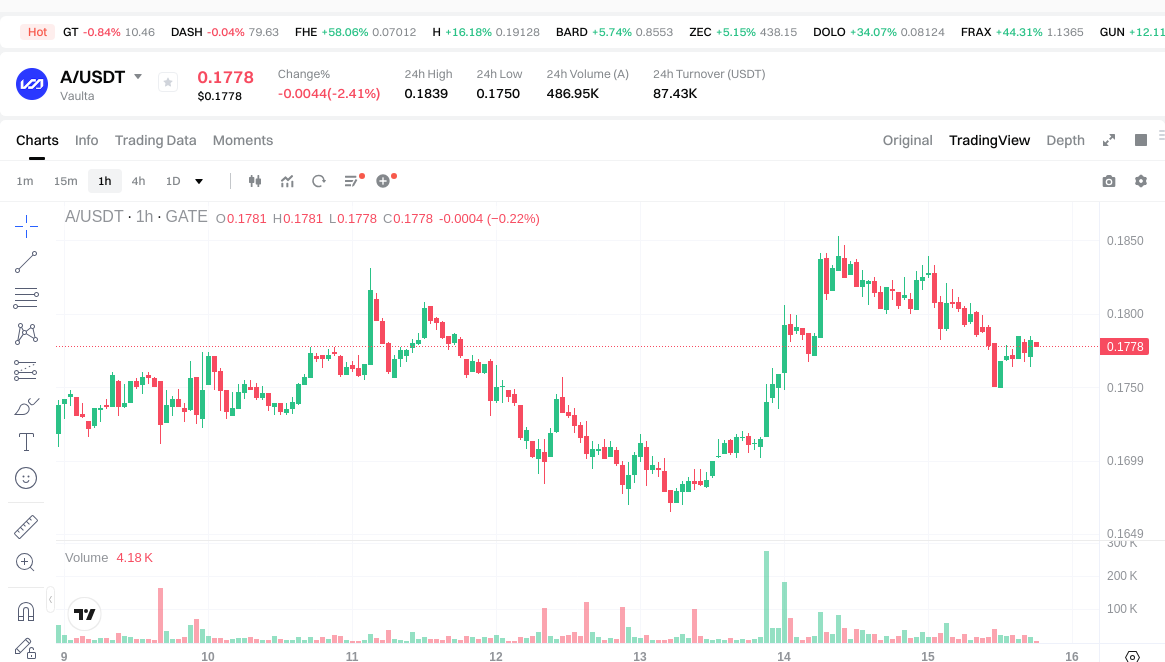
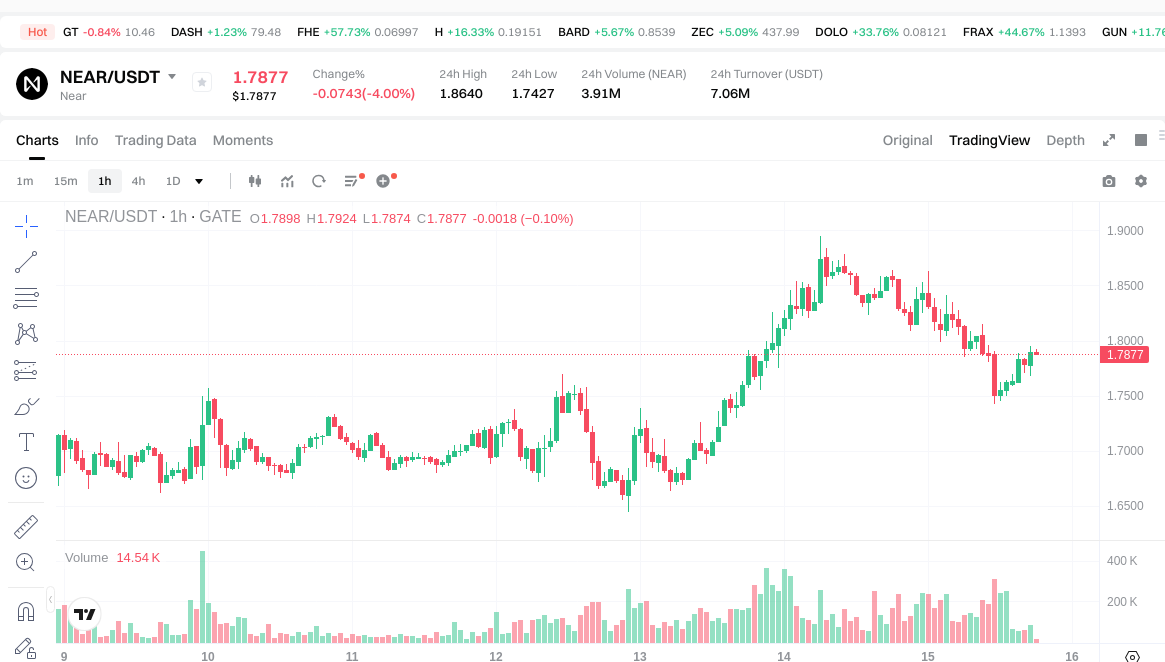
II. Core Factors Influencing A vs NEAR Investment Value
Supply Mechanism Comparison (Tokenomics)
- A: Information regarding the supply mechanism of A was not available in the reference materials.
- NEAR: NEAR Protocol launched with an initial supply of 1 billion tokens. The protocol implements an annual inflation rate of 5% as block rewards, with 90% (4.5% total) distributed to validators and 10% (0.5% total) allocated to the protocol treasury. Additionally, 30% of transaction fees are rebated to contracts involved in transactions, while the remaining 70% are burned, creating a deflationary pressure mechanism.
- 📌 Historical Pattern: NEAR's supply mechanism combines moderate inflation with transaction fee burning, potentially supporting long-term value through network usage growth.
Institutional Adoption and Market Application
- Institutional Holdings: Reference materials did not provide comparative data on institutional preferences between A and NEAR.
- Enterprise Adoption: NEAR Protocol has established partnerships with various projects including Aurora and Metapool, focusing on DeFi and cross-chain applications. The Rainbow Bridge facilitates cross-chain asset flow, potentially attracting capital from other blockchain ecosystems. Specific enterprise adoption details for cross-border payments or settlements were not mentioned in the materials.
- National Policy: The materials noted that regulatory policies and market uncertainty in the blockchain industry may impact NEAR's future development, though specific national regulatory stances were not detailed.
Technical Development and Ecosystem Building
- A Technical Upgrades: No information was provided in the reference materials regarding A's technical development.
- NEAR Technical Development: NEAR Protocol employs Nightshade sharding technology, designed to achieve linear scalability as the network grows, targeting 100,000 TPS with 1 million mobile nodes. The protocol features Aurora (an EVM-compatible layer) that lowers migration barriers for Ethereum developers. Recent protocol upgrades focus on enhancing scalability and performance.
- Ecosystem Comparison: NEAR's ecosystem includes growing applications in NFT and DeFi sectors. The platform emphasizes developer-friendly tools and user experience, with its native wallet supporting email-based registration. Recent data showed a surge of 600,000 returning users and transaction volume reaching 1.2 million, primarily driven by the kaikai DApp (a Web3 lifestyle application). Comparative ecosystem data for A was not available.
Macroeconomic Factors and Market Cycles
- Performance Under Inflation: Reference materials did not contain specific analysis of inflation-hedging properties for either A or NEAR.
- Macroeconomic Monetary Policy: The materials noted that NEAR's price may be influenced by market sentiment, policy changes, and technological progress, though specific impacts of interest rates or dollar index movements were not detailed.
- Geopolitical Factors: While the materials mentioned that increasing institutional investor interest in cryptocurrency markets during economic uncertainty could benefit NEAR, specific analysis of cross-border transaction demand or international situations was not provided.
III. 2026-2031 Price Prediction: A vs NEAR
Short-term Prediction (2026)
- Coin A: Conservative $0.11-$0.18 | Optimistic $0.18-$0.19
- NEAR: Conservative $1.61-$1.79 | Optimistic $1.79-$1.84
Mid-term Prediction (2028-2029)
- Coin A may enter a consolidation phase, with estimated price range of $0.14-$0.30
- NEAR may enter a growth phase, with estimated price range of $1.46-$2.68
- Key drivers: institutional capital inflows, ETF developments, ecosystem expansion
Long-term Prediction (2030-2031)
- Coin A: Baseline scenario $0.23-$0.31 | Optimistic scenario $0.26-$0.41
- NEAR: Baseline scenario $1.62-$2.42 | Optimistic scenario $2.69-$3.48
View detailed price predictions for Coin A and NEAR
Disclaimer
A:
| Year |
Predicted High Price |
Predicted Average Price |
Predicted Low Price |
Price Change |
| 2026 |
0.188468 |
0.1778 |
0.10668 |
0 |
| 2027 |
0.22525482 |
0.183134 |
0.10621772 |
2 |
| 2028 |
0.2327816274 |
0.20419441 |
0.1388521988 |
14 |
| 2029 |
0.297143705432 |
0.2184880187 |
0.146386972529 |
22 |
| 2030 |
0.31195719309986 |
0.257815862066 |
0.22687795861808 |
44 |
| 2031 |
0.407387734443589 |
0.28488652758293 |
0.264944470652124 |
59 |
NEAR:
| Year |
Predicted High Price |
Predicted Average Price |
Predicted Low Price |
Price Change |
| 2026 |
1.841434 |
1.7878 |
1.60902 |
0 |
| 2027 |
2.3590021 |
1.814617 |
1.2702319 |
1 |
| 2028 |
2.2328862185 |
2.08680955 |
1.460766685 |
16 |
| 2029 |
2.67821137647 |
2.15984788425 |
1.90066613814 |
20 |
| 2030 |
3.4834026677184 |
2.41902963036 |
1.6207498523412 |
35 |
| 2031 |
3.216825602452728 |
2.9512161490392 |
2.685606695625672 |
64 |
IV. Investment Strategy Comparison: A vs NEAR
Long-term vs Short-term Investment Strategies
- A: May be suitable for investors with higher risk tolerance seeking exposure to emerging Web3 banking infrastructure, though limited historical data and lower trading volume suggest careful consideration of liquidity constraints.
- NEAR: May appeal to investors interested in established Layer-1 blockchain ecosystems with demonstrated scalability solutions and active developer communities, particularly those focusing on DeFi and cross-chain applications.
Risk Management and Asset Allocation
- Conservative Investors: Consider limiting exposure with allocations such as A: 5-10% vs NEAR: 15-20% of crypto portfolio, maintaining substantial holdings in more established assets.
- Aggressive Investors: May explore higher allocations such as A: 15-25% vs NEAR: 25-35% of crypto portfolio, accepting increased volatility for potential growth opportunities.
- Hedging Tools: Stablecoin allocation for portfolio stability, options strategies for downside protection, cross-asset diversification across different blockchain protocols.
V. Potential Risk Comparison
Market Risk
- A: Exhibits significant price volatility with approximately 77.59% decline from peak over the past year, limited trading volume of $87,472.04 may result in execution challenges during market stress.
- NEAR: Experienced approximately 64.60% decline from all-time high, with 24-hour trading volume of $7,116,347.73 providing relatively better liquidity, though still subject to broader market correction trends.
Technical Risk
- A: Limited information available regarding technical infrastructure, scalability solutions, or network stability metrics in reference materials.
- NEAR: Nightshade sharding technology targets ambitious 100,000 TPS with 1 million mobile nodes, though achieving these metrics at scale remains under development. Network stability dependent on validator participation and protocol upgrade execution.
Regulatory Risk
- Both assets face uncertainty from evolving global regulatory frameworks for blockchain technology and digital assets. NEAR's cross-chain capabilities through Rainbow Bridge may face additional scrutiny regarding inter-protocol asset transfers. Specific regulatory impacts on A's Web3 banking positioning were not detailed in available materials.
VI. Conclusion: Which Is the Better Buy?
📌 Investment Value Summary:
- A Advantages: Positions itself within emerging Web3 banking infrastructure, offering exposure to financial system innovation, though currently demonstrates limited market maturity.
- NEAR Advantages: Established Layer-1 protocol with functioning ecosystem including Aurora EVM compatibility, demonstrated user growth with 600,000 returning users, active development in DeFi and NFT sectors, and deflationary mechanism through transaction fee burning.
✅ Investment Recommendations:
- New Investors: Consider starting with NEAR due to more established ecosystem, higher liquidity, and available educational resources, while limiting initial position sizes to manage volatility exposure.
- Experienced Investors: May evaluate both assets based on portfolio diversification needs, with NEAR offering exposure to Layer-1 scaling solutions and A providing access to Web3 banking concepts, emphasizing thorough due diligence given information limitations.
- Institutional Investors: NEAR may present more suitable characteristics including higher trading volume, established partnerships, and clearer technical roadmap, though both assets require assessment against institutional risk management frameworks.
⚠️ Risk Warning: Cryptocurrency markets exhibit extreme volatility. This content does not constitute investment advice. Past performance does not guarantee future results. Investors should conduct independent research and consider their risk tolerance before making investment decisions.
VII. FAQ
Q1: What is the primary difference between A and NEAR Protocol in terms of their core functionality?
A positions itself as a Web3 banking network focused on providing vault-like security and instant transaction capabilities for next-generation financial systems, while NEAR Protocol operates as a Layer-1 blockchain protocol emphasizing scalability through Nightshade sharding technology, targeting 100,000 TPS with support for mobile DApp operations. The fundamental distinction lies in A's financial infrastructure orientation versus NEAR's general-purpose blockchain platform approach with established DeFi and NFT ecosystem applications.
Q2: How do the supply mechanisms of A and NEAR differ, and what are their implications for long-term value?
NEAR Protocol implements a transparent tokenomics model with an initial supply of 1 billion tokens, 5% annual inflation for validator rewards, and a deflationary mechanism burning 70% of transaction fees while rebating 30% to contracts. A's supply mechanism details were not available in the reference materials. NEAR's balanced approach combining moderate inflation with usage-driven token burning creates potential long-term value support as network activity increases, whereas A's tokenomics remain unclear for evaluation purposes.
Q3: Which asset demonstrates better liquidity and trading characteristics?
NEAR Protocol exhibits significantly superior liquidity with a 24-hour trading volume of $7,116,347.73 compared to A's $87,472.04, representing approximately 81x higher trading activity. This substantial difference means NEAR offers better price execution, reduced slippage risk, and more efficient entry/exit opportunities for investors. A's limited trading volume may result in execution challenges during market stress periods, particularly for larger position sizes.
Q4: What are the key ecosystem and partnership differences between A and NEAR?
NEAR Protocol has established an active ecosystem including partnerships with Aurora (EVM-compatible layer), Metapool, and cross-chain infrastructure through Rainbow Bridge, facilitating asset flow from other blockchain networks. The protocol demonstrated substantial user engagement with 600,000 returning users and 1.2 million transactions, primarily driven by applications like the kaikai Web3 lifestyle DApp. In contrast, reference materials provided limited information regarding A's ecosystem development, partnerships, or user adoption metrics, making comparative analysis challenging.
Q5: Based on price predictions, which asset shows stronger growth potential through 2031?
According to provided predictions, NEAR demonstrates stronger projected growth with an estimated price range of $2.69-$3.48 (optimistic scenario) by 2031, representing approximately 64% potential upside from current levels. A shows projected range of $0.26-$0.41 (optimistic scenario) by 2031, representing approximately 59% potential upside. However, NEAR's predictions are supported by established ecosystem metrics, technical development roadmap, and clearer tokenomics, while A's predictions carry higher uncertainty given limited historical data and market information.
Q6: What regulatory and technical risks should investors consider when choosing between A and NEAR?
Both assets face evolving regulatory uncertainty surrounding blockchain technology and digital assets globally. NEAR's cross-chain capabilities through Rainbow Bridge may attract additional scrutiny regarding inter-protocol asset transfers and compliance requirements. From a technical perspective, A lacks detailed information about infrastructure stability and scalability solutions in available materials, creating evaluation challenges. NEAR's ambitious technical targets (100,000 TPS with 1 million nodes) remain under development, with execution risk dependent on protocol upgrades and validator participation. Investors should assess these factors against their risk tolerance and regulatory environment.
Q7: Which investment strategy is more appropriate for conservative versus aggressive investors?
Conservative investors may consider limited exposure with allocations of 5-10% for A and 15-20% for NEAR within their cryptocurrency portfolio, maintaining substantial holdings in more established assets and employing stablecoin hedging strategies. Aggressive investors accepting higher volatility for growth opportunities might explore 15-25% allocation for A and 25-35% for NEAR. However, given A's limited liquidity and information availability, even aggressive investors should carefully evaluate position sizing. NEAR's more established ecosystem, higher trading volume, and clearer technical roadmap may provide more suitable risk-adjusted characteristics for both investor types seeking Layer-1 blockchain exposure.
Q8: How have recent price performances compared, and what do they indicate about market sentiment?
A experienced approximately 77.59% decline from its May 2025 peak of $0.778734 to December 2025 low of $0.143078, demonstrating substantial volatility within a compressed timeframe. NEAR declined approximately 64.60% from its January 2022 all-time high of $20.44, representing a more extended correction period aligned with broader market cycles. Despite these declines, the current market sentiment index indicates 61 (Greed), suggesting renewed investor interest. NEAR's relatively smaller percentage decline over a longer period, combined with significantly higher trading volume, suggests more stable market absorption of selling pressure compared to A's sharper recent corrections.
* The information is not intended to be and does not constitute financial advice or any other recommendation of any sort offered or endorsed by Gate.