This comprehensive analysis compares AAVE and FIL as DeFi investment options, examining their market positioning, price trajectories, and growth potential. AAVE, ranked 42nd by market cap at $2.63 billion, operates as a decentralized lending protocol with multi-chain deployment and deflationary tokenomics, while FIL focuses on decentralized storage infrastructure. The article evaluates both tokens' historical performance, supply mechanisms, institutional adoption patterns, and technology developments across multiple blockchains including Ethereum, Polygon, Avalanche, and Arbitrum through Gate. Price forecasts extend through 2031, offering conservative and optimistic scenarios alongside tailored investment strategies for different investor profiles. Critical risk factors encompass market volatility, regulatory challenges, and protocol-specific vulnerabilities, with actionable insights for beginners, experienced traders, and institutional participants seeking diversified DeFi exposure.
Introduction: AAVE Investment Value, Price Prediction, and Risk Analysis
In the decentralized finance (DeFi) ecosystem, AAVE has emerged as one of the leading lending protocols, attracting significant attention from both retail and institutional participants. As of January 14, 2026, AAVE ranks 42nd by market capitalization with a total value of approximately $2.63 billion and a circulating supply of 15.18 million tokens.
AAVE is an open-source decentralized lending protocol that provides deposit and borrowing services to users. Interest rates for both lenders and borrowers are algorithmically calculated based on platform liquidity dynamics, while Chainlink oracles ensure fair pricing of collateral assets. The platform underwent a significant transition in October 2020 (block height 10978863) through improvement proposal AIP1, converting the previous LEND token to AAVE at a 100:1 ratio.
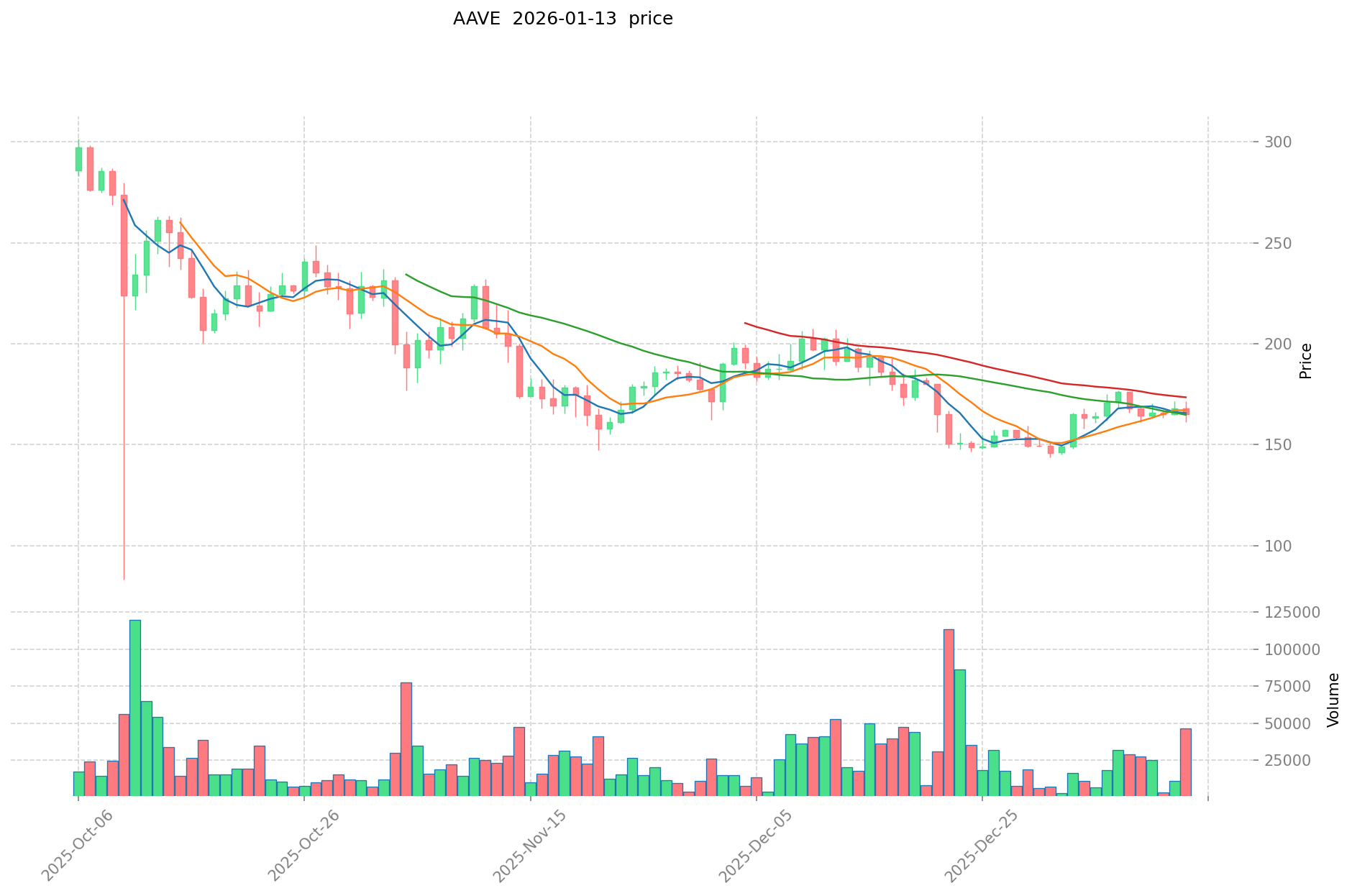
Currently trading at $173.38, AAVE has experienced notable volatility throughout its history. The token demonstrated positive short-term momentum with a 5.34% increase over 24 hours and a 1.27% gain in the past hour. However, medium to long-term performance shows mixed signals, with a 9.49% decline over 30 days and a 39.97% decrease over the past year.
This analysis aims to provide a comprehensive evaluation of AAVE's investment potential by examining:
Market positioning and competitive landscape within the DeFi sector
Historical price performance and volatility patterns
Supply dynamics and tokenomics structure
Technical infrastructure and protocol developments
Risk factors and potential growth catalysts
Through objective data analysis and market context, this report seeks to equip investors with essential information for informed decision-making regarding AAVE exposure.
I. Price History Comparison and Market Status
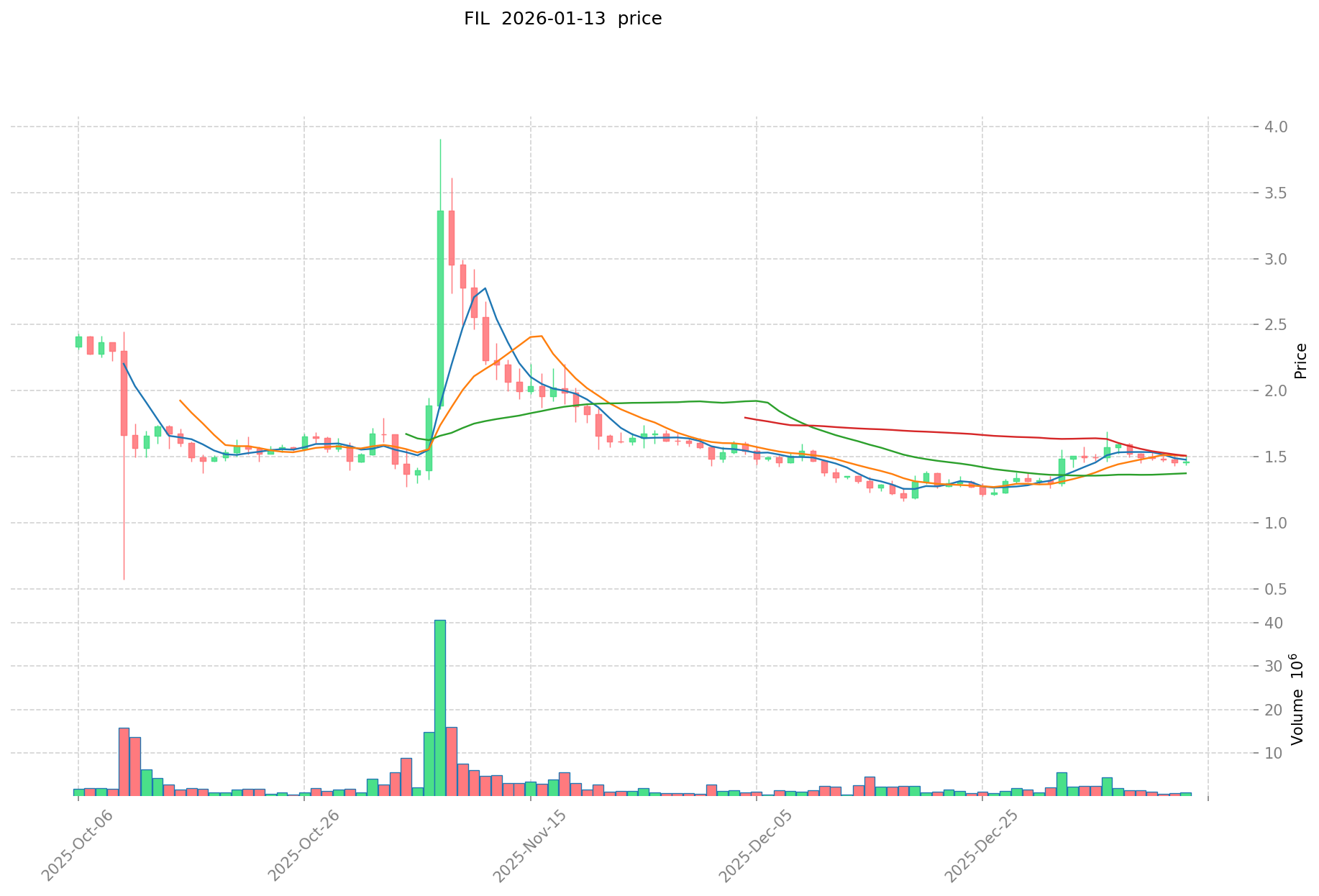
AAVE and FIL Historical Price Trends
- 2021: AAVE experienced significant price movement, with its price reaching notable levels during the DeFi boom period. The token saw substantial trading activity as the protocol expanded its lending and borrowing services.
- 2021: FIL saw considerable price fluctuations following its mainnet launch milestone. The token experienced notable volatility as the decentralized storage network gained traction in the market.
- Comparative Analysis: During the 2021-2025 market cycle, AAVE moved from its peak of $661.69 to lower levels, while FIL similarly declined from its historical high of $236.84 to current trading ranges, reflecting broader market trends.
Current Market Status (January 14, 2026)
- AAVE Current Price: $173.38
- FIL Current Price: $1.576
- 24-Hour Trading Volume: AAVE recorded $7,629,250.93 compared to FIL's $2,177,294.46
- Market Sentiment Index (Fear & Greed Index): 26 (Fear)
View real-time prices:
- Check AAVE current price Market Price
- Check FIL current price Market Price
II. Core Factors Influencing AAVE vs FIL Investment Value
Supply Mechanism Comparison (Tokenomics)
- AAVE: Features a fixed maximum supply of 16 million tokens with a deflationary mechanism through the Safety Module, where staked AAVE can be used to cover protocol deficits, potentially reducing circulating supply over time.
- FIL: Operates with a dynamic supply model tied to network storage capacity, with block rewards decreasing over time as the Filecoin network matures, creating a long-term supply curve influenced by mining activity.
- 📌 Historical Pattern: Supply mechanisms influence price cycles through scarcity dynamics. Higher staking rates in AAVE tend to reduce circulating supply, potentially supporting price appreciation, while FIL's mining-based release creates ongoing supply pressure that correlates with network growth phases.
Institutional Adoption and Market Application
- Institutional Holdings: AAVE has gained recognition among DeFi-focused institutional participants due to its established lending protocol and governance structure, while FIL attracts institutions interested in decentralized storage infrastructure.
- Enterprise Adoption: AAVE serves primarily in DeFi lending and borrowing ecosystems across multiple blockchains including Ethereum, Polygon, Avalanche, and Arbitrum. FIL focuses on decentralized storage solutions for data preservation and retrieval within the Filecoin network.
- Regulatory Environment: Both tokens face evolving regulatory frameworks across jurisdictions. DeFi lending protocols like Aave encounter scrutiny regarding compliance requirements, while decentralized storage networks navigate data sovereignty and storage regulations in different regions.
Technology Development and Ecosystem Building
- AAVE Technology Evolution: The protocol has expanded through multi-chain deployments and introduced innovations such as flash loans, variable interest rate models, and the GHO stablecoin. The development roadmap includes enhanced cross-chain functionality and integration with emerging blockchain networks.
- FIL Technology Progress: Filecoin's development focuses on network efficiency improvements, storage proof mechanisms, and integration capabilities with decentralized applications requiring storage solutions.
- Ecosystem Comparison: AAVE operates within the DeFi lending sector with applications in yield farming, liquidity provision, and collateralized borrowing. The protocol has also ventured into social applications through Lens Protocol. FIL's ecosystem centers on decentralized storage infrastructure, serving use cases in data archiving, content distribution, and Web3 storage needs.
Macroeconomic Environment and Market Cycles
- Performance During Inflation: Both assets exhibit characteristics influenced by broader cryptocurrency market trends rather than serving as traditional inflation hedges. Their value correlates more closely with DeFi adoption and storage demand respectively than with inflation metrics.
- Macroeconomic Monetary Policy: Interest rate changes and dollar strength affect both tokens through their impact on overall cryptocurrency market liquidity and risk appetite. Tightening monetary conditions typically create headwinds for digital assets broadly.
- Geopolitical Factors: AAVE benefits from increased DeFi activity during periods of financial system uncertainty, while FIL may see demand growth from data sovereignty concerns and cross-border data storage requirements in various geopolitical contexts.
III. 2026-2031 Price Forecast: AAVE vs FIL
Short-term Forecast (2026)
- AAVE: Conservative $145.04-$172.67 | Optimistic $172.67-$183.03
- FIL: Conservative $1.23-$1.57 | Optimistic $1.57-$1.94
Mid-term Forecast (2028-2029)
- AAVE may enter a growth phase with estimated price range of $162.73-$231.35
- FIL may enter an expansion phase with estimated price range of $1.66-$3.21
- Key drivers: institutional capital inflows, ETF developments, ecosystem expansion
Long-term Forecast (2030-2031)
- AAVE: Baseline scenario $111.13-$252.17 | Optimistic scenario $252.17-$320.26
- FIL: Baseline scenario $1.52-$2.98 | Optimistic scenario $2.98-$3.93
View detailed price predictions for AAVE and FIL
Disclaimer
AAVE:
| Year |
Predicted High Price |
Predicted Average Price |
Predicted Low Price |
Price Change |
| 2026 |
183.0302 |
172.67 |
145.0428 |
0 |
| 2027 |
192.078108 |
177.8501 |
104.931559 |
2 |
| 2028 |
207.15979648 |
184.964104 |
172.01661672 |
6 |
| 2029 |
231.3531012832 |
196.06195024 |
162.7314186992 |
13 |
| 2030 |
290.642235035776 |
213.7075257616 |
111.127913396032 |
23 |
| 2031 |
320.26209810633376 |
252.174880398688 |
221.91389475084544 |
45 |
FIL:
| Year |
Predicted High Price |
Predicted Average Price |
Predicted Low Price |
Price Change |
| 2026 |
1.93602 |
1.574 |
1.22772 |
0 |
| 2027 |
2.2639629 |
1.75501 |
1.4917585 |
11 |
| 2028 |
2.81328103 |
2.00948645 |
1.647778889 |
27 |
| 2029 |
3.2071403742 |
2.41138374 |
1.6638547806 |
53 |
| 2030 |
3.146373503952 |
2.8092620571 |
1.517001510834 |
78 |
| 2031 |
3.93071947029432 |
2.977817780526 |
2.79914871369444 |
88 |
IV. Investment Strategy Comparison: AAVE vs FIL
Long-term vs Short-term Investment Strategies
-
AAVE: Suitable for investors focused on DeFi ecosystem growth and protocol innovation. The token's deflationary mechanism through the Safety Module and expanding multi-chain presence may appeal to those seeking exposure to decentralized lending infrastructure. Short-term traders might consider the protocol's governance developments and new feature launches as potential catalysts.
-
FIL: Suitable for investors interested in decentralized storage infrastructure and Web3 data solutions. The token's value proposition centers on network storage capacity growth and enterprise adoption of decentralized storage. Long-term holders may focus on the network's utility expansion, while short-term participants might track storage demand fluctuations and mining dynamics.
Risk Management and Asset Allocation
-
Conservative Investors: AAVE 30% vs FIL 20%, with remaining allocation to stablecoins and established digital assets. This approach limits exposure to protocol-specific risks while maintaining diversification across different DeFi sectors.
-
Aggressive Investors: AAVE 50% vs FIL 35%, with higher concentration in growth-oriented protocols. This strategy assumes higher risk tolerance and belief in sector-specific expansion trajectories.
-
Hedging Tools: Stablecoin allocation for liquidity management, options strategies for downside protection, cross-asset portfolio construction combining lending protocols with storage networks to reduce correlation risks.
V. Potential Risk Comparison
Market Risks
-
AAVE: Faces volatility related to DeFi sector sentiment, lending protocol competition, and broader cryptocurrency market cycles. The token demonstrated a 39.97% decline over the past year, reflecting sensitivity to market conditions. Trading volume fluctuations and liquidity changes across multiple chains may impact price stability.
-
FIL: Experiences price movements influenced by storage demand cycles, mining profitability dynamics, and competition from alternative decentralized storage solutions. The current price of $1.576 represents significant distance from historical highs, indicating sustained market pressure and network adoption challenges.
Technology Risks
-
AAVE: Expansion across multiple blockchain networks (Ethereum, Polygon, Avalanche, Arbitrum) introduces cross-chain security considerations and smart contract vulnerabilities across different environments. Protocol upgrades and governance decisions may affect platform stability and user confidence.
-
FIL: Network efficiency improvements and storage proof mechanisms require ongoing development. The relationship between mining activity and token supply creates complexity in predicting supply dynamics and their impact on token economics.
Regulatory Risks
- Both tokens navigate evolving regulatory frameworks. DeFi lending protocols like AAVE encounter scrutiny regarding compliance requirements and potential classification under financial services regulations across different jurisdictions. Decentralized storage networks face data sovereignty considerations and storage regulations that vary by region, creating uncertainty for network participants and token holders.
VI. Conclusion: Which Is the Better Investment?
📌 Investment Value Summary:
-
AAVE Advantages: Established position within DeFi lending sector, multi-chain deployment strategy, deflationary tokenomics through Safety Module, diverse ecosystem including GHO stablecoin and Lens Protocol, current market capitalization of approximately $2.63 billion indicating significant market presence.
-
FIL Advantages: Focus on decentralized storage infrastructure addressing Web3 data needs, network utility tied to storage capacity growth, potential benefits from data sovereignty concerns and cross-border storage requirements.
✅ Investment Recommendations:
-
Beginner Investors: Consider smaller position sizes (10-15% of crypto portfolio) with focus on understanding protocol mechanics and risk factors before increasing exposure. Prioritize educational resources on DeFi lending and decentralized storage concepts.
-
Experienced Investors: May employ strategic allocation based on sector outlook, utilizing 20-40% portfolio weighting across both protocols depending on risk tolerance and market view. Consider technical analysis, on-chain metrics, and protocol development milestones for position timing.
-
Institutional Investors: Evaluate protocols based on governance structure, regulatory compliance frameworks, liquidity depth across trading venues, and alignment with broader portfolio strategy. Consider sector diversification benefits and correlation analysis with existing holdings.
⚠️ Risk Warning: Cryptocurrency markets exhibit high volatility. This analysis does not constitute investment advice. Market participants should conduct independent research and consider their financial circumstances before making investment decisions.
VII. FAQ
Q1: What is the fundamental difference between AAVE and FIL's value proposition?
AAVE is a decentralized lending protocol that generates value through DeFi borrowing and lending services, while FIL is a decentralized storage network that derives value from data storage capacity and retrieval services. AAVE's utility centers on interest rate markets, flash loans, and collateralized borrowing across multiple blockchains (Ethereum, Polygon, Avalanche, Arbitrum), with a deflationary token model through the Safety Module. FIL's value proposition focuses on providing decentralized storage infrastructure for Web3 applications, with token economics tied to network mining rewards and storage demand. The protocols serve different sectors within the blockchain ecosystem—AAVE addresses financial services needs while FIL targets data storage requirements.
Q2: How do AAVE and FIL's tokenomics affect their investment characteristics?
AAVE features a fixed maximum supply of 16 million tokens with deflationary pressure through Safety Module staking, while FIL operates with a dynamic supply model influenced by mining activity and network storage growth. AAVE's staking mechanism potentially reduces circulating supply over time, creating scarcity dynamics that may support price appreciation during periods of increased protocol adoption. FIL's mining-based token distribution creates ongoing supply pressure that correlates with network expansion phases, resulting in different supply-demand dynamics. As of January 14, 2026, AAVE has 15.18 million tokens in circulation with a market cap of $2.63 billion, while FIL's supply continues to expand based on storage provider participation and block rewards.
Q3: Which token showed better performance resilience over the past year?
Neither token demonstrated strong resilience, but their performance patterns differ significantly. AAVE declined 39.97% over the past year, trading at $173.38 as of January 14, 2026, down from its historical high of $661.69. FIL currently trades at $1.576, significantly below its peak of $236.84. AAVE showed short-term momentum with a 5.34% increase over 24 hours and higher trading volume of $7,629,250.93 compared to FIL's $2,177,294.46. Both tokens reflect broader cryptocurrency market challenges, though AAVE maintains stronger market capitalization ranking at 42nd position, suggesting relatively better market positioning within their respective sectors.
Q4: What are the primary risk factors for each protocol?
AAVE faces risks related to DeFi sector competition, multi-chain security vulnerabilities, smart contract exploits across different blockchain environments, and regulatory scrutiny of decentralized lending platforms. The protocol's expansion across multiple networks introduces cross-chain complexity and governance challenges. FIL's primary risks include storage demand volatility, mining profitability fluctuations, competition from alternative decentralized storage solutions, and uncertainty regarding data sovereignty regulations across jurisdictions. Both tokens experience correlation with broader cryptocurrency market cycles, though their sector-specific risks differ—AAVE's exposure to DeFi lending dynamics versus FIL's dependence on storage network adoption and mining economics.
Q5: How do institutional adoption patterns differ between AAVE and FIL?
AAVE attracts DeFi-focused institutional participants interested in decentralized lending infrastructure, governance participation, and yield generation strategies. The protocol's established position across multiple blockchain networks and integration with various DeFi applications provides institutional access points. FIL appeals to institutions seeking exposure to decentralized storage infrastructure and Web3 data solutions, particularly those concerned with data sovereignty and long-term archival needs. AAVE's current market capitalization of approximately $2.63 billion indicates stronger institutional recognition within the DeFi lending sector compared to FIL's focus on emerging decentralized storage markets. However, both protocols face evolving regulatory frameworks that may affect institutional participation patterns.
Q6: What are the price forecast ranges for 2026-2031?
According to the analysis, AAVE's conservative 2026 forecast ranges from $145.04-$172.67, with optimistic scenarios reaching $172.67-$183.03. Long-term projections for 2031 suggest a baseline range of $111.13-$252.17 and optimistic scenario of $252.17-$320.26. FIL's conservative 2026 estimates range from $1.23-$1.57, with optimistic targets of $1.57-$1.94. By 2031, FIL's baseline forecast suggests $1.52-$2.98, with optimistic scenarios reaching $2.98-$3.93. These projections incorporate factors including institutional capital flows, ecosystem expansion, and sector-specific development milestones. However, cryptocurrency markets exhibit high volatility, and actual performance may vary significantly from these estimates based on market conditions and protocol developments.
Q7: Which allocation strategy suits different investor profiles?
Conservative investors might consider 30% AAVE versus 20% FIL allocation, with remaining portfolio in stablecoins and established digital assets to limit protocol-specific risks. Aggressive investors with higher risk tolerance may employ 50% AAVE versus 35% FIL positioning, assuming stronger conviction in sector-specific growth trajectories. Beginner investors should start with smaller position sizes (10-15% of crypto portfolio) to understand protocol mechanics before increasing exposure. Experienced investors may utilize 20-40% portfolio weighting across both protocols based on technical analysis, on-chain metrics, and development milestones. Institutional investors should evaluate governance structures, regulatory compliance frameworks, and liquidity depth when determining appropriate allocation levels aligned with broader portfolio objectives.
Q8: How do macroeconomic conditions affect AAVE and FIL differently?
Both tokens correlate with broader cryptocurrency market trends rather than serving as traditional inflation hedges. AAVE's performance relates more closely to DeFi adoption rates, lending protocol competition, and decentralized finance sector sentiment. During periods of financial system uncertainty, AAVE may benefit from increased DeFi activity as users seek alternatives to traditional financial services. FIL's value correlates with storage demand cycles, data sovereignty concerns, and Web3 infrastructure adoption. Tightening monetary conditions and interest rate increases typically create headwinds for both tokens through reduced market liquidity and risk appetite. However, their sector-specific dynamics mean they respond differently to technological developments, regulatory changes, and industry-specific adoption patterns within DeFi lending and decentralized storage markets.
* The information is not intended to be and does not constitute financial advice or any other recommendation of any sort offered or endorsed by Gate.