This comprehensive analysis compares ACH (Alchemy Pay) and DOGE (Dogecoin) across critical investment dimensions, addressing which cryptocurrency offers superior opportunities in the current market. ACH, a payment infrastructure token launched in 2018, features a fixed 10 billion token supply and bridges fiat-crypto economies across 70+ countries. DOGE, established in 2013, maintains unlimited supply with significantly higher liquidity and market recognition. The article examines historical price trends, tokenomics, institutional adoption, and technology development, revealing ACH's enterprise payment positioning versus DOGE's community-driven retail appeal. Current prices stand at $0.012574 (ACH) and $0.1368 (DOGE), with forecasts through 2031 suggesting 122% potential upside for ACH and 78% for DOGE. Investment strategy recommendations vary by risk profile: conservative investors may favor DOGE's superior liquidity, while aggressive investors could emphasize ACH's payment technology growth potential and sca
Introduction: Investment Comparison Between ACH and DOGE
In the cryptocurrency market, the comparison between ACH and DOGE remains a topic of ongoing interest among investors. The two assets exhibit notable differences in market capitalization ranking, application scenarios, and price performance, representing distinct positioning within the crypto ecosystem.
Alchemy Pay (ACH): Launched in 2018, ACH has gained market recognition through its role as a payment solution provider, connecting fiat and cryptocurrency economies for consumers, merchants, developers, and institutions across over 70 countries.
Dogecoin (DOGE): Introduced in 2013, DOGE has established itself as a widely-used cryptocurrency, with a substantial user base and trading volume, making it one of the prominent digital assets in the market.
This analysis examines the investment comparison between ACH and DOGE across multiple dimensions, including historical price trends, supply mechanisms, ecosystem development, and market positioning, addressing a key question for investors:
"Which presents a more suitable investment opportunity based on current market conditions?"
I. Historical Price Comparison and Current Market Status
ACH and DOGE Historical Price Trends
-
2021: ACH reached its all-time high of $0.198666 on August 7, 2021. DOGE experienced significant price volatility during the same period, recording its all-time high of $0.731578 on May 8, 2021, driven by social media momentum and high-profile endorsements.
-
2015-2021: DOGE recorded its all-time low of $0.0000869 on May 6, 2015. ACH, having launched later in September 2020, recorded its all-time low of $0.00135537 on July 21, 2021.
-
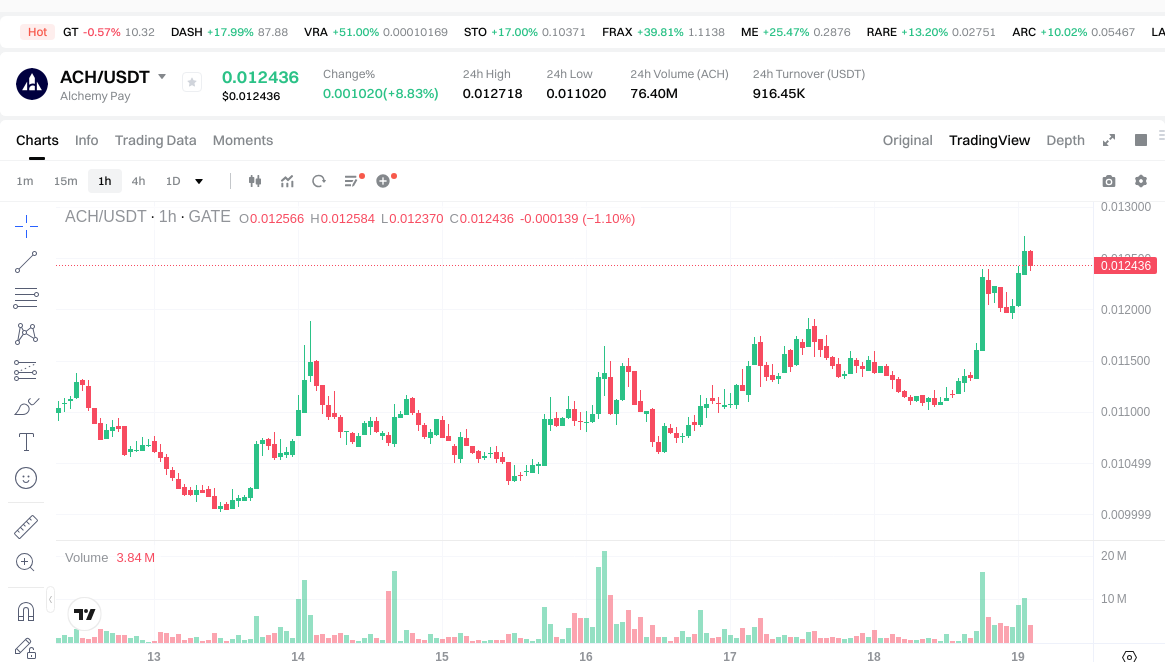
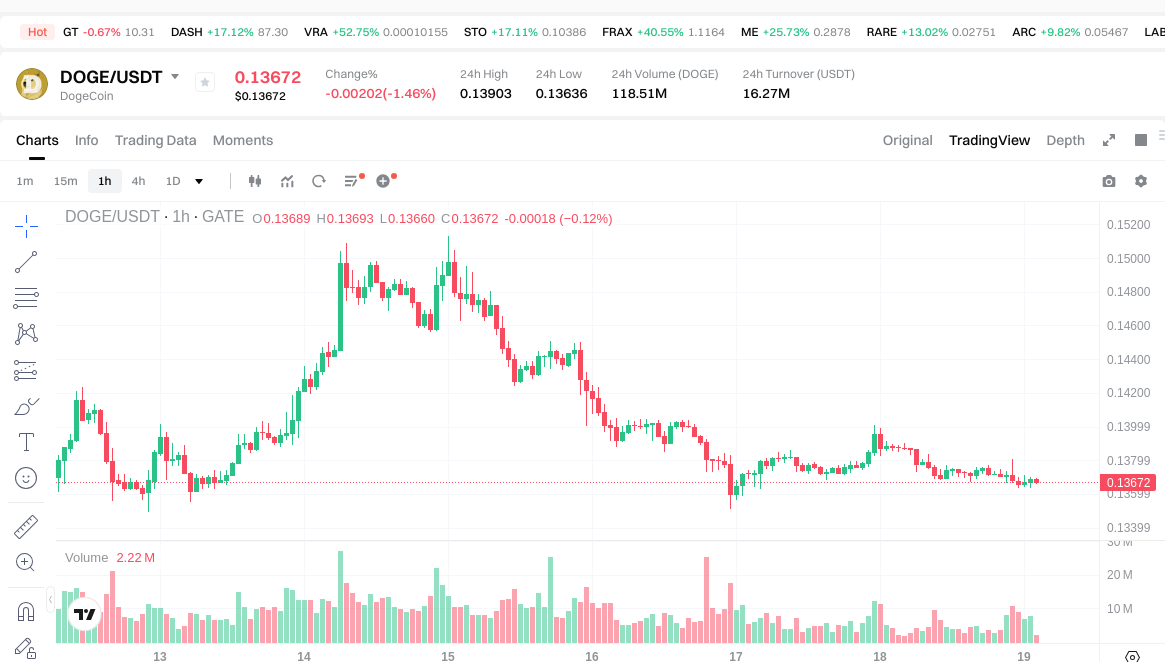
Comparative Analysis: During the 2021-2026 market cycle, ACH declined from its peak of $0.198666 to a current price range near $0.0126, representing a notable correction from historical highs. DOGE similarly experienced a substantial decline from its peak of $0.731578 to the current level around $0.1368, reflecting broader market adjustments and shifts in investor sentiment.
Current Market Status (January 19, 2026)
- ACH Current Price: $0.012574
- DOGE Current Price: $0.1368
- 24-Hour Trading Volume: ACH recorded approximately $878,589.92, while DOGE demonstrated significantly higher liquidity with a 24-hour trading volume of approximately $16,217,107.89
- Market Sentiment Index (Fear & Greed Index): 49 (Neutral)
View real-time prices:
II. Core Factors Influencing ACH vs DOGE Investment Value
Supply Mechanism Comparison (Tokenomics)
-
ACH: ACH operates with a maximum supply of 10 billion tokens. The reference materials indicate a current holder distribution pattern where major wallets control significant portions, with the top holders accounting for approximately 33.24% of the supply collectively. The token follows a standard ERC-20 framework without built-in deflationary mechanisms, relying on market demand and ecosystem expansion to drive value.
-
DOGE: DOGE features an unlimited supply model with approximately 5 billion new coins mined annually. Unlike assets with capped supplies, this inflationary design means continuous token generation. The reference materials highlight that supply and demand dynamics are fundamental drivers—assets with strong demand and scarce supply tend to appreciate, while those with weak demand and abundant supply may depreciate.
-
📌 Historical Pattern: Supply mechanisms have historically shaped price cycles. Fixed or deflationary models can create scarcity-driven rallies during demand surges, while inflationary models like DOGE's may dilute value over time unless adoption outpaces supply growth.
Institutional Adoption and Market Application
-
Institutional Holdings: Reference materials suggest ACH, through Alchemy Pay, positions itself within payment infrastructure, potentially attracting fintech partnerships. DOGE, despite high market capitalization, carries meme-driven volatility that may limit institutional appetite compared to utility-focused assets.
-
Enterprise Adoption: ACH serves in crypto-to-fiat payment gateways and settlement systems, bridging traditional finance with blockchain networks. DOGE has gained recognition in select merchant acceptance scenarios and retail payment experiments, though its enterprise utility remains more limited. The materials note ACH's focus on payment application expansion as a growth driver.
-
National Policy: Regulatory attitudes vary globally. The reference materials discuss stablecoin frameworks and payment regulations but do not specify distinct policy treatments for ACH versus DOGE. Both face evolving compliance requirements as governments develop crypto asset regulations.
Technology Development and Ecosystem Building
-
ACH Technical Upgrades: The reference materials emphasize Alchemy Pay's role in enabling fiat-crypto payment solutions, supporting multiple blockchains and payment methods (including ACH transfers, SEPA, card networks). Technical development centers on expanding payment infrastructure, KYC/AML integration, and cross-border settlement efficiency.
-
DOGE Technical Development: DOGE operates on a Proof-of-Work consensus similar to Bitcoin, with modest technical evolution. The materials do not highlight significant protocol upgrades or major ecosystem expansions for DOGE beyond its established blockchain infrastructure.
-
Ecosystem Comparison: ACH benefits from integration within DeFi payment rails, partnerships with exchanges, and fiat on/off-ramp services. DOGE's ecosystem revolves primarily around peer-to-peer transactions and community-driven merchant adoption. The reference materials detail extensive DeFi, NFT, and smart contract ecosystems across various platforms, though neither ACH nor DOGE features prominently in these advanced DeFi use cases compared to assets like Ethereum or Solana.
Macroeconomic and Market Cycles
-
Performance in Inflationary Environments: The materials discuss how assets with strong demand and limited supply may appreciate during inflationary periods. ACH's capped supply could theoretically provide scarcity value, while DOGE's continuous inflation may require sustained demand growth to maintain purchasing power. Historical crypto market behavior shows that utility-driven assets and those with deflationary characteristics tend to outperform during macro uncertainty.
-
Macro Monetary Policy: Interest rates and US dollar strength significantly impact crypto asset flows. The reference materials note that Federal Reserve policies, quantitative easing, and dollar liquidity conditions influence global capital allocation. Rising rates typically pressure speculative assets including cryptocurrencies, while accommodative policy may support risk appetite.
-
Geopolitical Factors: Cross-border payment demand and international settlement needs can drive adoption of payment-focused assets like ACH. The materials extensively cover global payment infrastructure evolution, stablecoin adoption, and remittance markets—areas where payment utility tokens may find growing use cases. DOGE's geopolitical relevance remains more limited, primarily driven by retail sentiment rather than structural international payment needs.
III. 2026-2031 Price Forecast: ACH vs DOGE
Short-term Forecast (2026)
- ACH: Conservative $0.00796544 - $0.012446 | Optimistic $0.012446 - $0.01418844
- DOGE: Conservative $0.0710736 - $0.13668 | Optimistic $0.13668 - $0.1407804
Mid-term Forecast (2028-2029)
- ACH may enter a gradual growth phase, with estimated price range of $0.008682161579 - $0.018540829629595
- DOGE may enter a consolidation phase, with estimated price range of $0.1106334500544 - $0.2091663665091
- Key drivers: institutional capital flows, ETF developments, ecosystem expansion
Long-term Forecast (2030-2031)
- ACH: Baseline scenario $0.009936773052075 - $0.017474321730547 | Optimistic scenario $0.017474321730547 - $0.027861932283271
- DOGE: Baseline scenario $0.13781773094804 - $0.19101556610955 | Optimistic scenario $0.19101556610955 - $0.24383137013884
View detailed price predictions for ACH and DOGE
Disclaimer
ACH:
| Year |
Predicted High Price |
Predicted Average Price |
Predicted Low Price |
Price Change |
| 2026 |
0.01418844 |
0.012446 |
0.00796544 |
-1 |
| 2027 |
0.0161138362 |
0.01331722 |
0.0083898486 |
5 |
| 2028 |
0.018100099563 |
0.0147155281 |
0.008682161579 |
17 |
| 2029 |
0.018540829629595 |
0.0164078138315 |
0.008367985054065 |
30 |
| 2030 |
0.021493415728573 |
0.017474321730547 |
0.011707795559466 |
38 |
| 2031 |
0.027861932283271 |
0.01948386872956 |
0.009936773052075 |
54 |
DOGE:
| Year |
Predicted High Price |
Predicted Average Price |
Predicted Low Price |
Price Change |
| 2026 |
0.1407804 |
0.13668 |
0.0710736 |
0 |
| 2027 |
0.185898468 |
0.1387302 |
0.108209556 |
1 |
| 2028 |
0.18341519742 |
0.162314334 |
0.1217357505 |
18 |
| 2029 |
0.2091663665091 |
0.17286476571 |
0.1106334500544 |
26 |
| 2030 |
0.233038990653651 |
0.19101556610955 |
0.120339806649016 |
39 |
| 2031 |
0.24383137013884 |
0.2120272783816 |
0.13781773094804 |
54 |
IV. Investment Strategy Comparison: ACH vs DOGE
Long-term vs Short-term Investment Strategies
-
ACH: May suit investors focused on payment infrastructure development and ecosystem expansion potential. The asset's positioning within fiat-crypto bridge solutions and fixed supply model could appeal to those seeking exposure to payment technology evolution over multi-year horizons.
-
DOGE: May attract investors comfortable with community-driven assets and established market presence. The asset's high liquidity and widespread recognition could serve participants seeking near-term trading opportunities or diversification through meme-driven sentiment cycles.
Risk Management and Asset Allocation
-
Conservative Investors: A potential allocation framework might consider ACH at 20-30% vs DOGE at 70-80% within a crypto payment sector allocation, reflecting DOGE's higher liquidity and established market depth as stabilizing factors.
-
Aggressive Investors: A more speculative approach could allocate ACH at 60-70% vs DOGE at 30-40%, emphasizing potential growth from payment infrastructure expansion and ecosystem development for ACH, while maintaining DOGE exposure for market beta and liquidity.
-
Hedging Tools: Stablecoin reserves for risk management, options strategies for downside protection, and cross-asset portfolio balancing across different crypto sectors can help manage volatility inherent in both assets.
V. Potential Risk Comparison
Market Risks
-
ACH: The asset faces liquidity constraints relative to larger market cap cryptocurrencies, with 24-hour trading volume around $878,589.92. Market depth limitations may result in higher price volatility during periods of reduced trading activity or sudden capital flows.
-
DOGE: Despite higher liquidity with approximately $16,217,107.89 in daily volume, the asset experiences sentiment-driven volatility. Price movements historically correlate with social media trends and retail investor behavior, introducing unpredictability beyond fundamental factors.
Technical Risks
-
ACH: As an ERC-20 token, scalability depends on underlying Ethereum network performance and transaction costs. Network congestion during high-activity periods may impact payment processing efficiency, though layer-2 solutions and multi-chain integration could mitigate these concerns.
-
DOGE: Operating on Proof-of-Work consensus, the network faces potential mining centralization concerns and security considerations inherent to computational proof systems. Limited protocol development compared to more actively upgraded blockchain platforms may present long-term technical competitiveness challenges.
Regulatory Risks
- Global regulatory frameworks for payment-focused cryptocurrencies continue evolving. ACH's integration with fiat payment systems subjects it to compliance requirements including KYC/AML standards, cross-border payment regulations, and potential licensing obligations across jurisdictions. DOGE faces broader cryptocurrency regulatory uncertainty, though its classification as a digital asset rather than payment infrastructure may result in different regulatory treatment. Jurisdictional approaches vary significantly, with some regions implementing comprehensive frameworks while others maintain developing policies.
VI. Conclusion: Which Is the Better Buy?
📌 Investment Value Summary
-
ACH Advantages: Positioning within payment infrastructure sector, fixed maximum supply of 10 billion tokens potentially offering scarcity characteristics, integration with fiat-crypto bridge solutions across multiple jurisdictions, and strategic focus on expanding payment ecosystem partnerships.
-
DOGE Advantages: Established market presence since 2013, significantly higher trading liquidity supporting entry and exit flexibility, widespread brand recognition and community engagement, proven resilience through multiple market cycles.
✅ Investment Considerations
-
Novice Investors: A measured approach emphasizing liquidity and established market presence may favor higher DOGE allocation, with smaller exploratory positions in ACH for diversification. Focus on understanding volatility patterns and risk management fundamentals before larger commitments.
-
Experienced Investors: Portfolio construction could incorporate both assets based on risk tolerance and sector exposure goals. ACH may provide payment technology sector exposure, while DOGE offers liquidity and market beta. Position sizing should reflect individual risk capacity and investment timeline.
-
Institutional Participants: Due diligence on payment infrastructure adoption trends, regulatory compliance frameworks, and liquidity requirements becomes essential. ACH's utility positioning may align with payment technology mandates, while DOGE's market depth could serve tactical allocation or market-making activities.
⚠️ Risk Disclosure: Cryptocurrency markets exhibit significant volatility. This analysis does not constitute investment advice. Market conditions, regulatory developments, and project execution carry substantial uncertainty. Participants should conduct independent research and consult qualified financial advisors before making investment decisions.
VII. FAQ
Q1: What are the main differences between ACH and DOGE's supply mechanisms?
ACH has a fixed maximum supply of 10 billion tokens following the ERC-20 standard without built-in deflationary mechanisms, while DOGE features an unlimited supply model generating approximately 5 billion new coins annually through mining. This fundamental difference means ACH may benefit from scarcity-driven value appreciation during demand surges, whereas DOGE requires sustained adoption growth to outpace its inflationary supply expansion and maintain purchasing power over time.
Q2: Which asset offers better liquidity for trading purposes?
DOGE demonstrates significantly superior liquidity with approximately $16,217,107.89 in 24-hour trading volume compared to ACH's $878,589.92. This 18x volume difference translates to tighter bid-ask spreads, reduced slippage on larger orders, and enhanced ability to enter or exit positions quickly. For investors prioritizing trade execution efficiency and portfolio flexibility, DOGE's established market depth provides substantial advantages over ACH's more constrained liquidity environment.
Q3: How do regulatory risks differ between ACH and DOGE?
ACH faces specific regulatory scrutiny as a payment infrastructure token, subjecting it to KYC/AML compliance requirements, cross-border payment regulations, and potential licensing obligations across the 70+ countries where Alchemy Pay operates. DOGE encounters broader cryptocurrency regulatory uncertainty but may receive different treatment as a digital asset rather than payment infrastructure. Both assets remain subject to evolving jurisdictional approaches, though ACH's integration with fiat payment systems exposes it to more stringent financial services regulations.
Q4: What portfolio allocation strategy suits conservative versus aggressive investors?
Conservative investors may consider allocating 20-30% to ACH and 70-80% to DOGE within a crypto payment sector allocation, leveraging DOGE's higher liquidity and established market presence as stabilizing factors. Aggressive investors could reverse this approach with 60-70% ACH and 30-40% DOGE, emphasizing potential growth from payment infrastructure expansion while maintaining DOGE exposure for market beta. Both strategies require appropriate hedging tools including stablecoin reserves and options for downside protection.
Q5: Which asset demonstrates stronger institutional adoption potential?
ACH positions itself more favorably for institutional adoption through its payment infrastructure focus, serving as a fiat-crypto bridge solution with KYC/AML integration and cross-border settlement capabilities. These utility-driven characteristics align with fintech partnerships and enterprise payment needs. DOGE, despite its high market capitalization and brand recognition, carries meme-driven volatility and limited enterprise utility beyond merchant acceptance experiments, potentially constraining institutional appetite compared to payment-focused assets like ACH.
Q6: How do historical price patterns inform future performance expectations?
ACH declined approximately 93.7% from its August 2021 peak of $0.198666 to current levels near $0.0126, while DOGE dropped roughly 81.3% from its May 2021 high of $0.731578 to approximately $0.1368. Both assets experienced substantial corrections reflecting broader market adjustments and sentiment shifts. Price forecasts through 2031 suggest ACH may reach $0.027861932283271 (optimistic scenario) representing 122% growth potential, while DOGE could achieve $0.24383137013884, indicating 78% upside—though historical volatility patterns indicate significant uncertainty remains in both projections.
Q7: What technical infrastructure advantages distinguish these assets?
ACH operates as an ERC-20 token benefiting from Ethereum's established smart contract ecosystem and multi-chain integration capabilities, though scalability depends on underlying network performance and layer-2 solutions. DOGE runs on Proof-of-Work consensus similar to Bitcoin with modest technical evolution, facing potential mining centralization concerns and limited protocol development compared to actively upgraded platforms. ACH's payment infrastructure focus emphasizes cross-border settlement efficiency and payment gateway expansion, while DOGE primarily serves peer-to-peer transactions with community-driven merchant adoption.
Q8: Which asset better serves payment utility versus speculative trading objectives?
ACH explicitly targets payment infrastructure development through fiat-crypto bridge solutions, serving consumers, merchants, developers, and institutions across international markets—aligning with utility-focused investment theses centered on payment technology adoption. DOGE functions primarily as a widely-recognized cryptocurrency with established brand presence, serving speculative trading objectives through its high liquidity and sentiment-driven price movements. Investors prioritizing payment sector exposure may favor ACH, while those seeking trading flexibility and market beta might prefer DOGE's established liquidity profile.
* The information is not intended to be and does not constitute financial advice or any other recommendation of any sort offered or endorsed by Gate.