This comprehensive analysis compares ACU and LINK, two distinct blockchain tokens with different market positions and use cases. ACU, launched in January 2026, powers decentralized verifiable compute networks using smartphone infrastructure, while LINK, established since 2017, ranks 18th by market capitalization as a leading oracle service connecting blockchain with off-chain data. The article examines critical investment dimensions including historical price performance, market capitalization comparisons, tokenomics structures, technical ecosystems, and risk factors. Current market data shows ACU trading at $0.11875 with extreme volatility, while LINK trades at $12.612 with more stable patterns. Through detailed price analysis, projected trajectories through 2031, and tailored allocation strategies for conservative to aggressive investors, this guide addresses which token suits different investment profiles. Investors discover risk comparisons, regulatory considerations, and actionable insights for portfolio
Introduction: ACU vs LINK Investment Comparison
In the cryptocurrency market, the comparison between ACU vs LINK continues to be a topic of significant interest among investors. The two tokens exhibit notable differences in market capitalization ranking, application scenarios, and price performance, representing distinct positioning within the crypto asset landscape.
Acurast (ACU): Launched in 2026, this project has gained attention for its decentralized verifiable compute network powered by smartphones. The platform aims to redefine computation by utilizing mobile devices as computing resources without requiring traditional data centers.
ChainLink (LINK): Since its 2017 launch, LINK has been recognized as a key infrastructure component in the blockchain ecosystem, serving as an ERC-20 token that facilitates oracle services connecting off-chain data with blockchain networks. It ranks 18th by market capitalization with a circulating supply of approximately 708 million tokens.
This article will analyze the investment value comparison between ACU vs LINK through multiple dimensions including historical price trends, supply mechanisms, technical ecosystems, and market positioning, attempting to address investors' core concerns:
"Which token presents a more suitable investment consideration based on current market conditions?"
I. Historical Price Comparison and Current Market Status
Price History of ACU (Coin A) and LINK (Coin B)
- 2017: LINK launched with an initial offering price of $0.091429, establishing its presence in the oracle services sector.
- 2021: LINK reached its all-time high of $52.7 on May 10, 2021, driven by growing adoption of decentralized oracle networks and DeFi expansion.
- 2026: ACU recorded its all-time high of $0.17717 on January 21, 2026, shortly after its launch on January 19, 2026, reflecting initial market enthusiasm for its smartphone-powered decentralized compute network.
- Comparative Analysis: During the recent market cycle, ACU experienced significant volatility, declining from its peak of $0.17717 to a low of $0.011 within just two days of trading. In contrast, LINK has demonstrated a more established price pattern, currently trading substantially below its 2021 peak, with a one-year decline of approximately 49.74%.
Current Market Status (January 22, 2026)
- ACU Current Price: $0.11875
- LINK Current Price: $12.612
- 24-Hour Trading Volume: ACU recorded $6,906,950.61 compared to LINK's $5,685,014.75
- Market Sentiment Index (Fear & Greed Index): 24 (Extreme Fear)
View real-time prices:
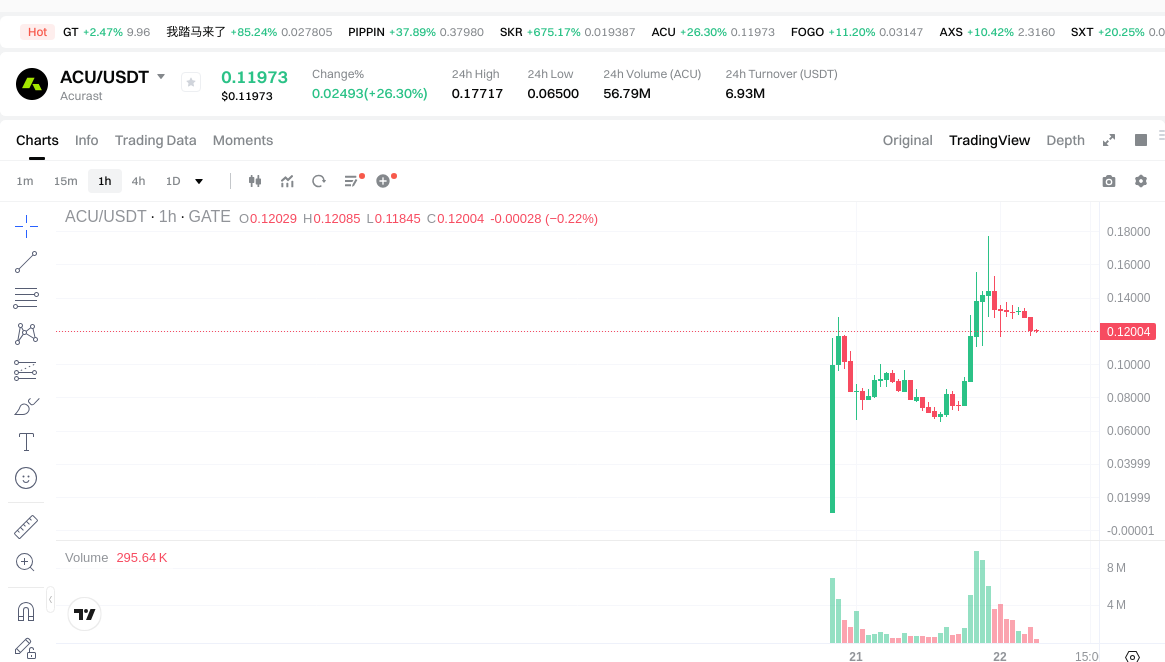
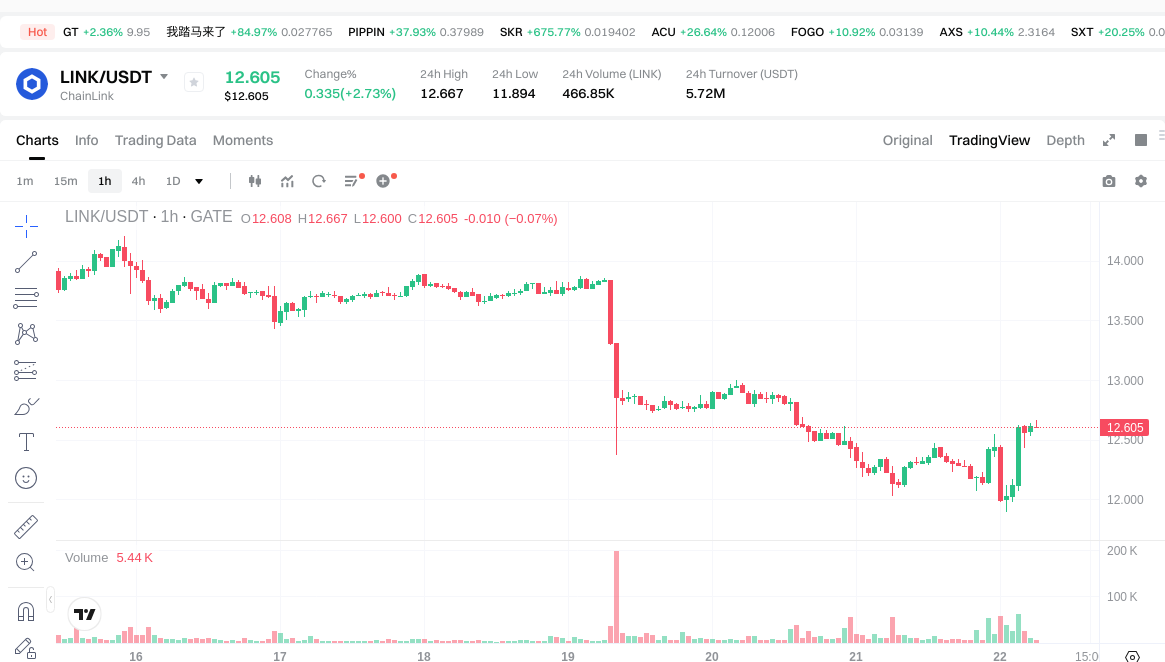
II. Core Factors Affecting ACU vs LINK Investment Value
Supply Mechanism Comparison (Tokenomics)
Due to limited available data on ACU's tokenomics structure, a comprehensive comparison of supply mechanisms cannot be provided at this time. LINK operates with a total supply cap, but specific details regarding inflation rates, token distribution schedules, and burn mechanisms for both assets require further research.
Institutional Adoption and Market Application
Institutional Holdings: Current data does not provide sufficient evidence to determine which asset commands stronger institutional preference between ACU and LINK.
Enterprise Adoption: Information regarding enterprise-level implementation of either ACU or LINK in cross-border payments, settlement systems, or institutional investment portfolios is not available in the provided materials.
National Policies: Regulatory approaches toward both assets vary across jurisdictions, though specific policy positions from major economies are not detailed in current resources.
Technical Development and Ecosystem Construction
ACU Technical Upgrades: Technical development roadmap and potential impacts on network performance are not documented in available materials.
LINK Technical Development: As an established oracle network, Chainlink continues infrastructure development, though specific recent upgrades and their projected impacts are not covered in current data.
Ecosystem Comparison: Comparative analysis of DeFi integration, NFT marketplace adoption, payment infrastructure, and smart contract deployment across both networks requires additional data.
Macroeconomic Environment and Market Cycles
Performance in Inflationary Environments: Historical performance data during inflationary periods is insufficient to determine which asset demonstrates stronger inflation-hedge characteristics.
Macroeconomic Monetary Policy: The relationship between interest rate movements, US Dollar Index fluctuations, and the respective price behaviors of ACU and LINK requires further empirical analysis.
Geopolitical Factors: While cross-border transaction demand and international developments may influence both assets, specific correlations and impact assessments are not available in current materials.
III. 2026-2031 Price Prediction: ACU vs LINK
Short-term Prediction (2026)
- ACU: Conservative $0.0945 - $0.1196 | Optimistic $0.1196 - $0.1543
- LINK: Conservative $11.98 - $12.61 | Optimistic $12.61 - $18.54
Mid-term Prediction (2028-2029)
- ACU may enter a gradual growth phase, with projected price range of $0.0933 - $0.2435
- LINK may enter an expansion phase, with projected price range of $15.12 - $25.48
- Key drivers: institutional capital inflows, ETF developments, ecosystem expansion
Long-term Prediction (2030-2031)
- ACU: Base scenario $0.1444 - $0.2517 | Optimistic scenario $0.2148 - $0.2866
- LINK: Base scenario $19.54 - $27.66 | Optimistic scenario $23.54 - $37.89
View detailed price predictions for ACU and LINK
Disclaimer
ACU:
| Year |
Predicted High Price |
Predicted Average Price |
Predicted Low Price |
Price Change |
| 2026 |
0.1543227 |
0.11963 |
0.0945077 |
0 |
| 2027 |
0.1849180725 |
0.13697635 |
0.0945136815 |
15 |
| 2028 |
0.2108408467375 |
0.16094721125 |
0.093349382525 |
35 |
| 2029 |
0.243521177981812 |
0.18589402899375 |
0.135702641165437 |
56 |
| 2030 |
0.251207896080704 |
0.214707603487781 |
0.180354386929736 |
80 |
| 2031 |
0.286538032234618 |
0.232957749784242 |
0.14443380486623 |
96 |
LINK:
| Year |
Predicted High Price |
Predicted Average Price |
Predicted Low Price |
Price Change |
| 2026 |
18.53964 |
12.612 |
11.9814 |
0 |
| 2027 |
21.1831152 |
15.57582 |
10.5915576 |
23 |
| 2028 |
24.81228126 |
18.3794676 |
16.909110192 |
45 |
| 2029 |
25.4831318274 |
21.59587443 |
15.117112101 |
71 |
| 2030 |
31.778329223745 |
23.5395031287 |
19.537787596821 |
86 |
| 2031 |
37.892715161424825 |
27.6589161762225 |
21.297365455691325 |
119 |
IV. Investment Strategy Comparison: ACU vs LINK
Long-term vs Short-term Investment Strategies
- ACU: May appeal to investors with higher risk tolerance seeking exposure to emerging decentralized compute infrastructure, particularly those interested in mobile-based blockchain innovation and early-stage project participation
- LINK: May suit investors seeking exposure to established blockchain infrastructure projects with demonstrated market positioning in oracle services and broader ecosystem integration
Risk Management and Asset Allocation
- Conservative Investors: ACU 10-20% vs LINK 80-90% allocation consideration, given LINK's longer market presence and established infrastructure role
- Aggressive Investors: ACU 30-40% vs LINK 60-70% allocation consideration, allowing for higher exposure to emerging technology while maintaining foundation in established assets
- Hedging Tools: Stablecoin allocation for liquidity management, options strategies where available, cross-asset portfolio diversification across multiple blockchain sectors
V. Potential Risk Comparison
Market Risks
- ACU: Exhibits substantial volatility patterns with sharp price movements observed in early trading history (decline from $0.17717 to $0.011 within two days), limited historical data for trend analysis, susceptibility to low-liquidity market conditions
- LINK: Subject to broader cryptocurrency market cycles with notable price decline of approximately 49.74% over the past year, correlation with overall digital asset market sentiment, trading substantially below previous cycle peaks
Technical Risks
- ACU: Network scalability considerations for smartphone-based compute infrastructure, potential challenges in maintaining distributed compute network stability, limited operational track record for technology validation
- LINK: Oracle network reliability dependencies, potential technical vulnerabilities in cross-chain data transmission mechanisms, network upgrade implementation risks
Regulatory Risks
- Regulatory frameworks continue to evolve across jurisdictions, potentially impacting both assets differently based on their functional classifications (compute services vs oracle infrastructure)
- Compliance requirements for decentralized networks may vary by region, affecting operational capabilities and market access for both projects
- Policy developments regarding blockchain infrastructure services could influence adoption trajectories and institutional participation levels
VI. Conclusion: Which Is the Better Buy?
📌 Investment Value Summary:
- ACU Characteristics: Represents exposure to emerging smartphone-powered decentralized compute technology, recently launched with limited operational history, demonstrates significant price volatility, offers participation in novel infrastructure approach
- LINK Characteristics: Established market position in oracle services sector (ranking 18th by market capitalization), longer operational track record since 2017, broader ecosystem integration, more extensive price history for analysis
✅ Investment Considerations:
- New Investors: May consider starting with smaller allocations to established infrastructure projects like LINK while gaining familiarity with cryptocurrency market dynamics before exploring higher-risk emerging projects
- Experienced Investors: Could evaluate portfolio diversification across both established infrastructure (LINK) and emerging technology sectors (ACU) based on individual risk tolerance and research conclusions
- Institutional Investors: Typically require extensive due diligence on regulatory compliance, liquidity depth, custody solutions, and operational track records before allocation decisions
⚠️ Risk Disclosure: Cryptocurrency markets exhibit extreme volatility. This analysis does not constitute investment advice. Investors should conduct independent research, assess personal risk tolerance, and consider consulting financial professionals before making investment decisions.
VII. FAQ
Q1: What is the primary difference between ACU and LINK in terms of their blockchain use cases?
ACU focuses on decentralized verifiable compute networks powered by smartphones, while LINK specializes in oracle services connecting off-chain data with blockchain networks. ACU represents an emerging approach to distributed computing that utilizes mobile devices as infrastructure, eliminating the need for traditional data centers. In contrast, LINK has established itself as critical blockchain middleware since 2017, providing the data connectivity layer that enables smart contracts to interact with real-world information. These fundamentally different value propositions position ACU in the infrastructure-as-a-service category and LINK in the data infrastructure category.
Q2: Which token demonstrates greater price stability based on available historical data?
LINK exhibits greater price stability compared to ACU. While LINK has experienced significant drawdowns (approximately 49.74% over the past year) aligned with broader cryptocurrency market cycles, ACU demonstrated extreme volatility in its brief trading history, declining from $0.17717 to $0.011 within two days of launch before recovering to $0.11875. LINK's eight-year operational history provides substantially more data points for analyzing price patterns, whereas ACU's recent January 2026 launch offers limited historical reference for assessing typical volatility ranges or establishing support/resistance levels.
Q3: What are the key risk factors investors should consider when comparing ACU and LINK?
For ACU, primary risk factors include extreme price volatility, limited operational track record, unproven scalability of smartphone-based compute infrastructure, and insufficient tokenomics transparency. The project's nascent stage means technology validation remains incomplete, and low liquidity conditions may amplify price swings. For LINK, risks center on broader cryptocurrency market correlation, oracle network reliability dependencies, potential technical vulnerabilities in cross-chain data transmission, and trading substantially below previous cycle peaks. Both assets face evolving regulatory frameworks that could impact their operational capabilities and market access differently based on their distinct functional classifications.
Q4: How do the market capitalizations of ACU and LINK compare, and what does this indicate?
LINK ranks 18th by market capitalization with approximately 708 million tokens in circulation, indicating established market recognition and substantial investor capital allocation. ACU's market capitalization data is not provided in available materials, but its recent launch in January 2026 suggests significantly smaller market presence compared to LINK's eight-year accumulation of market value. This disparity reflects LINK's longer operational history, broader ecosystem integration, and established position in blockchain infrastructure versus ACU's emerging status. Market capitalization differences typically correlate with liquidity depth, institutional participation levels, and overall market maturity.
Q5: What investment allocation strategy might suit different investor profiles when considering ACU vs LINK?
Conservative investors might consider an ACU 10-20% versus LINK 80-90% allocation approach, prioritizing exposure to LINK's established infrastructure role while maintaining limited exposure to ACU's emerging technology potential. Aggressive investors with higher risk tolerance could evaluate ACU 30-40% versus LINK 60-70% allocations, accepting greater volatility for potential upside from early-stage participation in decentralized compute innovation. New investors may benefit from starting with smaller positions in established projects like LINK before exploring higher-risk emerging assets, while experienced investors can calibrate allocations based on comprehensive due diligence, portfolio diversification objectives, and individual risk assessment frameworks.
Q6: What are the projected price trajectories for ACU and LINK through 2031?
Short-term 2026 projections suggest ACU may range between $0.0945-$0.1543 (conservative-optimistic scenarios), while LINK may range between $11.98-$18.54. Mid-term 2028-2029 forecasts indicate ACU potentially reaching $0.0933-$0.2435 and LINK achieving $15.12-$25.48, driven by institutional capital inflows and ecosystem expansion. Long-term 2030-2031 projections estimate ACU at $0.1444-$0.2866 (base-optimistic scenarios) and LINK at $19.54-$37.89. These predictions incorporate assumptions about adoption trajectories, market cycle dynamics, and technological development progress. However, cryptocurrency price forecasts carry substantial uncertainty, and actual outcomes may deviate significantly from projected ranges due to unpredictable market conditions and technological developments.
Q7: How does the current market sentiment affect investment considerations for ACU and LINK?
The current Fear & Greed Index reading of 24 (Extreme Fear) indicates substantial negative market sentiment as of January 22, 2026. This environment typically presents both challenges and opportunities: prices may face continued downward pressure from risk-averse investor behavior, but historically, extreme fear levels have occasionally preceded market recoveries. For ACU, extreme fear conditions may exacerbate volatility given its limited liquidity and recent launch status. For LINK, such sentiment may create accumulation opportunities for long-term investors if fundamental value propositions remain intact. However, timing market bottoms remains inherently uncertain, and investors should prioritize risk management over attempting to capitalize on sentiment extremes without comprehensive analysis and appropriate position sizing.
* The information is not intended to be and does not constitute financial advice or any other recommendation of any sort offered or endorsed by Gate.