This comprehensive analysis compares Cardano (ADA) and Cronos (CRO) as investment options in 2024, examining two distinct cryptocurrency projects within the digital asset ecosystem. ADA, ranked 11th by market capitalization at $0.3922, emphasizes academic-driven smart contract development with institutional adoption potential. CRO, positioned 34th at $0.1003, focuses on DeFi and gaming applications within the Crypto.com ecosystem. The article evaluates historical price trajectories showing both tokens declined approximately 87-90% from 2021 peaks, analyzes tokenomics, technical development, and macroeconomic factors influencing performance. Detailed price predictions spanning 2026-2031 suggest CRO offers higher growth potential (115-135%) versus ADA's stable trajectory (69-72%), though ADA provides greater market stability through superior liquidity and established infrastructure. Investment recommendations accommodate different risk profiles, from conservative allocation strategies emphasizing ADA dominance
Introduction: Investment Comparison Between ADA and CRO
In the cryptocurrency market, the comparison between ADA vs CRO remains a topic of ongoing interest among investors. Both assets exhibit distinct differences in market cap ranking, application scenarios, and price performance, representing different positioning within the crypto ecosystem.
Cardano (ADA): Launched in 2017, it has gained market recognition through its layered architecture and academic approach to blockchain development. As of January 13, 2026, ADA ranks 11th by market capitalization with a current price of $0.3922.
Cronos (CRO): Introduced in 2018, the token serves as the native currency of the Cronos blockchain ecosystem, focusing on decentralized finance and gaming applications. Currently ranked 34th, CRO trades at $0.1003 with a circulating supply representing approximately 38.61% of its maximum supply.
This article will examine historical price trajectories, supply mechanisms, institutional adoption patterns, technical ecosystem development, and future projections to provide a comprehensive analysis of ADA vs CRO investment value comparison, addressing the question that concerns investors most:
"Which is the better buy right now?"
I. Historical Price Comparison and Current Market Status
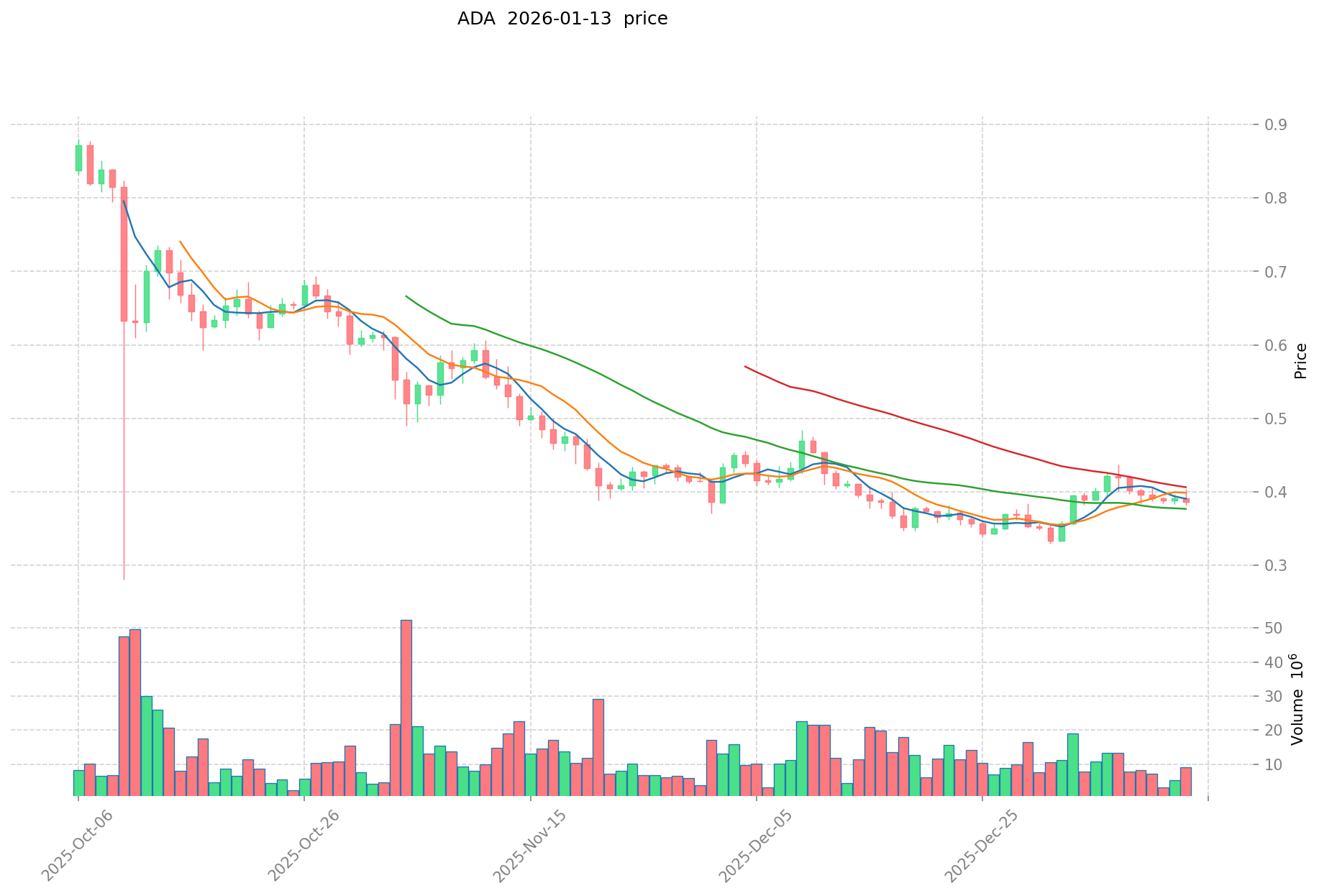
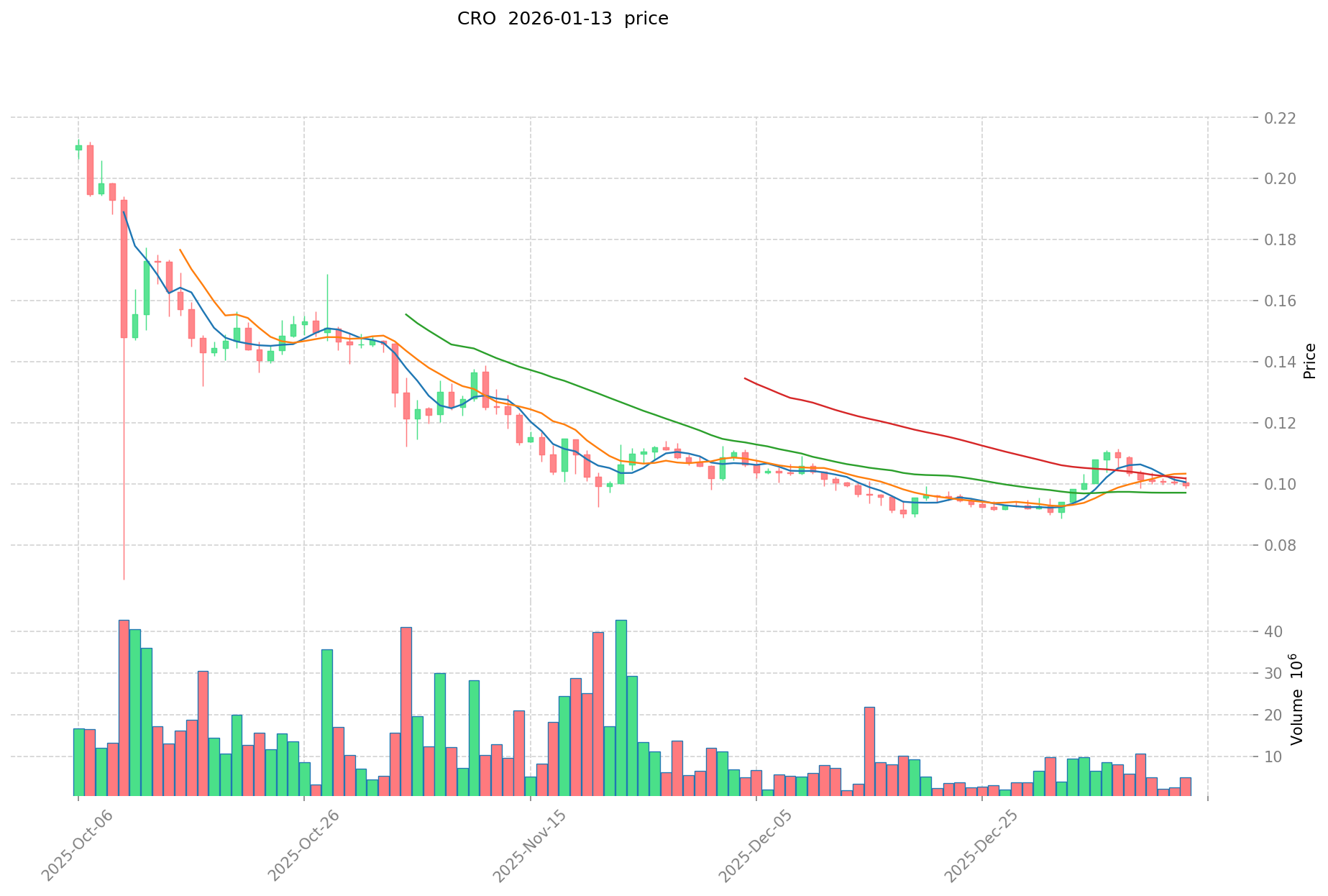
Historical Price Trends of ADA (Coin A) and CRO (Coin B)
-
2021: ADA reached a peak price of $3.09 in September 2021, driven by the Alonzo upgrade that introduced smart contract functionality. During the same period, CRO achieved its historical high of $0.965407 in November 2021, supported by aggressive marketing campaigns and ecosystem expansion efforts by Crypto.com.
-
2020-2021: ADA experienced significant growth from its historical low of $0.01925275 recorded in March 2020. Similarly, CRO recovered from its all-time low of $0.0121196 in February 2019, showing substantial appreciation during the bull market cycle.
-
Comparative Analysis: Throughout the 2021-2026 market cycle, ADA declined from its peak of $3.09 to the current level of $0.3922, representing a decrease of approximately 87%. During the same period, CRO dropped from its high of $0.965407 to $0.1003, reflecting a decline of nearly 90%. Both tokens experienced substantial corrections following the 2021 peaks, with CRO showing a slightly steeper percentage decline.
Current Market Status (2026-01-13)
- ADA Current Price: $0.3922
- CRO Current Price: $0.1003
- 24-Hour Trading Volume: ADA recorded $2,887,260.476442 compared to CRO's $469,730.3648301
- Market Sentiment Index (Fear & Greed Index): 26 (Fear)
Click to view real-time prices:
- View ADA current price Market Price
- View CRO current price Market Price
II. Core Factors Influencing ADA vs CRO Investment Value
Supply Mechanism Comparison (Tokenomics)
- CRO: Features a fixed total supply cap with scheduled phased releases according to a predetermined plan
- ADA: Supply mechanism details were not provided in the reference materials
- 📌 Historical Pattern: Deflationary mechanisms through transaction fee burning have historically influenced price cycle dynamics
Institutional Adoption and Market Applications
- Institutional Holdings: CRO has attracted attention from institutional investors, with its relatively smaller market capitalization combined with ETF asset allocation making it a speculative asset for investors seeking higher returns
- Enterprise Adoption: Specific comparative applications in cross-border payments, settlements, and investment portfolios were not detailed in the available materials
- National Policies: Regulatory attitudes toward these assets vary across different jurisdictions
Technical Development and Ecosystem Building
- ADA Technical Development: The ecosystem relies on technological innovation and development initiatives
- CRO Technical Development: Technical factors serve as an important driving force behind market performance
- Ecosystem Comparison: Both projects are developing their respective ecosystems, though specific implementation details regarding DeFi, NFT, payments, and smart contract applications require further observation
Macroeconomic Factors and Market Cycles
- Performance Under Inflationary Environments: Market risk remains significant due to the high volatility of digital assets, with factors including inflation, economic slowdowns, and geopolitical events potentially impacting investment value
- Macroeconomic Monetary Policy: Interest rates, dollar index movements, and broader economic conditions influence both assets
- Geopolitical Factors: Strategic partnerships, compliance considerations, and cross-border transaction demand continue to shape market dynamics
III. 2026-2031 Price Prediction: ADA vs CRO
Short-term Prediction (2026)
- ADA: Conservative $0.231-$0.392 | Optimistic $0.392-$0.486
- CRO: Conservative $0.055-$0.100 | Optimistic $0.100-$0.141
Mid-term Prediction (2028-2029)
- ADA may enter a growth phase, with estimated price range of $0.370-$0.736 in 2028, potentially reaching $0.379-$0.708 in 2029
- CRO may enter an expansion stage, with estimated price range of $0.112-$0.214 in 2028, potentially reaching $0.128-$0.252 in 2029
- Key drivers: institutional capital inflows, ETF developments, ecosystem expansion
Long-term Prediction (2030-2031)
- ADA: Base scenario $0.339-$0.665 (2030), $0.655-$0.675 (2031) | Optimistic scenario $0.665-$0.685 (2030), $0.675-$0.729 (2031)
- CRO: Base scenario $0.181-$0.216 (2030), $0.229-$0.236 (2031) | Optimistic scenario $0.216-$0.257 (2030), $0.236-$0.342 (2031)
View detailed price predictions for ADA and CRO
Disclaimer: Price predictions are based on historical data analysis and market trends. Cryptocurrency markets are highly volatile and subject to numerous unpredictable factors. These projections should not be considered as financial advice or guarantees of future performance.
ADA:
| Year |
Predicted High Price |
Predicted Average Price |
Predicted Low Price |
Price Change |
| 2026 |
0.486328 |
0.3922 |
0.231398 |
0 |
| 2027 |
0.57543584 |
0.439264 |
0.29430688 |
12 |
| 2028 |
0.735657384 |
0.50734992 |
0.3703654416 |
29 |
| 2029 |
0.70851416328 |
0.621503652 |
0.37911722772 |
58 |
| 2030 |
0.6849591748692 |
0.66500890764 |
0.3391545428964 |
69 |
| 2031 |
0.728982764554968 |
0.6749840412546 |
0.654734520016962 |
72 |
CRO:
| Year |
Predicted High Price |
Predicted Average Price |
Predicted Low Price |
Price Change |
| 2026 |
0.1413102 |
0.10022 |
0.055121 |
0 |
| 2027 |
0.170278791 |
0.1207651 |
0.070043758 |
20 |
| 2028 |
0.213917259885 |
0.1455219455 |
0.112051898035 |
45 |
| 2029 |
0.2516074437695 |
0.1797196026925 |
0.127600917911675 |
79 |
| 2030 |
0.25663959264489 |
0.215663523231 |
0.18115735951404 |
115 |
| 2031 |
0.34241975901002 |
0.236151557937945 |
0.229067011199806 |
135 |
IV. Investment Strategy Comparison: ADA vs CRO
Long-term vs Short-term Investment Strategies
- ADA: Suitable for investors focused on technological innovation and academic-driven blockchain development, particularly those interested in smart contract platforms and ecosystem growth potential over extended timeframes
- CRO: Suitable for investors seeking exposure to decentralized finance applications and gaming ecosystem development, with interest in exchange-linked utility tokens
Risk Management and Asset Allocation
- Conservative Investors: ADA 40% vs CRO 10% (with remaining allocation to stablecoins and established assets)
- Aggressive Investors: ADA 50% vs CRO 30% (with higher exposure to growth-oriented digital assets)
- Hedging Tools: Stablecoin allocation for liquidity management, options strategies for downside protection, cross-asset portfolio diversification
V. Potential Risk Comparison
Market Risk
- ADA: Subject to broader cryptocurrency market volatility, with price movements influenced by competitive smart contract platform developments and adoption rates within the decentralized application ecosystem
- CRO: Exposed to exchange platform performance correlation, with price sensitivity to Crypto.com ecosystem expansion and user adoption metrics
Technical Risk
- ADA: Scalability considerations regarding transaction throughput, network stability during high-demand periods
- CRO: Network security considerations, dependency on centralized exchange infrastructure for ecosystem functionality
Regulatory Risk
- Global regulatory frameworks may impact both assets differently, with ADA potentially subject to smart contract platform regulations and CRO facing exchange-related compliance requirements across multiple jurisdictions
VI. Conclusion: Which Is the Better Buy?
📌 Investment Value Summary:
- ADA Advantages: Established academic research foundation, layered architecture design approach, smart contract functionality supporting diverse applications
- CRO Advantages: Integration with established exchange ecosystem, focus on DeFi and gaming applications, institutional interest in smaller market cap positioning
✅ Investment Recommendations:
- Novice Investors: Consider starting with smaller position sizes in either asset, prioritizing risk management and portfolio diversification across multiple digital assets and traditional holdings
- Experienced Investors: Evaluate both assets based on technical development roadmaps, ecosystem growth metrics, and correlation with broader market cycles for strategic allocation decisions
- Institutional Investors: Assess regulatory compliance frameworks, liquidity profiles, and integration with existing portfolio strategies when considering exposure to either asset
⚠️ Risk Disclosure: Cryptocurrency markets exhibit substantial volatility. This analysis does not constitute investment advice, and investors should conduct independent research and consult financial professionals before making investment decisions.
VII. FAQ
Q1: What are the main differences between ADA and CRO's use cases?
ADA focuses on smart contract platform development with an academic research-driven approach and layered blockchain architecture, while CRO serves as the native token of the Cronos ecosystem with primary emphasis on decentralized finance (DeFi) applications and gaming integrations. ADA positions itself as a foundational blockchain infrastructure for diverse decentralized applications, whereas CRO functions primarily as a utility token integrated with the Crypto.com exchange ecosystem and its associated services.
Q2: Which cryptocurrency has better growth potential from 2026 to 2031?
Based on price predictions, CRO shows higher percentage growth potential, with projected increases ranging from 115-135% by 2031 compared to ADA's 69-72% growth over the same period. However, ADA maintains a larger market capitalization (ranked 11th versus CRO's 34th position) and more established ecosystem, offering potentially more stable growth with lower volatility. The choice depends on risk tolerance—CRO appeals to growth-focused investors seeking higher returns with increased risk, while ADA suits those preferring established projects with moderate growth expectations.
Q3: How does market capitalization ranking affect investment decisions between ADA and CRO?
ADA's 11th place market cap ranking indicates greater market acceptance, higher liquidity, and potentially lower volatility compared to CRO's 34th position. Larger market capitalization typically correlates with more institutional involvement, better exchange listing availability, and reduced susceptibility to price manipulation. However, CRO's smaller market cap presents higher growth potential as institutional investors seeking speculative opportunities may allocate capital to smaller-cap assets. Conservative investors typically favor higher-ranked assets like ADA, while aggressive investors may allocate larger portions to smaller-cap tokens like CRO for amplified returns.
Q4: What are the key risk factors unique to each cryptocurrency?
ADA faces risks primarily related to competition from other smart contract platforms, scalability challenges during network congestion, and adoption rates among developers building decentralized applications. CRO carries specific risks tied to Crypto.com's centralized exchange performance, regulatory compliance challenges affecting exchange operations across jurisdictions, and dependency on the parent platform's continued market presence. Additionally, CRO's circulating supply represents only 38.61% of maximum supply, meaning future token releases could create selling pressure affecting price performance.
Q5: How should investors allocate between ADA and CRO based on risk profile?
Conservative investors should consider allocating approximately 40% to ADA and 10% to CRO within their cryptocurrency holdings, maintaining larger positions in stablecoins and established assets for portfolio stability. Moderate-risk investors might adjust to 45% ADA and 20% CRO, balancing growth potential with established project exposure. Aggressive investors seeking maximum cryptocurrency exposure could allocate 50% to ADA and 30% to CRO, accepting higher volatility for potentially greater returns. All allocation strategies should incorporate regular rebalancing based on market conditions and maintain total cryptocurrency exposure appropriate to individual financial circumstances.
Q6: What factors could drive significant price movements for ADA versus CRO?
ADA price movements depend heavily on technological development milestones, ecosystem expansion through decentralized application adoption, institutional integration for smart contract use cases, and competitive positioning against platforms like Ethereum and Solana. CRO's price responds primarily to Crypto.com platform growth metrics including user acquisition, exchange trading volumes, institutional partnerships, and expansion of DeFi and gaming applications within the Cronos ecosystem. Macroeconomic factors such as regulatory developments, Bitcoin market cycles, and institutional capital flows into cryptocurrency markets affect both assets, though CRO demonstrates higher sensitivity to exchange-specific catalysts.
Q7: Are there specific market conditions that favor ADA over CRO or vice versa?
Bull market conditions with high retail participation typically favor CRO more significantly due to its smaller market capitalization and exchange ecosystem integration attracting speculative capital flows. Conversely, mature market phases with institutional focus on technological fundamentals favor ADA's academic approach and established smart contract infrastructure. During regulatory uncertainty, ADA's decentralized governance model may provide advantages over CRO's exchange-linked structure. Bear markets generally impact CRO more severely due to reduced trading volumes affecting exchange revenue, while ADA's development-focused roadmap maintains long-term holder confidence through technological progress regardless of short-term price action.
Q8: How do supply mechanisms impact long-term investment value for ADA versus CRO?
CRO features a fixed maximum supply with scheduled phased releases and deflationary mechanisms through transaction fee burning, potentially creating scarcity-driven value appreciation as ecosystem adoption increases. The current circulating supply represents only 38.61% of maximum supply, indicating significant future token releases that could create downward price pressure during distribution phases. ADA's supply mechanism details remain unspecified in available materials, though understanding tokenomics proves critical for evaluating inflation rates and long-term value preservation. Investors should research each project's emission schedules, burning mechanisms, and staking reward structures when assessing multi-year investment horizons and comparing dilution risks between assets.
* The information is not intended to be and does not constitute financial advice or any other recommendation of any sort offered or endorsed by Gate.