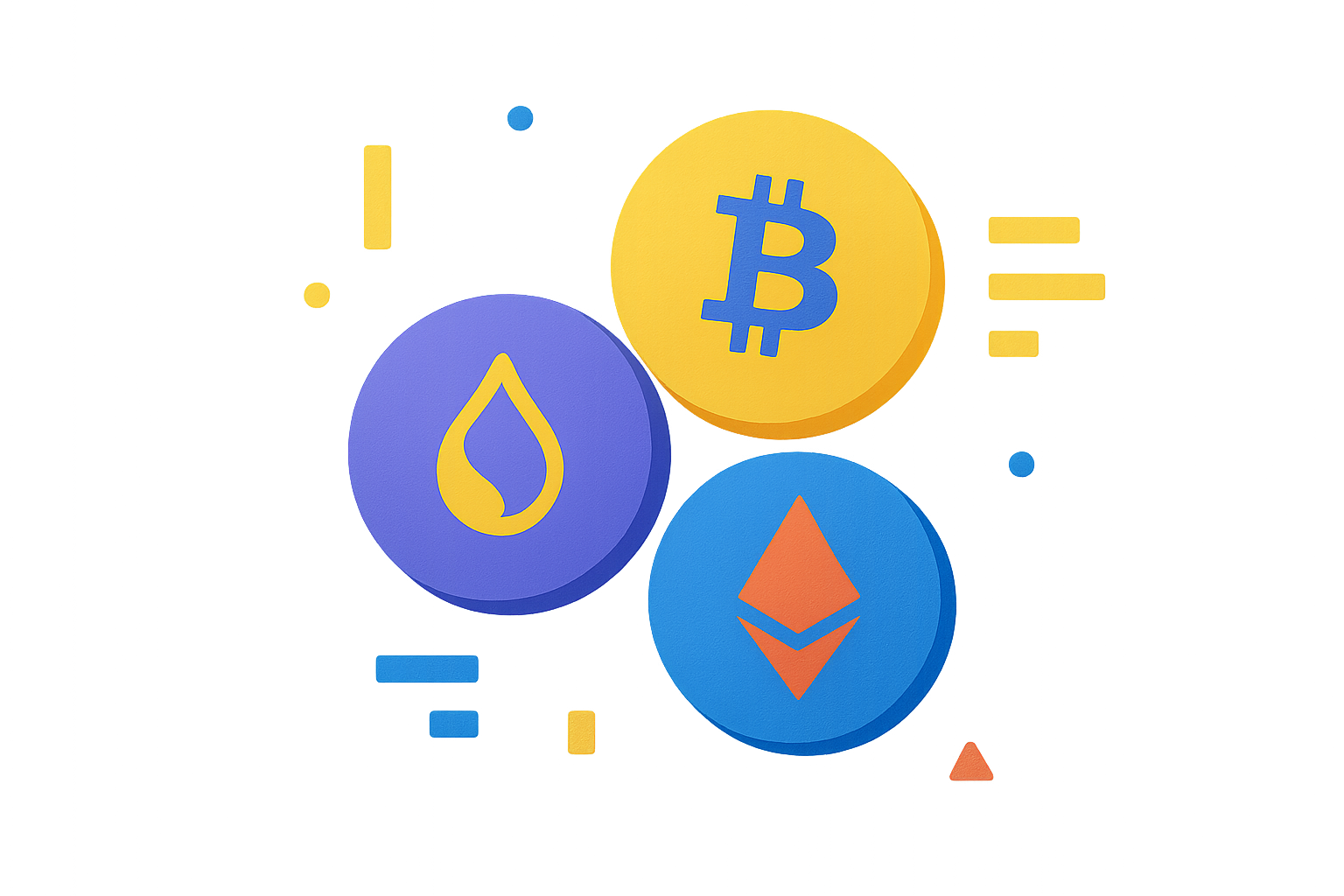
Discover the innovative use cases and future prospects of the Sui blockchain. See how its high-speed transactions, low fees, and intuitive design are reshaping DeFi, NFTs, and the gaming sector. This analysis contrasts Sui with Bitcoin and Ethereum to evaluate its potential as a next-generation cryptocurrency—making it a compelling choice for both investors and developers.
What Is Sui (SUI)? A Comprehensive Overview
Sui (SUI) is a Layer 1 blockchain platform developed by Mysten Labs, with the SUI token as its native crypto asset. Launched as a relatively new project in recent years, Sui aims to address the critical issues of slow transaction speeds and high fees that have long challenged traditional blockchains such as Bitcoin and Ethereum.

The development team is largely composed of former Meta (formerly Facebook) Diem project members, bringing deep blockchain development expertise. Since its inception, Mysten Labs has experienced rapid growth backed by several rounds of major venture capital investment.
Sui’s vision is to “enable anyone to easily own and use digital assets at high speed, low cost, and with robust security,” positioning itself as a leader in next-generation blockchain infrastructure. The platform prioritizes not just technical performance, but also user experience, aiming to lower the barriers to Web3 adoption and accelerate mainstream blockchain usage.
Primary Utilities and Economic Model of the SUI Token
The SUI token serves several essential roles within the Sui ecosystem, including:
- Network Fee Payments: Users pay gas fees in SUI when conducting transactions on the Sui network.
- Staking Participation: Token holders can stake SUI to participate in network maintenance and governance, earning rewards in return.
- Network Governance: SUI holders have the right to vote on protocol upgrades and major decisions.
SUI uses a Delegated Proof of Stake (DPoS) consensus mechanism. Any SUI holder can delegate tokens to a validator node, participate in network consensus, and earn staking rewards. This structure lowers participation barriers, allowing everyday users to help secure the network and benefit from its growth.
Sui’s economic model is also designed for long-term sustainability. A portion of network fees is deposited into a Storage Fund to cover future data storage costs, ensuring that future users are not burdened with legacy expenses.
| Item |
Details & Specifications |
| Maximum Supply |
10 billion (10,000,000,000) |
| Consensus Mechanism |
Delegated Proof of Stake (DPoS) (open to regular holders for staking) |
| Mainnet Launch |
May 2023 (official mainnet launch) |
| Development Team |
Mysten Labs (founded by five former Meta engineers, including Evan Cheng) |
| Programming Language |
Move Language (security language developed for Meta’s Diem project) |
| Core Technical Features |
Object-oriented data model, parallel processing architecture, permissionless design |
| Main Functional Applications |
Smart contract execution, NFT issuance and management, high-speed payments and settlements, staking rewards, governance voting |
Three Key Reasons Why Sui Stands Out as a Next-Generation Cryptocurrency
Sui is regarded as “the next-generation crypto asset after Bitcoin and Ethereum” based on three breakthrough advantages in technical architecture and user experience:
- Ultra-fast transaction processing
- Low, stable fee mechanism
- Beginner-friendly usability
Together, these features not only resolve core limitations of current blockchains but also provide a robust foundation for mass Web3 adoption.
Reason 1: Astonishing High-Speed Performance—Scalability via Parallel Execution
Sui’s standout feature is its exceptional transaction processing speed. Through an innovative blockchain architecture, Sui achieves parallel processing of massive transaction volumes, with theoretical throughput reaching approximately 300,000 transactions per second. In comparison, Ethereum processes about 20–30 transactions per second, underscoring Sui’s dramatic performance edge.
In real-world testing, Sui processed roughly 297,000 transactions in a single second (10,000 transactions in 0.39 seconds), ranking just behind Solana among Layer 1 blockchains and earning recognition as one of the fastest public chains. This high performance makes large-scale commercial use possible, supporting hundreds of millions of concurrent users.
Core Technical Innovations Enabling High-Speed Processing
Sui’s high throughput relies on two core innovations: the “object-centric data model” and “partial consensus omission.”
Traditional blockchains like Bitcoin and Ethereum process transactions sequentially, creating a natural bottleneck in throughput. Sui’s approach treats assets and data as independent “objects,” each maintaining its own state and history.
When transactions are independent—for example, user A sends funds to B while user C sends to D—they can be processed in parallel, bypassing the need for global execution order. Sui calls this “causal order.” For these simple, single-writer transactions, Sui omits traditional global consensus, requiring only majority validator confirmation for nearly instant finality.
This design allows basic transfers and NFT minting to achieve one-second finality, delivering a vastly improved user experience.
Consensus Mechanism for Complex Transactions
For complex transactions involving shared objects (such as token swaps on decentralized exchanges or multi-signature asset modifications), Sui implements a dual-layer consensus engine: “Narwhal & Bullshark.”
- Narwhal Layer: Gathers and propagates transactions from validators, ensuring data availability and efficiency.
- Bullshark Layer: Employs a Byzantine Fault Tolerant (BFT) consensus algorithm to finalize transaction order.
This layered design ensures security and efficiency. Research indicates this mechanism can theoretically handle over 400,000 transactions per second, paving the way for future mass adoption.
Performance Validated by Real-World Data
Recent statistics show that Sui’s cumulative processed transactions have exceeded 2.58 billion, surpassing Ethereum’s 2.57 billion in the same timeframe. This milestone highlights both Sui’s technical prowess and its ecosystem’s rapid growth.
With the blockchain user base projected to reach hundreds of millions or even billions, high-performance chains like Sui will be critical to supporting mass Web3 adoption. Its parallel architecture is purpose-built to handle surging transaction demand.
Reason 2: Low, Stable Fee Mechanism—Solving Gas Fee Spikes
Sui’s second major advantage is its low, stable transaction (gas) fees, directly tackling the cost issues plaguing traditional blockchains.
On Bitcoin and Ethereum, network congestion can send transaction fees soaring into the thousands of dollars. On Ethereum in particular, DeFi and NFT hype have pushed gas fees to hundreds of dollars, making small transactions unworkable and limiting mainstream adoption.
Sui’s parallel processing fundamentally prevents congestion-induced fee spikes. By expanding network capacity, Sui keeps fees steady even at peak demand. In practice, basic Sui transfers and operations typically cost only a few cents—far below traditional public chains.
Innovative Economic Model for Stable Gas Fees
Sui’s unique token economic model ensures long-term fee stability. Gas fees adjust automatically based on network demand, but the mechanism is carefully designed to avoid wild swings. Validator rewards are structured to support overall network sustainability.
During demand spikes, validators can scale hardware to process more transactions and earn higher total rewards without raising per-transaction fees. This incentive system encourages capacity expansion rather than price hikes, maintaining fee stability for users.
Sui also allocates a portion of fee revenue to a Storage Fund, covering future data storage costs. This proactive approach prevents cost burdens from being shifted to future users and reflects a commitment to long-term sustainability.
Revolutionary “Sponsored Transactions” Enhance User Experience
Sui introduced “Sponsored Transactions,” a user experience breakthrough. This feature allows DApp developers to pay gas fees on behalf of users, so end users never need to worry about transaction costs while interacting with blockchain applications.
This enables Sui-based apps to deliver a seamless, Web2-like experience. Users don’t need to pre-purchase tokens or calculate fees—using blockchain services is as straightforward as using traditional web apps. This dramatically lowers the entry barrier to Web3, attracting mainstream users to the blockchain ecosystem.
For developers, this feature enables flexible business models, such as covering gas costs through subscriptions or ads, without requiring users to directly pay transaction fees.
Reason 3: Beginner-Friendly Usability—Web2-Level User Experience
The third key advantage is Sui’s breakthrough in usability. Sui’s guiding philosophy is to “deliver Web3’s benefits with Web2’s convenience,” making blockchain accessible even to first-time users.
Traditional blockchain apps often require users to manage complex private keys and seed phrases, creating a significant barrier to adoption. Sui addresses this with a suite of innovations that dramatically lower the learning curve and bring blockchain to the masses.
Familiar Social Login with zkLogin
Sui’s revolutionary “zkLogin” feature lets users log into blockchain applications using common social media accounts like Google, Apple, or Facebook. This technology, built on zero-knowledge proofs, ensures security while removing the need for users to handle complex keys or seed phrases.
zkLogin works by having users log in via OAuth; the system then generates a temporary key and verifies identity using zero-knowledge proofs in the background. The entire process is transparent, allowing users to access blockchain services as easily as any regular app—without needing to learn crypto-specific technical details.
This innovation significantly lowers the Web3 entry barrier, enabling billions of social media users to transition seamlessly to blockchain applications and paving the way for mass adoption.
Intuitive, User-Friendly Official Wallet
Sui provides an official wallet application, “Sui Wallet” (now renamed Slush Wallet), supporting browser extension and mobile formats. The design goal: “make crypto management as simple as banking apps.”
The wallet interface is intuitive and clear—token transfers, NFT displays, and staking can all be completed in just a few clicks. For staking, users simply choose a validator and amount, click confirm, and start earning rewards—no technical expertise required.
The wallet also features a built-in DApp browser, allowing users to access the Sui ecosystem’s applications directly within the wallet, delivering a one-stop experience without switching tools.
Standardized Technical Specs for Consistent User Experience
Sui has established a series of technical standards to ensure a consistent user experience across its ecosystem:
- Object Display Standard: Standardizes NFT and digital asset displays, ensuring proper rendering across applications.
- Kiosk Standard: Provides a unified framework for NFT market transactions and royalty management, protecting creator rights and simplifying user operations.
These standardization efforts ensure high consistency among Sui ecosystem applications. Once users learn one app, they can quickly adapt to others, significantly reducing the learning curve.
Sui vs. Bitcoin and Ethereum—A Generational Leap in Blockchain Technology
As detailed above, Sui is a next-generation blockchain platform combining high speed, low cost, and user-friendly design. To clarify Sui’s positioning and strengths, here’s a comprehensive comparison with Bitcoin and Ethereum.
| Item |
Bitcoin |
Ethereum |
Sui |
| Technology Generation |
First generation (store of value) |
Second generation (smart contract platform) |
Third generation (high-performance L1 platform) |
| Consensus Mechanism |
Proof of Work (PoW mining) |
Proof of Stake (PoS staking) |
Delegated Proof of Stake (DPoS) |
| Smart Contracts |
Not supported (scripts only) |
Supported (Solidity + EVM) |
Supported (Move language + object model) |
| Performance |
~7 tx/s |
~25 tx/s (L2 scaling) |
Thousands to tens of thousands tx/s (theoretical 300,000 TPS) |
| Transaction Fees |
High (thousands when congested) |
High (surges with demand) |
Extremely low (just a few cents, stable) |
| Confirmation Time |
~10 minutes (1 block) |
~12 seconds (1 block) |
Under 1 second (instant confirmation for simple transactions) |
| Main Use Cases |
Digital gold, payment method |
DeFi, NFT, DApp infrastructure |
Gaming, NFT, high-speed DeFi, etc. |
| Development Difficulty |
High (complex protocols) |
Medium (learn Solidity) |
Lower (Move is safer and more intuitive) |
| Ecosystem Maturity |
Very mature |
Very mature |
Rapidly growing |
Essential Differences in Technical Architecture
Bitcoin, as the first-generation blockchain, focused on “store of value and peer-to-peer payments,” prioritizing security and decentralization, with performance as a secondary priority. Its breakthrough was the concept of digital scarcity, earning it the title “digital gold.”
Ethereum, the second generation, introduced smart contracts and launched the era of DApps and DeFi. Ethereum uses the Solidity programming language and EVM (Ethereum Virtual Machine), providing a Turing-complete environment for developers. However, its account model and sequential execution create inherent performance and cost bottlenecks.
Sui, representing the third generation, rethinks blockchain architecture from the ground up. It uses the Move language and an object-oriented model, with asset ownership and double-spend prevention built in at the language level—making it safer than Solidity. Its parallel execution architecture fundamentally shatters performance limits, delivering high speed, low cost, and strong security all at once.
Security Advantages of Move Language and Object Model
The Move language was originally developed for Meta’s Diem project, optimized for digital asset management. Compared to Solidity, Move offers key benefits:
- Resource Type System: Assets are defined as “resources” within the language, preventing duplication or accidental destruction and eliminating common vulnerabilities.
- Formal Verification: Move supports mathematical proof methods for code correctness, drastically reducing smart contract risks.
- Modular Design: Clear code structure aids auditing and maintenance.
Sui’s object model organizes blockchain states into independent objects with explicit ownership and history, supporting parallel processing and making asset management more intuitive and secure.
Current Challenges Facing Sui
Despite its strong technical edge, Sui—like any emerging public chain—faces key challenges:
- Network Decentralization: Validator count and geographic distribution are still expanding and lag behind established chains.
- Ecosystem Scale: Number of DApps, DeFi TVL, and user base are not yet comparable to Ethereum.
- Developer Community: Far fewer Move developers than Solidity developers, requiring time to develop the talent pool.
- Brand Awareness: Needs higher recognition among mainstream users.
However, these challenges are likely to be resolved with time and development. With a solid technical foundation, experienced team, and rapidly growing ecosystem, Sui’s growth potential is substantial.
Expanding Sui Applications and Future Outlook
Innovative DeFi Applications
In decentralized finance (DeFi), Sui’s high performance and low costs are drawing a growing number of projects:
- Decentralized Exchanges (DEX): DEXs such as Cetus and Turbos provide fast, low-slippage trading—confirmation speeds vastly outpace conventional DEXs.
- Lending Protocols: Platforms like SuiLend leverage Sui’s speed for real-time lending with precise rate calculations.
- Liquid Staking: Multiple protocols offer SUI liquid staking, so users can earn rewards while keeping assets liquid.
- Stablecoins: Various stablecoin projects are issued on Sui, providing stable mediums of exchange for the ecosystem.
Sui’s parallel architecture enables complex DeFi operations—such as flash loans or multi-step arbitrage—to be carried out efficiently in a single transaction, expanding the horizon for financial innovation.
NFTs and Digital Art: New Possibilities
Sui offers an ideal foundation for NFT and digital art creators:
- Low-Cost Minting: Artists can mint NFTs at minimal cost, lowering creative barriers.
- Instant Trade Confirmation: NFT trades are nearly instant, enhancing user experience.
- Flexible Royalty Mechanisms: The Kiosk standard supports customizable royalty rules, better protecting creators’ rights.
- Dynamic NFTs: Sui’s object model natively enables upgradable, interactive NFTs, opening new frontiers for digital art.
Several NFT marketplace platforms have already launched on Sui, offering creators and collectors a rich set of trading options.
Blockchain-Enabled Gaming Industry
Gaming is among Sui’s most promising sectors, with high throughput and low latency perfectly matching game requirements:
- Real-Time Interactive Games: Sui’s low latency supports fast-paced genres such as action and competitive games.
- Complex Game Logic: Parallel processing enables large-scale multiplayer games with sophisticated rules.
- Seamless Blockchain Experience: With sponsored transactions and social login, players can engage as they would with traditional games—no blockchain expertise needed.
- True Asset Ownership: In-game items as NFTs grant players actual ownership and the ability to trade freely.
Many well-known game studios have announced Sui-based projects, including major IP collaborations, signaling a new era for blockchain gaming.
Competition and Differences with Aptos
Aptos, another public chain founded by Meta Diem alumni, also runs on Move and is often compared to Sui. Key differences include:
- Data Model: Sui uses an object model; Aptos uses an enhanced account model.
- Consensus Mechanism: Both employ BFT consensus but differ in technical implementation.
- Ecosystem Focus: Aptos focuses on DeFi, while Sui prioritizes gaming and consumer applications.
This competition ultimately benefits the broader Move ecosystem, as innovations from both projects push the technology forward.
Enterprise-Grade Use Case Potential
Sui’s performance and reliability are drawing enterprise interest:
- Supply Chain Management: Blockchain is used to track product provenance and movement for greater transparency.
- Digital Identity: Blockchain-based identity systems provide verifiable credentials while preserving privacy.
- Enterprise Asset Tokenization: Physical assets and rights can be tokenized, increasing liquidity and transaction efficiency.
As regulation becomes clearer and technology matures, more enterprises are expected to choose Sui as blockchain infrastructure.
The Evolution of Cross-Chain Interoperability
To integrate with the broader blockchain ecosystem, Sui is actively developing cross-chain technology:
- Bridge Protocols: Multiple cross-chain bridges support asset transfers between Sui and major chains like Ethereum and BSC.
- Cross-Chain Communication: In-development messaging protocols will enable Sui to interact with applications on other chains.
- Multi-Chain Wallet Support: Leading wallets are adding Sui support, simplifying multi-chain asset management.
Cross-chain interoperability will help Sui attract users and assets from other blockchains, accelerating ecosystem expansion.
Conclusion: Assessing Sui’s Potential as the Third Major Cryptocurrency
With outstanding high-speed performance, stable low-fee mechanisms, and a user-friendly design, Sui is emerging as a driving force for Web3 adoption. As a next-generation blockchain platform, Sui not only solves the challenges of traditional blockchains but also provides the technical foundation for large-scale commercial applications.
Technically, Sui’s innovative architecture—Move language, object model, parallel processing—represents the future of blockchain evolution. These are not just incremental improvements, but architectural rethinks driving true performance breakthroughs.
From an ecosystem perspective, Sui is rapidly attracting developers, projects, and users. High-quality projects are emerging across DeFi, NFT, gaming, and more, creating a virtuous cycle. Support from mainstream exchanges and institutional investors further secures Sui’s long-term development.
From a market positioning perspective, Sui fills a critical gap as a high-performance, low-cost, user-friendly general-purpose public chain. Bitcoin is focused on value storage, Ethereum dominates DeFi and NFTs, while Sui is poised to become the preferred platform for large-scale consumer applications, especially in gaming and social sectors.
To become a top-three cryptocurrency alongside Bitcoin and Ethereum, Sui must further decentralize its network, expand its developer community, strengthen brand awareness, and establish a mature regulatory framework. Given its strong technical foundation, experienced team, fast-growing ecosystem, and clear market positioning, Sui has a realistic path to achieving this goal within the coming years.
As blockchain technology moves from early adopters to the mainstream, the market demands not just innovation, but infrastructure capable of serving billions. Sui was born for this mission, and its progress is well worth watching. Developers, investors, and everyday users alike should follow the Sui ecosystem closely, as it may well shape the future of Web3.
FAQ
What is SUI? What advantages does it have over Bitcoin and Ethereum?
SUI is a high-performance public chain that offers faster transaction speeds and lower transaction fees. With parallel execution technology, SUI delivers greater scalability than Bitcoin and Ethereum, making it ideal for mass adoption.
What are SUI’s technical innovations? Why is it considered next-generation crypto?
SUI leverages parallel execution and the Move programming language to achieve high scalability, sub-second transaction speeds, and extremely low costs. It is purpose-built for gaming, NFTs, and DeFi, making it a leading next-generation L1 blockchain.
What are SUI’s use cases and outlook? Is it worth investing in?
SUI is used in cross-border payments, smart contracts, and the Web3 ecosystem. As blockchain adoption grows, its market potential is significant. With rapid ecosystem expansion expected by 2026, SUI is well worth close attention and investment consideration.
How do SUI’s transaction speed and costs compare to Ethereum?
SUI’s transaction speed far exceeds Ethereum, and its costs are 150 times lower. With parallel processing and a unique object model, SUI delivers a far more efficient blockchain experience.
What are the main DApps and projects in the SUI ecosystem?
The SUI ecosystem features 28 major DApps, spanning DeFi (AMMs, lending, payments, liquid staking, meme coin platforms) and Web 3.0 DePIN, among other innovative projects, with rapid ecosystem development.
How do you buy and store SUI? What risks should you consider?
Purchase SUI through reputable crypto platforms and store it in a cold wallet for maximum security. Be mindful of market volatility and smart contract risks—choose reliable platforms, and keep your private keys safe.
* The information is not intended to be and does not constitute financial advice or any other recommendation of any sort offered or endorsed by Gate.