This comprehensive guide compares AIA and ETC as distinct cryptocurrency investment opportunities. AIA, launched in 2025, positions itself as the largest AI Agent infrastructure across Sui, BSC, and BTC ecosystems, while ETC, established in 2015, represents the continuation of the original Ethereum chain upholding the 'code is law' principle. The article analyzes historical price trends, current market status as of January 21, 2026, tokenomics, institutional adoption, and technical ecosystems to evaluate investment merit. AIA demonstrates extreme volatility with 99.86% decline from peak, while ETC exhibits extended price cycles with 92.95% drawdown from highs. Price forecasts through 2031 project AIA appreciation to $0.537 and ETC appreciation to $27.722, with differentiated investment strategies for conservative and aggressive investors. The analysis addresses cryptocurrency market risks including volatility, technical challenges, and regulatory uncertainty while providing allocation recommendations through
Introduction: AIA vs ETC Investment Comparison
In the cryptocurrency market, the comparison between AIA vs ETC has consistently been a topic of interest for investors. The two differ significantly in market cap ranking, application scenarios, and price performance, representing distinct positioning within the crypto asset landscape.
AIA (DeAgentAI): Launched in 2025, it has gained market recognition by positioning itself as the largest AI Agent infrastructure across Sui, BSC, and BTC ecosystems, empowering AI Agents with trustless autonomous decision-making capabilities on-chain.
ETC (Ethereum Classic): Since 2015, it has been regarded as the continuation of the original Ethereum chain, upholding the "code is law" principle, and ranks among cryptocurrencies with substantial global trading volume and market capitalization.
This article will comprehensively analyze the investment value comparison of AIA vs ETC through historical price trends, supply mechanisms, institutional adoption, technological ecosystems, and future forecasts, attempting to address investors' most pressing question:
"Which is the better buy right now?"
I. Historical Price Comparison and Current Market Overview
AIA and ETC Historical Price Trends
- 2025: AIA experienced significant volatility, reaching an all-time high of $48.3 on November 7, 2025, before declining to an all-time low of $0.0664 on December 13, 2025.
- 2016-2021: ETC showed substantial price movement, with its all-time high of $167.09 recorded on May 7, 2021, while its all-time low of $0.615038 occurred on July 25, 2016.
- Comparative analysis: During recent market cycles, AIA demonstrated extreme volatility with a decline of approximately 99.86% from its peak to trough within a short timeframe, while ETC has shown a more extended price history with a current decline of approximately 92.95% from its all-time high.
Current Market Status (January 21, 2026)
- AIA current price: $0.30612
- ETC current price: $11.774
- 24-hour trading volume: AIA $19,077,980.86 vs ETC $2,110,010.60
- Market Sentiment Index (Fear & Greed Index): 24 (Extreme Fear)
View real-time prices:
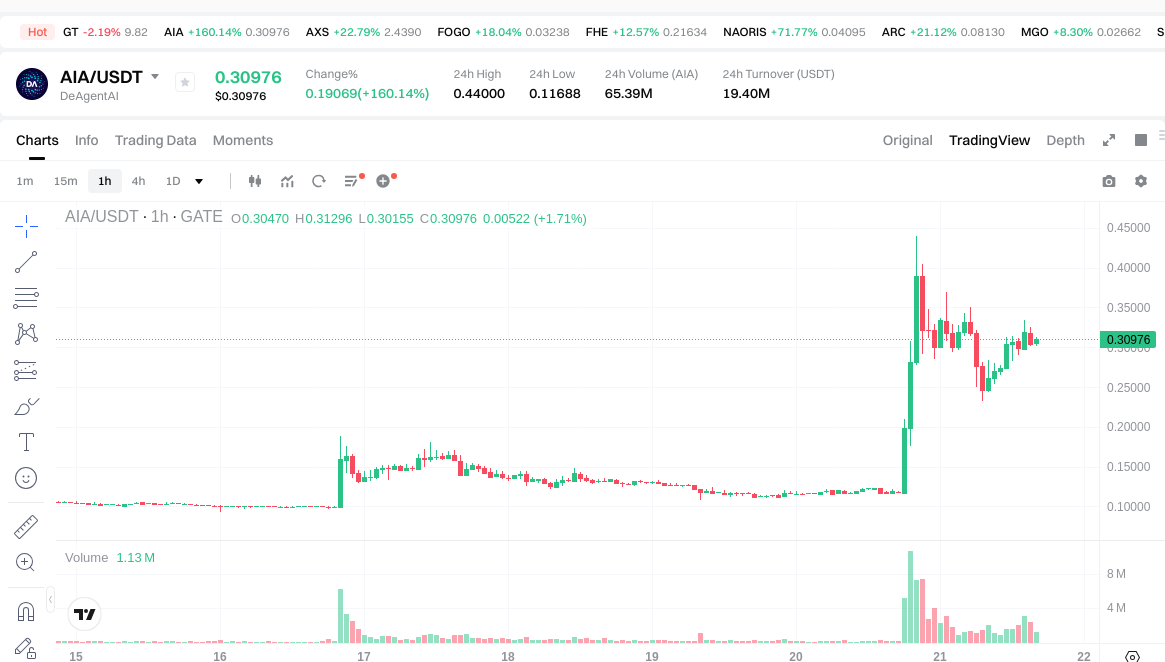
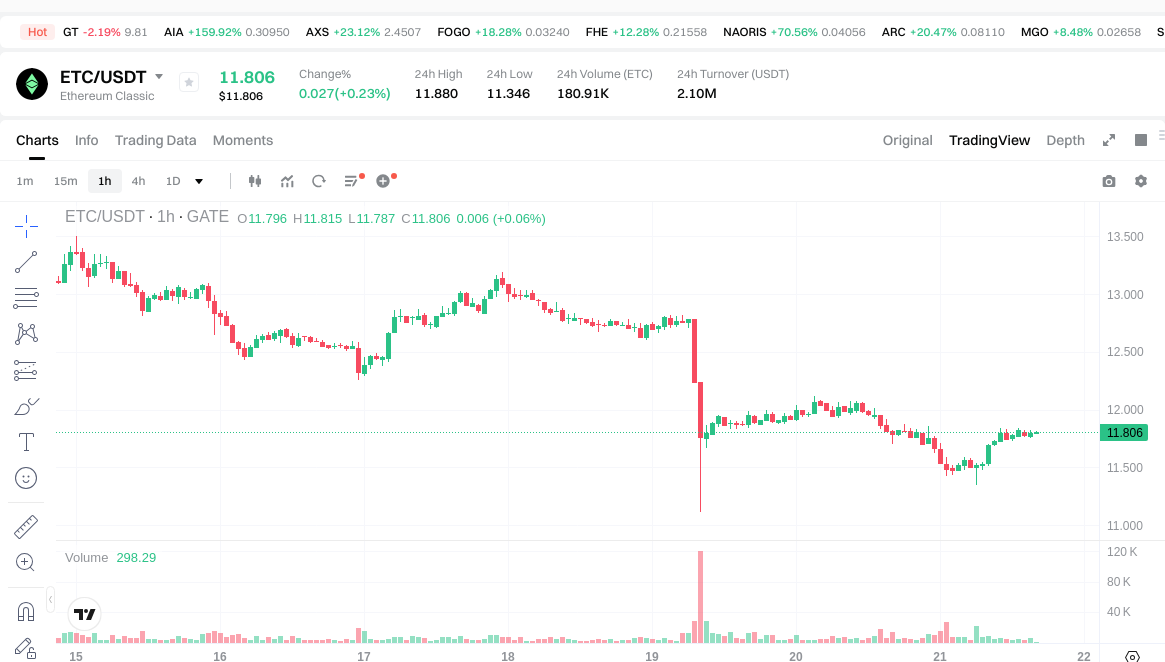
II. Core Factors Influencing AIA vs ETC Investment Value
Due to the absence of reference materials and insufficient information in the knowledge base regarding AIA and ETC, a comprehensive comparative analysis of their investment value factors cannot be provided at this time.
Supply Mechanism Comparison (Tokenomics)
Insufficient data available to compare the supply mechanisms of these two assets.
Institutional Adoption and Market Application
Insufficient data available to analyze institutional holdings, enterprise adoption, or regulatory approaches for these assets.
Technical Development and Ecosystem Building
Insufficient data available to evaluate technical upgrades or ecosystem developments for either asset.
Macroeconomic Environment and Market Cycles
Insufficient data available to assess the performance of these assets under various macroeconomic conditions.
III. 2026-2031 Price Forecast: AIA vs ETC
Short-term Forecast (2026)
- AIA: Conservative $0.183-$0.305 | Optimistic $0.305-$0.336
- ETC: Conservative $8.74-$11.81 | Optimistic $11.81-$16.18
Mid-term Forecast (2028-2029)
- AIA may enter a gradual appreciation phase, with projected price range of $0.290-$0.508
- ETC may enter a consolidation and growth phase, with projected price range of $10.55-$27.57
- Key drivers: institutional capital inflows, ETF developments, ecosystem expansion
Long-term Forecast (2030-2031)
- AIA: Baseline scenario $0.365-$0.537 | Optimistic scenario $0.624-$0.735
- ETC: Baseline scenario $20.03-$27.72 | Optimistic scenario $32.15-$34.38
View detailed price predictions for AIA and ETC
Disclaimer
AIA:
| Year |
Predicted High Price |
Predicted Average Price |
Predicted Low Price |
Price Change |
| 2026 |
0.335511 |
0.30501 |
0.183006 |
0 |
| 2027 |
0.361894365 |
0.3202605 |
0.278626635 |
4 |
| 2028 |
0.439989887925 |
0.3410774325 |
0.289915817625 |
11 |
| 2029 |
0.50769375827625 |
0.3905336602125 |
0.33585894778275 |
27 |
| 2030 |
0.624268055849681 |
0.449113709244375 |
0.435640297967043 |
46 |
| 2031 |
0.735266509089428 |
0.536690882547028 |
0.364949800131979 |
75 |
ETC:
| Year |
Predicted High Price |
Predicted Average Price |
Predicted Low Price |
Price Change |
| 2026 |
16.18381 |
11.813 |
8.74162 |
0 |
| 2027 |
20.57765535 |
13.998405 |
13.4384688 |
18 |
| 2028 |
20.74563621 |
17.288030175 |
10.54569840675 |
46 |
| 2029 |
27.574408129125 |
19.0168331925 |
10.839594919725 |
61 |
| 2030 |
32.14795651192125 |
23.2956206608125 |
20.03423376829875 |
97 |
| 2031 |
34.375017847094925 |
27.721788586366875 |
20.791341439775156 |
135 |
IV. Investment Strategy Comparison: AIA vs ETC
Long-term vs Short-term Investment Strategies
- AIA: May appeal to investors focused on emerging AI Agent infrastructure narratives and high-risk, high-reward opportunities in nascent blockchain ecosystems across Sui, BSC, and BTC networks
- ETC: May appeal to investors seeking exposure to established blockchain networks with longer operational histories and code immutability principles
Risk Management and Asset Allocation
- Conservative investors: AIA 20% vs ETC 80%
- Aggressive investors: AIA 60% vs ETC 40%
- Hedging instruments: stablecoin allocation, options strategies, cross-asset diversification
V. Potential Risk Comparison
Market Risk
- AIA: Demonstrated extreme price volatility with significant decline from peak levels within a compressed timeframe, reflecting heightened sensitivity to market sentiment shifts
- ETC: Exhibits extended price history with substantial drawdown from historical highs, subject to broader cryptocurrency market cycles and sentiment fluctuations
Technical Risk
- AIA: Scalability considerations, network stability assessment in multi-chain deployment
- ETC: Mining power concentration considerations, historical security incident exposure
Regulatory Risk
- Global regulatory policy developments may impact both assets differently based on their respective positioning, operational frameworks, and market maturity levels
VI. Conclusion: Which Is the Better Buy?
📌 Investment Value Summary:
- AIA advantages: Positioning in AI Agent infrastructure narrative, multi-chain ecosystem presence across Sui, BSC, and BTC networks
- ETC advantages: Extended operational history since 2015, established market presence, adherence to original Ethereum protocol principles
✅ Investment Recommendations:
- Novice investors: Consider gradual exposure through diversified portfolio approach, prioritizing risk management and market education
- Experienced investors: Evaluate allocation based on risk tolerance, market cycle positioning, and portfolio diversification objectives
- Institutional investors: Conduct comprehensive due diligence incorporating liquidity analysis, custody solutions, and regulatory compliance frameworks
⚠️ Risk Disclosure: Cryptocurrency markets exhibit extreme volatility. This analysis does not constitute investment advice.
VII. FAQ
Q1: What are the main differences between AIA and ETC in terms of market positioning?
AIA and ETC represent fundamentally different blockchain value propositions. AIA is a 2025-launched AI Agent infrastructure platform focused on enabling trustless autonomous decision-making across Sui, BSC, and BTC ecosystems, positioning itself within the emerging AI-blockchain convergence narrative. ETC, established in 2015, represents the continuation of the original Ethereum blockchain maintaining the "code is law" principle, with a decade-long operational history and established market presence among top-ranked cryptocurrencies by trading volume and market capitalization.
Q2: How do the price volatilities of AIA and ETC compare historically?
AIA demonstrates extreme short-term volatility, experiencing approximately 99.86% decline from its all-time high of $48.3 (November 7, 2025) to its all-time low of $0.0664 (December 13, 2025) within just over one month. ETC exhibits more extended price cycles, with its all-time high of $167.09 (May 7, 2021) and all-time low of $0.615038 (July 25, 2016) spanning multiple years, currently down approximately 92.95% from peak levels. This comparison suggests AIA carries significantly higher volatility risk within compressed timeframes compared to ETC's more gradual market cycles.
Q3: Which asset offers better long-term growth potential through 2031?
Based on price forecasts, AIA shows projected growth from $0.305 (2026 average) to $0.537 (2031 average), representing approximately 76% appreciation. ETC forecasts indicate growth from $11.813 (2026 average) to $27.722 (2031 average), representing approximately 135% appreciation. While ETC demonstrates higher absolute percentage growth potential, AIA's positioning in emerging AI Agent infrastructure may offer alternative narrative-driven appreciation opportunities. Investment decisions should consider risk tolerance, portfolio diversification objectives, and market cycle positioning rather than growth projections alone.
Q4: What portfolio allocation strategy is appropriate for investing in AIA vs ETC?
Portfolio allocation should reflect individual risk tolerance and investment objectives. Conservative investors may consider 20% AIA allocation versus 80% ETC allocation, prioritizing established market presence and extended operational history. Aggressive investors seeking higher risk-reward profiles may consider 60% AIA versus 40% ETC allocation, emphasizing exposure to emerging AI-blockchain infrastructure narratives. All allocation strategies should incorporate comprehensive risk management frameworks including stablecoin reserves, options hedging instruments, and cross-asset diversification to mitigate cryptocurrency market volatility.
Q5: Are AIA and ETC suitable for novice cryptocurrency investors?
Both assets present challenges for novice investors but through different risk vectors. AIA's extreme volatility (99.86% peak-to-trough decline within one month) and nascent infrastructure positioning require sophisticated risk assessment capabilities and high loss tolerance. ETC's extended operational history provides more reference points for analysis, but its 92.95% decline from all-time highs demonstrates significant market cycle risk exposure. Novice investors should prioritize gradual market exposure through diversified portfolio approaches, comprehensive market education, and potentially starting with smaller allocation percentages until developing deeper understanding of cryptocurrency market dynamics and risk management frameworks.
Q6: How does the current market sentiment affect AIA vs ETC investment decisions?
As of January 21, 2026, the Fear & Greed Index registers 24 (Extreme Fear), indicating market-wide risk aversion sentiment. Under such conditions, AIA's higher volatility profile may experience amplified downside pressure, while ETC's established market presence may provide relative stability. However, extreme fear conditions historically precede market bottoms, potentially presenting accumulation opportunities for investors with appropriate risk tolerance and longer-term investment horizons. Investment timing should integrate sentiment analysis with fundamental evaluation, technical analysis, and individual portfolio risk parameters rather than relying on sentiment indicators alone.
Q7: What are the key risks investors should monitor when holding AIA vs ETC?
AIA investors should monitor multi-chain deployment scalability challenges, network stability across Sui, BSC, and BTC ecosystems, and AI Agent infrastructure adoption metrics. The asset's extreme price volatility requires vigilant position sizing and risk management protocols. ETC investors should assess mining power concentration risks, historical security incident implications, and competitive positioning relative to Ethereum mainnet developments. Both assets face regulatory uncertainty as global cryptocurrency policy frameworks evolve, requiring ongoing monitoring of jurisdiction-specific regulatory developments that may impact market access, custody solutions, and institutional adoption trajectories.
Q8: What trading volume differences exist between AIA and ETC, and what do they indicate?
As of January 21, 2026, AIA demonstrates 24-hour trading volume of $19,077,980.86 compared to ETC's $2,110,010.60, representing approximately 9x higher trading activity for AIA despite ETC's longer market history and higher absolute price point ($11.774 vs $0.30612). This volume differential may indicate heightened speculative interest in AIA's AI Agent infrastructure narrative, potentially providing better short-term liquidity for traders but also suggesting elevated volatility risk. Higher trading volumes do not necessarily correlate with superior investment quality, and investors should evaluate liquidity metrics alongside fundamental analysis, market positioning, and risk-adjusted return objectives.
* The information is not intended to be and does not constitute financial advice or any other recommendation of any sort offered or endorsed by Gate.