This comprehensive analysis compares AIOZ Network and AAVE, two distinct blockchain protocols targeting different market segments. AAVE dominates decentralized lending with $7.5 billion in active loans across 13 blockchain networks, backed by Grayscale and generating consistent revenue through interest and liquidation fees. AIOZ operates as a blockchain-based content distribution network for streaming media, currently priced at $0.10351 with lower trading volume. While AAVE demonstrates institutional adoption, revenue resilience, and near-complete tokenomics supporting price stability, AIOZ presents potential recovery opportunities from 2021 peaks. Conservative investors should prioritize AAVE's proven market leadership and sustainable financial model, while experienced investors may diversify with AIOZ exposure for potential upside. The analysis provides allocation strategies and 2031 price projections on Gate, emphasizing risk management across both assets.
Introduction: Investment Comparison Between AIOZ and AAVE
In the cryptocurrency market, the comparison between AIOZ vs AAVE has consistently been a topic of interest for investors. Both assets demonstrate notable differences in market capitalization ranking, application scenarios, and price performance, representing distinct positioning within the crypto asset landscape.
AIOZ (AIOZ): Launched in 2021, AIOZ Network has gained market recognition through its positioning as a blockchain-based content distribution network that combines blockchain technology with streaming media capabilities.
AAVE (AAVE): Originating in 2020, AAVE has established itself as a leading decentralized lending protocol, ranking among the top cryptocurrencies globally by trading volume and market capitalization.
This article will comprehensively analyze the investment value comparison between AIOZ vs AAVE, focusing on historical price trends, supply mechanisms, institutional adoption, technological ecosystems, and future projections. The analysis aims to address investors' most pressing question:
"Which is the better buy right now?"
I. Historical Price Comparison and Current Market Status
AIOZ Network (AIOZ) and Aave (AAVE) Historical Price Trends
- 2021: AIOZ Network reached its all-time high of $2.65 in April 2021, coinciding with a broader cryptocurrency market rally. The token experienced significant price appreciation during this period.
- 2023: AIOZ Network recorded its historical low of approximately $0.011 in September 2023, reflecting broader market challenges and sector-specific pressures.
- 2021: Aave achieved its all-time high of $661.69 in May 2021, driven by growing adoption of DeFi protocols and favorable market conditions during the bull run.
- 2020: Aave recorded its historical low of $26.02 in November 2020, shortly after the token transition from LEND to AAVE.
- Comparative Analysis: During the 2021-2023 market cycle, AIOZ Network declined from its peak of $2.65 to a low of $0.011, representing a substantial correction. In contrast, Aave dropped from $661.69 to $26.02 during its lowest point, though both assets experienced significant volatility aligned with broader market trends.
Current Market Status (2026-01-17)
- AIOZ Network Current Price: $0.10351
- Aave Current Price: $171.83
- 24-Hour Trading Volume: AIOZ Network recorded $125,475.26, while Aave showed $4,208,018.23
- Market Sentiment Index (Fear & Greed Index): 49 (Neutral)
View real-time prices:
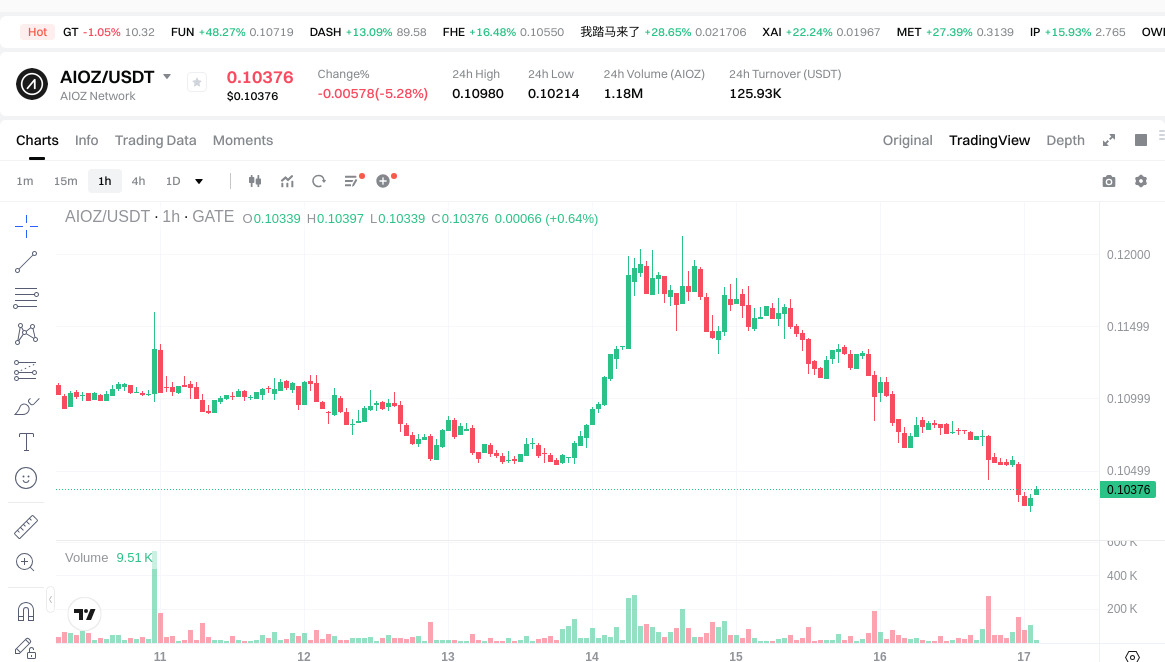
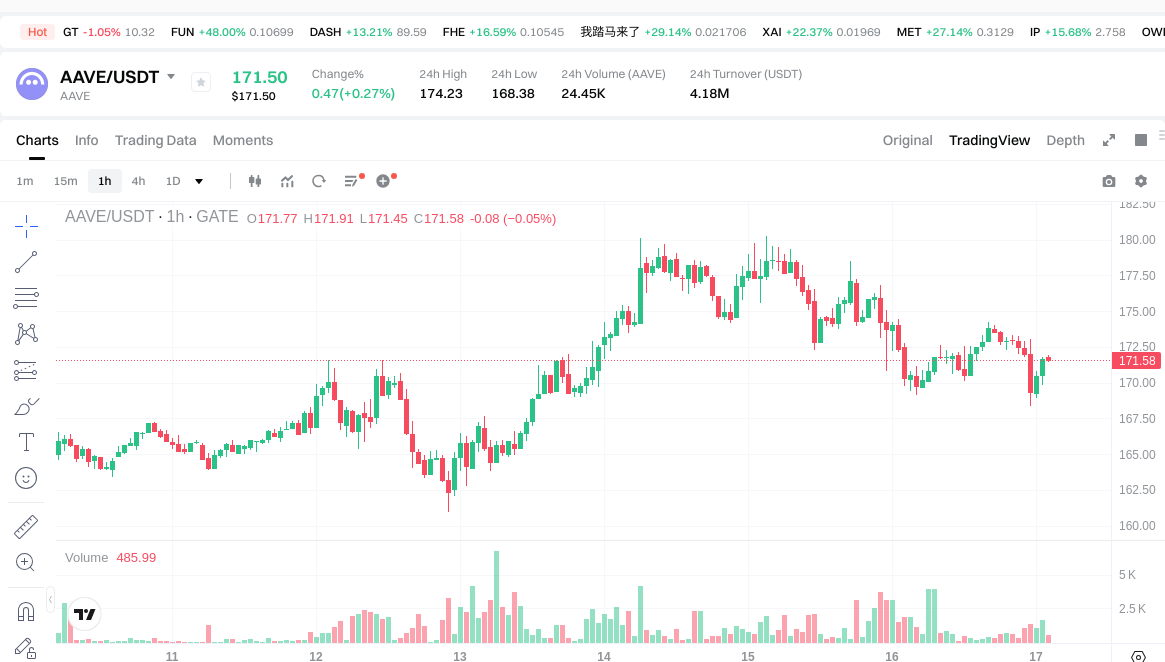
II. Core Factors Influencing AIOZ vs AAVE Investment Value
Tokenomics Comparison
- AAVE: The protocol features a near-complete token dilution model with minimal future supply unlocks, distinguishing it from many newer tokens that face significant post-TGE sell pressure. The tokenomics reform proposal introduces revenue-sharing mechanisms to enhance token utility, aligning AAVE stakers with protocol performance.
- AIOZ: Information regarding AIOZ tokenomics was not available in the provided materials.
- 📌 Historical Pattern: AAVE's supply mechanism supports price stability through its fully diluted structure, reducing the risk of future supply shocks that typically impact price cycles.
Institutional Adoption and Market Applications
- Institutional Holdings: AAVE received backing from Grayscale, the world's largest digital asset management company, which added AAVE to its investment portfolio fund in December 2020. The protocol also secured funding from prominent investors including Three Arrows Capital, Blockchain Capital, and Standard Crypto.
- Enterprise Adoption: AAVE dominates decentralized lending with active loans totaling $7.5 billion, five times larger than its closest competitor. The protocol has deployed across 13 blockchain networks, including zkSync, with potential expansion to non-EVM chains like Aptos.
- Regulatory Environment: As a DeFi protocol, AAVE operates in a decentralized manner, though it faces varying regulatory approaches across jurisdictions. The protocol's multi-chain deployment strategy positions it to adapt to different regional regulatory frameworks.
Technology Development and Ecosystem Building
- AAVE Technology Upgrades: The upcoming Aave V4 will introduce a unified liquidity layer, enabling seamless cross-chain borrowing without complexity. The upgrade incorporates account abstraction and smart accounts, allowing users to manage multiple positions across isolated assets. Plans include integration of RWA-based products around GHO, potentially bridging traditional finance with DeFi.
- AIOZ Technology Development: Information regarding AIOZ technical developments was not available in the provided materials.
- Ecosystem Comparison: AAVE maintains leading positions across nearly all mainstream EVM L1/L2 deployments (except BNB Chain). The protocol's asset base comprises over 75% non-stablecoin assets, primarily BTC and ETH derivatives. AAVE demonstrated strong product-market fit, with quarterly revenue maintaining 50-60% growth even during market recovery phases.
Macroeconomic Factors and Market Cycles
- Performance in Inflationary Environment: AAVE's exposure to cryptocurrency growth provides a hedge opportunity, as its TVL and revenue growth correlate directly with BTC and ETH asset appreciation. The protocol's revenue remained resilient even during market downturns, successfully collecting liquidation fees during the August risk-off period.
- Monetary Policy Impact: With global central banks signaling rate-cutting cycles, lower opportunity costs for yield-seeking may drive capital from traditional finance instruments toward DeFi stablecoin farming. This environment could increase stablecoin borrowing utilization on platforms like AAVE.
- Geopolitical Factors: AAVE's decentralized nature and multi-chain deployment enable cross-border lending without intermediaries. The protocol's annualized 90-day revenue reached 150% of year-to-date protocol expenses, demonstrating financial sustainability independent of geopolitical disruptions.
III. 2026-2031 Price Prediction: AIOZ vs AAVE
Short-term Prediction (2026)
- AIOZ: Conservative $0.0913 - $0.1037 | Optimistic $0.1037 - $0.1348
- AAVE: Conservative $151.09 - $171.69 | Optimistic $171.69 - $242.08
Medium-term Prediction (2028-2029)
- AIOZ may enter a consolidation phase, with projected price range of $0.0899 - $0.2286
- AAVE may enter an expansion phase, with projected price range of $219.33 - $393.59
- Key drivers: institutional capital inflows, ETF developments, ecosystem growth
Long-term Prediction (2031)
- AIOZ: Baseline scenario $0.1248 - $0.2152 | Optimistic scenario $0.2152 - $0.2798
- AAVE: Baseline scenario $269.23 - $414.20 | Optimistic scenario $414.20 - $513.61
View detailed price predictions for AIOZ and AAVE
Disclaimer
AIOZ:
| Year |
Predicted High Price |
Predicted Average Price |
Predicted Low Price |
Price Change |
| 2026 |
0.134836 |
0.10372 |
0.0912736 |
0 |
| 2027 |
0.15744696 |
0.119278 |
0.09780796 |
15 |
| 2028 |
0.1978583464 |
0.13836248 |
0.089935612 |
34 |
| 2029 |
0.228630161952 |
0.1681104132 |
0.144574955352 |
62 |
| 2030 |
0.23209323646392 |
0.198370287576 |
0.11505476679408 |
92 |
| 2031 |
0.279801290625948 |
0.21523176201996 |
0.124834421971576 |
108 |
AAVE:
| Year |
Predicted High Price |
Predicted Average Price |
Predicted Low Price |
Price Change |
| 2026 |
242.0829 |
171.69 |
151.0872 |
0 |
| 2027 |
275.1589785 |
206.88645 |
151.0271085 |
20 |
| 2028 |
313.329528525 |
241.02271425 |
219.3306699675 |
40 |
| 2029 |
393.59009237025 |
277.1761213875 |
235.599703179375 |
61 |
| 2030 |
493.01316711194625 |
335.383106878875 |
191.16837092095875 |
95 |
| 2031 |
513.605689874309175 |
414.198136995410625 |
269.228789047016906 |
141 |
IV. Investment Strategy Comparison: AIOZ vs AAVE
Long-term vs Short-term Investment Strategies
-
AIOZ: May appeal to investors focused on emerging infrastructure projects within the content distribution and streaming media sectors. The token's current price position below historical peaks could attract those seeking potential recovery opportunities, though limited information about technological developments requires careful consideration.
-
AAVE: Suitable for investors prioritizing established DeFi protocols with demonstrated revenue generation and institutional backing. The protocol's dominant position in decentralized lending, combined with multi-chain deployment and consistent financial performance, aligns with portfolios emphasizing proven market adoption and ecosystem maturity.
Risk Management and Asset Allocation
-
Conservative Investors: AIOZ 20-30% vs AAVE 70-80% - Higher allocation toward AAVE reflects its established market position, institutional support, and demonstrated revenue sustainability. The protocol's fully diluted token structure reduces future supply pressure concerns.
-
Aggressive Investors: AIOZ 40-50% vs AAVE 50-60% - Increased AIOZ allocation captures potential upside from recovery scenarios, while maintaining substantial AAVE exposure provides portfolio stability through its market leadership and consistent performance metrics.
-
Hedging Tools: Stablecoin reserves (15-25% of portfolio), cross-asset correlation management between lending protocols and infrastructure tokens, options strategies for downside protection during market volatility periods.
V. Potential Risk Comparison
Market Risks
-
AIOZ: The token experienced substantial decline from $2.65 to $0.011 between April 2021 and September 2023, demonstrating high volatility characteristics. Current 24-hour trading volume of $125,475.26 indicates relatively limited liquidity compared to major cryptocurrencies, potentially amplifying price movements during market stress periods.
-
AAVE: While exhibiting lower volatility compared to smaller-cap tokens, AAVE remains exposed to broader DeFi sector sentiment shifts. The protocol's TVL correlation with BTC and ETH prices creates systematic risk during cryptocurrency market downturns. However, revenue resilience during the August risk-off period demonstrates operational stability.
Technical Risks
-
AIOZ: Limited information regarding network scalability, security audits, and technical infrastructure development constrains comprehensive risk assessment. The content distribution network model requires evaluation of bandwidth efficiency, node reliability, and streaming quality maintenance during network expansion.
-
AAVE: Multi-chain deployment across 13 blockchain networks introduces complexity in security management and smart contract audit requirements. The upcoming V4 upgrade's unified liquidity layer and account abstraction features require successful implementation without introducing vulnerabilities. Oracle dependency for price feeds creates potential manipulation vectors during extreme volatility.
Regulatory Risks
-
Global Regulatory Environment: AAVE operates as a decentralized lending protocol, attracting regulatory attention in jurisdictions implementing DeFi oversight frameworks. The protocol's multi-chain strategy provides geographic flexibility but requires monitoring of regional compliance requirements. AIOZ's content distribution model faces different regulatory considerations related to data transmission and content hosting across jurisdictions.
-
Institutional Adoption Impact: AAVE's institutional backing from Grayscale and established venture funds provides legitimacy but also exposes the protocol to regulatory developments affecting institutional cryptocurrency participation. Changes in lending regulations or DeFi classification could impact protocol operations and token utility.
VI. Conclusion: Which Is the Better Buy?
📌 Investment Value Summary:
-
AIOZ Advantages: Current price of $0.10351 represents substantial distance from 2021 peak of $2.65, potentially offering entry opportunity for recovery scenarios. The blockchain-based content distribution network addresses growing streaming media infrastructure demands. Lower absolute price point enables position accumulation with limited capital allocation.
-
AAVE Advantages: Market leadership in decentralized lending with $7.5 billion in active loans demonstrates proven product-market fit. Institutional backing from Grayscale and major venture funds provides credibility and potential capital inflows. Near-complete token dilution model eliminates future supply unlock pressures. Consistent revenue generation with 50-60% quarterly growth during market recovery phases indicates financial sustainability. Multi-chain deployment across 13 networks positions protocol for continued expansion.
✅ Investment Recommendations:
-
Beginner Investors: Consider AAVE as core DeFi exposure due to established market position, institutional validation, and demonstrated revenue model. The protocol's dominance in decentralized lending provides clearer value proposition compared to emerging infrastructure projects. Limit initial position sizing to 3-5% of total portfolio, complemented with stablecoin reserves for volatility management.
-
Experienced Investors: Evaluate portfolio diversification between established DeFi protocols (AAVE) and emerging infrastructure projects (AIOZ) based on risk tolerance and market cycle positioning. AAVE's upcoming V4 upgrade and RWA integration plans warrant monitoring for long-term growth potential. AIOZ allocation requires additional due diligence on technological developments and ecosystem adoption metrics not available in current materials.
-
Institutional Investors: AAVE presents stronger institutional investment case through Grayscale backing, multi-chain regulatory flexibility, and sustainable revenue generation model. The protocol's 150% revenue-to-expense ratio and cross-chain lending capabilities align with institutional requirements for operational sustainability and market depth. Consider AAVE exposure within broader DeFi infrastructure allocation, maintaining correlation monitoring with BTC and ETH price movements.
⚠️ Risk Warning: Cryptocurrency markets exhibit extreme volatility characteristics. This analysis does not constitute investment advice. Investors should conduct independent research, assess personal risk tolerance, and consider consultation with financial advisors before making investment decisions. Past performance does not guarantee future results.
VII. FAQ
Q1: What are the main differences between AIOZ and AAVE in terms of use cases?
AAVE is a decentralized lending protocol with $7.5 billion in active loans, while AIOZ operates as a blockchain-based content distribution network for streaming media. AAVE enables users to borrow and lend cryptocurrency assets across 13 blockchain networks, generating consistent revenue through interest payments and liquidation fees. In contrast, AIOZ focuses on decentralized content delivery infrastructure, combining blockchain technology with streaming capabilities to address media distribution challenges.
Q2: Which asset has stronger institutional backing?
AAVE demonstrates significantly stronger institutional support compared to AIOZ. AAVE received backing from Grayscale, the world's largest digital asset management company, which added AAVE to its investment portfolio in December 2020. Additional institutional investors include Three Arrows Capital, Blockchain Capital, and Standard Crypto. The provided materials contain no information regarding institutional investment in AIOZ, suggesting limited institutional adoption at this time.
Q3: How do the tokenomics differ between AIOZ and AAVE?
AAVE features a near-complete token dilution model with minimal future supply unlocks, reducing the risk of post-TGE sell pressure that typically impacts newer tokens. This fully diluted structure supports price stability by eliminating future supply shock concerns. The protocol also introduced revenue-sharing mechanisms through tokenomics reform proposals, aligning AAVE stakers with protocol performance. Unfortunately, specific tokenomics information for AIOZ was not available in the provided materials, limiting comprehensive comparison.
Q4: What is the price volatility comparison between these two assets?
AIOZ demonstrates higher volatility characteristics, declining from its all-time high of $2.65 in April 2021 to approximately $0.011 in September 2023—representing a substantial correction. Current 24-hour trading volume of $125,475.26 indicates relatively limited liquidity. AAVE, while still volatile, shows more moderate price movements, declining from $661.69 in May 2021 to $26.02 at its lowest point. AAVE's current 24-hour trading volume of $4,208,018.23 provides significantly deeper liquidity, potentially reducing slippage during large transactions.
Q5: Which asset has better long-term growth potential according to price predictions?
Based on 2031 projections, AAVE shows stronger anticipated growth with a predicted price range of $269.23-$513.61 (baseline to optimistic scenarios), representing a potential 141% increase from 2026 levels. AIOZ's 2031 projections range from $0.1248-$0.2798, indicating a 108% potential increase. AAVE's growth trajectory benefits from established market dominance, upcoming V4 upgrade with unified liquidity layer, and planned RWA integration. However, these predictions should be considered alongside broader market conditions and technological developments.
Q6: What are the key technological developments to watch for each project?
AAVE's upcoming V4 upgrade introduces significant innovations including a unified liquidity layer enabling seamless cross-chain borrowing, account abstraction for simplified user experience, and smart accounts allowing management of multiple positions across isolated assets. The protocol plans to integrate RWA-based products around its GHO stablecoin, potentially bridging traditional finance with DeFi. For AIOZ, the provided materials contain limited information regarding specific technological developments, requiring additional research to assess technical roadmap and innovation pipeline.
Q7: How do these assets perform in different market conditions?
AAVE demonstrated revenue resilience during market downturns, successfully collecting liquidation fees during the August risk-off period and maintaining 50-60% quarterly revenue growth during market recovery phases. The protocol's exposure to BTC and ETH appreciation provides growth correlation during bull markets, while its established user base supports baseline activity during bearish conditions. AIOZ's performance across market cycles remains unclear from available materials, though its historical price pattern shows significant correlation with broader cryptocurrency market trends.
Q8: What allocation strategy makes sense for different investor types?
Conservative investors should consider 70-80% AAVE allocation versus 20-30% AIOZ, reflecting AAVE's established market position and institutional backing. Aggressive investors might balance positions at 50-60% AAVE versus 40-50% AIOZ to capture potential recovery upside from AIOZ while maintaining stability through AAVE's market leadership. Beginners should prioritize AAVE as core DeFi exposure, limiting initial positions to 3-5% of total portfolio with stablecoin reserves for volatility management. All allocations should incorporate hedging tools including stablecoin reserves (15-25% of portfolio) and cross-asset correlation management.
* The information is not intended to be and does not constitute financial advice or any other recommendation of any sort offered or endorsed by Gate.