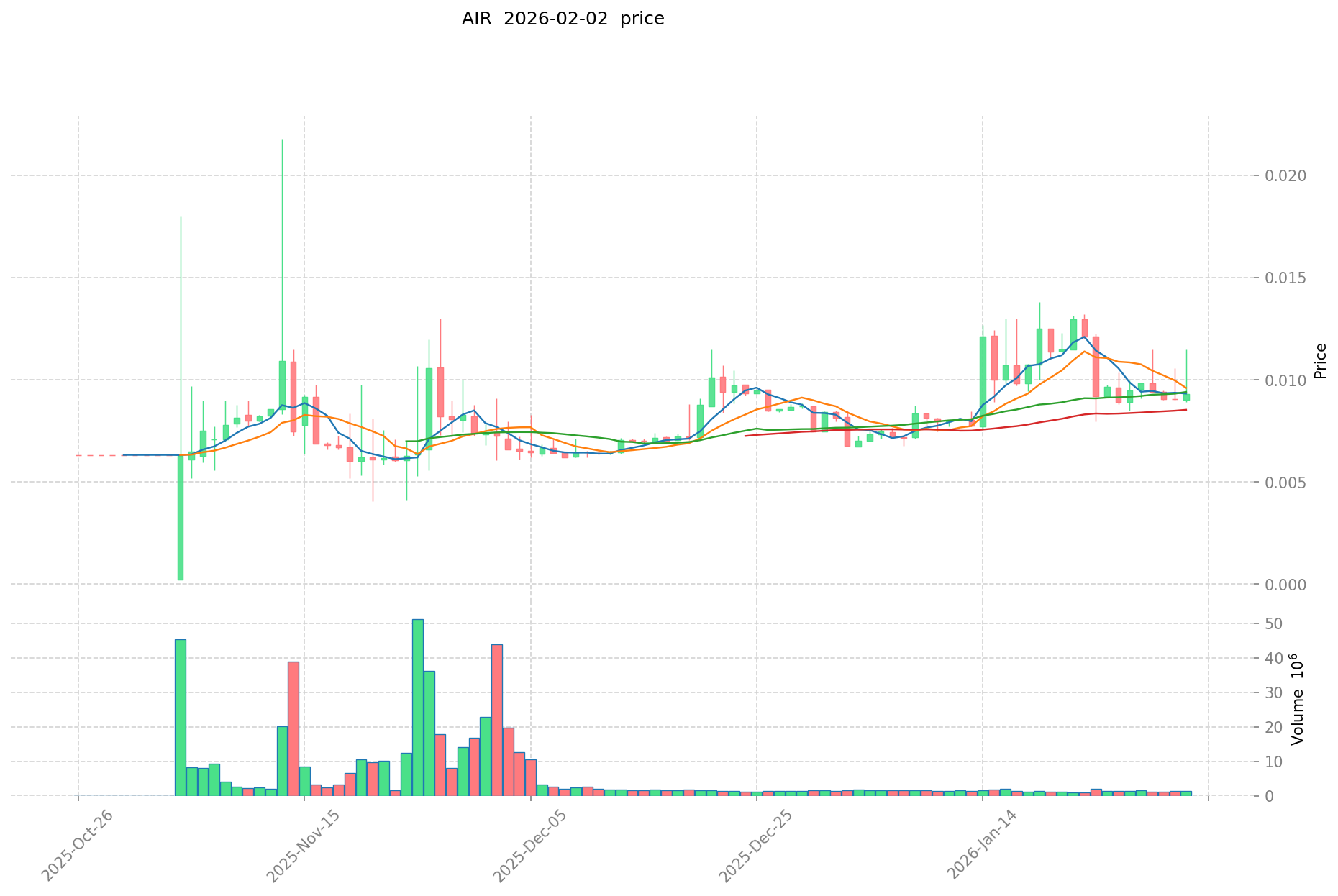
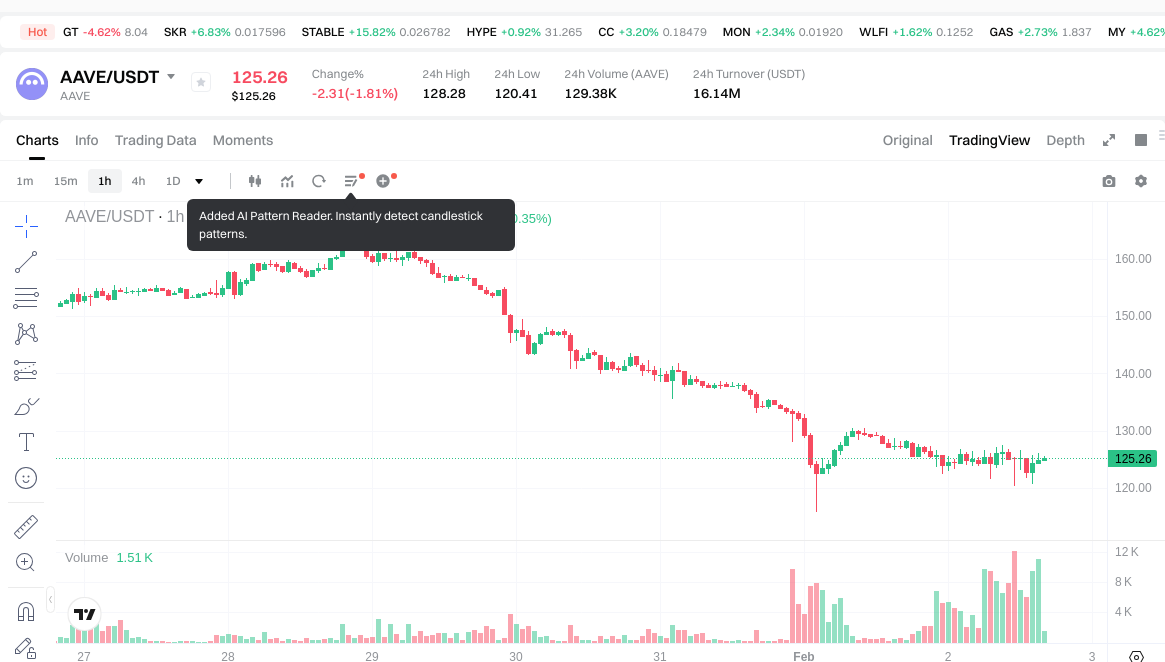
This comprehensive guide compares AIR and AAVE, two distinct cryptocurrency projects in different development stages. AAVE, established since 2020, operates as a leading DeFi lending protocol with TVL doubling year-to-date, offering institutional-grade features and multi-chain deployment. AIR, launched in 2024, represents an emerging web3 community project focused on DePIN and Sport AI ecosystems. The analysis examines historical price trends, tokenomics, institutional adoption, technical development, and risk profiles to help investors evaluate which asset aligns with their investment objectives. Current market conditions show AAVE trading at $124.96 with $15.97M daily volume versus AIR at $0.008894 with $13,227.83 volume. Long-term forecasts through 2031 suggest both projects offer different risk-return profiles. Check real-time prices on Gate for both tokens.
Introduction: Investment Comparison Between AIR and AAVE
In the cryptocurrency market, the comparison between AIR and AAVE remains a topic of ongoing interest among investors. Both assets exhibit distinct differences in market capitalization ranking, application scenarios, and price performance, representing different positioning within the crypto asset landscape.
AIRian (AIR): Launched in 2024, this web3 community project focuses on DePIN and Sport AI ecosystems, aiming to improve user health globally through gamified data sharing and competition.
AAVE (AAVE): Since its inception in 2020, AAVE has established itself as a decentralized lending protocol, providing deposit and borrowing services within the DeFi ecosystem, ranking among the most recognized protocols in decentralized finance.
This article will comprehensively analyze the investment value comparison between AIR and AAVE through historical price trends, supply mechanisms, institutional adoption, technical ecosystems, and future projections, attempting to address investors' most pressing question:
"Which is the better buy right now?"
I. Historical Price Comparison and Current Market Status
AIR and AAVE Historical Price Trends
- 2024: AIR recorded its all-time high at $0.15 in July 2024. The token subsequently experienced notable volatility, declining from this peak level over the following months.
- 2025: AIR reached its all-time low at $0.00022 in November 2025, reflecting significant downward pressure during this period.
- 2021: AAVE achieved its all-time high at $661.69 in May 2021. This peak coincided with broader market expansion in the DeFi sector during that period.
- 2020: AAVE recorded its all-time low at $26.02 in November 2020, shortly after its platform token conversion from LEND to AAVE.
- Comparative Analysis: During different market cycles, AIR demonstrated a price range from $0.15 to $0.00022, while AAVE exhibited a broader range from $661.69 to $26.02. AIR's market history spans a shorter timeframe compared to AAVE's established presence since 2020.
Current Market Status (2026-02-02)
- AIR Current Price: $0.008894
- AAVE Current Price: $124.96
- 24-Hour Trading Volume: AIR $13,227.83 vs AAVE $15,972,093.46
- Market Sentiment Index (Fear & Greed Index): 14 (Extreme Fear)
View Real-Time Prices:
II. Core Factors Influencing AIR vs AAVE Investment Value
Tokenomics Comparison
- AAVE: The platform operates with a liquidity pool model that enhances capital efficiency. Token value is influenced by staking mechanisms, where increased staking rates reduce circulating supply and may create upward price pressure, while reduced staking can increase supply pressure.
- AIR: Specific tokenomics details are not provided in available materials.
- 📌 Historical Pattern: Supply mechanisms play a role in shaping price cycles through their impact on token circulation and market availability.
Institutional Adoption and Market Application
- Institutional Holdings: AAVE's growing Total Value Locked (TVL), which has reportedly doubled year-to-date, reflects increased institutional and user confidence in the protocol. The growth benefits from both increased deposits and appreciation of underlying collateral assets such as WBTC and ETH.
- Enterprise Adoption: AAVE has established itself as a prominent decentralized finance lending platform, offering features including flash loans and deployment across multiple blockchain networks. Its application in DeFi lending and borrowing serves as an alternative to traditional banking functions.
- Regulatory Landscape: Different jurisdictions maintain varying approaches toward DeFi protocols and their native tokens, which can affect adoption patterns and market access.
Technical Development and Ecosystem Building
- AAVE Technical Evolution: The protocol underwent a significant upgrade in 2018, transitioning from its original peer-to-peer model to a liquidity pool-based system, addressing earlier limitations in liquidity and standardization. The platform now supports multiple interest rate modes (variable and stable rates) and has been deployed across various blockchain networks.
- AIR Technical Development: Specific technical development information is not available in provided materials.
- Ecosystem Comparison: AAVE has established itself within the DeFi ecosystem, particularly in lending and borrowing applications. The platform's flash loan feature represents a notable innovation in the space. Its multi-chain deployment strategy extends its reach across different blockchain ecosystems.
Macroeconomic Environment and Market Cycles
- Performance in Inflationary Environments: The cryptocurrency market, including tokens like AAVE, has shown strong correlation with broader financial markets. In Q4 2024, the total cryptocurrency market cap demonstrated a 0.84 correlation with the S&P 500, though cryptocurrency returns significantly outpaced traditional markets with 45.7% growth compared to 3.0% for the S&P 500.
- Macroeconomic Monetary Policy: Interest rates, dollar index movements, and broader monetary policy decisions can influence both demand dynamics and market sentiment for crypto assets.
- Geopolitical Factors: Cross-border transaction requirements and international developments may affect adoption patterns and usage of decentralized financial protocols.
III. 2026-2031 Price Forecast: AIR vs AAVE
Short-term Forecast (2026)
- AIR: Conservative $0.00674576 - $0.008876 | Optimistic $0.008876 - $0.00923104
- AAVE: Conservative $101.4444 - $125.24 | Optimistic $125.24 - $154.0452
Mid-term Forecast (2028-2029)
- AIR may enter a growth phase with estimated price range of $0.005108901336 - $0.01366725716664
- AAVE may enter a consolidation phase with estimated price range of $134.0933427186 - $172.05364746
- Key drivers: institutional capital inflows, ETF developments, ecosystem expansion
Long-term Forecast (2030-2031)
- AIR: Baseline scenario $0.010276895630786 - $0.01234461937632 | Optimistic scenario $0.01234461937632 - $0.018054005837868
- AAVE: Baseline scenario $122.826231360903 - $196.68795157117575 | Optimistic scenario $196.68795157117575 - $257.661216558240232
View detailed price predictions for AIR and AAVE
Disclaimer
AIR:
| Year |
Predicted High Price |
Predicted Average Price |
Predicted Low Price |
Price Change |
| 2026 |
0.00923104 |
0.008876 |
0.00674576 |
0 |
| 2027 |
0.0098683368 |
0.00905352 |
0.0074238864 |
1 |
| 2028 |
0.012583034772 |
0.0094609284 |
0.005108901336 |
6 |
| 2029 |
0.01366725716664 |
0.011021981586 |
0.00727450784676 |
23 |
| 2030 |
0.0154307742204 |
0.01234461937632 |
0.010863265051161 |
38 |
| 2031 |
0.018054005837868 |
0.01388769679836 |
0.010276895630786 |
56 |
AAVE:
| Year |
Predicted High Price |
Predicted Average Price |
Predicted Low Price |
Price Change |
| 2026 |
154.0452 |
125.24 |
101.4444 |
0 |
| 2027 |
170.363972 |
139.6426 |
89.371264 |
11 |
| 2028 |
172.05364746 |
155.003286 |
148.80315456 |
24 |
| 2029 |
168.4343207319 |
163.52846673 |
134.0933427186 |
30 |
| 2030 |
227.3945094114015 |
165.98139373095 |
122.826231360903 |
32 |
| 2031 |
257.661216558240232 |
196.68795157117575 |
159.317240772652357 |
57 |
IV. Investment Strategy Comparison: AIR vs AAVE
Long-term vs Short-term Investment Strategies
- AIR: May be suitable for investors interested in emerging web3 community projects with focus on DePIN and Sport AI ecosystems. The token's shorter market history and price volatility suggest a higher-risk profile that may appeal to those with tolerance for early-stage projects.
- AAVE: May be suitable for investors seeking exposure to established DeFi infrastructure. The protocol's presence since 2020 and its position as a decentralized lending platform suggest a relatively more established market position compared to newer entrants.
Risk Management and Asset Allocation
- Conservative Investors: AIR 10-20% vs AAVE 80-90% allocation may be considered, given AAVE's longer operational history and established protocol infrastructure.
- Aggressive Investors: AIR 40-50% vs AAVE 50-60% allocation could potentially reflect higher risk tolerance and interest in emerging ecosystem development.
- Hedging Tools: Stablecoin allocation, options strategies, and cross-asset diversification may be employed to manage portfolio volatility.
V. Potential Risk Comparison
Market Risk
- AIR: The token has experienced notable price volatility, with a recorded range from $0.15 to $0.00022. Limited trading volume of $13,227.83 may present liquidity considerations. The shorter market history provides less data for historical pattern analysis.
- AAVE: Price movements have shown correlation with broader DeFi sector trends. The token demonstrated a historical range from $661.69 to $26.02. Current market conditions reflect an Extreme Fear sentiment index of 14, which may indicate heightened market uncertainty.
Technical Risk
- AIR: Specific technical risk factors are not detailed in available information regarding network stability or scalability considerations.
- AAVE: The protocol's multi-chain deployment strategy presents both opportunities and considerations regarding network security across different blockchain ecosystems. The liquidity pool model's performance depends on user participation and collateral asset stability.
Regulatory Risk
- Different jurisdictions maintain varying approaches toward DeFi protocols and their native tokens. Lending protocols face ongoing scrutiny in various markets regarding classification and compliance requirements. Projects with shorter operational histories may face additional considerations regarding regulatory clarity. Cross-border transaction requirements and policy developments may affect both projects differently based on their application scenarios and geographic user distribution.
VI. Conclusion: Which Is the Better Buy?
📌 Investment Value Summary:
- AIR Characteristics: Represents an emerging web3 community project focused on DePIN and Sport AI ecosystems. The token's market history spans from 2024, with price performance showing significant volatility. Current trading volume stands at $13,227.83.
- AAVE Characteristics: Established decentralized lending protocol operational since 2020. The platform features liquidity pool infrastructure, flash loan capabilities, and multi-chain deployment. Growing Total Value Locked reflects user and institutional engagement. Current trading volume reaches $15,972,093.46.
✅ Investment Considerations:
- New Investors: May consider starting with smaller allocations to understand market dynamics and protocol mechanics. AAVE's longer operational history and established DeFi infrastructure provide more historical data for analysis. Market education regarding DeFi lending mechanisms and web3 ecosystem development may be beneficial.
- Experienced Investors: May evaluate both projects based on portfolio diversification objectives, risk tolerance levels, and investment timeframes. AAVE's established protocol infrastructure and AIR's emerging ecosystem positioning represent different risk-return profiles. Multi-asset strategies incorporating both established and emerging projects could be explored based on individual investment frameworks.
- Institutional Investors: May assess protocol infrastructure maturity, liquidity depth, regulatory landscape, and ecosystem integration. AAVE's position within DeFi lending and growing TVL may align with institutional infrastructure requirements. Due diligence regarding smart contract audits, governance structures, and operational track records remains essential.
⚠️ Risk Disclosure: Cryptocurrency markets exhibit high volatility characteristics. This content does not constitute investment advice. Market participants should conduct independent research and consider individual circumstances before making investment decisions.
VII. FAQ
Q1: What are the main differences between AIR and AAVE in terms of their core business models?
AAVE operates as an established decentralized lending protocol that provides deposit and borrowing services within the DeFi ecosystem, while AIR is a web3 community project focused on DePIN and Sport AI ecosystems through gamified data sharing. AAVE has been operational since 2020 and has developed a liquidity pool model that enables users to lend and borrow crypto assets with features including flash loans and multi-chain deployment. The platform's Total Value Locked (TVL) has reportedly doubled year-to-date, reflecting growing institutional and user confidence. In contrast, AIR launched in 2024 and aims to improve user health globally through its Sport AI ecosystem, representing a newer entrant in the web3 space with a different application focus outside of traditional DeFi lending.
Q2: How does the current trading volume difference between AIR and AAVE affect investment decisions?
AAVE demonstrates significantly higher trading volume at $15,972,093.46 compared to AIR's $13,227.83, which creates important liquidity considerations for investors. Higher trading volume typically indicates greater market liquidity, making it easier to enter and exit positions without significant price impact. For AAVE, the substantial trading volume suggests active market participation and potentially more stable price discovery mechanisms. AIR's lower trading volume may present challenges for larger position sizes and could result in higher slippage during trades. Investors should consider their position sizes relative to daily trading volumes—conservative investors may prefer AAVE's deeper liquidity, while those comfortable with emerging projects and smaller position sizes might still explore AIR despite its limited liquidity profile.
Q3: What role do tokenomics play in the long-term value proposition of AAVE?
AAVE's tokenomics are structured around a staking mechanism that directly influences circulating supply and potential price dynamics. When more AAVE tokens are staked, the circulating supply decreases, which may create upward price pressure assuming constant or growing demand. The protocol's liquidity pool model enhances capital efficiency by allowing continuous lending and borrowing activities without requiring peer-to-peer matching. Token holders who stake AAVE participate in protocol governance and may receive rewards, creating utility beyond speculative value. The growing TVL reflects not only increased deposits but also appreciation of underlying collateral assets such as WBTC and ETH, which can positively impact the protocol's overall value proposition. These tokenomics features contribute to AAVE's positioning within the DeFi infrastructure landscape, though market dynamics remain subject to broader cryptocurrency market conditions.
Q4: How should investors interpret the current Extreme Fear sentiment index of 14 in their investment strategy?
The Fear & Greed Index reading of 14 indicates Extreme Fear in the cryptocurrency market, which historically has sometimes preceded market bottoms or consolidation periods. This sentiment metric reflects collective market psychology rather than fundamental value assessments. For contrarian investors, extreme fear conditions might represent potential accumulation opportunities if they believe in long-term fundamentals, as assets may be trading below intrinsic value due to sentiment-driven selling. However, extreme fear can also signal ongoing downward pressure and potential for further declines. Conservative investors might interpret this as a signal to maintain defensive positioning or wait for sentiment stabilization before deploying capital. Risk management becomes particularly important during extreme sentiment periods—investors should consider position sizing, dollar-cost averaging strategies, and maintaining adequate stablecoin reserves for potential opportunities. The current sentiment should be evaluated alongside fundamental factors such as protocol development, adoption metrics, and broader macroeconomic conditions rather than used as a standalone timing indicator.
Q5: What are the key technical development differences that might affect future price performance?
AAVE has demonstrated significant technical evolution, transitioning from a peer-to-peer model in 2018 to a liquidity pool-based system that addressed earlier limitations in liquidity and standardization. The platform supports multiple interest rate modes (variable and stable rates) and has successfully deployed across various blockchain networks, demonstrating technical maturity and ecosystem integration. The introduction of flash loans represents a notable technical innovation that has found applications across DeFi. This established technical infrastructure and proven ability to adapt and upgrade may provide a foundation for sustained protocol relevance. In contrast, specific technical development information for AIR is not detailed in available materials, which presents an information gap for comparative technical analysis. Investors evaluating technical development trajectories should consider factors such as development team track record, code audit history, upgrade implementation success, and community developer engagement. AAVE's longer operational history provides more data points for assessing technical execution capabilities, while AIR's newer status means its technical evolution is still developing.
Q6: How do institutional adoption patterns differ between AIR and AAVE?
AAVE has demonstrated measurable institutional adoption through its growing Total Value Locked and establishment as a prominent DeFi lending platform. The protocol's infrastructure serves as an alternative to traditional banking functions, providing institutional-grade features such as multi-chain deployment, multiple interest rate options, and flash loan capabilities. The doubling of TVL year-to-date reflects increased institutional and sophisticated user confidence in the protocol's infrastructure. AAVE's position within DeFi lending has been built over several years of operational history since 2020. Regarding AIR, specific institutional adoption metrics and enterprise usage patterns are not detailed in available information. For institutional investors conducting due diligence, established protocols with proven infrastructure, regulatory clarity, and operational track records typically receive preference. The difference in institutional adoption patterns between a four-year-old DeFi protocol and a project launched in 2024 reflects natural maturation cycles in cryptocurrency infrastructure development.
Q7: What regulatory considerations should investors evaluate when comparing AIR and AAVE?
Different jurisdictions maintain varying regulatory approaches toward DeFi protocols and their native tokens, creating a complex landscape for both AIR and AAVE. Lending protocols like AAVE face ongoing scrutiny in various markets regarding classification as securities, compliance requirements, and potential lending license obligations. AAVE's longer operational history means it has navigated regulatory environments across multiple market cycles and jurisdictions, potentially providing insights into compliance approaches. Projects with shorter operational histories like AIR may face additional considerations regarding regulatory clarity and classification. Cross-border transaction requirements, anti-money laundering provisions, and evolving DeFi regulations affect both projects differently based on their application scenarios and geographic user distribution. Investors should monitor regulatory developments in their jurisdictions and where these protocols operate, considering factors such as licensing requirements, tax treatment, reporting obligations, and potential restrictions on DeFi participation. The regulatory landscape remains dynamic, and neither established nor emerging projects can guarantee immunity from future regulatory changes affecting operational models or token classifications.
Q8: How do the price forecasts for 2026-2031 reflect different growth trajectories for AIR and AAVE?
The price forecasts suggest different growth trajectories reflecting each project's market positioning and maturity stage. For AIR, the baseline 2031 scenario projects prices ranging from $0.010276895630786 to $0.01234461937632, representing approximately 56% growth from 2026 levels. This growth trajectory reflects potential expansion in the web3 community and DePIN/Sport AI ecosystems. For AAVE, the baseline 2031 scenario projects prices ranging from $122.826231360903 to $196.68795157117575, representing approximately 57% growth from 2026 levels despite starting from a significantly higher absolute price point. These forecasts incorporate assumptions about institutional capital inflows, ETF developments, and ecosystem expansion. The similar percentage growth rates suggest that analysts view both projects as having growth potential, though from different bases and market positions. Investors should recognize that long-term price forecasts involve substantial uncertainty and depend on numerous variables including technological development, competitive dynamics, regulatory evolution, and macroeconomic conditions. These projections should inform but not solely determine investment decisions, and actual outcomes may vary significantly from forecasted ranges.
* The information is not intended to be and does not constitute financial advice or any other recommendation of any sort offered or endorsed by Gate.