This comprehensive analysis compares AKT and ATOM, two leading tokens within the Cosmos ecosystem, providing investors with data-driven insights for informed decision-making. AKT powers Akash Network's decentralized cloud computing marketplace with a current price of $0.4734, while ATOM serves as the Cosmos Hub's governance token at $2.478. The article examines historical price performance, tokenomics structures, and ecosystem positioning, revealing AKT's higher volatility (85.22% annual decline) and ATOM's established infrastructure status. Investment strategy recommendations vary by profile: conservative investors may favor 70-80% ATOM allocation, while aggressive investors could pursue 40-50% AKT exposure. Price predictions through 2031 suggest ATOM's potential for sustained growth alongside continued ecosystem expansion. Risk factors including regulatory uncertainty, market volatility, and technical dependencies require careful assessment for both tokens on Gate exchange.
Introduction: AKT Investment Value, Price Prediction, and Risk Analysis
In the cryptocurrency market, Akash Network (AKT) represents a distinctive approach to decentralized cloud computing infrastructure. Launched with a vision to unlock underutilized cloud capacity across millions of data centers, AKT has established itself as a niche player in the blockchain ecosystem.
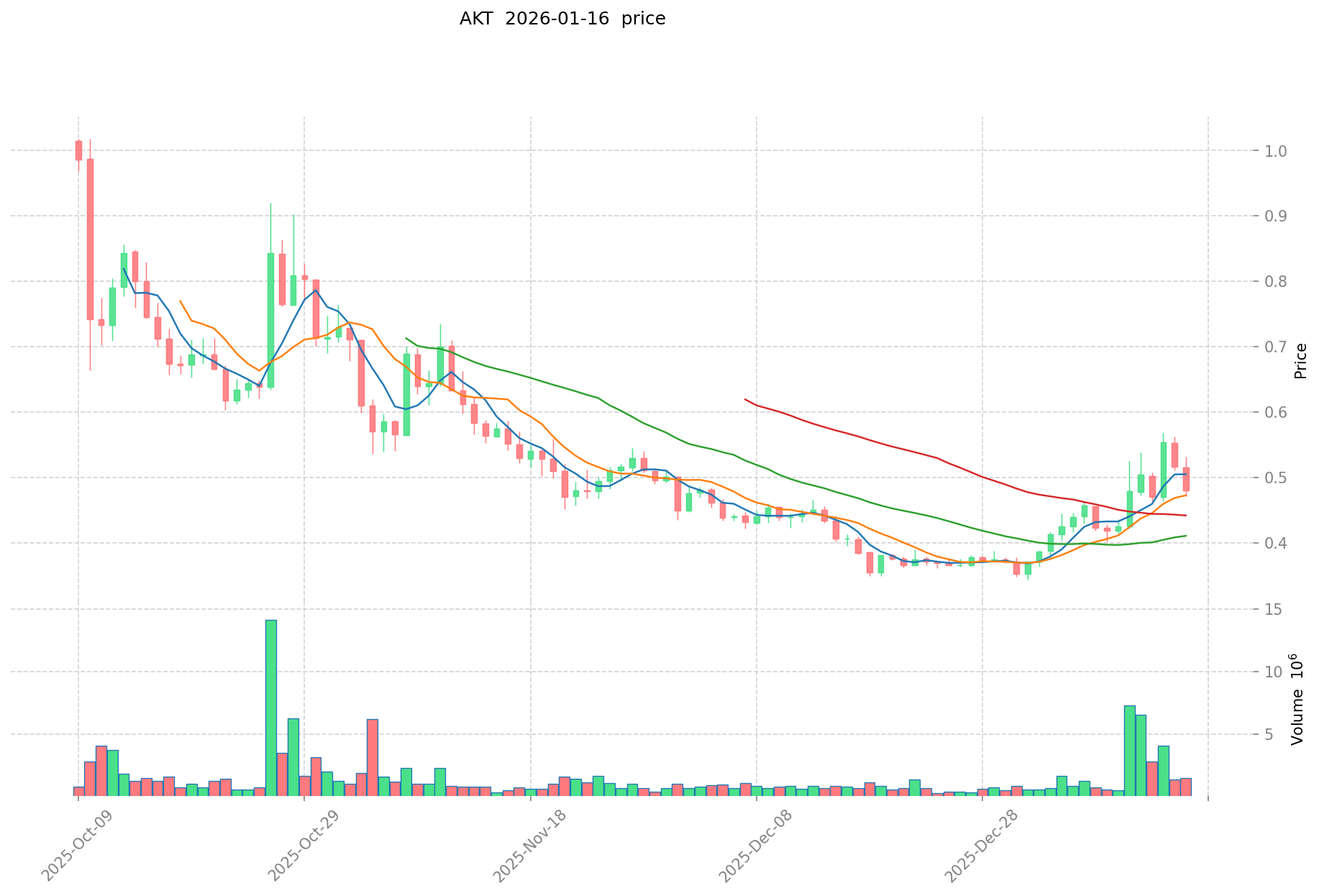
Akash Network (AKT): Developed on the Cosmos Hub since its inception, this project positions itself as a decentralized cloud marketplace (DeCloud) specifically designed for DeFi applications. As of January 16, 2026, AKT ranks #305 by market capitalization, with a circulating supply of approximately 284.8 million tokens and a current price of $0.4734.
The token serves multiple functions within the Akash ecosystem, including governance, network security through staking, and acting as a reserve currency in its multi-currency, multi-chain environment. With a fully diluted market cap of approximately $135.5 million and a circulating supply representing 73.3% of the total supply, AKT demonstrates a relatively mature tokenomics structure.
This article will comprehensively analyze AKT's investment considerations across several dimensions: historical price performance, supply mechanism, technical ecosystem, market positioning, and future outlook. We aim to address key questions that investors frequently consider:
"What are the fundamental value drivers and risk factors associated with AKT?"
Through examining price trends (including a notable 18.82% increase over 30 days alongside an 85.22% decline over one year), tokenomics, technological infrastructure, and market dynamics, this analysis provides a data-driven framework for understanding AKT's investment profile in the evolving decentralized cloud computing sector.
I. Historical Price Comparison and Current Market Conditions
AKT and ATOM Historical Price Trends
-
2021: AKT experienced notable price movement during April 2021, when it reached an all-time high of $8.07. This peak occurred amid broader market enthusiasm for decentralized cloud computing solutions.
-
2022: ATOM recorded its historical high of $44.45 in January 2022, reflecting strong momentum driven by ecosystem expansion and growing adoption of the Cosmos Hub's interoperability framework.
-
Comparative Analysis: During the 2021-2022 market cycle, AKT declined from its peak of $8.07 to a low of $0.164994 in November 2022, representing a substantial correction. Meanwhile, ATOM fell from $44.45 to $1.16 in March 2020, demonstrating volatility across different market phases. Both tokens experienced significant price compression following their respective peaks, reflecting broader crypto market corrections.
Current Market Conditions (January 16, 2026)
- AKT Current Price: $0.4734
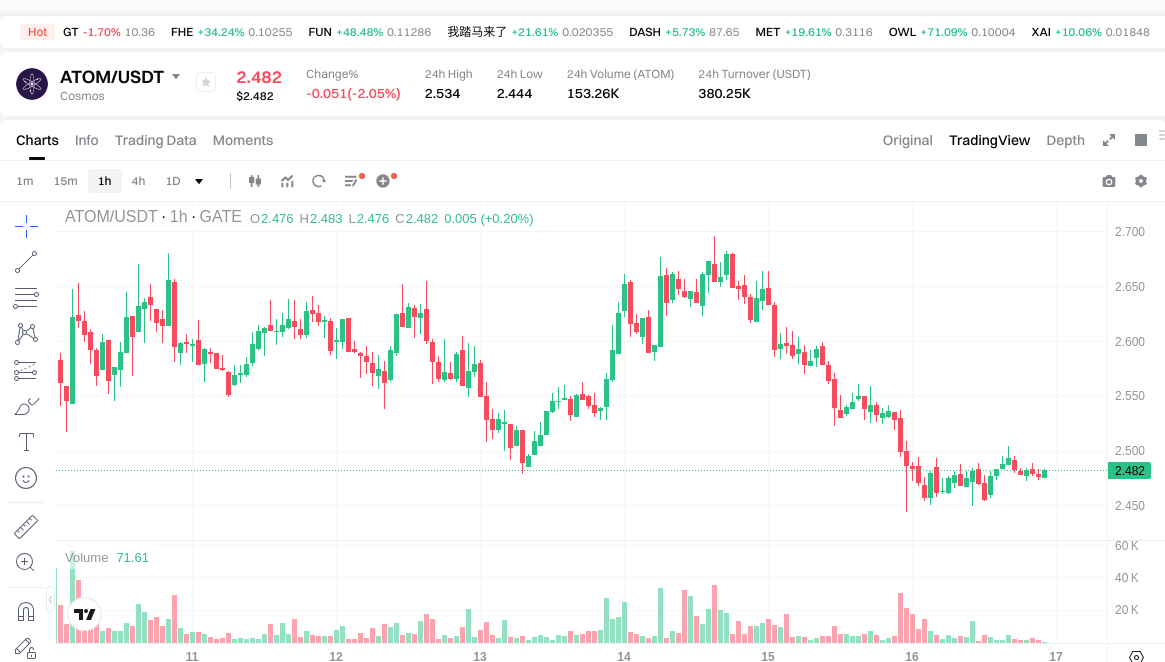
- ATOM Current Price: $2.478
- 24-Hour Trading Volume: AKT recorded $383,697.73 compared to ATOM's $380,448.43
- Market Sentiment Index (Fear & Greed Index): 49 (Neutral)
Both tokens exhibited modest trading activity, with AKT showing a 24-hour price decline of 1.6%, while ATOM decreased by 2.09%. Over the weekly timeframe, AKT gained 10.91%, whereas ATOM declined by 0.88%. Monthly performance indicated stronger positive momentum for ATOM with an 18.82% increase compared to AKT's comparable gains. The neutral market sentiment suggests balanced investor positioning without extreme fear or greed.
View real-time prices:
- Check AKT current price Market Price
- Check ATOM current price Market Price
II. Core Factors Influencing AKT vs ATOM Investment Value
Tokenomics Comparison
-
ATOM: Functions as the native token of the Cosmos network, primarily used for network governance and security through staking mechanisms. ATOM plays a role in the Proof-of-Stake consensus, where token holders can participate in securing the broader ecosystem.
-
AKT: Associated with liquidity staking within the Cosmos ecosystem. AKT tokens are utilized by projects built on Cosmos SDK, serving specific functions within decentralized applications and liquidity provision mechanisms.
-
📌 Historical Pattern: Token supply mechanisms and staking reward structures have influenced participation rates and token value cycles within the Cosmos ecosystem. The effectiveness of releasing staked asset value and addressing protocol liquidity challenges remains a factor in ecosystem development.
Institutional Adoption and Market Application
-
Institutional Holdings: ATOM, as the governance token of the Cosmos Hub, has received attention in terms of network security and cross-chain communication infrastructure.
-
Enterprise Adoption: ATOM supports interoperability through the Inter-Blockchain Communication (IBC) protocol, enabling cross-chain asset and data exchange. AKT is linked to specific DeFi applications within Cosmos-based chains, including liquidity provision on decentralized exchanges.
-
Regulatory Environment: Both tokens operate within the evolving regulatory landscape for crypto assets, with policy approaches varying across jurisdictions.
Technical Development and Ecosystem Construction
-
ATOM Technical Development: The Cosmos SDK framework and IBC protocol facilitate blockchain interoperability, allowing developers to build customized application-specific blockchains. The Tendermint consensus engine provides a foundation for network operations.
-
AKT Technical Development: AKT tokens are integrated into projects utilizing Cosmos SDK, participating in liquidity staking mechanisms and DeFi protocols within the ecosystem.
-
Ecosystem Comparison: The Cosmos ecosystem includes approximately 400 protocols derived from Cosmos SDK. DeFi applications span decentralized exchanges, liquidity staking, and cross-chain trading. However, liquidity concentration within Cosmos-native assets has been observed, with projects like Osmosis and Injective facilitating cross-chain trading activities. The ecosystem faces challenges in attracting external assets and capital inflows compared to other blockchain networks.
Macroeconomic Environment and Market Cycles
-
Inflation Context: Crypto asset performance is influenced by broader macroeconomic conditions, including inflation trends and monetary policy shifts.
-
Macroeconomic Monetary Policy: Interest rate adjustments and currency index movements affect capital allocation across digital asset categories.
-
Geopolitical Factors: Cross-border transaction requirements and international developments may influence demand for blockchain-based solutions and interoperability protocols.
III. 2026-2031 Price Prediction: AKT vs ATOM
Short-term Prediction (2026)
- AKT: Conservative scenario $0.459-$0.473 | Optimistic scenario $0.473-$0.506
- ATOM: Conservative scenario $2.256-$2.479 | Optimistic scenario $2.479-$3.446
Mid-term Prediction (2028-2029)
- AKT may enter a gradual growth phase, with estimated price range of $0.321-$0.693 in 2028 and $0.400-$0.675 in 2029
- ATOM may enter an expansion phase, with estimated price range of $2.773-$4.985 in 2028 and $2.294-$5.395 in 2029
- Key drivers: institutional capital flows, ETF developments, ecosystem expansion
Long-term Prediction (2030-2031)
- AKT: Baseline scenario $0.388-$0.636 (2030) | Optimistic scenario $0.508-$0.835 (2031)
- ATOM: Baseline scenario $2.700-$4.821 (2030) | Optimistic scenario $3.830-$7.880 (2031)
View detailed price predictions for AKT and ATOM
Disclaimer
AKT:
| Year |
Predicted High Price |
Predicted Average Price |
Predicted Low Price |
Price Change |
| 2026 |
0.506217 |
0.4731 |
0.458907 |
0 |
| 2027 |
0.514141425 |
0.4896585 |
0.36234729 |
3 |
| 2028 |
0.69262194825 |
0.5018999625 |
0.321215976 |
6 |
| 2029 |
0.67490487957375 |
0.597260955375 |
0.40016484010125 |
26 |
| 2030 |
0.699691209221812 |
0.636082917474375 |
0.388010579659368 |
34 |
| 2031 |
0.834858829185117 |
0.667887063348093 |
0.507594168144551 |
41 |
ATOM:
| Year |
Predicted High Price |
Predicted Average Price |
Predicted Low Price |
Price Change |
| 2026 |
3.44581 |
2.479 |
2.25589 |
0 |
| 2027 |
4.05849485 |
2.962405 |
1.777443 |
19 |
| 2028 |
4.9848388935 |
3.510449925 |
2.77325544075 |
41 |
| 2029 |
5.3945083997475 |
4.24764440925 |
2.293727980995 |
71 |
| 2030 |
6.122767033713412 |
4.82107640449875 |
2.6998027865193 |
94 |
| 2031 |
7.879567275512757 |
5.471921719106081 |
3.830345203374256 |
120 |
IV. Investment Strategy Comparison: AKT vs ATOM
Long-term vs Short-term Investment Strategies
-
AKT: May appeal to investors focused on decentralized cloud computing infrastructure and niche DeFi applications within the Cosmos ecosystem. The token's historical volatility and current market positioning suggest consideration for those with higher risk tolerance and interest in emerging infrastructure sectors.
-
ATOM: May appeal to investors seeking exposure to blockchain interoperability infrastructure and the broader Cosmos network governance. As the native token of Cosmos Hub with established cross-chain communication protocols, ATOM presents characteristics associated with core infrastructure assets in the multi-chain ecosystem.
Risk Management and Asset Allocation
-
Conservative Investors: AKT 20-30% vs ATOM 70-80% - Given ATOM's established position as the Cosmos Hub governance token and AKT's more specialized focus, conservative portfolios might emphasize greater ATOM exposure while maintaining limited AKT allocation for diversification.
-
Aggressive Investors: AKT 40-50% vs ATOM 50-60% - Investors with higher risk tolerance seeking exposure to both core infrastructure (ATOM) and emerging decentralized cloud solutions (AKT) might consider more balanced allocations, acknowledging the distinct volatility profiles and development stages.
-
Hedging Tools: Stablecoin allocations for liquidity management, options contracts where available for downside protection, and cross-asset portfolio construction incorporating tokens with differing correlation patterns to broader market movements.
V. Potential Risk Comparison
Market Risks
-
AKT: Exposure to market sentiment shifts regarding decentralized cloud computing adoption, liquidity constraints given lower market capitalization ($135.5 million fully diluted), and price sensitivity to broader crypto market cycles. The 85.22% decline over one year demonstrates substantial volatility characteristics.
-
ATOM: Subject to market dynamics affecting blockchain interoperability narratives, competition from alternative cross-chain solutions, and valuation pressures during periods of reduced DeFi activity. Price movements reflect broader trends in blockchain infrastructure investment and multi-chain ecosystem development.
Technical Risks
-
AKT: Ecosystem development dependencies on Cosmos SDK adoption, challenges in scaling decentralized cloud marketplace participation, and reliance on broader Cosmos network infrastructure stability. Limited documentation regarding specific technical implementations may present information asymmetry for investors.
-
ATOM: Network upgrade execution risks, validator concentration considerations within the Proof-of-Stake consensus mechanism, and interoperability protocol vulnerabilities. The Cosmos ecosystem faces ongoing challenges in attracting external assets and maintaining competitive positioning against alternative Layer 1 solutions.
Regulatory Risks
- Evolving regulatory frameworks for crypto assets across jurisdictions may differentially impact both tokens. ATOM's role in network governance and cross-chain infrastructure may attract scrutiny regarding securities classification in certain regulatory environments. AKT's association with decentralized cloud services and liquidity staking mechanisms faces uncertainty regarding regulatory treatment of DeFi protocols and infrastructure tokens. Policy developments in major markets could influence accessibility, listing availability, and institutional participation for both assets.
VI. Conclusion: Which Is the Better Buy?
📌 Investment Value Summary:
-
AKT Characteristics: Positioning in decentralized cloud computing infrastructure, integration with Cosmos ecosystem DeFi applications, relatively mature tokenomics with 73.3% circulating supply, demonstrated recent positive momentum (18.82% monthly gain), and market capitalization offering potential for growth alongside sector development.
-
ATOM Characteristics: Core infrastructure status within Cosmos Hub ecosystem, established governance and staking mechanisms, support for IBC protocol enabling cross-chain interoperability, broader ecosystem participation across approximately 400 Cosmos SDK-derived protocols, and relatively higher market capitalization reflecting network maturity.
✅ Investment Considerations:
-
New Investors: Consider beginning with established infrastructure tokens before exploring specialized assets. ATOM's position as Cosmos Hub governance token and broader ecosystem recognition may provide more accessible entry points. Understanding staking mechanisms, network participation requirements, and basic tokenomics remains important before allocation decisions.
-
Experienced Investors: Portfolio construction might incorporate both tokens based on individual risk tolerance, sector exposure preferences, and conviction regarding decentralized cloud computing versus blockchain interoperability narratives. Position sizing should reflect liquidity considerations, correlation analysis with broader portfolio holdings, and assessment of ecosystem development trajectories.
-
Institutional Investors: Due diligence processes should encompass technical infrastructure audits, regulatory compliance frameworks across operating jurisdictions, liquidity depth analysis for execution capabilities, custody solution availability, and ongoing monitoring of ecosystem developments. Both tokens present distinct risk-return profiles requiring comprehensive evaluation within institutional investment mandates.
⚠️ Risk Disclosure: Cryptocurrency markets exhibit extreme volatility characteristics. Historical performance does not indicate future results. This content does not constitute investment advice, financial guidance, or recommendations for any specific action. Investors should conduct independent research, consult qualified financial advisors, and only allocate capital they can afford to lose. Regulatory environments remain uncertain and subject to change across jurisdictions.
VII. FAQ
Q1: What is the fundamental difference between AKT and ATOM tokens?
AKT serves as the native token for Akash Network's decentralized cloud computing marketplace, while ATOM functions as the governance and security token for the Cosmos Hub ecosystem. AKT focuses specifically on enabling decentralized cloud infrastructure services, including compute resource provisioning, network governance, and staking within the Akash ecosystem. In contrast, ATOM operates as the core infrastructure token supporting blockchain interoperability through the Inter-Blockchain Communication (IBC) protocol, validator staking for network security, and governance across the broader Cosmos network comprising approximately 400 SDK-derived protocols.
Q2: Which token demonstrates stronger short-term price momentum as of January 2026?
AKT exhibits stronger short-term momentum with a 10.91% weekly gain and 18.82% monthly increase, while ATOM shows a 0.88% weekly decline despite comparable monthly performance. However, AKT experienced an 85.22% annual decline compared to more moderate corrections for ATOM, indicating higher volatility characteristics. The 24-hour trading volumes remain similar ($383,697.73 for AKT versus $380,448.43 for ATOM), suggesting comparable liquidity conditions during the current period. Investors should note that short-term momentum does not necessarily predict sustained performance trends.
Q3: What are the primary risks associated with investing in AKT versus ATOM?
AKT faces specialized risks including dependence on decentralized cloud computing adoption, lower liquidity given its $135.5 million fully diluted market cap, and reliance on Cosmos SDK infrastructure development. The token's 85.22% annual decline demonstrates substantial volatility exposure. ATOM encounters risks related to blockchain interoperability competition, validator concentration within its Proof-of-Stake mechanism, and challenges attracting external assets into the Cosmos ecosystem. Both tokens face regulatory uncertainty regarding securities classification, particularly concerning governance functions and staking mechanisms. Additionally, macroeconomic conditions affecting cryptocurrency markets broadly impact both assets.
Q4: How do tokenomics compare between AKT and ATOM?
AKT maintains a circulating supply of 284.8 million tokens representing 73.3% of total supply, indicating relatively mature distribution. The token serves multiple functions including governance, network security through staking, and reserve currency within Akash's multi-chain environment. ATOM operates with inflationary staking rewards designed to incentivize network security through validator participation. The token's primary utilities encompass governance voting, staking for consensus participation, and facilitating cross-chain transactions via IBC protocol. Both tokens employ staking mechanisms, though serving distinct ecosystem purposes—AKT for decentralized cloud marketplace operations and ATOM for broader Cosmos Hub security and interoperability.
Q5: What investment allocation strategy suits different investor profiles?
Conservative investors might consider 20-30% AKT versus 70-80% ATOM allocation, emphasizing ATOM's established infrastructure position while maintaining limited AKT exposure for diversification into decentralized cloud computing. Aggressive investors with higher risk tolerance could pursue 40-50% AKT versus 50-60% ATOM allocation, balancing core infrastructure exposure (ATOM) with emerging sector participation (AKT). These allocations acknowledge distinct volatility profiles—AKT's specialized focus and higher price sensitivity versus ATOM's broader ecosystem integration. Regardless of profile, risk management should incorporate stablecoin reserves for liquidity, position sizing relative to total portfolio, and ongoing monitoring of ecosystem developments affecting both tokens.
Q6: What technical developments could drive future value for each token?
AKT's value drivers include expansion of the decentralized cloud marketplace, increased adoption by DeFi applications requiring compute resources, and integration with additional Cosmos SDK-based protocols. Success in attracting enterprise clients to Akash Network's infrastructure could enhance token utility and demand. ATOM's prospects depend on IBC protocol adoption across blockchain ecosystems, successful network upgrades enhancing interoperability capabilities, and Cosmos Hub's ability to attract external assets and liquidity. The development of application-specific blockchains (app-chains) leveraging Cosmos SDK directly influences ATOM's positioning as core infrastructure within the multi-chain ecosystem landscape.
Q7: How does market capitalization affect investment considerations for AKT versus ATOM?
AKT's fully diluted market cap of approximately $135.5 million positions it as a lower-capitalization asset with potential for substantial growth alongside sector development, though accompanied by higher liquidity risks and price volatility. ATOM's larger market capitalization reflects established network maturity and broader ecosystem participation, typically offering greater liquidity for position entry and exit. Lower market cap assets like AKT may experience more pronounced price movements from capital inflows, presenting both opportunity and risk. Investors should assess liquidity requirements against position sizes, particularly for larger allocations where execution efficiency becomes critical for both entry and exit strategies.
Q8: What macroeconomic factors should investors monitor when holding AKT or ATOM?
Key macroeconomic indicators include monetary policy shifts affecting cryptocurrency capital allocation, particularly interest rate adjustments influencing risk asset valuations. Inflation trends impact investor preferences for digital assets as alternative stores of value. Regulatory developments across major jurisdictions—including securities classification determinations, staking mechanism treatment, and DeFi protocol oversight—directly affect accessibility and institutional participation for both tokens. Additionally, geopolitical factors influencing cross-border transaction demand and blockchain infrastructure adoption create varying conditions for interoperability protocols (ATOM) and decentralized cloud services (AKT). Currency index movements and broader equity market trends often correlate with cryptocurrency sector performance patterns.
* The information is not intended to be and does not constitute financial advice or any other recommendation of any sort offered or endorsed by Gate.