This comprehensive guide compares ALGO and BTC investment potential across multiple dimensions. ALGO, launched in 2019, employs Pure Proof-of-Stake technology for DeFi and enterprise applications, while BTC, established in 2008, functions as digital gold with institutional adoption. The analysis examines historical price trends, supply mechanisms, institutional adoption, ecosystem development, and macroeconomic factors. ALGO demonstrates higher volatility with significant growth potential, while BTC offers established market presence and resilience. Price forecasts indicate BTC growth of 172% by 2031, while ALGO projects 115% growth. Investment strategies vary by risk tolerance: conservative investors favor BTC (70-80%), aggressive investors balance both assets (40-50% ALGO, 50-60% BTC). Real-time trading data is available on Gate exchange platform.
Introduction: ALGO vs BTC Investment Comparison
In the cryptocurrency market, the comparison between ALGO and BTC remains a central topic for investors. Both assets differ significantly in market cap ranking, application scenarios, and price performance, representing distinct positioning within the crypto asset landscape.
Algorand (ALGO): Launched in 2019, it has gained market recognition through its focus on blockchain efficiency and expanded application prospects via innovations such as the BA* consensus mechanism and cryptographic sortition.
Bitcoin (BTC): Since its introduction in 2008, it has been regarded as digital gold and remains one of the cryptocurrencies with the highest global trading volume and market capitalization.
This article will provide a comprehensive analysis of the investment value comparison between ALGO and BTC, examining historical price trends, supply mechanisms, institutional adoption, technical ecosystems, and future predictions, while attempting to address the question investors care about most:
"Which is the better buy right now?"
I. Historical Price Comparison and Current Market Status
ALGO (Algorand) vs BTC (Bitcoin) Historical Price Trends
- 2019: ALGO launched in June 2019, reaching an all-time high of $3.56 on June 20, 2019, shortly after its debut through a Dutch auction that raised over $60 million in under 4 hours.
- 2021: BTC experienced a bull market cycle, with its price reaching a previous all-time high of $68,790 in November 2021, driven by increased institutional adoption and mainstream recognition.
- 2022: During the market downturn, BTC declined to approximately $17,708 in June 2022, while ALGO fell to its all-time low of $0.087513 on September 12, 2023.
- 2025: BTC reached a new all-time high of $126,080 on October 7, 2025, reflecting renewed market optimism and institutional interest.
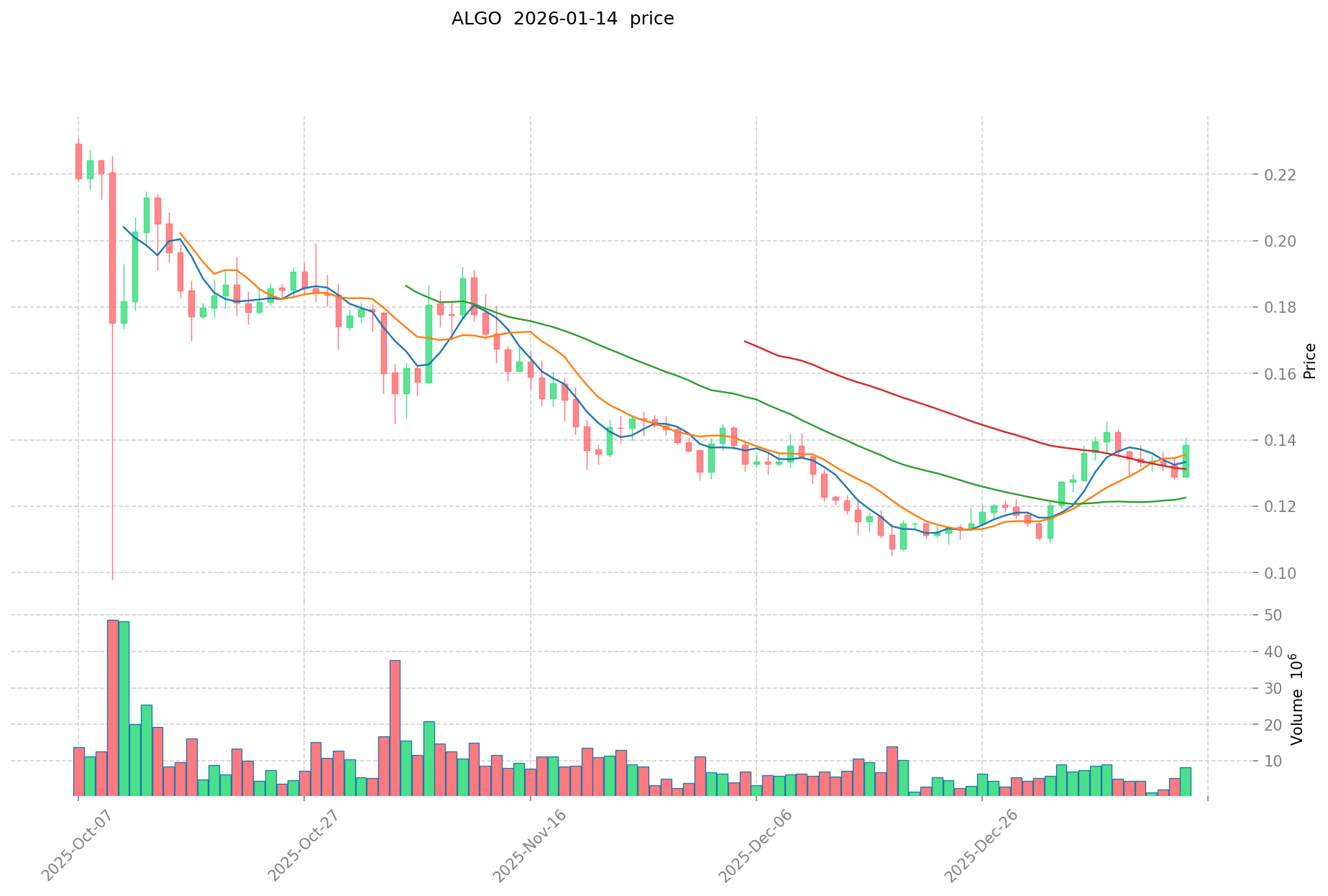
- Comparative Analysis: Throughout recent market cycles, ALGO has declined from its peak of $3.56 to current levels around $0.14, representing a significant retracement. In contrast, BTC has demonstrated greater price resilience, recovering from cyclical lows and establishing new highs during favorable market conditions.
Current Market Status (January 14, 2026)
- ALGO Current Price: $0.13911
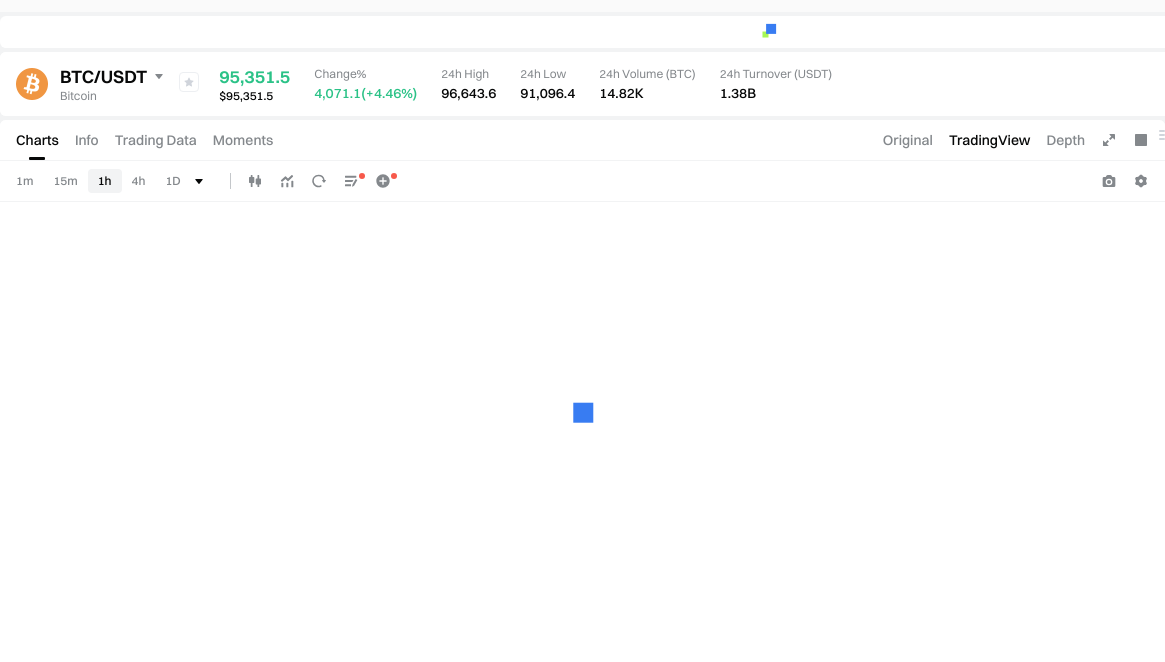
- BTC Current Price: $95,281.5
- 24-Hour Trading Volume: ALGO $1,160,411.44 vs BTC $1,379,177,805.13
- Market Sentiment Index (Fear & Greed Index): 48 (Neutral)
View real-time prices:
- Check ALGO Current Price Market Price
- Check BTC Current Price Market Price
II. Core Factors Influencing ALGO vs BTC Investment Value
Supply Mechanism Comparison (Tokenomics)
-
ALGO: Algorand has established a large total supply cap with a circulation of approximately 8.79 billion tokens, representing 87.94% of the total supply. The high circulation rate indicates relatively stable token distribution, though the substantial supply cap may present challenges for price appreciation.
-
BTC: Bitcoin operates under a fixed supply model with a 21 million coin cap, featuring a halving mechanism that reduces mining rewards approximately every four years. This programmed scarcity has historically influenced long-term price cycles.
-
📌 Historical Pattern: Supply mechanisms have demonstrated correlation with price cycles. Bitcoin's halving events have been associated with bull market phases, while tokens with larger supply caps may require stronger adoption rates to sustain price growth.
Institutional Adoption and Market Applications
-
Institutional Holdings: Available data suggests Bitcoin maintains broader institutional recognition, with various investment funds and corporations including BTC in their portfolios. ALGO's institutional adoption remains in development stages.
-
Enterprise Adoption: Bitcoin has gained traction in cross-border payment solutions and as a treasury reserve asset for some corporations. Algorand focuses on DeFi applications and enterprise-level blockchain solutions, though mainstream adoption remains limited compared to Bitcoin.
-
National Policies: Regulatory approaches vary significantly across jurisdictions. Bitcoin faces ongoing regulatory scrutiny globally, while Algorand, as a newer blockchain platform, encounters evolving policy frameworks.
Technology Development and Ecosystem Building
-
ALGO Technical Advancement: Algorand employs a Pure Proof-of-Stake (PPoS) consensus mechanism designed to address blockchain scalability challenges. The platform aims to balance decentralization, scalability, and security.
-
BTC Technical Evolution: Bitcoin development continues through protocol improvements and layer-two solutions. The network prioritizes security and decentralization over transaction throughput.
-
Ecosystem Comparison: Algorand's ecosystem encompasses DeFi, NFT, and enterprise applications, enhancing ALGO token utility. Bitcoin primarily functions as a store of value and payment network, with limited smart contract functionality compared to platforms like Algorand.
Macroeconomic Environment and Market Cycles
-
Performance in Inflationary Environments: Bitcoin has been discussed as a potential inflation hedge due to its fixed supply, though its correlation with traditional risk assets varies across market conditions. ALGO's behavior in inflationary scenarios remains less documented.
-
Macroeconomic Monetary Policy: Interest rate adjustments and U.S. dollar movements influence cryptocurrency markets broadly. Both assets demonstrate sensitivity to changes in monetary policy and liquidity conditions.
-
Geopolitical Factors: Cross-border transaction demand and international developments affect cryptocurrency adoption patterns. Bitcoin maintains a longer track record in periods of economic uncertainty, while Algorand's response to geopolitical events continues to develop alongside its ecosystem maturation.
III. 2026-2031 Price Forecast: ALGO vs BTC
Short-term Forecast (2026)
- ALGO: Conservative $0.072 - $0.139 | Optimistic $0.139 - $0.202
- BTC: Conservative $56,237 - $95,317 | Optimistic $95,317 - $131,537
Mid-term Forecast (2028-2029)
- ALGO may enter a consolidation phase with projected price range of $0.127 - $0.284, showing potential growth of 52% - 68% compared to 2026 baseline
- BTC may enter an expansion phase with projected price range of $88,868 - $252,933, indicating potential growth of 45% - 79% compared to 2026 baseline
- Key drivers: institutional capital inflows, ETF developments, ecosystem expansion
Long-term Forecast (2030-2031)
- ALGO: Base scenario $0.209 - $0.299 | Optimistic scenario $0.259 - $0.371
- BTC: Base scenario $145,375 - $259,598 | Optimistic scenario $211,917 - $308,922
View detailed price predictions for ALGO and BTC
Disclaimer: Price predictions are based on historical data analysis and market modeling. Cryptocurrency markets are highly volatile and subject to numerous unpredictable factors. These forecasts should not be considered as investment advice or guarantees of future performance.
ALGO:
| Year |
Predicted High Price |
Predicted Average Price |
Predicted Low Price |
Price Change |
| 2026 |
0.201695 |
0.1391 |
0.072332 |
0 |
| 2027 |
0.253892275 |
0.1703975 |
0.1499498 |
22 |
| 2028 |
0.256695313875 |
0.2121448875 |
0.133651279125 |
52 |
| 2029 |
0.283648321831875 |
0.2344201006875 |
0.12658685437125 |
68 |
| 2030 |
0.33933481675019 |
0.259034211259687 |
0.191685316332168 |
86 |
| 2031 |
0.370988797366124 |
0.299184514004939 |
0.209429159803457 |
115 |
BTC:
| Year |
Predicted High Price |
Predicted Average Price |
Predicted Low Price |
Price Change |
| 2026 |
131537.322 |
95316.9 |
56236.971 |
0 |
| 2027 |
163335.03984 |
113427.111 |
62384.91105 |
19 |
| 2028 |
203420.1808674 |
138381.07542 |
89947.699023 |
45 |
| 2029 |
252932.929652676 |
170900.6281437 |
88868.326634724 |
79 |
| 2030 |
307279.3294023726 |
211916.778898188 |
129269.23512789468 |
122 |
| 2031 |
308921.684438833557 |
259598.0541502803 |
145374.910324156968 |
172 |
IV. Investment Strategy Comparison: ALGO vs BTC
Long-term vs Short-term Investment Strategies
-
ALGO: May appeal to investors focused on blockchain efficiency innovations and DeFi ecosystem development potential. The platform's Pure Proof-of-Stake mechanism and enterprise application focus present opportunities for those interested in emerging blockchain infrastructure.
-
BTC: May suit investors seeking exposure to an established cryptocurrency with broader institutional recognition and a longer market history. Bitcoin's fixed supply model and role as a digital store of value position it differently within portfolio considerations.
Risk Management and Asset Allocation
-
Conservative Investors: Consider allocation frameworks such as ALGO 20-30% vs BTC 70-80%, emphasizing assets with established market presence while maintaining limited exposure to higher-volatility alternatives.
-
Aggressive Investors: May explore allocation models such as ALGO 40-50% vs BTC 50-60%, balancing exposure to newer blockchain platforms with established cryptocurrency assets.
-
Hedging Tools: Portfolio risk management may incorporate stablecoin positions for liquidity preservation, derivatives instruments where available, and diversified cryptocurrency holdings to address market volatility.
V. Potential Risk Comparison
Market Risk
-
ALGO: The asset demonstrates higher volatility characteristics relative to Bitcoin, with significant price retracement from historical peaks. Lower trading volumes compared to major cryptocurrencies may contribute to price sensitivity during market fluctuations.
-
BTC: While exhibiting cyclical volatility patterns, Bitcoin maintains broader market liquidity and institutional participation. Price movements often correlate with macroeconomic conditions and regulatory developments affecting the cryptocurrency sector.
Technical Risk
-
ALGO: Network scalability features require ongoing validation through ecosystem growth and transaction volume increases. Platform adoption rates influence long-term technical viability and ecosystem sustainability.
-
BTC: Mining concentration across specific geographic regions presents considerations for network decentralization. Protocol development emphasizes security and stability, though transaction throughput limitations persist relative to newer blockchain platforms.
Regulatory Risk
- Global regulatory approaches toward cryptocurrencies continue to evolve, with different implications for established assets like Bitcoin versus newer blockchain platforms such as Algorand. Jurisdictional policy variations affect market access, institutional adoption pathways, and operational frameworks for both assets.
VI. Conclusion: Which Is the Better Buy?
📌 Investment Value Summary:
-
ALGO Characteristics: Features Pure Proof-of-Stake consensus mechanism, targets DeFi and enterprise blockchain applications, maintains lower market capitalization with corresponding growth potential and volatility characteristics.
-
BTC Characteristics: Demonstrates established market presence with broader institutional recognition, operates under fixed supply model with historical halving cycles, functions primarily as digital store of value with extensive global liquidity.
✅ Investment Considerations:
-
Newer Market Participants: May prioritize assets with established trading infrastructure, broader institutional adoption, and longer market history to understand cryptocurrency market dynamics before exploring alternative platforms.
-
Experienced Market Participants: Consider portfolio diversification strategies that balance exposure to established cryptocurrencies with emerging blockchain platforms based on individual risk tolerance and investment timeframes.
-
Institutional Participants: Evaluate assets based on regulatory clarity, custody solutions availability, liquidity requirements, and alignment with organizational investment mandates and risk management frameworks.
⚠️ Risk Disclosure: Cryptocurrency markets demonstrate significant volatility characteristics. This analysis does not constitute investment advice. Market participants should conduct independent research and consult qualified financial professionals before making investment decisions.
VII. FAQ
Q1: What is the main difference between ALGO and BTC's consensus mechanisms?
ALGO utilizes a Pure Proof-of-Stake (PPoS) consensus mechanism, while BTC employs a Proof-of-Work (PoW) mining model. Algorand's PPoS mechanism aims to balance decentralization, scalability, and security through cryptographic sortition and the BA* consensus protocol, enabling faster transaction processing with lower energy consumption. Bitcoin's PoW model prioritizes security and network decentralization through computational mining, establishing a proven track record since 2008 but with limitations in transaction throughput and higher energy requirements.
Q2: Which asset demonstrates better performance during market downturns?
BTC has historically shown greater price resilience during market downturns compared to ALGO. During the 2022 market correction, BTC declined to approximately $17,708 but subsequently recovered to establish new all-time highs reaching $126,080 in October 2025. In contrast, ALGO experienced a more significant retracement from its peak of $3.56 to an all-time low of $0.087513 in September 2023, currently trading around $0.13911, reflecting its higher volatility characteristics and lower market liquidity compared to Bitcoin.
Q3: How do the supply mechanisms of ALGO and BTC affect long-term price potential?
BTC operates under a fixed supply cap of 21 million coins with a halving mechanism that reduces mining rewards approximately every four years, creating programmed scarcity that has historically correlated with bull market cycles. ALGO has a larger total supply with approximately 8.79 billion tokens in circulation (87.94% of total supply), which may present challenges for price appreciation as it requires stronger adoption rates and demand growth to sustain price increases relative to the substantial token availability.
Q4: What are the primary institutional adoption differences between ALGO and BTC?
Bitcoin maintains broader institutional recognition with various investment funds, corporations, and even national treasury reserves including BTC in their portfolios. Available data suggests BTC has gained traction in cross-border payment solutions and as a treasury reserve asset for some corporations. Algorand's institutional adoption remains in development stages, focusing on DeFi applications and enterprise-level blockchain solutions, though mainstream institutional participation remains limited compared to Bitcoin's established presence in institutional portfolios.
Q5: Which asset is more suitable for conservative versus aggressive investors?
For conservative investors, a suggested allocation framework emphasizes BTC at 70-80% versus ALGO at 20-30%, prioritizing the established market presence and broader institutional recognition of Bitcoin while maintaining limited exposure to higher-volatility alternatives. Aggressive investors may explore allocation models such as ALGO 40-50% versus BTC 50-60%, balancing exposure to newer blockchain platforms with growth potential against established cryptocurrency assets. Both strategies should incorporate risk management tools including stablecoin positions, derivatives instruments where available, and diversified holdings to address market volatility.
Q6: What are the price forecast ranges for ALGO and BTC by 2031?
Based on historical data analysis and market modeling, ALGO's 2031 projections range from $0.209 (base scenario low) to $0.371 (optimistic scenario high), representing potential growth of 115% compared to 2026 baseline. BTC's 2031 projections range from $145,375 (base scenario low) to $308,922 (optimistic scenario high), indicating potential growth of 172% compared to 2026 baseline. These forecasts should not be considered as investment advice or guarantees of future performance, as cryptocurrency markets are highly volatile and subject to numerous unpredictable factors including regulatory developments, institutional adoption rates, and macroeconomic conditions.
* The information is not intended to be and does not constitute financial advice or any other recommendation of any sort offered or endorsed by Gate.