This comprehensive guide compares Algorand (ALGO) and Cronos (CRO), two leading blockchain platforms with distinct market positioning. ALGO focuses on blockchain infrastructure efficiency driven by MIT cryptography expertise, while CRO emphasizes payment ecosystem integration through Crypto.com's platform serving over 100 million users. The article analyzes historical price trends, tokenomics, institutional adoption, technical ecosystems, and investment strategies across multiple time horizons. Current market data shows ALGO trading at $0.13884 with $1.23 billion market cap, while CRO trades at $0.10277 with $3.97 billion market cap. Through detailed risk assessment, price predictions through 2031, and strategic allocation frameworks, readers gain actionable insights for informed investment decisions based on their risk tolerance and investment horizon.
Introduction: Investment Comparison Between ALGO and CRO
In the cryptocurrency market, the comparison between ALGO vs CRO has consistently been a topic investors cannot avoid. Both demonstrate notable differences in market cap ranking, application scenarios, and price performance, representing distinct positioning within the crypto asset landscape.
Algorand (ALGO): Since its launch in 2019, it has gained market recognition through its efficient blockchain infrastructure led by MIT professor and Turing Award winner Silvio Micali, focusing on blockchain efficiency improvement through the BA* consensus mechanism and cryptographic sortition.
Cronos (CRO): Since its inception in 2018, it has been positioned as a leading blockchain ecosystem, partnering with Crypto.com and over 500 application developers, serving an addressable user base of more than 100 million people globally with emphasis on decentralized finance and gaming.
This article will comprehensively analyze the investment value comparison between ALGO vs CRO through historical price trends, supply mechanisms, institutional adoption, technical ecosystems, and future predictions, attempting to address investors' most pressing question:
"Which is the better buy right now?"
I. Historical Price Comparison and Market Overview
Historical Price Trends of ALGO (Coin A) and CRO (Coin B)
- 2019: ALGO reached its all-time high of $3.56 on June 20, 2019, shortly after launch, driven by initial market enthusiasm for the project led by Turing Award winner Silvio Micali.
- 2021: CRO experienced significant growth, reaching its all-time high of $0.965407 on November 24, 2021, coinciding with broader cryptocurrency market expansion and increased adoption of the Crypto.com ecosystem.
- 2023: ALGO recorded its all-time low of $0.087513 on September 12, 2023, reflecting challenging market conditions during the crypto bear market.
- 2019: CRO hit its all-time low of $0.0121196 on February 8, 2019, during its early trading period.
- Comparative Analysis: During market cycles, ALGO declined from its peak of $3.56 to current levels around $0.13884, representing a substantial correction. Meanwhile, CRO has declined from its peak of $0.965407 to approximately $0.10277, showing a similar pattern of significant price reduction from historical highs.
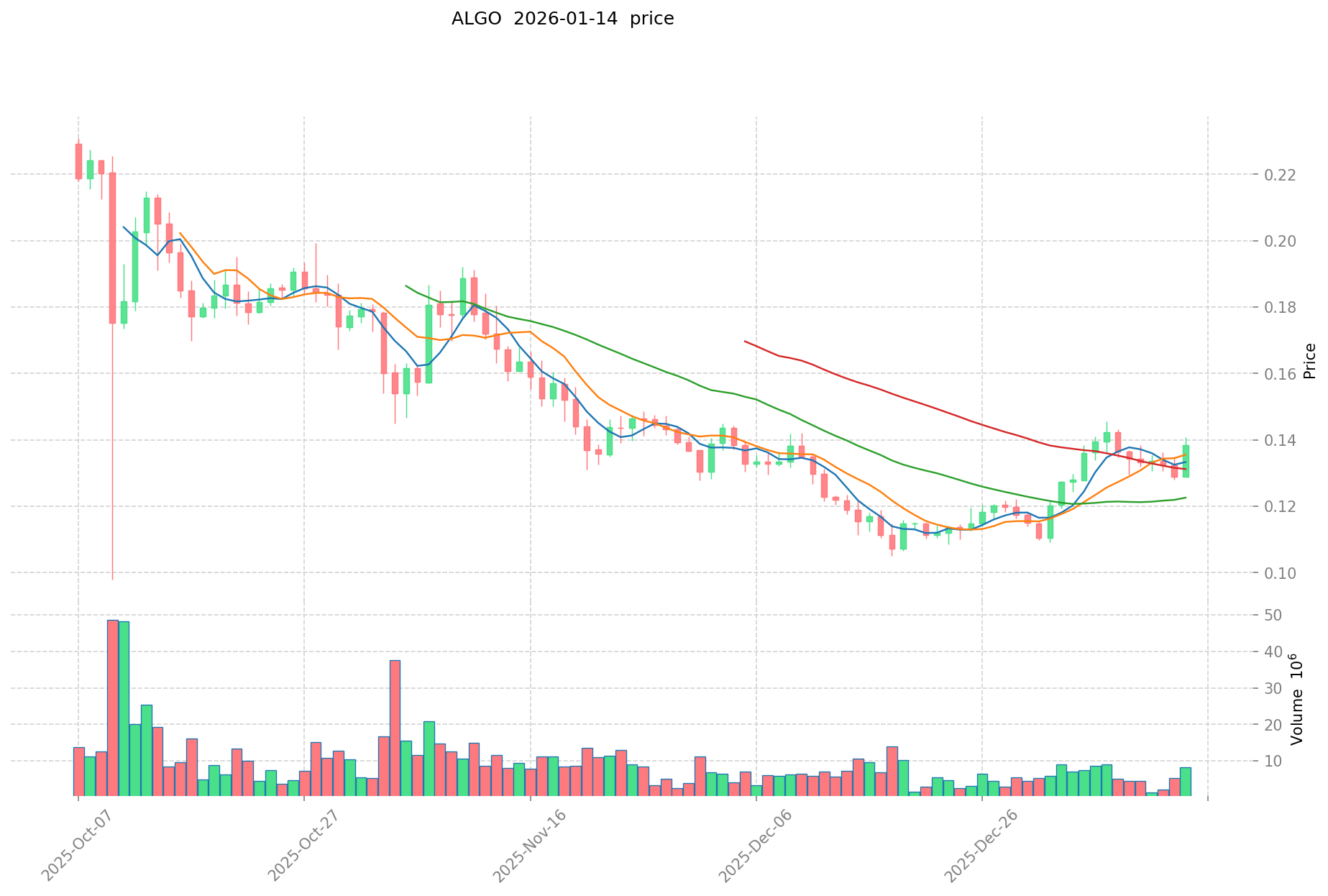
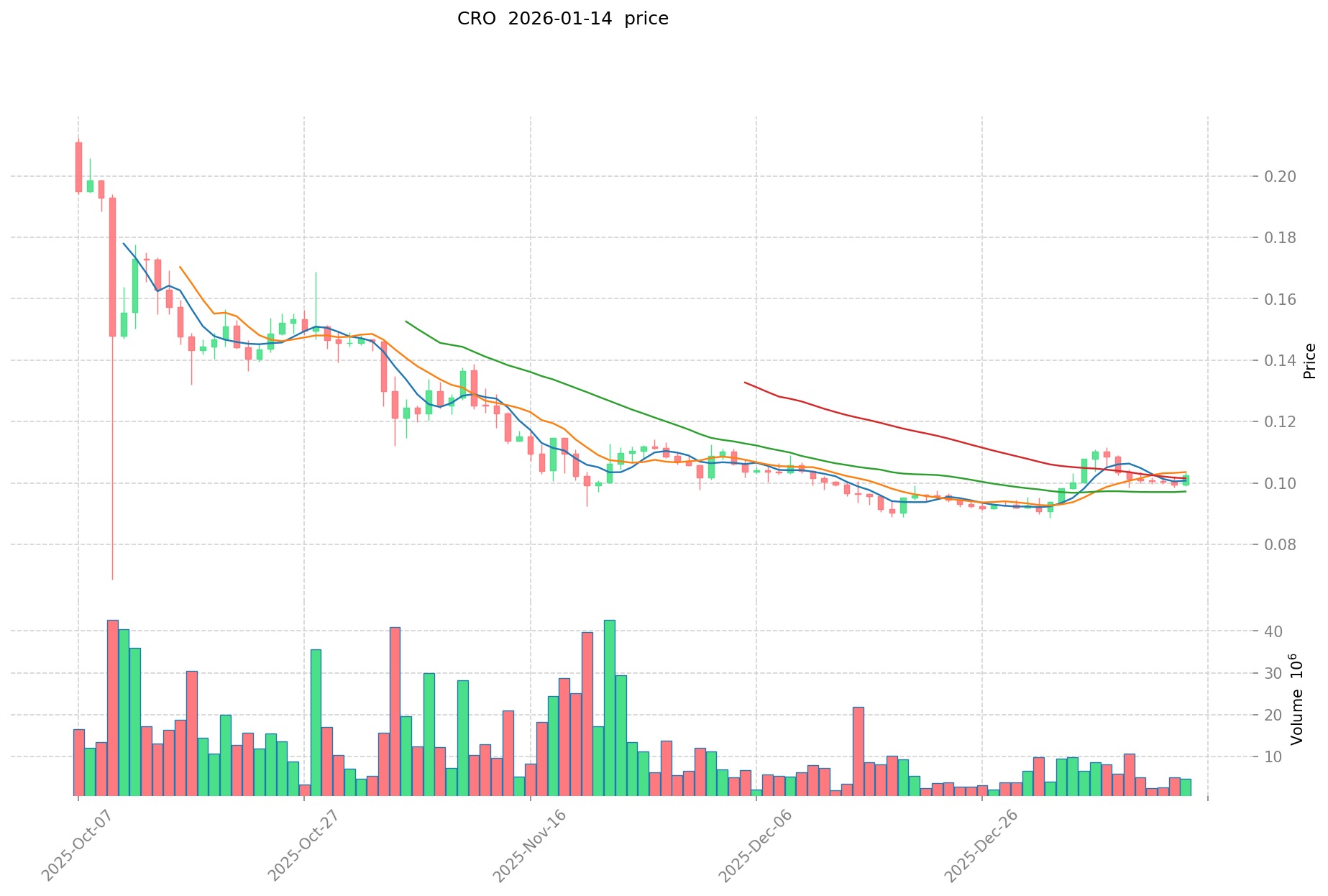
Current Market Status (January 14, 2026)
- ALGO current price: $0.13884
- CRO current price: $0.10277
- 24-hour trading volume: ALGO $1,117,735.26 vs CRO $484,753.20
- Market sentiment index (Fear & Greed Index): 26 (Fear)
- ALGO 24-hour price change: +7.79%
- CRO 24-hour price change: +3.27%
- ALGO market capitalization: $1.23 billion
- CRO market capitalization: $3.97 billion
- ALGO circulating supply: 8.85 billion tokens (88.52% of max supply)
- CRO circulating supply: 38.61 billion tokens (38.61% of max supply)
View real-time prices:
II. Core Factors Influencing ALGO vs CRO Investment Value
Supply Mechanism Comparison (Tokenomics)
- ALGO: Features a dynamic supply structure designed to support network growth and development, with mechanisms aimed at balancing circulation and ecosystem expansion.
- CRO: Implements supply management strategies that align with platform utility and market demand dynamics.
- 📌 Historical Pattern: Supply mechanisms play a role in shaping price cycles through their influence on token availability and market liquidity dynamics.
Institutional Adoption and Market Application
- Institutional Holdings: Evaluation of institutional interest requires analysis of multiple factors including technological maturity, regulatory clarity, and ecosystem development.
- Enterprise Adoption: Both ALGO and CRO have explored applications in various sectors, though specific adoption patterns vary across different use cases and geographic regions.
- National Policy: Regulatory approaches toward digital assets differ significantly across jurisdictions, influencing adoption trajectories and market accessibility.
Technology Development and Ecosystem Building
- ALGO Technology Development: The platform continues to evolve its technical infrastructure, focusing on scalability, security, and interoperability features.
- CRO Technology Development: Technology advancement centers on platform utility expansion and integration with broader financial services.
- Ecosystem Comparison: Both projects have pursued ecosystem development across DeFi, NFT, payment solutions, and smart contract implementations, with varying degrees of traction in different sectors.
Macroeconomic Factors and Market Cycles
- Performance in Inflationary Environments: Digital asset performance during inflationary periods depends on multiple variables including market sentiment, adoption trends, and broader economic conditions.
- Macroeconomic Monetary Policy: Interest rate movements and dollar index fluctuations can influence digital asset valuations through their impact on risk appetite and capital flows.
- Geopolitical Factors: Cross-border transaction demands and international developments may affect digital asset adoption patterns and market dynamics.
III. 2026-2031 Price Prediction: ALGO vs CRO
Short-term Forecast (2026)
- ALGO: Conservative $0.1350-$0.1392 | Optimistic $0.1453-$0.1963
- CRO: Conservative $0.0700-$0.1030 | Optimistic $0.1030-$0.1452
Mid-term Forecast (2028-2029)
- ALGO may enter a consolidation phase, with projected prices ranging from $0.1102 to $0.2746
- CRO may enter a growth phase, with projected prices ranging from $0.0692 to $0.1750
- Key drivers: institutional capital inflows, ETF developments, ecosystem expansion
Long-term Forecast (2030-2031)
- ALGO: Baseline scenario $0.1287-$0.2445 | Optimistic scenario $0.2445-$0.2738
- CRO: Baseline scenario $0.1494-$0.1987 | Optimistic scenario $0.1987-$0.2333
View detailed price predictions for ALGO and CRO
Disclaimer
ALGO:
| Year |
Predicted High Price |
Predicted Average Price |
Predicted Low Price |
Price Change |
| 2026 |
0.1962861 |
0.13921 |
0.1350337 |
0 |
| 2027 |
0.211362543 |
0.16774805 |
0.124133557 |
20 |
| 2028 |
0.19713750836 |
0.1895552965 |
0.149748684235 |
36 |
| 2029 |
0.2745518914506 |
0.19334640243 |
0.1102074493851 |
39 |
| 2030 |
0.255004570164927 |
0.2339491469403 |
0.128672030817165 |
68 |
| 2031 |
0.273814081578927 |
0.244476858552613 |
0.149130883717094 |
76 |
CRO:
| Year |
Predicted High Price |
Predicted Average Price |
Predicted Low Price |
Price Change |
| 2026 |
0.1452159 |
0.10299 |
0.0700332 |
0 |
| 2027 |
0.1725031005 |
0.12410295 |
0.069497652 |
20 |
| 2028 |
0.1586842370175 |
0.14830302525 |
0.1171593899475 |
44 |
| 2029 |
0.174982739492475 |
0.15349363113375 |
0.09209617868025 |
49 |
| 2030 |
0.233218223144619 |
0.164238185313112 |
0.149456748634932 |
59 |
| 2031 |
0.220588306694041 |
0.198728204228866 |
0.178855383805979 |
93 |
IV. Investment Strategy Comparison: ALGO vs CRO
Long-term vs Short-term Investment Strategies
- ALGO: May appeal to investors focused on technological infrastructure development and blockchain efficiency improvements, with consideration for ecosystem expansion potential in enterprise applications
- CRO: May appeal to investors interested in payment ecosystem integration and decentralized finance applications, with attention to platform utility expansion
Risk Management and Asset Allocation
- Conservative investors: ALGO 30-40% vs CRO 30-40% (remainder in stablecoins or other diversified assets)
- Aggressive investors: ALGO 50-60% vs CRO 40-50% (with smaller allocations to emerging opportunities)
- Hedging instruments: Stablecoin allocation, options strategies, cross-asset portfolio diversification
V. Potential Risk Comparison
Market Risks
- ALGO: Price volatility influenced by broader cryptocurrency market cycles, with historical price fluctuations demonstrating significant variability between peak and trough levels
- CRO: Market performance correlation with platform adoption rates and competitive dynamics in the exchange-affiliated token sector
Technical Risks
- ALGO: Network scalability considerations and ongoing technical development requirements for maintaining competitive positioning
- CRO: Platform dependency factors and technical infrastructure evolution needs aligned with ecosystem growth
Regulatory Risks
- Global regulatory developments affect both projects differently, with ALGO facing considerations related to blockchain infrastructure regulations and CRO facing scrutiny related to exchange-affiliated tokens and payment services frameworks across various jurisdictions
VI. Conclusion: Which Is the Better Buy?
📌 Investment Value Summary:
- ALGO advantages: Technical foundation developed by recognized cryptography expertise, focus on blockchain efficiency and scalability, established presence since 2019 with ongoing ecosystem development
- CRO advantages: Integration with established exchange platform infrastructure, access to substantial user base exceeding 100 million addressable users, partnerships with numerous application developers
✅ Investment Considerations:
- New investors: Consider starting with smaller position sizes in both assets, prioritizing education about tokenomics, supply mechanisms, and ecosystem developments before significant capital allocation
- Experienced investors: Evaluate both projects based on technical roadmap execution, ecosystem growth metrics, and alignment with broader portfolio strategy and risk tolerance
- Institutional investors: Assess regulatory clarity, liquidity depth, custody solutions, and alignment with institutional investment mandates when evaluating exposure to either asset
⚠️ Risk Disclosure: Cryptocurrency markets exhibit high volatility. This content does not constitute investment advice. Market conditions, project developments, and external factors may significantly impact asset performance. Conduct thorough independent research and consider consulting financial professionals before making investment decisions.
VII. FAQ
Q1: What are the main differences between ALGO and CRO in terms of market positioning?
ALGO focuses on blockchain infrastructure efficiency through academic cryptography leadership, while CRO emphasizes payment ecosystem integration and DeFi applications. ALGO was launched in 2019 by Turing Award winner Silvio Micali with the BA* consensus mechanism aimed at improving blockchain scalability and efficiency. In contrast, CRO has been positioned since 2018 as an exchange-affiliated token integrated with Crypto.com's platform, serving over 100 million addressable users globally and partnering with 500+ application developers focusing on decentralized finance, gaming, and payment solutions.
Q2: Which cryptocurrency has better historical price performance?
Neither has demonstrated conclusively superior performance, as both experienced significant declines from their all-time highs. ALGO reached its peak of $3.56 on June 20, 2019, shortly after launch, declining to current levels around $0.13884—a substantial correction of approximately 96%. CRO peaked at $0.965407 on November 24, 2021, falling to approximately $0.10277—representing roughly an 89% decline. However, as of January 14, 2026, ALGO showed stronger short-term momentum with a 24-hour price change of +7.79% compared to CRO's +3.27%, though past performance does not guarantee future results.
Q3: How do the supply mechanisms of ALGO and CRO differ?
ALGO has a more transparent maximum supply structure with 8.85 billion tokens currently circulating (88.52% of max supply), while CRO has 38.61 billion tokens in circulation (38.61% of max supply). ALGO features a dynamic supply structure designed to balance circulation with ecosystem expansion, implementing mechanisms that support network growth and development. CRO implements supply management strategies aligned with platform utility and market demand dynamics. The higher circulating percentage of ALGO suggests closer proximity to full dilution, while CRO maintains a larger proportion of tokens yet to enter circulation, which could impact future supply-side pressure.
Q4: What are the key risks investors should consider when comparing ALGO vs CRO?
Both assets face distinct risk profiles across market, technical, and regulatory dimensions. ALGO risks include price volatility influenced by broader cryptocurrency market cycles and network scalability considerations requiring ongoing technical development. CRO faces platform dependency factors, with performance correlation to Crypto.com adoption rates and competitive dynamics in the exchange-affiliated token sector. Regulatory risks differ significantly—ALGO confronts considerations related to blockchain infrastructure regulations, while CRO faces scrutiny related to exchange-affiliated tokens and payment services frameworks across various jurisdictions. Both exhibit high volatility characteristics inherent to cryptocurrency markets.
Q5: What are the price predictions for ALGO and CRO through 2031?
Price predictions suggest divergent trajectories with significant uncertainty ranges. For 2026, ALGO forecasts range from $0.1350-$0.1392 (conservative) to $0.1453-$0.1963 (optimistic), while CRO ranges from $0.0700-$0.1030 (conservative) to $0.1030-$0.1452 (optimistic). By 2031, ALGO predictions span $0.1287-$0.2738 depending on scenario assumptions, representing potential gains of 76% from current levels in optimistic scenarios. CRO forecasts for 2031 range from $0.1494-$0.2333, representing potential gains of 93% in optimistic scenarios. These predictions depend on multiple variables including institutional capital inflows, ETF developments, ecosystem expansion, and broader market conditions, with no guarantee of accuracy.
Q6: How should investors allocate between ALGO and CRO based on risk tolerance?
Asset allocation should align with individual risk profiles and investment horizons. Conservative investors might consider allocating 30-40% to ALGO and 30-40% to CRO, with the remainder in stablecoins or other diversified assets to manage downside risk. Aggressive investors comfortable with higher volatility might allocate 50-60% to ALGO and 40-50% to CRO, maintaining smaller positions in emerging opportunities. Risk management strategies should incorporate hedging instruments such as stablecoin allocations, options strategies for downside protection, and cross-asset portfolio diversification. New investors should prioritize education about tokenomics, supply mechanisms, and ecosystem developments before significant capital allocation, starting with smaller position sizes.
Q7: Which factors most significantly influence the investment value of ALGO versus CRO?
Several core factors differentiate investment considerations between these assets. For ALGO, key influences include technological infrastructure development led by recognized cryptography expertise, network scalability achievements, and enterprise adoption in blockchain efficiency applications. For CRO, critical factors encompass integration depth with Crypto.com platform infrastructure, user base expansion beyond 100 million addressable users, partnership development with application developers, and competitive positioning in payment and DeFi sectors. Both are affected by supply mechanism dynamics, institutional adoption patterns, regulatory clarity across jurisdictions, macroeconomic conditions including interest rate movements, and broader cryptocurrency market cycles. Investors should evaluate these factors through ongoing monitoring of ecosystem development metrics and technological roadmap execution.
Q8: What are the current market indicators suggesting about ALGO and CRO investment timing?
Current market indicators present a mixed picture for both assets. As of January 14, 2026, the Fear & Greed Index stands at 26 (Fear), indicating cautious market sentiment that historically has preceded periods of both continued decline and potential bottoming formations. ALGO demonstrates higher 24-hour trading volume ($1,117,735.26 vs CRO's $484,753.20), suggesting greater short-term liquidity and market interest. ALGO's market capitalization of $1.23 billion compared to CRO's $3.97 billion indicates different scale and potentially different risk-return profiles. Both assets have declined significantly from historical peaks, trading at approximately 96% and 89% below their all-time highs respectively. These conditions may present opportunities for value-oriented investors with appropriate risk tolerance, though market timing remains challenging and past patterns do not guarantee future performance.
* The information is not intended to be and does not constitute financial advice or any other recommendation of any sort offered or endorsed by Gate.