This comprehensive guide compares ALT and DOT as investment opportunities within the cryptocurrency market. ALT, launched in 2024, focuses on Layer 2 scaling solutions through its Restaked Rollup technology, while DOT, established in 2019, operates as multi-chain interoperability infrastructure via relay chain architecture. The article analyzes historical price trends, tokenomics, institutional adoption, technical ecosystems, and risk profiles to help investors determine suitability. Current prices show ALT at $0.01271 and DOT at $2.159 (as of January 2026). Detailed price predictions through 2031, investment allocation strategies for conservative and aggressive investors, and risk management considerations are provided. Whether you seek emerging Layer 2 infrastructure or established cross-chain solutions, this guide clarifies which asset aligns with your investment objectives and risk tolerance on Gate exchange.
Introduction: Investment Comparison Between ALT and DOT
In the cryptocurrency market, the comparison between ALT vs DOT has been a topic that investors cannot avoid. The two not only show significant differences in market cap ranking, application scenarios, and price performance, but also represent different positioning within the crypto asset landscape.
ALT (ALT): Since its launch in 2024, it has gained market recognition with its positioning as an open and decentralized protocol for rollups, providing enhanced security and interoperability through restaking mechanisms.
DOT (DOT): Launched in 2019, it has been regarded as a multi-chain interoperability infrastructure, connecting various blockchains through its relay chain architecture and facilitating trustless information exchange.
This article will comprehensively analyze the investment value comparison between ALT vs DOT around historical price trends, supply mechanisms, institutional adoption, technical ecosystems, and future predictions, attempting to answer the question that investors care most about:
"Which is the better buy right now?"
I. Historical Price Comparison and Market Status
ALT and DOT Historical Price Trends
-
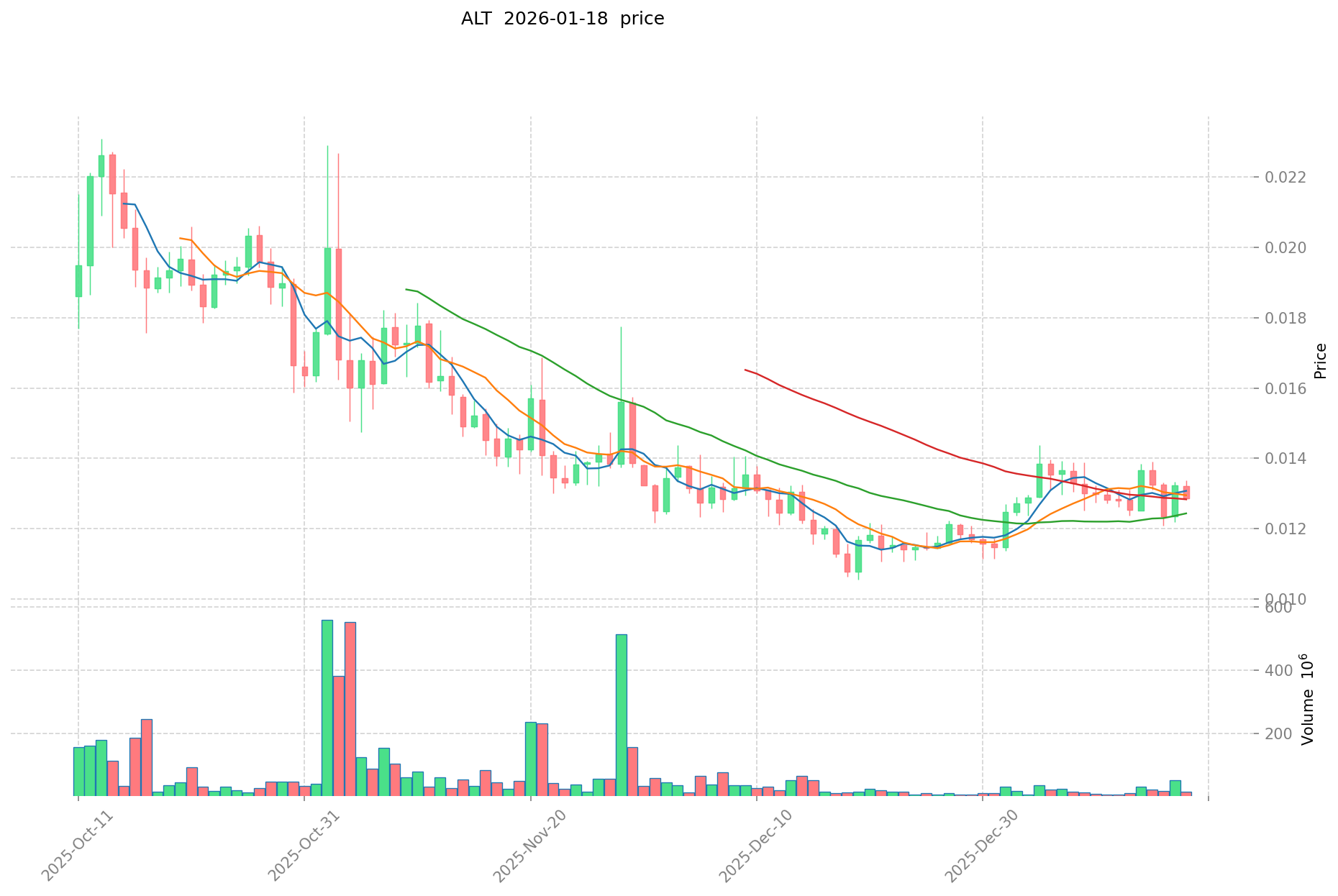
2024: ALT reached a significant price level of $0.6948 on March 27, 2024, marking a notable peak in its trading history. During this period, the token demonstrated considerable price volatility following its listing on multiple exchanges.
-
2021: DOT experienced substantial growth, reaching $54.98 on November 4, 2021, representing a major milestone during the broader cryptocurrency market expansion. The price movement reflected strong interest in interoperability solutions.
-
2025: Both assets experienced downward pressure during this period. ALT recorded a low of $0.00831 on October 10, 2025, while DOT declined to $1.66 on December 26, 2025.
-
Comparative Analysis: Throughout recent market cycles, ALT has shown higher volatility with a decline of approximately 98.17% from its peak to trough, while DOT experienced a decline of approximately 96.98% from its all-time high to its recent low.
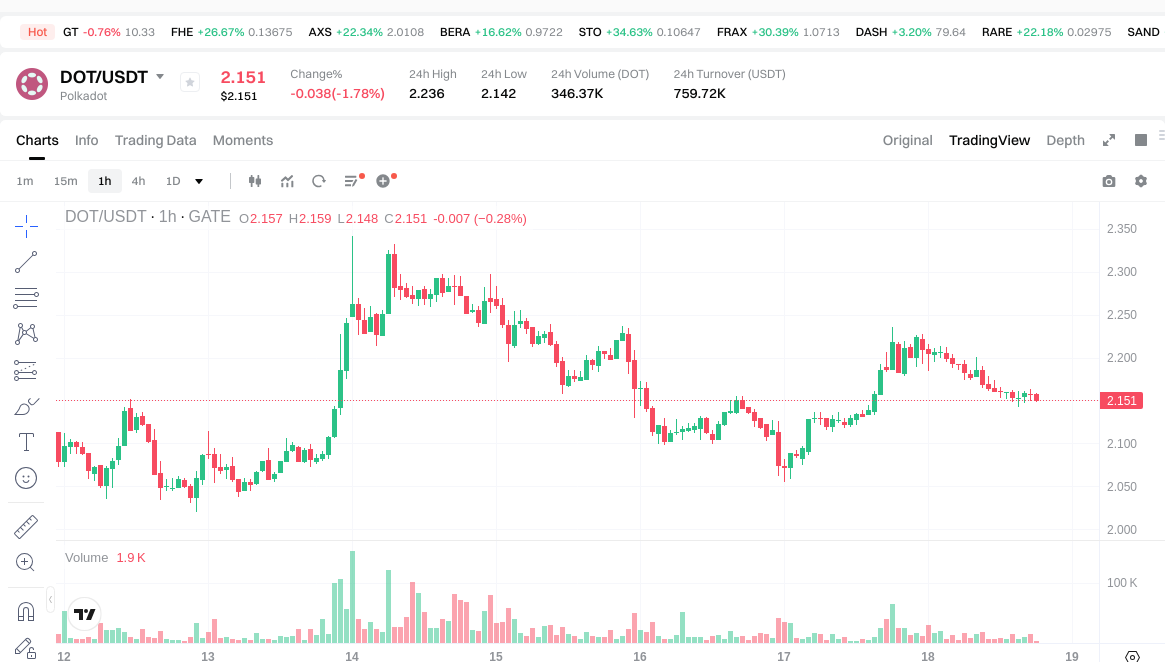
Current Market Situation (January 18, 2026)
- ALT current price: $0.01271
- DOT current price: $2.159
- 24-hour trading volume: ALT recorded $148,628.04 versus DOT's $756,992.72
- Market Sentiment Index (Fear & Greed Index): 49 (Neutral)
View real-time prices:
II. Core Factors Influencing ALT vs DOT Investment Value
Supply Mechanism Comparison (Tokenomics)
- ALT: AltLayer operates with a circulating supply of 5,204,203,154 ALT tokens. The token serves as an incentive mechanism for ecosystem participants and is used for staking and network fee payments.
- DOT: Polkadot features an inflationary supply model designed to incentivize network validators and maintain security through staking mechanisms.
- 📌 Historical Pattern: Supply mechanisms have historically influenced price cycles through token unlocks, staking rewards, and circulation adjustments that affect market liquidity.
Institutional Adoption and Market Applications
- Institutional Holdings: Market data suggests varying degrees of institutional interest, with both assets experiencing trading activity across major exchanges.
- Enterprise Adoption: ALT focuses on Layer 2 scaling solutions and rollup infrastructure for blockchain developers, while DOT emphasizes cross-chain interoperability and parachain ecosystems.
- Regulatory Landscape: Different jurisdictions maintain evolving regulatory frameworks that impact both assets' market accessibility and compliance requirements.
Technical Development and Ecosystem Building
- ALT Technical Upgrades: AltLayer introduced the "Restaked Rollup" concept, enhancing security and interoperability for existing rollup networks through its zero-code deployment solution for customized Layer 2 networks.
- DOT Technical Development: Polkadot continues developing its multi-chain architecture and parachain auction mechanism to facilitate cross-chain communication and scalability.
- Ecosystem Comparison: ALT concentrates on Layer 2 infrastructure and rollup optimization, while DOT supports diverse applications across DeFi, governance, and cross-chain interoperability use cases.
Macroeconomic Environment and Market Cycles
- Inflationary Environment Performance: Market participants consider various factors when evaluating anti-inflation characteristics, including supply dynamics and utility value.
- Macroeconomic Monetary Policy: Interest rate fluctuations and dollar strength indices historically correlate with cryptocurrency market sentiment and capital flows.
- Geopolitical Factors: Cross-border transaction requirements and international developments influence demand patterns for blockchain infrastructure and interoperability solutions.
III. 2026-2031 Price Prediction: ALT vs DOT
Short-term Forecast (2026)
- ALT: Conservative $0.007614 - $0.01269 | Optimistic $0.01269 - $0.0166239
- DOT: Conservative $1.54728 - $2.149 | Optimistic $2.149 - $2.98711
Mid-term Forecast (2028-2029)
- ALT may enter a gradual growth phase, with estimated price range of $0.011782788061275 - $0.026161783661475
- DOT may enter a consolidation and expansion phase, with estimated price range of $1.844377101 - $3.97507179006
- Key drivers: institutional capital flows, ETF developments, ecosystem expansion
Long-term Forecast (2030-2031)
- ALT: Base scenario $0.01683840297265 - $0.023066305441987 | Optimistic scenario $0.023066305441987 - $0.036463215642693
- DOT: Base scenario $2.52763274598912 - $3.59038742328 | Optimistic scenario $3.949426165608 - $5.3317253235708
View detailed price predictions for ALT and DOT
Disclaimer
Price predictions are based on historical data analysis and market modeling. Cryptocurrency markets are highly volatile and subject to various unpredictable factors. These forecasts should not be considered as investment advice. Users should conduct their own research and risk assessment before making any investment decisions.
ALT:
| Year |
Predicted High Price |
Predicted Average Price |
Predicted Low Price |
Price Change |
| 2026 |
0.0166239 |
0.01269 |
0.007614 |
0 |
| 2027 |
0.0189074655 |
0.01465695 |
0.0136309635 |
15 |
| 2028 |
0.023159446695 |
0.01678220775 |
0.01275447789 |
32 |
| 2029 |
0.026161783661475 |
0.0199708272225 |
0.011782788061275 |
57 |
| 2030 |
0.033907468999721 |
0.023066305441987 |
0.01683840297265 |
81 |
| 2031 |
0.036463215642693 |
0.028486887220854 |
0.0233592475211 |
124 |
DOT:
| Year |
Predicted High Price |
Predicted Average Price |
Predicted Low Price |
Price Change |
| 2026 |
2.98711 |
2.149 |
1.54728 |
0 |
| 2027 |
3.2871104 |
2.568055 |
2.43965225 |
19 |
| 2028 |
3.483823413 |
2.9275827 |
1.844377101 |
35 |
| 2029 |
3.97507179006 |
3.2057030565 |
2.94924681198 |
48 |
| 2030 |
4.308464907936 |
3.59038742328 |
3.3031564294176 |
66 |
| 2031 |
5.3317253235708 |
3.949426165608 |
2.52763274598912 |
83 |
IV. Investment Strategy Comparison: ALT vs DOT
Long-term vs Short-term Investment Strategies
-
ALT: May appeal to investors focusing on Layer 2 infrastructure development and rollup technology innovation. The asset's emphasis on restaking mechanisms and zero-code deployment solutions positions it within the scaling solutions sector.
-
DOT: May suit investors interested in multi-chain interoperability and cross-chain infrastructure. The relay chain architecture and parachain ecosystem represent an approach to blockchain interconnectivity.
Risk Management and Asset Allocation
-
Conservative Investors: ALT 30% vs DOT 70% - This allocation reflects consideration of DOT's longer market presence and established ecosystem compared to ALT's more recent introduction.
-
Aggressive Investors: ALT 60% vs DOT 40% - Higher allocation to ALT considers potential growth within emerging Layer 2 solutions, while maintaining exposure to DOT's interoperability infrastructure.
-
Hedging Tools: Stablecoin allocation for liquidity management, derivatives instruments for downside protection, cross-asset portfolio diversification strategies.
V. Potential Risk Comparison
Market Risk
-
ALT: Price volatility remains elevated with historical decline of approximately 98.17% from peak to trough. Limited trading history since 2024 launch provides fewer historical reference points for trend analysis.
-
DOT: Experienced decline of approximately 96.98% from all-time high, demonstrating exposure to broader market cycles. Market sentiment shifts and competitive dynamics within interoperability solutions present ongoing considerations.
Technical Risk
-
ALT: Scalability considerations for rollup infrastructure adoption, network stability as ecosystem expands, integration dependencies with existing blockchain platforms.
-
DOT: Parachain auction mechanism complexity, relay chain security maintenance requirements, cross-chain communication protocol vulnerabilities.
Regulatory Risk
- Evolving regulatory frameworks across jurisdictions affect both assets differently. ALT's Layer 2 infrastructure positioning and DOT's multi-chain architecture face distinct compliance considerations regarding network governance, token classification, and cross-border transaction regulations.
VI. Conclusion: Which Is the Better Buy?
📌 Investment Value Summary:
-
ALT Characteristics: Focuses on Layer 2 scaling solutions and restaking mechanisms, represents emerging rollup infrastructure sector, shorter market history with higher volatility patterns.
-
DOT Characteristics: Established multi-chain interoperability platform, longer operational history since 2019, relay chain architecture supporting diverse parachain applications.
✅ Investment Considerations:
-
New Investors: Consider starting with smaller position sizes, prioritize understanding underlying technology and use cases, maintain diversified portfolio approach with risk management protocols.
-
Experienced Investors: Evaluate allocation based on risk tolerance and sector exposure preferences, consider technical development roadmaps and ecosystem growth metrics, implement position sizing strategies aligned with volatility profiles.
-
Institutional Investors: Assess infrastructure maturity and regulatory compliance frameworks, evaluate liquidity depth across trading venues, consider correlation patterns with broader crypto market movements and portfolio construction objectives.
⚠️ Risk Disclaimer: Cryptocurrency markets exhibit high volatility. This content does not constitute investment advice. Users should conduct independent research and consult qualified financial advisors before making investment decisions.
VII. FAQ
Q1: What are the main differences between ALT and DOT in terms of their core technology?
ALT focuses on Layer 2 scaling solutions through its "Restaked Rollup" concept, providing zero-code deployment for customized Layer 2 networks with enhanced security via restaking mechanisms. DOT, on the other hand, operates as a multi-chain interoperability infrastructure utilizing relay chain architecture to connect various blockchains and facilitate trustless cross-chain communication through its parachain ecosystem.
Q2: How do the supply mechanisms of ALT and DOT differ?
ALT operates with a circulating supply of 5,204,203,154 tokens used for staking, network fees, and ecosystem incentives. DOT features an inflationary supply model specifically designed to incentivize network validators and maintain security through staking rewards. These distinct tokenomics approaches reflect their different operational models—ALT's focus on rollup infrastructure versus DOT's emphasis on validator-driven network security.
Q3: Which asset experienced greater price volatility from peak to trough?
ALT demonstrated higher volatility with approximately 98.17% decline from its peak of $0.6948 (March 27, 2024) to its trough of $0.00831 (October 10, 2025). DOT experienced a 96.98% decline from its all-time high of $54.98 (November 4, 2021) to its recent low of $1.66 (December 26, 2025). While both assets showed significant volatility, ALT's shorter market history and emerging technology focus contributed to slightly higher percentage swings.
Q4: What are the projected price ranges for ALT and DOT by 2030?
For 2030, ALT's base scenario projects a range of $0.01683840297265 - $0.023066305441987, with an optimistic scenario reaching $0.023066305441987 - $0.036463215642693. DOT's base scenario forecasts $2.52763274598912 - $3.59038742328, with optimistic projections of $3.949426165608 - $5.3317253235708. These estimates are based on historical data analysis and market modeling, though actual results may vary significantly due to market volatility.
Q5: How should conservative versus aggressive investors allocate between ALT and DOT?
Conservative investors might consider a 30% ALT / 70% DOT allocation, reflecting DOT's longer market presence and established ecosystem. Aggressive investors could opt for a 60% ALT / 40% DOT split, emphasizing ALT's potential growth within emerging Layer 2 solutions while maintaining DOT exposure for interoperability infrastructure. Both strategies should incorporate stablecoin reserves for liquidity management and implement appropriate risk management protocols.
Q6: What are the primary regulatory risks facing ALT and DOT?
Both assets face evolving regulatory frameworks across different jurisdictions, though their specific challenges differ. ALT's Layer 2 infrastructure positioning encounters compliance considerations regarding network governance and token classification within scaling solutions. DOT's multi-chain architecture faces distinct regulations concerning cross-border transactions, parachain governance structures, and cross-chain communication protocols. Investors should monitor regulatory developments in their respective jurisdictions.
Q7: Which asset is more suitable for institutional investors?
The suitability depends on institutional investment objectives. DOT may appeal to institutions prioritizing infrastructure maturity, longer operational history (since 2019), and established regulatory compliance frameworks. ALT might interest institutions focusing on emerging Layer 2 technologies and rollup infrastructure innovation. Institutional investors should evaluate liquidity depth across trading venues, assess correlation patterns with broader crypto markets, and consider how each asset aligns with their portfolio construction objectives and risk management requirements.
Q8: What are the key technical risks associated with each asset?
ALT faces technical risks including scalability considerations for rollup infrastructure adoption, network stability challenges as the ecosystem expands, and integration dependencies with existing blockchain platforms. DOT's technical risks involve parachain auction mechanism complexity, relay chain security maintenance requirements, and potential vulnerabilities in cross-chain communication protocols. Both assets require ongoing technical development and security audits to address these challenges.
* The information is not intended to be and does not constitute financial advice or any other recommendation of any sort offered or endorsed by Gate.