This comprehensive guide explores Bitcoin dominance decline and its implications for altcoin season timing. Analyst Matthew Hyland identifies weakening Bitcoin dominance at 59.90%, suggesting favorable conditions for altcoin rallies through technical indicators. Despite Bitcoin's recent volatility below $100,000, the market hasn't fully transitioned to altcoin season, with CoinMarketCap's index at 28/100. The article examines potential Wall Street market manipulation amid $19 billion liquidation events, while JPMorgan projects Bitcoin reaching $170,000 within 6-12 months based on deleveraging completion and gold-ratio analysis. Investors learn to identify altcoin season signals, understand investment risks, and develop strategies for trading periods when capital rotates from Bitcoin into alternative cryptocurrencies on platforms like Gate.
Crypto analyst Matthew Hyland has identified significant weakness in Bitcoin's market dominance, suggesting that the long-anticipated altcoin season may be approaching sooner than many market participants expect. This analysis comes as Bitcoin's share of the total cryptocurrency market capitalization has declined notably, creating favorable conditions for alternative cryptocurrencies to gain momentum.
Bitcoin dominance, which measures the proportion of total crypto market capitalization held by BTC, has experienced a substantial decline, dropping over 5% in a multi-month period and currently standing at approximately 59.90% according to market data. This weakening dominance pattern has historically preceded periods of strong altcoin performance, as capital flows rotate from Bitcoin into alternative cryptocurrencies seeking higher returns.
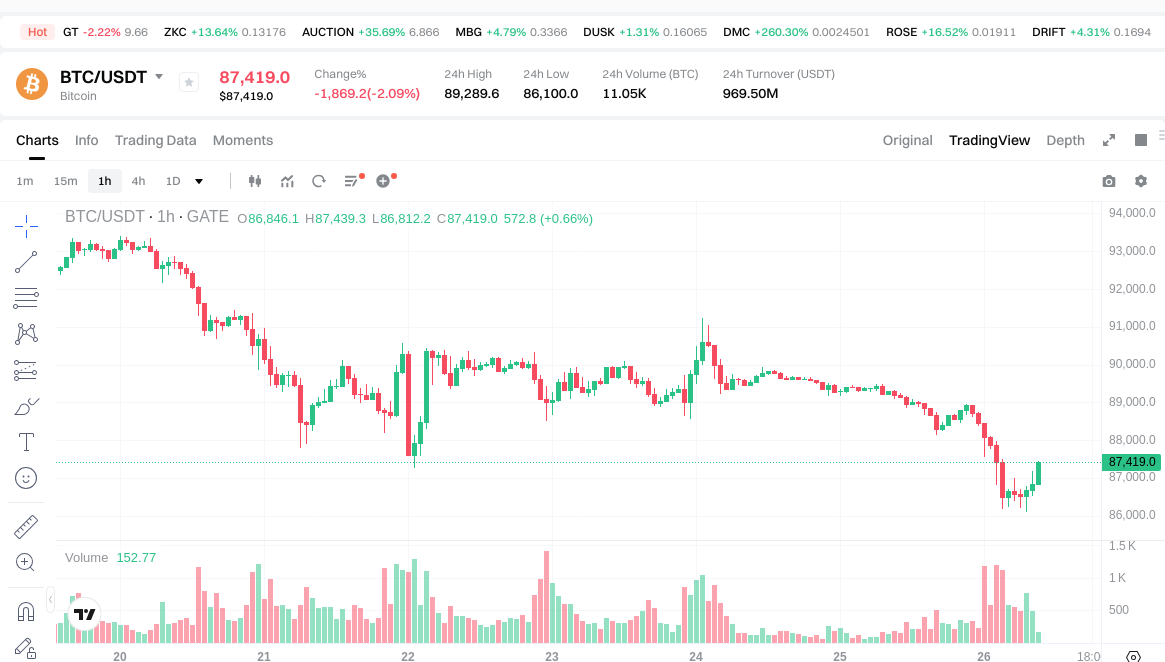
The market dynamics have been particularly interesting, with Bitcoin itself experiencing significant volatility. The world's largest cryptocurrency recently dipped below the psychologically important $100,000 threshold for the first time in several months before recovering to trade around $102,090. Despite this modest rebound, Bitcoin has declined approximately 15.6% over an extended period, contributing to subdued sentiment across the broader cryptocurrency market.
Hyland emphasized his conviction in the upcoming altcoin rally by pointing to technical indicators on the Bitcoin dominance chart. "The reason why you should have confidence in the altcoin price action is because the BTC Dominance chart looks bearish and has looked bearish for many weeks," Hyland stated in his analysis. He further elaborated that "the downtrend is favorable to continue; therefore, this relief rally has been a dead cat bounce in a downtrend."
However, it's important to note that despite these bearish signals for Bitcoin dominance, the broader market has not yet fully transitioned into altcoin season. CoinMarketCap's Altcoin Season Index currently registers at 28 out of 100, firmly within "Bitcoin Season" territory. This indicates that capital remains predominantly concentrated around Bitcoin rather than flowing into alternative cryptocurrencies. The index last flipped into "Altcoin Season" territory in late 2024, shortly after Bitcoin reached an all-time high of $125,100, but that optimism proved short-lived.
Market analysts increasingly believe that the next altcoin season, when it arrives, will differ substantially from the euphoric bull runs witnessed in 2017 and 2021. The current market structure, regulatory environment, and investor sophistication suggest a more selective and measured altcoin rally, where quality projects with strong fundamentals may outperform rather than the broad-based gains seen in previous cycles.
Analyst Claims Wall Street May Be Behind Market Volatility
Beyond the technical analysis of Bitcoin dominance, Hyland has put forward a controversial theory regarding the source of the market's volatility. In his detailed market commentary, he suggested that the price swings observed in the cryptocurrency market may not be entirely organic or driven by retail investor sentiment alone.
"Over an extended period, I've kind of just maintained the view that a lot of this was really just manipulation, essentially for Wall Street to set themselves up," Hyland explained in his analysis. This perspective suggests that institutional players, including traditional Wall Street financial institutions, may be strategically positioning themselves in the cryptocurrency market through deliberate price manipulation.
The theory of institutional manipulation gains some credence when considering the timing and magnitude of recent market moves. The cryptocurrency market experienced one of its largest liquidation events in history during late 2024, when approximately $19 billion in leveraged positions were wiped out in a single day. This event, followed by a smaller but still significant liquidation wave triggered by a major protocol exploit, demonstrates the market's vulnerability to coordinated selling pressure.
Institutional involvement in cryptocurrency markets has grown substantially, with major financial institutions now offering crypto trading services, custody solutions, and investment products. This increased institutional presence has brought greater liquidity to the market but has also introduced new dynamics that differ from the retail-driven volatility of earlier crypto market cycles. The sophisticated trading strategies employed by institutional players, including algorithmic trading and derivatives manipulation, can create price movements that appear disconnected from fundamental factors.
The shift toward institutional dominance has also been evident in the behavior of Bitcoin spot ETFs, which have seen varying flows of capital. While redemptions from these products have remained modest compared to the substantial inflows witnessed during their initial launch period, the pattern of institutional investment suggests strategic positioning rather than panic selling. This measured approach by institutional investors contrasts with the more emotional trading patterns typically associated with retail participants.
JPMorgan Predicts Bitcoin Could Reach $170K Within Extended Timeframe
Adding an optimistic counterpoint to concerns about market manipulation and volatility, major financial institution JPMorgan has issued a bullish long-term forecast for Bitcoin. The bank's strategists, led by Nikolaos Panigirtzoglou, project that Bitcoin could climb to approximately $170,000 within a six to twelve month timeframe, representing a substantial increase from current price levels.
This optimistic projection is based on several key factors that JPMorgan's analysts believe have improved the fundamental outlook for Bitcoin. Primarily, the bank notes that the cryptocurrency market has completed what they term the "perpetual futures deleveraging phase." This technical development is significant because excessive leverage in derivatives markets had been identified as a major source of volatility and downside risk for Bitcoin prices.
The analysts observed that Bitcoin markets have largely stabilized following the historic liquidation events that occurred in late 2024. Open interest in Bitcoin perpetual futures, a key metric for measuring leverage in the cryptocurrency market, has returned to historical norms that existed before the period of excessive speculation. "The message from the stabilization observed in the market is that deleveraging in perpetual futures is likely behind us," the JPMorgan team wrote in their research note.
JPMorgan's methodology for arriving at the $170,000 price target involves comparing Bitcoin to gold, the traditional store of value asset. The bank's strategists have identified an improving volatility ratio between Bitcoin and gold, which has fallen below 2.0. This declining volatility ratio suggests that Bitcoin is becoming relatively more stable compared to gold, potentially making it more attractive to institutional investors seeking portfolio diversification.
The bank's calculation methodology is based on the premise that Bitcoin should capture a portion of private-sector gold investments, which are currently valued at approximately $6.2 trillion globally. For Bitcoin's market capitalization to align proportionally with gold investments, accounting for the volatility differential, Bitcoin would need to appreciate roughly 67% from current levels. This calculation yields a fair value estimate near $170,000 per Bitcoin.
Importantly, JPMorgan's analysts emphasized that they view perpetual futures markets as the key gauge of cryptocurrency market health, rather than traditional futures contracts or ETF activity. This focus on perpetual futures reflects the reality that these instruments have become the dominant venue for price discovery and leverage in the cryptocurrency market, particularly among sophisticated traders and institutional participants.
The bank's bullish outlook stands in interesting contrast to concerns about market manipulation and the challenges facing altcoins. It suggests that while short-term volatility and market dynamics may be influenced by various factors including institutional positioning, the longer-term fundamental case for Bitcoin remains intact. The completion of the deleveraging process and improving volatility characteristics could create a more stable foundation for sustained price appreciation.
As traders and investors navigate this complex market environment, they are closely monitoring Bitcoin dominance trends for signals of capital rotation into altcoins. The interplay between institutional positioning, technical indicators, and fundamental factors will likely determine whether the anticipated altcoin season materializes and how it compares to previous cycles of alternative cryptocurrency outperformance.
FAQ
What is Bitcoin Dominance (BTC Dominance) and how is it calculated?
Bitcoin Dominance measures Bitcoin's market cap as a percentage of total cryptocurrency market cap. It's calculated by dividing Bitcoin's market capitalization by the entire crypto market cap, then multiplying by 100. A declining dominance typically suggests capital flowing into altcoins, potentially signaling altcoin season.
Bitcoin dominance decline typically signals what market signal?
Bitcoin dominance breakdown signals potential altcoin season arrival. When BTC dominance drops, capital often rotates into altcoins, indicating increased market risk appetite and potential altcoin rallies ahead.
How to identify the arrival of altcoin season?
Watch for Bitcoin dominance declining below 50%, altcoin trading volume surging, and alternative tokens outperforming Bitcoin consistently. When institutional interest broadens beyond Bitcoin and retail FOMO enters altcoins, altcoin season typically accelerates.
During altcoin season, Layer 1 blockchains, DeFi tokens, and emerging utility projects typically outperform. Small-cap altcoins with strong community support and technological innovation often see the highest returns, particularly those addressing real use cases and gaining increased trading volume.
What risks should I pay attention to when investing in altcoins when Bitcoin dominance declines?
When Bitcoin dominance drops, altcoins face increased volatility and liquidity risks. Market sentiment shifts rapidly, causing sharp price swings. Many altcoins lack fundamental value, making them susceptible to manipulation. Additionally, regulatory uncertainty and increased competition intensify downside pressure during market corrections.
What are historical cases of significant Bitcoin dominance decline? What were the final outcomes?
Bitcoin dominance dropped sharply in 2017-2018 and 2021, triggering altcoin rallies. In 2018, it fell from 65% to 33%, but recovered as altcoins collapsed. In 2021, it declined to 38%, then rebounded to 65%. These cycles typically end with Bitcoin dominance recovering as markets mature and consolidate.
How to develop a reasonable investment strategy and risk management plan during altcoin season?
Diversify across promising altcoins with strong fundamentals. Set clear entry and exit points, allocate only a portion of your portfolio to high-risk assets. Use dollar-cost averaging to reduce timing risk. Monitor market sentiment and technical indicators closely. Establish stop-loss levels and take-profit targets. Rebalance regularly to lock in gains and manage exposure during volatile altcoin rallies.
* The information is not intended to be and does not constitute financial advice or any other recommendation of any sort offered or endorsed by Gate.