This comprehensive guide compares ApeCoin (APE) and Avalanche (AVAX) as investment assets, examining their distinct value propositions within the cryptocurrency ecosystem. APE functions as a governance token for NFT communities like Bored Ape Yacht Club, while AVAX operates as infrastructure for a multi-chain smart contract platform with deflationary tokenomics and EVM compatibility. Currently trading at $0.213 and $13.72 respectively, both tokens have declined significantly from 2021-2022 peaks, though AVAX demonstrates stronger market establishment with higher liquidity and institutional adoption patterns. The analysis projects APE ranging $0.235-$0.403 by 2031 and AVAX reaching $12.4-$28.4, while offering tailored investment strategies for conservative, aggressive, and institutional participants. Critical risk factors include APE's high volatility and NFT market dependency versus AVAX's technical complexity, with both facing evolving regulatory frameworks affecting broader cryptocurrency participation.
Introduction: APE Investment Value, Price Prediction, and Risk Analysis
ApeCoin (APE) has emerged as a notable digital asset in the cryptocurrency market since its launch in March 2022. As of January 16, 2026, APE is ranked #240 by market capitalization with a current price of $0.213, representing a significant decline from its all-time high of $26.7 recorded in April 2022.
APE serves as the native governance token for the APE ecosystem, which includes prominent NFT communities such as Bored Ape Yacht Club (BAYC) and Mutant Ape Yacht Club (MAYC). The token operates as a decentralized protocol layer, empowering community-driven initiatives and cultural development in the metaverse space. Managed by ApeCoin DAO and supported by the Ape Foundation, APE holders participate in ecosystem governance through a decentralized voting mechanism.
With a circulating supply of 908.66 million tokens out of a maximum supply of 1 billion, APE currently has a circulation ratio of approximately 90.87%. The token has experienced considerable price volatility, with recent performance showing a 24-hour decrease of 5.42% and a one-year decline of 80.17%. The project maintains presence across 58 exchanges and has attracted over 185,000 holders.
This analysis examines APE's investment characteristics, including price trends, supply dynamics, ecosystem development, and associated risk factors, providing investors with an objective assessment of the token's current market position and potential considerations for investment decisions.
"Understanding both opportunities and risks is essential for informed cryptocurrency investment decisions."
I. Historical Price Comparison and Current Market Status
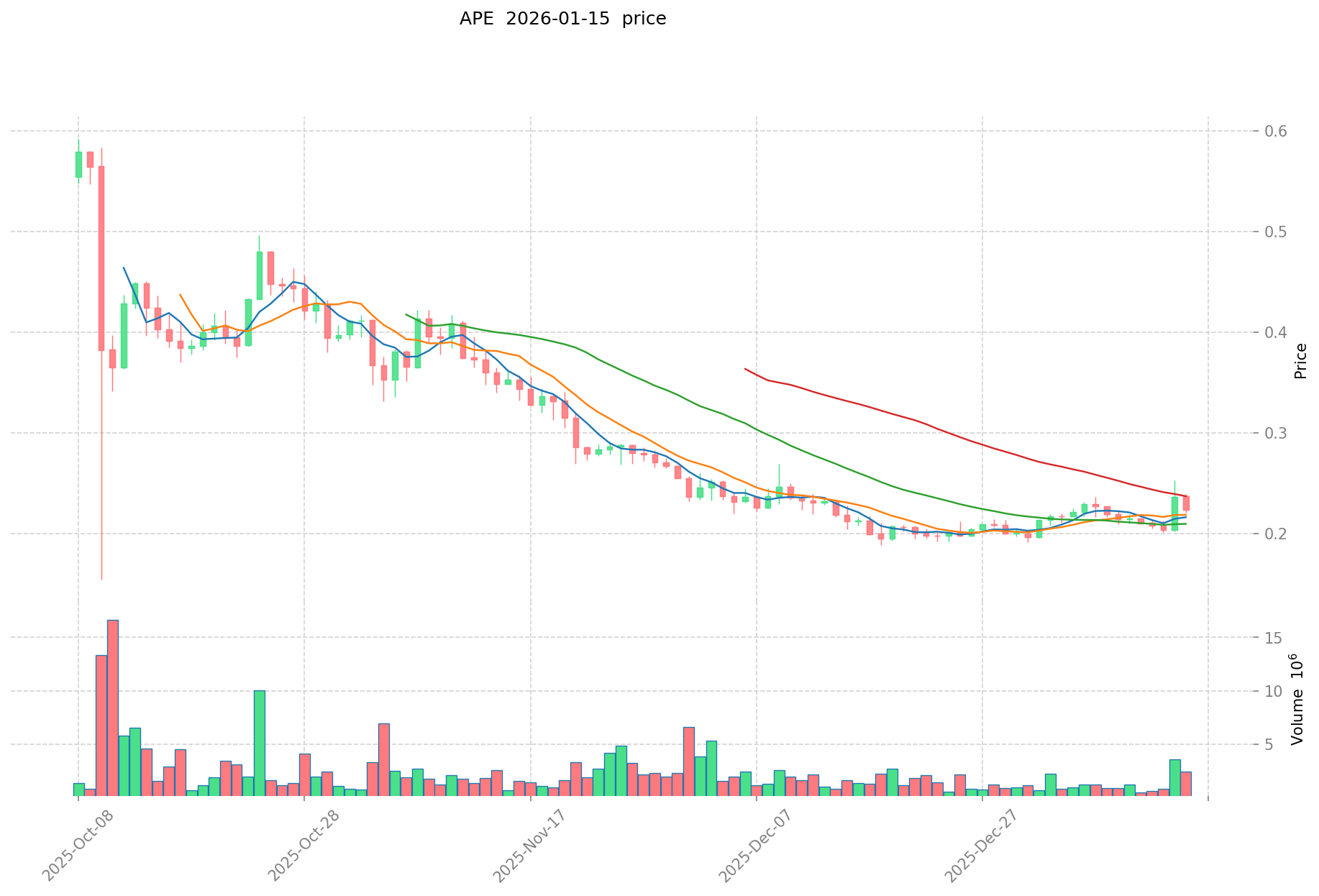
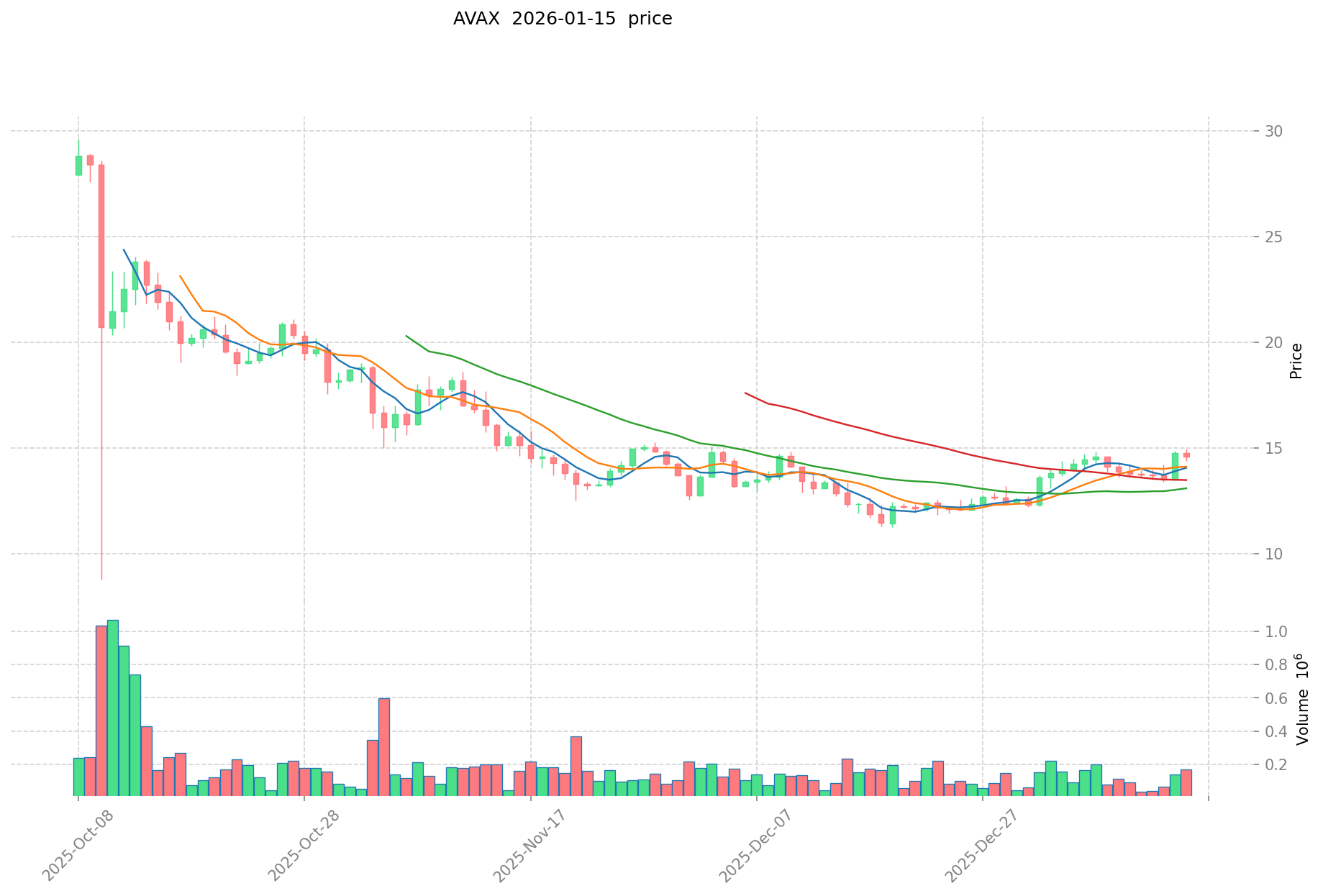
ApeCoin (APE) and Avalanche (AVAX) Historical Price Trends
- 2022: APE reached its all-time high of $26.7 in April 2022, coinciding with the peak of NFT market enthusiasm and the Bored Ape Yacht Club ecosystem expansion.
- 2021: AVAX achieved its all-time high of $144.96 in November 2021, driven by the broader crypto market rally and increasing adoption of its smart contract platform.
- Comparative Analysis: During the 2022-2025 market cycle, APE declined from its peak of $26.7 to a low of $0.180437 (recorded in October 2025), representing a significant correction. In contrast, AVAX fell from $144.96 to $2.8 (recorded in December 2020), though its current price shows relatively stronger recovery momentum compared to APE's position relative to its historical high.
Current Market Status (January 16, 2026)
- APE Current Price: $0.213
- AVAX Current Price: $13.72
- 24-Hour Trading Volume: APE $358,540.89 vs AVAX $2,180,641.38
- Market Sentiment Index (Fear & Greed Index): 61 (Greed)
View Real-Time Prices:
II. Core Factors Influencing APE vs AVAX Investment Value
Supply Mechanism Comparison (Tokenomics)
- APE: The reference materials do not provide specific details about APE's supply mechanism or tokenomics model.
- AVAX: Features a maximum supply cap of 720 million tokens. The minting speed is controlled by AVAX holders through voting mechanisms, allowing the community to adjust the rate of new token creation for block rewards. Transaction fees are burned (removed from circulation), creating a deflationary pressure over time. Users vote on transaction fee structures, which may vary based on network congestion and transaction types.
- 📌 Historical Pattern: AVAX's deflationary burn mechanism and community-governed supply adjustments may contribute to potential scarcity effects during periods of high network activity.
Institutional Adoption and Market Applications
- Institutional Holdings: Reference materials indicate growing institutional interest in the crypto space broadly, with analysts noting sustained institutional engagement as a bullish factor. Materials suggest projects with strong team backgrounds and significant funding from leading institutions tend to gain market traction.
- Enterprise Adoption: Materials note that alternative Layer 1 networks, including those like Avalanche, have attracted substantial capital from hedge funds and institutions betting on future success. The EVM compatibility of some platforms facilitates cross-chain deployment and potential enterprise use cases.
- Regulatory Environment: Senate hearings on crypto market structure legislation have been noted as reducing uncertainty in the sector, though specific country-by-country policies for APE or AVAX are not detailed in the materials.
Technology Development and Ecosystem Building
- APE Technology: The reference materials provide limited specific information about APE's technical upgrades or development roadmap.
- AVAX Technology: Operates through a three-chain architecture: Exchange Chain (X-Chain) for creating and exchanging AVAX tokens and digital assets, with transaction fees paid in AVAX using the Avalanche consensus protocol. The platform emphasizes faster and cheaper smart contract execution compared to some competitors. As of 2024, AVAX consistently ranks around 11th by market cap and daily trading volume, supporting multiple DeFi applications, liquidity mining, and other programs.
- Ecosystem Comparison: Materials indicate that alternative L1 networks like Avalanche have been developing DeFi ecosystems with EVM compatibility, potentially enabling cross-chain DApp deployment. The NFT market presence is mentioned for various platforms, though specific comparative metrics between APE and AVAX ecosystems are not provided in detail.
Macroeconomic Environment and Market Cycles
- Performance in Inflationary Environments: Reference materials suggest that smart contract platforms may have different value propositions during various economic conditions, though specific inflation-hedging characteristics are not detailed for either token.
- Macroeconomic Monetary Policy: Materials note that factors such as interest rates and the US dollar index influence crypto assets broadly, though token-specific impacts on APE versus AVAX are not explicitly compared.
- Geopolitical Factors: Cross-border transaction demands and international developments affect the broader crypto market sentiment. Materials indicate that projects with clear logic, strong market recognition, and ability to capture new crypto market participants tend to perform better during various market phases.
III. 2026-2031 Price Forecast: APE vs AVAX
Short-term Forecast (2026)
- APE: Conservative $0.13237 - $0.2135 | Optimistic $0.2135 - $0.249795
- AVAX: Conservative $10.32 - $13.76 | Optimistic $13.76 - $14.9984
Mid-term Forecast (2028-2029)
- APE may enter a consolidation phase with projected price range of $0.146586538 - $0.367251630025
- AVAX may enter an expansion phase with projected price range of $9.85118992 - $25.418453346
- Key drivers: institutional capital inflows, ETF developments, ecosystem growth
Long-term Forecast (2030-2031)
- APE: Baseline scenario $0.235066630419731 - $0.3341387781375 | Optimistic scenario $0.350845717044375 - $0.403472574601031
- AVAX: Baseline scenario $12.411265914333 - $22.123468653 | Optimistic scenario $24.3358155183 - $28.472904156411
View detailed price predictions for APE and AVAX
Disclaimer
Price predictions are based on historical data analysis and market trends. Cryptocurrency markets are highly volatile and subject to numerous unpredictable factors. These forecasts should not be considered as investment advice. Past performance does not guarantee future results.
APE:
| Year |
Predicted High Price |
Predicted Average Price |
Predicted Low Price |
Price Change |
| 2026 |
0.249795 |
0.2135 |
0.13237 |
0 |
| 2027 |
0.29187585 |
0.2316475 |
0.20848275 |
8 |
| 2028 |
0.3402901775 |
0.261761675 |
0.146586538 |
22 |
| 2029 |
0.367251630025 |
0.30102592625 |
0.2378104817375 |
41 |
| 2030 |
0.36755265595125 |
0.3341387781375 |
0.3074076758865 |
56 |
| 2031 |
0.403472574601031 |
0.350845717044375 |
0.235066630419731 |
64 |
AVAX:
| Year |
Predicted High Price |
Predicted Average Price |
Predicted Low Price |
Price Change |
| 2026 |
14.9984 |
13.76 |
10.32 |
0 |
| 2027 |
17.398832 |
14.3792 |
12.366112 |
4 |
| 2028 |
21.76795192 |
15.889016 |
9.85118992 |
15 |
| 2029 |
25.418453346 |
18.82848396 |
10.5439510176 |
37 |
| 2030 |
26.5481623836 |
22.123468653 |
15.4864280571 |
61 |
| 2031 |
28.472904156411 |
24.3358155183 |
12.411265914333 |
77 |
IV. Investment Strategy Comparison: APE vs AVAX
Long-term vs Short-term Investment Strategies
-
APE: May appeal to investors focused on NFT ecosystem participation and community-driven governance models. The token's connection to established NFT communities like Bored Ape Yacht Club provides exposure to cultural and metaverse-related developments. Given the current significant distance from historical highs, some investors may view this as a speculative long-term positioning opportunity, though substantial recovery remains uncertain.
-
AVAX: May suit investors seeking exposure to smart contract platform development and DeFi ecosystem growth. The three-chain architecture and EVM compatibility position AVAX as a technical infrastructure play. The deflationary burn mechanism and community governance features may attract those interested in supply dynamics and platform utility beyond speculative positioning.
Risk Management and Asset Allocation
-
Conservative Investors: A cautious approach might consider AVAX allocation at a higher proportion given its more established technical infrastructure and broader institutional interest patterns noted in materials. A potential framework could examine AVAX-weighted positions (example range: 60-70% AVAX, 30-40% APE or alternative assets) for those seeking platform infrastructure exposure with some NFT ecosystem participation.
-
Aggressive Investors: Those with higher risk tolerance exploring speculative opportunities might consider more balanced or APE-weighted allocations, given the token's significant distance from historical price levels. However, such strategies carry substantial risk given the 80.17% one-year decline noted in materials. Example exploratory ranges might include 40-50% APE, 50-60% AVAX, adjusted based on individual risk parameters.
-
Hedging Tools: Diversification strategies may include stablecoin reserves for market volatility management, derivative instruments where available and appropriate for investor sophistication levels, and cross-asset positioning across different cryptocurrency categories to reduce concentration risk.
V. Potential Risk Comparison
Market Risk
-
APE: The token has demonstrated high volatility with a 24-hour decrease of 5.42% and one-year decline of 80.17% as noted in reference materials. Price movements appear closely correlated with NFT market sentiment and the broader performance of digital collectibles sectors. The significant distance from the April 2022 all-time high of $26.7 to the current $0.213 level indicates substantial market correction risk materialized historically.
-
AVAX: While specific recent volatility metrics for AVAX are not detailed in materials, the token's price movement from historical highs of $144.96 to current levels of $13.72 reflects broader smart contract platform market cycles. Materials indicate AVAX maintains rankings around 11th by market capitalization, suggesting relatively established market positioning compared to APE's #240 ranking, though this does not eliminate volatility exposure.
Technology Risk
-
APE: Reference materials provide limited information about specific technical infrastructure or development roadmap details for APE. The token functions primarily as a governance mechanism for the APE ecosystem rather than as the foundation for technical platform operations, which may present different risk profiles compared to infrastructure-layer protocols.
-
AVAX: The three-chain architecture (X-Chain, C-Chain, P-Chain) creates technical complexity that requires ongoing maintenance and coordination. Network stability depends on validator participation and consensus protocol performance. Materials note the platform emphasizes faster and cheaper smart contract execution, though specific technical vulnerability assessments or network stability incidents are not detailed in the provided references.
Regulatory Risk
- Materials indicate that Senate hearings on crypto market structure legislation have been noted as potentially reducing uncertainty in the sector broadly. However, specific regulatory frameworks affecting APE versus AVAX differently are not detailed in reference materials. Both tokens face general cryptocurrency regulatory considerations including classification questions (utility vs security), tax treatment variations across jurisdictions, and evolving compliance requirements for exchanges and custodians. The NFT-focused nature of APE's ecosystem may encounter different regulatory scrutiny compared to AVAX's smart contract platform positioning, though specific policy distinctions are not provided in materials.
VI. Conclusion: Which Is the Better Buy?
📌 Investment Value Summary:
-
APE Characteristics: Connected to established NFT communities (BAYC, MAYC) providing cultural brand recognition; governance token structure enabling community participation in ecosystem decisions; approximately 90.87% of maximum supply already in circulation; significant distance from historical price peaks may represent speculative positioning for some risk-tolerant investors, though recovery prospects remain uncertain.
-
AVAX Characteristics: Technical infrastructure supporting DeFi applications with three-chain architecture; deflationary token economics through fee burning mechanism; EVM compatibility facilitating cross-chain development; maintains more established market capitalization ranking; community governance over supply and fee structures; broader platform utility beyond single-use case focus.
✅ Investment Considerations:
-
Newer Participants: Those new to cryptocurrency markets may benefit from focusing on understanding fundamental differences between governance tokens (like APE) and platform infrastructure tokens (like AVAX) before allocation decisions. Starting with smaller position sizes across diversified holdings and prioritizing education about tokenomics, use cases, and risk factors may provide foundational experience.
-
Experienced Participants: Investors with established cryptocurrency knowledge might evaluate whether their portfolio objectives align more closely with NFT ecosystem exposure (APE) or smart contract platform infrastructure (AVAX). Consideration of existing portfolio concentrations, risk tolerance levels, and investment time horizons may inform allocation approaches. Both tokens present distinct risk-return profiles requiring individual assessment.
-
Institutional Participants: Materials indicate growing institutional interest in crypto assets broadly, with particular attention to projects demonstrating clear utility, strong development teams, and significant backing. AVAX's technical infrastructure positioning and noted institutional capital flows into alternative Layer 1 networks may align with some institutional mandate parameters. APE's governance focus and NFT ecosystem connections present different institutional consideration factors not extensively detailed in materials.
⚠️ Risk Disclosure: Cryptocurrency markets demonstrate high volatility characteristics. Price predictions are based on historical analysis and do not guarantee future performance. This content does not constitute investment advice. Participants should conduct independent research and consider their financial circumstances before making investment decisions.
VII. FAQ
Q1: What are the primary differences between APE and AVAX as investment assets?
APE functions as a governance token for NFT-focused communities (BAYC, MAYC), while AVAX operates as an infrastructure token for a multi-chain smart contract platform. APE's value proposition centers on community participation in metaverse and cultural initiatives, with approximately 90.87% of its 1 billion token maximum supply already circulating. In contrast, AVAX supports a broader technical ecosystem with a three-chain architecture (X-Chain, C-Chain, P-Chain), deflationary fee burning mechanism, and EVM compatibility enabling DeFi application development. AVAX maintains a market cap ranking around 11th position compared to APE's #240 ranking, suggesting different levels of market establishment and liquidity depth.
Q2: How have APE and AVAX performed relative to their historical peaks?
APE currently trades at $0.213, representing a decline of approximately 99.2% from its April 2022 all-time high of $26.7, with a one-year performance showing an 80.17% decrease. AVAX trades at $13.72, down approximately 90.5% from its November 2021 peak of $144.96. While both tokens have experienced significant corrections from historical highs, AVAX demonstrates relatively stronger price recovery momentum and maintains higher market capitalization rankings. The 24-hour trading volume comparison shows AVAX at $2,180,641.38 versus APE's $358,540.89, indicating substantially different liquidity profiles between the two assets.
Q3: What are the projected price ranges for APE and AVAX through 2031?
Short-term 2026 forecasts project APE in a conservative range of $0.13237-$0.2135 and optimistic range of $0.2135-$0.249795. For long-term 2031 projections, APE's baseline scenario estimates $0.235066630419731-$0.3341387781375, with optimistic scenarios reaching $0.350845717044375-$0.403472574601031. AVAX shows short-term 2026 projections of $10.32-$13.76 (conservative) and $13.76-$14.9984 (optimistic), extending to 2031 baseline estimates of $12.411265914333-$22.123468653 and optimistic scenarios of $24.3358155183-$28.472904156411. These forecasts reflect historical data analysis but should not be interpreted as guaranteed outcomes given cryptocurrency market volatility and unpredictable factors.
Q4: Which token presents greater risk exposure for investors?
Both tokens carry substantial but different risk profiles. APE demonstrates higher historical volatility with a 5.42% 24-hour decrease and 80.17% one-year decline, closely correlated with NFT market sentiment fluctuations. Its lower market capitalization ranking (#240) and smaller trading volume indicate potentially lower liquidity and higher price impact risk. AVAX presents technical infrastructure complexity risks through its three-chain architecture requiring ongoing validator coordination and network stability maintenance. However, AVAX's higher market cap ranking, broader institutional interest patterns, and deflationary tokenomics may suggest relatively more established market positioning. Neither token eliminates market risk exposure, and both face evolving regulatory considerations affecting the broader cryptocurrency sector.
Q5: What allocation strategies might suit different investor profiles?
Conservative investors exploring platform infrastructure exposure might examine AVAX-weighted positions (example range: 60-70% AVAX, 30-40% alternative assets) given its technical foundation and institutional interest patterns noted in materials. Aggressive investors with higher risk tolerance exploring speculative opportunities might consider more balanced allocations (example: 40-50% APE, 50-60% AVAX), though APE's 80.17% one-year decline indicates substantial risk materialization. Newer participants may benefit from smaller initial positions across diversified holdings while prioritizing education about tokenomics differences between governance tokens versus infrastructure tokens. All allocation approaches should incorporate stablecoin reserves for volatility management and reflect individual risk tolerance, investment time horizons, and existing portfolio concentrations.
Q6: How do supply mechanisms differ between APE and AVAX, and what are the implications?
APE has a maximum supply of 1 billion tokens with approximately 90.87% (908.66 million) already in circulation, though specific minting schedule details are not extensively documented in available materials. AVAX features a maximum supply cap of 720 million tokens with community-governed minting speed controlled through holder voting mechanisms. AVAX's transaction fee burning creates deflationary pressure by removing fees from circulation, potentially contributing to scarcity effects during high network activity periods. The user-voted fee structures allow community adjustment based on network congestion and transaction types. These supply mechanism differences suggest AVAX incorporates more explicit deflationary economics through burn mechanisms, while APE's high existing circulation ratio (90.87%) indicates limited remaining supply expansion potential.
Q7: What role does institutional adoption play in the comparative investment thesis?
Materials indicate growing institutional interest in cryptocurrency assets broadly, with particular focus on projects demonstrating clear utility, strong development teams, and significant institutional backing. Alternative Layer 1 networks like Avalanche have attracted substantial capital from hedge funds and institutions, with AVAX's EVM compatibility facilitating cross-chain deployment potentially appealing to enterprise use cases. Institutional adoption patterns appear more prominently associated with technical infrastructure platforms (like AVAX) compared to governance-focused NFT ecosystem tokens (like APE). Senate hearings on crypto market structure legislation have been noted as reducing sector uncertainty, though specific country-by-country policy frameworks differentially affecting APE versus AVAX institutional participation are not detailed in available materials.
Q8: What external factors beyond token-specific characteristics should investors monitor?
Macroeconomic monetary policy including interest rates and US dollar index movements influence cryptocurrency assets broadly, though token-specific impacts vary. The broader market sentiment as measured by the Fear & Greed Index (currently at 61, indicating "Greed") affects risk asset positioning. Regulatory developments including evolving classification frameworks (utility versus security distinctions), tax treatment variations across jurisdictions, and exchange compliance requirements impact both tokens. NFT market sentiment cycles specifically affect APE given its community connections, while DeFi ecosystem growth trends influence AVAX's platform utility demand. Geopolitical factors affecting cross-border transaction demands and international crypto market participant growth contribute to overall sector conditions affecting both assets.
* The information is not intended to be and does not constitute financial advice or any other recommendation of any sort offered or endorsed by Gate.