This comprehensive article compares ARIO and DOT, two distinct blockchain solutions serving different infrastructure needs. ARIO operates as a decentralized permanent cloud network built on Arweave, emphasizing censorship-resistant data storage and self-sovereign domains launched in 2025. DOT functions as an established multi-chain interoperability protocol since 2019, connecting various blockchain networks through its relay chain architecture. The analysis examines both tokens across historical price trends, supply mechanisms, adoption metrics, and technical ecosystems to address critical investment questions. Both assets experienced significant declines from peak values, with ARIO showing 96% depreciation and DOT declining 97%, though DOT maintains substantially higher trading liquidity on Gate. The article provides detailed price forecasts through 2031, tailored investment strategies for different investor profiles from novice to institutional, comprehensive risk assessments, and strategic recommendations
Introduction: ARIO vs DOT Investment Comparison
In the cryptocurrency market, the comparison between ARIO and DOT has become a topic of interest for investors. The two tokens demonstrate notable differences in market cap ranking, application scenarios, and price performance, representing distinct positioning within the crypto asset landscape.
ARIO (ARIO): Launched in 2025, it positions itself as the first decentralized permanent cloud network built on Arweave, ensuring censorship-resistant access to data, storage, and domains through its incentivized gateway network and self-sovereign smart domains (ArNS).
DOT (DOT): Since its launch in 2019, Polkadot has been recognized for its multi-chain interoperability framework, connecting private chains, consortium chains, public chains, and oracles through its relay chain architecture.
This article will analyze the investment value comparison between ARIO and DOT across multiple dimensions including historical price trends, supply mechanisms, adoption metrics, technical ecosystems, and future outlook, attempting to address investors' most pressing question:
"Which token presents more compelling investment characteristics based on current market data?"
I. Historical Price Comparison and Current Market Status
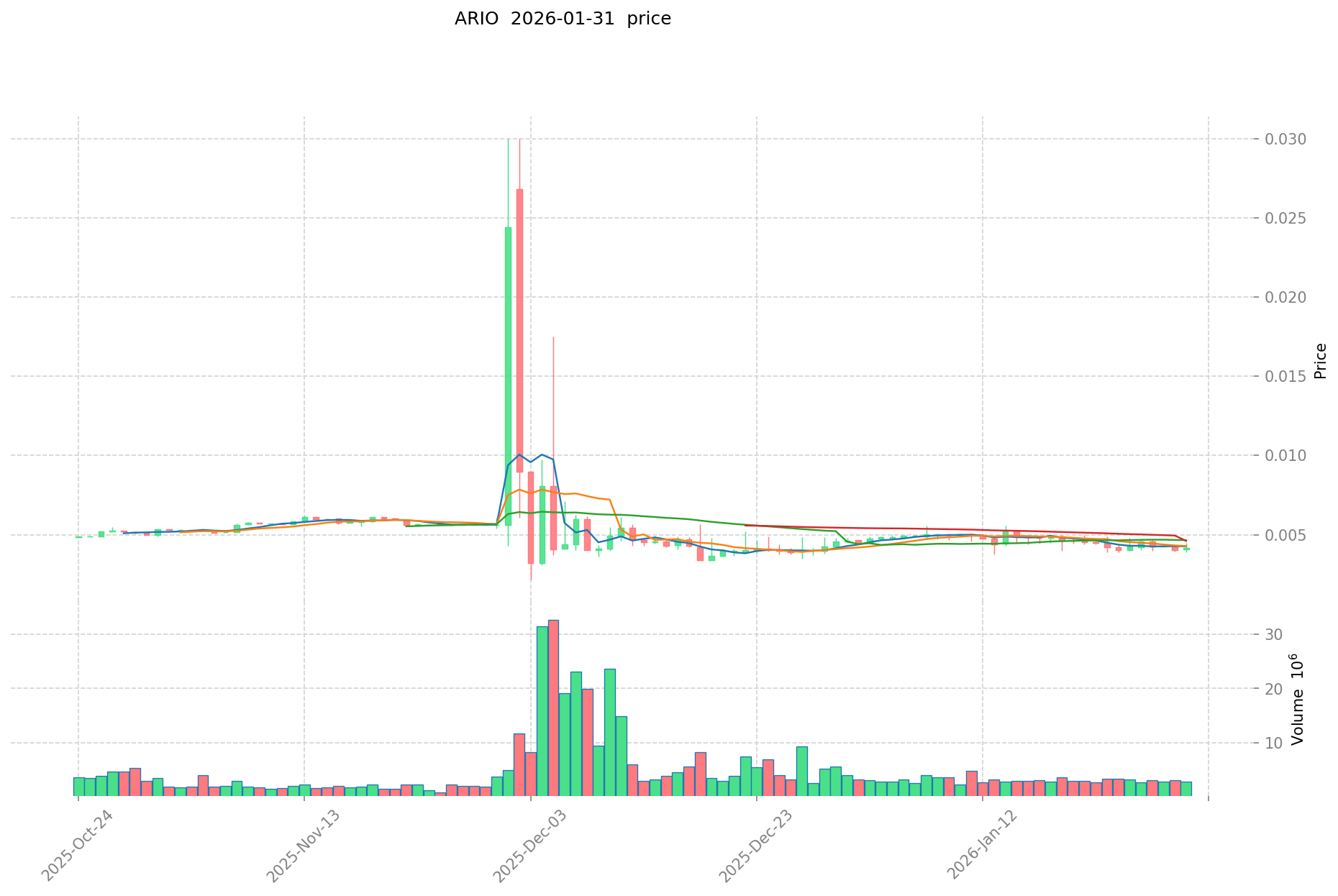
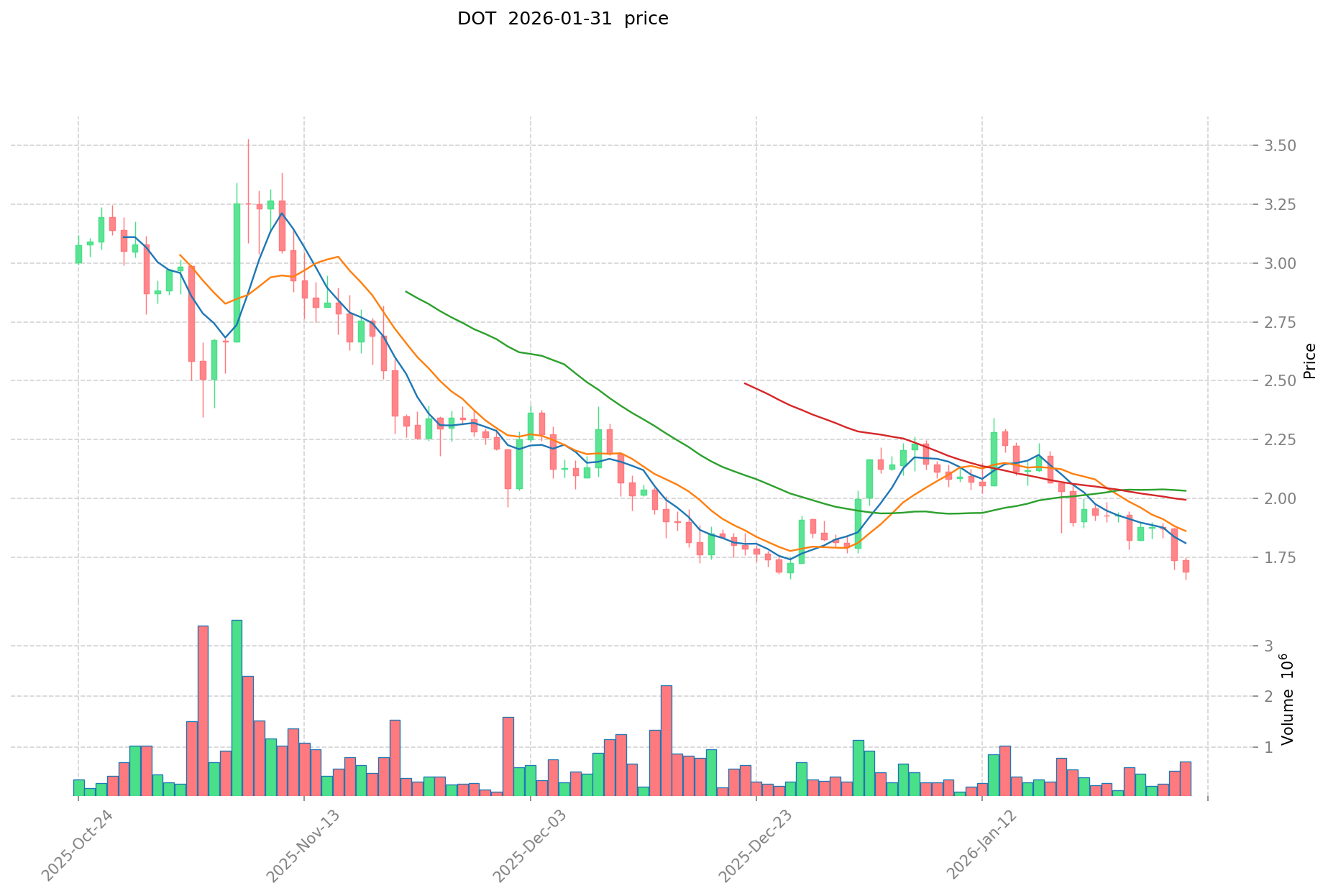
Historical Price Trends of ARIO (Coin A) and DOT (Coin B)
- 2025: ARIO experienced notable volatility, reaching an all-time high of $0.0601 on March 19, 2025, before declining to an all-time low of $0.002154 on December 3, 2025.
- 2021: DOT was influenced by market expansion during the bull cycle, with its price reaching an all-time high of $54.98 on November 4, 2021.
- 2026: DOT faced downward pressure, recording an all-time low of $1.49 on February 1, 2026.
- Comparative analysis: During recent market cycles, ARIO declined from its peak of $0.0601 to $0.002154, reflecting approximately 96% depreciation, while DOT decreased from $54.98 to $1.49, representing roughly 97% decline from its historical peak.
Current Market Status (2026-02-01)
- ARIO current price: $0.004057
- DOT current price: $1.499
- 24-hour trading volume: ARIO recorded $12,729.47 compared to DOT's $1,615,453.99
- Market Sentiment Index (Fear & Greed Index): 20 (Extreme Fear)
View real-time prices:
II. Core Factors Influencing ARIO vs DOT Investment Value
Supply Mechanism Comparison (Tokenomics)
- ARIO: Information regarding ARIO's supply mechanism is not available in the provided materials.
- DOT: Polkadot employs an inflationary model with staking rewards, though specific mechanism details are not comprehensively covered in the reference materials.
- 📌 Historical Pattern: Supply mechanisms tend to influence price cycles through scarcity dynamics and incentive structures, though the specific relationship varies across different tokenomic models.
Institutional Adoption and Market Application
- Institutional Holdings: The reference materials indicate that Polkadot's ecosystem development has drawn attention from various participants, with Parity playing an increasingly central role in the ecosystem's advancement. However, comparative institutional preference data between ARIO and DOT is not available.
- Enterprise Adoption: Specific applications in cross-border payments, settlements, or investment portfolios for either token are not documented in the provided materials.
- National Policies: Regulatory attitudes toward these specific assets across different jurisdictions are not addressed in the reference materials.
Technology Development and Ecosystem Building
- ARIO Technology Upgrades: Technical development information for ARIO is not available in the provided materials.
- DOT Technology Development: Polkadot continues to evolve with Parity assuming a more central role in ecosystem development. The materials suggest ongoing fundamental changes in how the ecosystem operates, though specific technical upgrade details are not elaborated.
- Ecosystem Comparison: The reference materials note that Polkadot is working to introduce valuable new projects to its ecosystem even during market downturns. However, detailed comparisons of DeFi, NFT, payment, and smart contract implementations between ARIO and DOT are not available.
Macroeconomic Environment and Market Cycles
- Performance Under Inflation: Comparative anti-inflation properties between ARIO and DOT are not discussed in the provided materials.
- Macroeconomic Monetary Policy: The specific impacts of interest rates and the US dollar index on these two assets are not covered in the reference materials.
- Geopolitical Factors: While global economic conditions and investment trends are mentioned in broader contexts within the materials, specific analysis of how geopolitical factors affect ARIO and DOT is not available.
III. 2026-2031 Price Forecasts: ARIO vs DOT
Short-term Forecast (2026)
- ARIO: Conservative $0.00288 - $0.00406 | Optimistic $0.00406 - $0.00471
- DOT: Conservative $1.05 - $1.50 | Optimistic $1.50 - $1.67
Mid-term Forecast (2028-2029)
- ARIO may enter a gradual growth phase, with estimated price range of $0.00301 - $0.00567 in 2028 and $0.00459 - $0.00759 in 2029
- DOT may enter a consolidation phase, with estimated price range of $1.48 - $1.99 in 2028 and $1.22 - $1.94 in 2029
- Key drivers: institutional capital flows, ETF developments, ecosystem expansion
Long-term Forecast (2030-2031)
- ARIO: Base scenario $0.00537 - $0.00765 | Optimistic scenario $0.00765 - $0.01131
- DOT: Base scenario $1.57 - $2.04 | Optimistic scenario $2.04 - $2.69
View detailed price predictions for ARIO and DOT
Disclaimer
ARIO:
| Year |
Predicted High Price |
Predicted Average Price |
Predicted Low Price |
Price Change |
| 2026 |
0.00470612 |
0.004057 |
0.00288047 |
0 |
| 2027 |
0.0056522124 |
0.00438156 |
0.0022784112 |
8 |
| 2028 |
0.005669081406 |
0.0050168862 |
0.00301013172 |
23 |
| 2029 |
0.00758703700026 |
0.005342983803 |
0.00459496607058 |
31 |
| 2030 |
0.008921714354249 |
0.00646501040163 |
0.005365958633352 |
59 |
| 2031 |
0.011309242695571 |
0.007693362377939 |
0.006616291645028 |
89 |
DOT:
| Year |
Predicted High Price |
Predicted Average Price |
Predicted Low Price |
Price Change |
| 2026 |
1.66611 |
1.501 |
1.0507 |
0 |
| 2027 |
1.82108825 |
1.583555 |
1.0451463 |
5 |
| 2028 |
1.99171630125 |
1.702321625 |
1.48101981375 |
13 |
| 2029 |
1.93936991128125 |
1.847018963125 |
1.2190325156625 |
23 |
| 2030 |
2.177173602783593 |
1.893194437203125 |
1.684943049110781 |
26 |
| 2031 |
2.686442906391234 |
2.035184019993359 |
1.567091695394886 |
36 |
IV. Investment Strategy Comparison: ARIO vs DOT
Long-term vs Short-term Investment Strategies
- ARIO: May appeal to investors focusing on decentralized storage infrastructure and emerging network ecosystems, given its positioning within the Arweave permanent data storage framework
- DOT: May suit investors interested in multi-chain interoperability infrastructure and established ecosystem frameworks with broader adoption patterns
Risk Management and Asset Allocation
- Conservative investors: ARIO 20-30% vs DOT 70-80%
- Aggressive investors: ARIO 40-50% vs DOT 50-60%
- Hedging instruments: stablecoin allocation, options strategies, cross-asset portfolio diversification
V. Potential Risk Comparison
Market Risk
- ARIO: Exhibits significant price volatility with limited historical data, having experienced approximately 96% decline from peak levels, alongside relatively low trading volume of $12,729.47 as of February 1, 2026
- DOT: Demonstrates substantial price fluctuation patterns, with approximately 97% decline from historical peak, though maintaining higher liquidity with 24-hour trading volume of $1,615,453.99
Technical Risk
- ARIO: Limited information available regarding scalability implementations and network stability metrics in current documentation
- DOT: Ongoing ecosystem restructuring with Parity assuming increasingly central operational roles, presenting potential centralization considerations for network governance
Regulatory Risk
- Global regulatory frameworks continue evolving for decentralized storage networks and multi-chain protocols, with potential differentiated impacts based on jurisdictional classification of utility tokens versus platform assets
VI. Conclusion: Which Is the Better Buy?
📌 Investment Value Summary:
- ARIO advantages: Positioned within emerging decentralized permanent storage infrastructure, potentially benefiting from data sovereignty and censorship-resistance trends
- DOT advantages: Established multi-chain interoperability framework with broader ecosystem development history and higher market liquidity
✅ Investment Recommendations:
- Novice investors: Consider prioritizing DOT for its relatively established market presence and higher liquidity, while limiting exposure to ARIO given its early-stage development and volatility patterns
- Experienced investors: May explore diversified exposure across both assets, with weighted allocation favoring DOT while maintaining selective ARIO positions for infrastructure diversification
- Institutional investors: Evaluate allocation based on portfolio mandate, with consideration for DOT's multi-chain infrastructure positioning and ARIO's niche within decentralized storage protocols
⚠️ Risk Disclosure: Cryptocurrency markets exhibit extreme volatility. This analysis does not constitute investment advice. Investors should conduct independent research and consult qualified financial advisors before making investment decisions.
VII. FAQ
Q1: What are the main differences between ARIO and DOT in terms of use cases?
ARIO focuses on decentralized permanent data storage as part of the Arweave ecosystem, offering censorship-resistant access to data and domains, while DOT serves as a multi-chain interoperability protocol connecting various blockchain networks. ARIO positions itself as infrastructure for permanent cloud storage with self-sovereign smart domains (ArNS), launched in 2025. In contrast, DOT has operated since 2019 as a relay chain framework enabling communication between private chains, consortium chains, public chains, and oracles, representing fundamentally different value propositions within the blockchain ecosystem.
Q2: Which token demonstrates better liquidity based on current market data?
DOT shows significantly better liquidity with a 24-hour trading volume of $1,615,453.99 compared to ARIO's $12,729.47 as of February 1, 2026. This substantial difference reflects DOT's more established market presence and broader investor participation. Higher liquidity generally translates to easier entry and exit positions, tighter bid-ask spreads, and reduced slippage during trades, making DOT more suitable for investors prioritizing trading flexibility and position management capabilities.
Q3: How have both tokens performed since their respective all-time highs?
Both tokens have experienced significant declines from their peak values. ARIO declined approximately 96% from its all-time high of $0.0601 (March 19, 2025) to its all-time low of $0.002154 (December 3, 2025). DOT decreased roughly 97% from its peak of $54.98 (November 4, 2021) to its all-time low of $1.49 (February 1, 2026). These similar percentage declines reflect broader market cycle dynamics, though DOT's longer trading history provides more extensive price behavior data for analysis.
Q4: What are the price forecast ranges for ARIO and DOT through 2031?
For 2026, ARIO's conservative forecast ranges from $0.00288 to $0.00406, with optimistic scenarios reaching $0.00471. DOT's 2026 conservative range spans $1.05 to $1.50, with optimistic projections up to $1.67. By 2031, ARIO's base scenario forecasts $0.00537 to $0.00765, potentially reaching $0.01131 in optimistic conditions. DOT's 2031 base scenario estimates $1.57 to $2.04, with optimistic projections extending to $2.69. These forecasts suggest both tokens may experience gradual appreciation, though actual performance depends on ecosystem development, institutional adoption, and broader market conditions.
Q5: What allocation strategy should different investor types consider between ARIO and DOT?
Conservative investors may consider allocating 20-30% to ARIO and 70-80% to DOT, prioritizing the more established asset with higher liquidity. Aggressive investors might explore 40-50% ARIO allocation versus 50-60% DOT to capture potential growth in emerging decentralized storage infrastructure while maintaining exposure to multi-chain interoperability. Novice investors should prioritize DOT given its established market presence and limit ARIO exposure due to early-stage volatility. Experienced and institutional investors may evaluate diversified exposure based on portfolio mandates, considering DOT's infrastructure positioning alongside ARIO's niche within permanent storage protocols.
Q6: What are the primary risk factors investors should evaluate for each token?
ARIO presents risks including extreme price volatility (96% decline from peak), limited trading volume, early-stage development status, and insufficient historical performance data. DOT's risks include substantial price fluctuation patterns (97% decline from peak), ongoing ecosystem restructuring with Parity's increasingly central role potentially raising centralization concerns, and evolving regulatory frameworks for multi-chain protocols. Both assets face market risk from broader cryptocurrency volatility, with the current Fear & Greed Index at 20 (Extreme Fear) indicating challenging sentiment conditions. Investors should implement proper risk management including stablecoin allocation and portfolio diversification strategies.
Q7: How do the technological ecosystems of ARIO and DOT differ in terms of development trajectory?
ARIO operates within the Arweave ecosystem focusing on decentralized permanent cloud networks, incentivized gateway architecture, and self-sovereign smart domains, representing emerging infrastructure for data sovereignty. DOT's ecosystem emphasizes multi-chain interoperability through relay chain architecture, with Parity assuming increasingly central development roles and ongoing efforts to introduce valuable projects even during market downturns. DOT benefits from longer operational history since 2019 and broader ecosystem maturity, while ARIO represents newer infrastructure launched in 2025 targeting the permanent storage niche, each serving distinct technological paradigms within the blockchain landscape.
Q8: What market conditions would favor ARIO versus DOT performance?
ARIO may outperform during periods emphasizing data sovereignty, censorship-resistance trends, decentralized storage adoption, and infrastructure diversification demands. Increasing regulatory scrutiny of centralized data storage or growing enterprise requirements for permanent data preservation could benefit ARIO's value proposition. DOT may perform better during market phases prioritizing cross-chain functionality, blockchain interoperability solutions, and established ecosystem frameworks with proven track records. Institutional capital flows favoring mature multi-chain infrastructure, ETF developments around interoperability protocols, and broader market recoveries reducing risk appetite could favor DOT. Both tokens remain subject to macroeconomic conditions, regulatory developments, and overall cryptocurrency market cycles.
* The information is not intended to be and does not constitute financial advice or any other recommendation of any sort offered or endorsed by Gate.