This comprehensive analysis compares ARKM and ETC investment value across multiple dimensions. ARKM, a blockchain intelligence platform launched in July 2023, offers data analytics services backed by Coinbase Ventures, currently trading at $0.2075 with $114.22M market cap. ETC, the original Ethereum continuation since 2015, maintains $1.98B market capitalization and $12.768 current price with established Proof-of-Work infrastructure. The article examines historical price trends, tokenomics, institutional adoption, and technological ecosystems to guide investor decisions. ARKM suits growth-focused investors seeking emerging platform exposure, while ETC appeals to those prioritizing established infrastructure stability. Price predictions through 2031 suggest divergent trajectories based on adoption metrics and supply mechanics, with detailed allocation strategies provided for conservative, aggressive, and institutional investors on Gate trading platform.
Introduction: ARKM vs ETC Investment Comparison
In the cryptocurrency market, the comparison between ARKM and ETC remains a focal point for investors. Both exhibit notable differences in market cap ranking, application scenarios, and price performance, representing distinct positions within the crypto asset landscape.
ARKM (ARKM): Launched in July 2023, it has gained market recognition as a blockchain intelligence platform providing real-world entity and individual information behind crypto market activities.
ETC (ETC): Since its inception in November 2015, it has been recognized as the continuation of the original Ethereum chain, adhering to the "code is law" principle and supporting smart contract execution without downtime or third-party interference.
This article comprehensively analyzes the investment value comparison between ARKM and ETC through historical price trends, supply mechanisms, institutional adoption, technological ecosystems, and future predictions, attempting to answer the question most concerning to investors:
"Which is the better buy right now?"
I. Historical Price Comparison and Current Market Status
ARKM (Coin A) and ETC (Coin B) Historical Price Trends
- 2024: ARKM reached a notable price level of $3.9923 on March 10, 2024, reflecting significant market interest during this period.
- 2021: ETC experienced substantial price movement, reaching $167.09 on May 7, 2021, influenced by broader cryptocurrency market momentum.
- 2025: ARKM recorded a low of $0.1162 on October 10, 2025, while ETC maintained relatively higher price levels during the same period.
- Comparative Analysis: During recent market cycles, ARKM has shown considerable volatility, moving from its peak of $3.9923 to lower levels, while ETC has demonstrated a different pattern, declining from its 2021 high of $167.09 to current trading ranges.
Current Market Status (2026-01-17)
- ARKM current price: $0.2075
- ETC current price: $12.768
- 24-hour trading volume: ARKM $379,988.70 vs ETC $1,533,611.47
- Market Sentiment Index (Fear & Greed Index): 49 (Neutral)
- ARKM 24-hour price change: +1.41%
- ETC 24-hour price change: +0.93%
- ARKM market capitalization: $114.22M
- ETC market capitalization: $1.98B
View real-time prices:
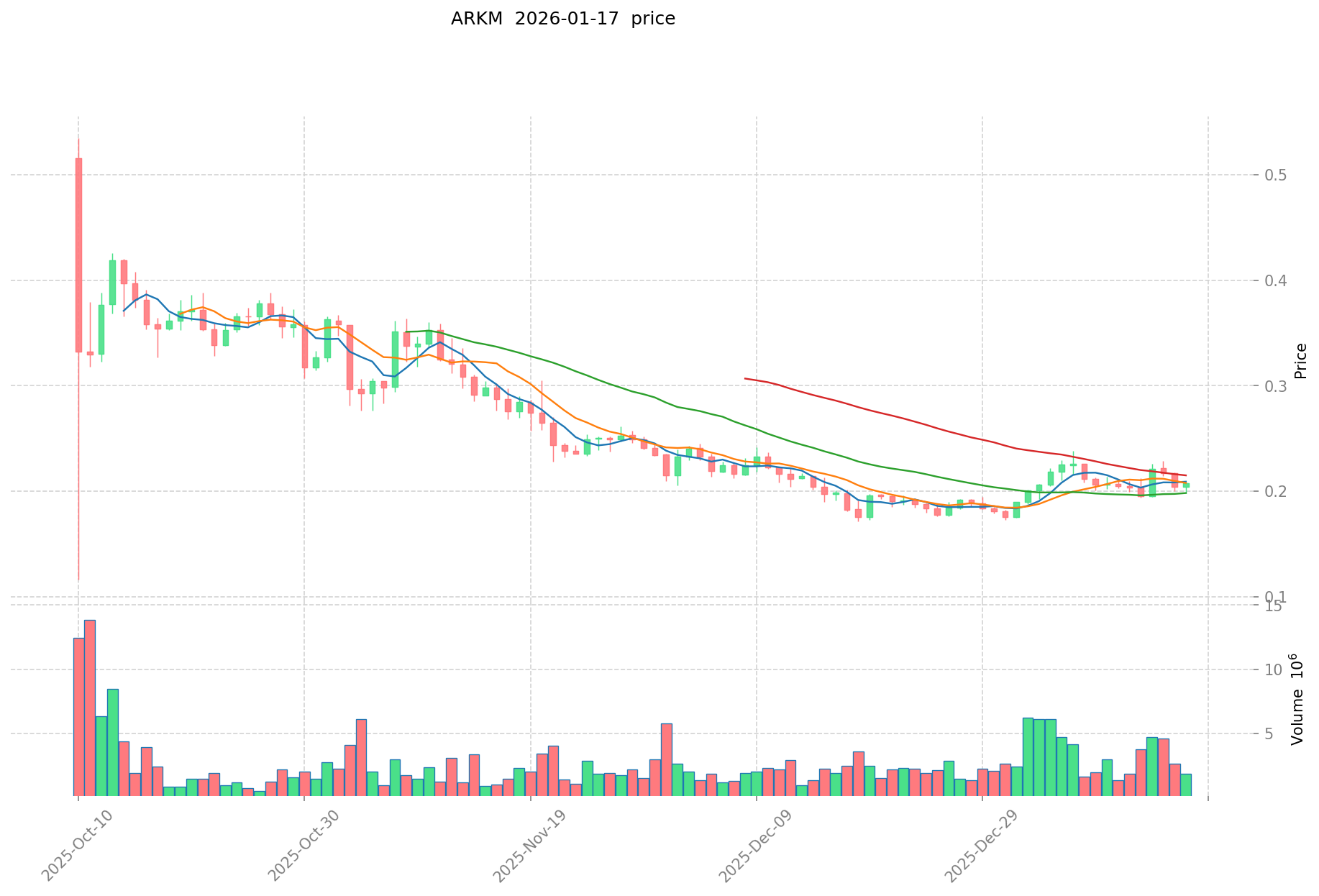
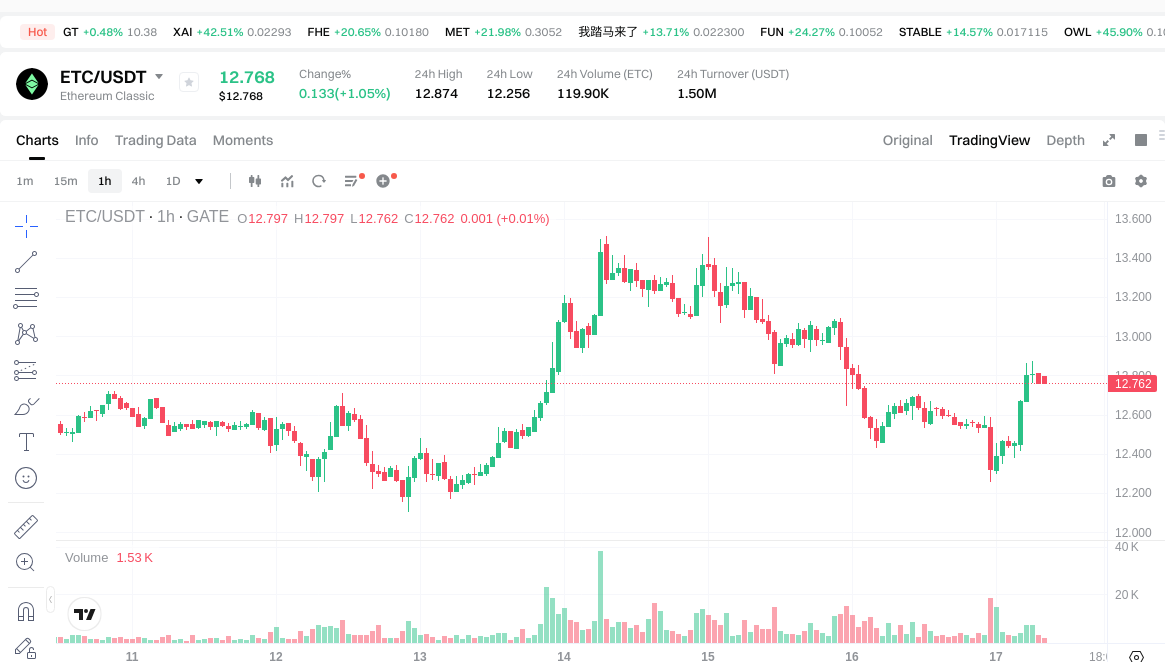
II. Core Factors Influencing ARKM vs ETC Investment Value
Supply Mechanism Comparison (Tokenomics)
-
ARKM: According to available information, ARKM has approximately 23% of its supply in circulation, which may indicate potential unlock risks and high Fully Diluted Valuation (FDV) characteristics. The token economics design connects platform activity with token demand, where data analysts purchase ARKM tokens to access encrypted data intelligence on the platform.
-
ETC: The materials mention ETC's production reduction mechanism, suggesting it follows a deflationary supply model similar to traditional Proof-of-Work cryptocurrencies. Production reduction events may influence market expectations and price cycles.
-
📌 Historical Pattern: Supply mechanisms tend to drive price cycle changes through scarcity dynamics and market anticipation of future supply constraints.
Institutional Adoption and Market Application
-
ARKM Institutional Focus: ARKM aims to expand institutional-grade alpha and compliance intelligence services. Its backers include Ribbit Capital and Coinbase Ventures (with $14.5M in funding). The platform targets data analysts and institutional users requiring on-chain data analysis capabilities.
-
ETC Market Positioning: Reference materials indicate ETC investment is influenced by macroeconomic policy changes and leverage cost fluctuations, suggesting its appeal may vary based on broader market conditions.
-
Regulatory Considerations: Policy volatility represents a factor for both assets, with potential impacts on investment activity and market sentiment.
Technology Development and Ecosystem Building
-
ARKM Platform Features: ARKM operates as a blockchain data intelligence platform, providing encrypted data analysis services. The core demand stems from data analysts and users seeking access to on-chain intelligence. Platform activity and user engagement directly influence token utility and demand.
-
ETC Technical Characteristics: The materials reference ETC's participation in the broader cryptocurrency infrastructure but do not detail specific technical upgrades or ecosystem developments during the referenced period.
-
Ecosystem Comparison: ARKM focuses on data analysis and intelligence services within the crypto ecosystem, while ETC maintains its position as an established blockchain network.
Macroeconomic Environment and Market Cycles
-
Monetary Policy Impacts: Rising interest rates tend to increase leverage costs, which may suppress economic growth and reduce investment activity. This factor appears particularly relevant for ETC, as mentioned in reference materials discussing policy perspective shifts.
-
Market Cycle Dynamics: The materials note that in 2024, following Federal Reserve statements proved to be a generally reliable strategy, suggesting central bank policy remains influential for crypto asset performance.
-
Risk Management Considerations: Investment strategies may need to account for policy-driven volatility, with some analysts recommending position adjustments before major policy shifts and strategic reentry during price pullbacks.
III. 2026-2031 Price Prediction: ARKM vs ETC
Short-term Prediction (2026)
- ARKM: Conservative $0.196555 - $0.2069 | Optimistic $0.2069 - $0.295867
- ETC: Conservative $11.62707 - $12.777 | Optimistic $12.777 - $13.79916
Mid-term Prediction (2028-2029)
- ARKM may enter a phase of gradual appreciation, with estimated price range of $0.2898954522 - $0.49469256198
- ETC may enter a phase of moderate growth, with estimated price range of $13.346547552 - $25.17060004992
- Key drivers: institutional capital inflow, ETF developments, ecosystem expansion
Long-term Prediction (2030-2031)
- ARKM: Baseline scenario $0.2516838027291 - $0.42658271649 | Optimistic scenario $0.447570586141308 - $0.712990352341386
- ETC: Baseline scenario $12.3072963826176 - $21.97731496896 | Optimistic scenario $22.786080159817728 - $30.618795214755072
View detailed price predictions for ARKM and ETC
Disclaimer
ARKM:
| Year |
Predicted High Price |
Predicted Average Price |
Predicted Low Price |
Price Change |
| 2026 |
0.295867 |
0.2069 |
0.196555 |
0 |
| 2027 |
0.37204758 |
0.2513835 |
0.188537625 |
21 |
| 2028 |
0.405230202 |
0.31171554 |
0.2898954522 |
50 |
| 2029 |
0.49469256198 |
0.358472871 |
0.20074480776 |
72 |
| 2030 |
0.6142791117456 |
0.42658271649 |
0.2516838027291 |
105 |
| 2031 |
0.712990352341386 |
0.5204309141178 |
0.447570586141308 |
150 |
ETC:
| Year |
Predicted High Price |
Predicted Average Price |
Predicted Low Price |
Price Change |
| 2026 |
13.79916 |
12.777 |
11.62707 |
0 |
| 2027 |
19.6663584 |
13.28808 |
11.1619872 |
4 |
| 2028 |
21.090840576 |
16.4772192 |
13.346547552 |
29 |
| 2029 |
25.17060004992 |
18.784029888 |
12.39745972608 |
47 |
| 2030 |
25.4936853639936 |
21.97731496896 |
12.3072963826176 |
72 |
| 2031 |
30.618795214755072 |
23.7355001664768 |
22.786080159817728 |
85 |
IV. Investment Strategy Comparison: ARKM vs ETC
Long-term vs Short-term Investment Strategies
- ARKM: May suit investors focused on blockchain intelligence platforms and data analytics ecosystem growth potential, with emphasis on platform adoption metrics and institutional intelligence service demand.
- ETC: May appeal to investors seeking exposure to established Proof-of-Work blockchain infrastructure with deflationary supply characteristics and smart contract functionality without third-party interference.
Risk Management and Asset Allocation
- Conservative Investors: ARKM 30% vs ETC 70% - prioritizing the more established asset with larger market capitalization and historical price stability.
- Aggressive Investors: ARKM 60% vs ETC 40% - emphasizing higher growth potential associated with emerging platform tokens, while maintaining exposure to established infrastructure.
- Hedging Tools: Stablecoin allocation for liquidity management, options strategies for volatility exposure, cross-asset portfolio combinations to reduce correlation risk.
V. Potential Risk Comparison
Market Risks
- ARKM: Higher volatility characteristics evident from price movements between $3.9923 and $0.1162 within recent periods; relatively lower market capitalization ($114.22M) may result in increased price sensitivity to trading activity; approximately 23% circulating supply suggests potential unlock events that could affect market dynamics.
- ETC: Market performance influenced by macroeconomic policy changes and leverage cost fluctuations; price demonstrated historical decline from $167.09 peak levels; current market capitalization of $1.98B provides relatively higher liquidity compared to ARKM.
Technical Risks
- ARKM: Platform adoption dependency where token utility correlates directly with data analyst engagement and intelligence service demand; ecosystem development stage may present scalability considerations as user base expands.
- ETC: Network security considerations related to mining infrastructure distribution; technical development pace compared to other smart contract platforms; maintaining decentralized operation without third-party intervention requirements.
Regulatory Risks
- Global regulatory policy developments may affect both assets differently based on their functional characteristics. ARKM's data intelligence services may face scrutiny related to privacy and data access frameworks. ETC's position as a Proof-of-Work blockchain may encounter environmental policy considerations and mining activity regulations. Policy volatility represents a common factor requiring ongoing monitoring for both investment positions.
VI. Conclusion: Which Is the Better Buy?
📌 Investment Value Summary:
- ARKM Advantages: Positioned within the growing blockchain intelligence and data analytics sector; backed by notable investors including Ribbit Capital and Coinbase Ventures; platform utility model connecting token demand with data access services; potential for ecosystem expansion as institutional adoption of on-chain intelligence increases.
- ETC Advantages: Established blockchain infrastructure since November 2015; larger market capitalization ($1.98B) providing relatively higher liquidity; deflationary supply mechanism through production reduction events; adherence to immutable code principles supporting predictable network operation.
✅ Investment Recommendations:
- Beginner Investors: Consider starting with ETC due to its larger market capitalization, established history, and relatively higher liquidity. Position sizing should account for market volatility and macroeconomic policy influences. Educational focus on understanding Proof-of-Work mechanisms and smart contract functionality recommended.
- Experienced Investors: Portfolio diversification between both assets may be considered based on individual risk tolerance. ARKM exposure could complement positions focused on data analytics and platform tokens, while ETC provides infrastructure exposure. Active monitoring of platform adoption metrics for ARKM and policy developments affecting ETC suggested.
- Institutional Investors: Evaluation should incorporate due diligence on ARKM's institutional intelligence service roadmap and token unlock schedules, alongside ETC's network security parameters and mining ecosystem dynamics. Risk-adjusted allocation frameworks accounting for correlation with broader crypto market cycles and macroeconomic conditions recommended.
⚠️ Risk Disclaimer: Cryptocurrency markets exhibit high volatility characteristics. This content does not constitute investment advice. Market conditions, regulatory developments, and technological factors may significantly affect asset performance. Independent research and professional consultation are essential before making investment decisions.
VII. FAQ
Q1: What are the main differences between ARKM and ETC in terms of their core functionality?
ARKM functions as a blockchain intelligence platform providing data analytics services, while ETC operates as an established smart contract blockchain infrastructure. ARKM's primary value proposition centers on delivering encrypted data intelligence about on-chain activities to analysts and institutional users, with token utility directly tied to platform access and data services. In contrast, ETC represents the continuation of the original Ethereum chain, maintaining immutable code principles and supporting decentralized smart contract execution without third-party interference. The fundamental distinction lies in ARKM serving as a data layer application versus ETC providing base-layer blockchain infrastructure with its own native currency and programmable functionality.
Q2: How does the market capitalization difference between ARKM ($114.22M) and ETC ($1.98B) impact investment considerations?
The significant market capitalization gap indicates ETC offers substantially higher liquidity and established market presence compared to ARKM. ETC's larger market cap of $1.98B suggests greater price stability, easier entry and exit positions, and broader institutional recognition accumulated since its November 2015 launch. Conversely, ARKM's smaller $114.22M market cap reflects its early-stage positioning (launched July 2023) and presents both higher volatility risk and potentially greater upside opportunity. The liquidity differential means ETC positions can typically be adjusted with minimal price impact, while ARKM trades may experience more pronounced slippage during larger transactions. For conservative investors prioritizing capital preservation, ETC's market depth provides a more established foundation, whereas risk-tolerant investors may view ARKM's smaller capitalization as offering asymmetric growth potential.
Q3: What role do supply mechanisms play in the long-term value proposition of each asset?
Supply dynamics significantly influence price trajectory expectations for both assets through scarcity economics. ARKM currently has approximately 23% of its total supply in circulation, indicating substantial future token unlocks that could create selling pressure and affect price stability during unlock events. This characteristic suggests investors should monitor vesting schedules and FDV-to-market-cap ratios closely. ETC implements a production reduction mechanism similar to deflationary Proof-of-Work cryptocurrencies, where scheduled supply decreases create anticipatory market dynamics around reduction events. Historical patterns demonstrate that deflationary assets often experience price appreciation cycles coinciding with supply constraints. The key distinction is that ARKM faces gradual supply expansion from unlocks, while ETC benefits from decreasing new issuance over time, making supply mechanics a critical differentiator in multi-year holding strategies.
Q4: How should investors interpret the price volatility differences between ARKM and ETC?
ARKM has demonstrated extreme volatility, ranging from $3.9923 (March 2024) to $0.1162 (October 2025), representing approximately 97% drawdown from peak levels. This volatility pattern reflects typical characteristics of lower-capitalization platform tokens during early adoption phases, where sentiment shifts and adoption metrics create pronounced price swings. ETC's historical range from $167.09 (May 2021) to current $12.768 levels, while substantial, occurred over a longer timeframe and reflects broader cryptocurrency market cycles rather than asset-specific volatility. For practical investment management, ARKM's volatility profile suggests position sizing should be conservative relative to total portfolio allocation, potentially 2-5% for risk-tolerant investors. ETC's relatively moderated volatility within the crypto asset class may support larger position weights of 10-20% in diversified portfolios, though both assets remain subject to significant market risk inherent to digital assets.
Q5: What factors should investors prioritize when choosing between ARKM and ETC for portfolio allocation?
Investment selection should align with specific portfolio objectives and risk parameters. Investors seeking exposure to emerging blockchain applications and data intelligence infrastructure should evaluate ARKM based on platform adoption metrics, institutional service traction, and ecosystem development milestones, recognizing the higher risk-reward profile associated with early-stage platform tokens. Those prioritizing established blockchain infrastructure with proven operational history may favor ETC, particularly if portfolio strategy emphasizes Proof-of-Work mechanisms and immutable code principles. Time horizon considerations are critical: ARKM may require 3-5 year holding periods for platform maturation, while ETC's established position provides more immediate liquidity and recognition. Diversification strategies might incorporate both assets in varying proportions—conservative allocations favoring ETC 70%/ARKM 30%, while growth-oriented approaches could reverse this ratio to ETC 40%/ARKM 60%. Macroeconomic sensitivity differs as well, with ETC showing correlation to leverage costs and policy cycles, whereas ARKM's performance ties more closely to adoption of blockchain intelligence services. Regular rebalancing and monitoring of project-specific developments remains essential regardless of allocation strategy.
* The information is not intended to be and does not constitute financial advice or any other recommendation of any sort offered or endorsed by Gate.