This comprehensive guide compares ATLAS and MANA, two leading metaverse tokens representing distinct investment opportunities. ATLAS, a Solana-based gaming token launched in 2021, focuses on blockchain gaming and play-to-earn mechanics, currently trading at $0.000265 with $23,191.76 daily volume. MANA, Decentraland's established virtual world platform on Ethereum since 2017, trades at $0.1383 with $78,957.64 daily volume, offering virtual real estate and decentralized property ownership. The article analyzes historical price trends, tokenomics, technical ecosystems, 2026-2031 price forecasts, and investment allocation strategies for both conservative and aggressive investors. Conservative investors may favor MANA's 70-80% allocation due to higher liquidity and maturity, while aggressive investors could balance 40-50% ATLAS exposure for gaming innovation potential. Understanding these tokens' distinct risk profiles, market positioning, and long-term growth projections helps investors make informed metaverse se
Introduction: Investment Comparison Between ATLAS and MANA
In the cryptocurrency market, the comparison between ATLAS vs MANA remains a topic that investors cannot overlook. Both tokens demonstrate significant differences in market cap ranking, application scenarios, and price performance, while representing distinct positioning within the crypto asset landscape.
ATLAS (Star Atlas): Launched in 2021, this metaverse gaming token has positioned itself within the blockchain gaming and virtual world sector, operating on the Solana blockchain with technical support from Unreal Engine 5.
MANA (Decentraland): Since its inception in 2017, MANA has been recognized as a pioneering virtual world platform token, utilizing blockchain technology to enable decentralized virtual property ownership and trading.
This article will provide a comprehensive analysis of ATLAS vs MANA investment value comparison, examining historical price trends, supply mechanisms, technical ecosystems, and future projections, attempting to address the question investors care about most:
"Which is the better buy right now?"
I. Historical Price Comparison and Current Market Status
ATLAS (Coin A) and MANA (Coin B) Historical Price Trends
- 2021: ATLAS reached a notable price level of $0.267549 in September, reflecting initial market interest in blockchain-based metaverse gaming projects.
- 2021: MANA experienced growth to $5.85 in November, influenced by increasing attention to virtual world platforms and NFT integration.
- Comparative Analysis: During market cycles, ATLAS declined from $0.267549 to $0.00025465, while MANA decreased from $5.85 to $0.00923681, showing both assets experienced considerable volatility.
Current Market Status (2026-01-28)
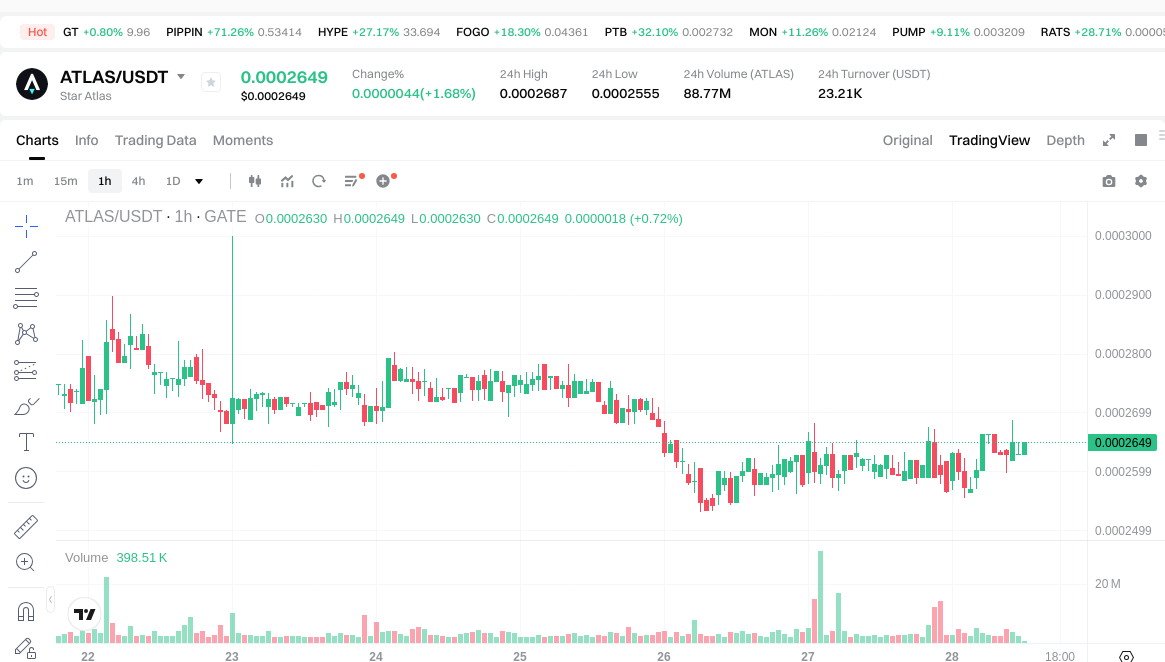
- ATLAS Current Price: $0.000265
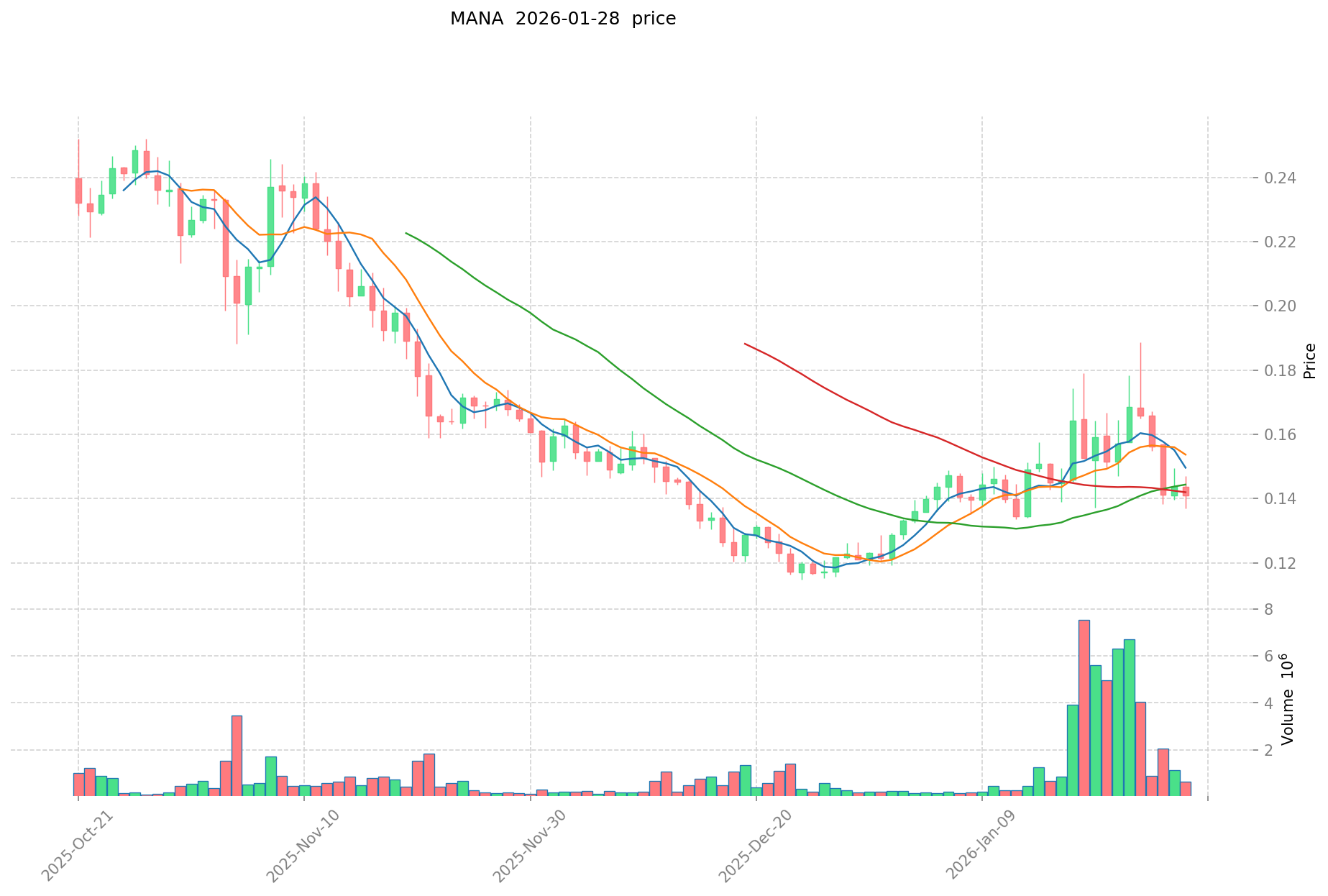
- MANA Current Price: $0.1383
- 24-Hour Trading Volume: ATLAS $23,191.76 vs MANA $78,957.64
- Market Sentiment Index (Fear & Greed Index): 29 (Fear)
View Real-Time Prices:
II. Core Factors Influencing ATLAS vs MANA Investment Value
Tokenomics Comparison
-
ATLAS: Functions as the in-game currency within the Star Atlas ecosystem, enabling users to participate in battles, explore new territories, and engage in marketplace transactions. The token operates within a decentralized economy framework integrated into the gaming mechanics.
-
MANA: Features a limited supply model where tokens can be burned or spent to acquire virtual land parcels. Land represents non-fungible digital assets maintained through Ethereum smart contracts, creating scarcity relative to the expanding virtual worlds being developed.
-
📌 Historical Pattern: Token scarcity mechanisms have demonstrated influence on price cycles, with limited supply models contributing to value preservation during ecosystem expansion phases.
Institutional Adoption and Market Applications
-
Institutional Positioning: Reference materials indicate that institutional investment represents a key factor influencing token valuation, though specific comparative data between ATLAS and MANA institutional holdings was not provided in the available sources.
-
Enterprise Implementation: MANA has established presence in digital asset trading and virtual activities, strengthening its position within metaverse ecosystems. The platform enables users to engage in virtual land transactions and participate in decentralized economic activities.
-
Regulatory Environment: Macroeconomic conditions and regulatory frameworks influence both tokens' investment dynamics, though specific jurisdictional policies were not detailed in the reference materials.
Technology Development and Ecosystem Construction
-
ATLAS Technical Foundation: Operates on the Solana blockchain, leveraging high-throughput infrastructure for gaming applications. The reward system (play-to-earn mechanism) represents a significant value contributor, implemented through decentralized economic structures and in-game mechanisms.
-
MANA Technical Infrastructure: Built on Ethereum blockchain, utilizing smart contract functionality for land ownership and transactions. The platform provides practical utility value while enhancing long-term investment potential through digital asset trading capabilities.
-
Ecosystem Comparison: Both tokens participate in metaverse development, with ATLAS focused on space exploration gaming experiences and MANA centered on virtual real estate and social interactions. The Star Atlas ecosystem emphasizes technical innovation and gaming mechanics, while MANA's ecosystem consolidates its position through virtual land scarcity and platform activities.
Macroeconomic Environment and Market Cycles
-
Inflationary Context: The reference materials note that macroeconomic conditions influence token valuations, though specific comparative performance data during inflationary periods was not available in the provided sources.
-
Monetary Policy Impact: Macro factors including interest rates and currency dynamics affect both tokens' market performance, though detailed correlation analysis was not present in the reference materials.
-
Geopolitical Considerations: Cross-border transaction requirements and international developments may influence adoption patterns, though specific impacts on ATLAS and MANA were not elaborated in the available documentation.
III. 2026-2031 Price Forecast: ATLAS vs MANA
Short-term Forecast (2026)
- ATLAS: Conservative $0.00013413 - $0.000263 | Optimistic $0.000263 - $0.00037872
- MANA: Conservative $0.079982 - $0.1379 | Optimistic $0.1379 - $0.187544
Mid-term Forecast (2028-2029)
- ATLAS may enter a gradual accumulation phase, with estimated price range of $0.000262 - $0.000502
- MANA may enter a moderate growth phase, with estimated price range of $0.148 - $0.272
- Key drivers: institutional capital inflows, ETF developments, ecosystem expansion
Long-term Forecast (2031)
- ATLAS: Baseline scenario $0.000374 - $0.000485 | Optimistic scenario $0.000485 - $0.000573
- MANA: Baseline scenario $0.274 - $0.288 | Optimistic scenario $0.288 - $0.395
View detailed price predictions for ATLAS and MANA
Disclaimer
ATLAS:
| Year |
Predicted High Price |
Predicted Average Price |
Predicted Low Price |
Price Change |
| 2026 |
0.00037872 |
0.000263 |
0.00013413 |
0 |
| 2027 |
0.0004395782 |
0.00032086 |
0.0002053504 |
21 |
| 2028 |
0.00045626292 |
0.0003802191 |
0.000262351179 |
43 |
| 2029 |
0.000501889212 |
0.00041824101 |
0.0003387752181 |
57 |
| 2030 |
0.00051067227321 |
0.000460065111 |
0.00026683776438 |
73 |
| 2031 |
0.000572735056683 |
0.000485368692105 |
0.00037373389292 |
83 |
MANA:
| Year |
Predicted High Price |
Predicted Average Price |
Predicted Low Price |
Price Change |
| 2026 |
0.187544 |
0.1379 |
0.079982 |
0 |
| 2027 |
0.20502972 |
0.162722 |
0.10088764 |
17 |
| 2028 |
0.2721362728 |
0.18387586 |
0.174682067 |
32 |
| 2029 |
0.269047158352 |
0.2280060664 |
0.14820394316 |
64 |
| 2030 |
0.32805512833632 |
0.248526612376 |
0.14414543517808 |
79 |
| 2031 |
0.394958492387939 |
0.28829087035616 |
0.273876326838352 |
108 |
IV. Investment Strategy Comparison: ATLAS vs MANA
Long-term vs Short-term Investment Strategies
-
ATLAS: May appeal to investors interested in blockchain gaming ecosystems and emerging metaverse applications, particularly those evaluating early-stage gaming token opportunities with focus on technological development within the Solana ecosystem.
-
MANA: May attract investors seeking exposure to established virtual world platforms with existing user bases and digital asset trading infrastructure, particularly those evaluating metaverse real estate and decentralized virtual economy participation.
Risk Management and Asset Allocation
-
Conservative Investors: ATLAS 20-30% vs MANA 70-80% - This allocation reflects the relative market maturity differences, with greater weight toward the more established platform while maintaining exposure to gaming sector developments.
-
Aggressive Investors: ATLAS 40-50% vs MANA 50-60% - This structure provides balanced exposure to both gaming innovation potential and established metaverse infrastructure, suitable for portfolios accepting higher volatility in exchange for diversified metaverse sector participation.
-
Hedging Instruments: Stablecoin allocations for liquidity management, options strategies for downside protection, cross-asset combinations to reduce correlation risk within crypto portfolios.
V. Potential Risk Comparison
Market Risk
-
ATLAS: Trading volume of $23,191.76 indicates lower liquidity conditions, which may contribute to price volatility during market movements. The token's correlation with gaming sector sentiment and Solana ecosystem performance represents additional market dynamics to consider.
-
MANA: While demonstrating higher trading volume at $78,957.64, the token remains exposed to metaverse sector adoption trends and Ethereum network conditions. Market sentiment index at 29 (Fear) reflects broader risk-averse conditions affecting both assets.
Technical Risk
-
ATLAS: Scalability considerations relate to Solana network performance and gaming infrastructure requirements. Network stability factors include transaction throughput demands during peak gaming activities and smart contract execution reliability.
-
MANA: Technical considerations include Ethereum gas fee structures affecting transaction economics, smart contract security for land ownership records, and platform scalability as user participation expands.
Regulatory Risk
- Global regulatory frameworks may impact both tokens differently based on their specific use cases - gaming tokens face considerations around virtual asset regulations and gaming industry compliance requirements, while virtual real estate platforms encounter property rights frameworks and digital asset trading regulations. Jurisdiction-specific policies regarding metaverse activities and blockchain gaming continue to evolve.
VI. Conclusion: Which Is the Better Buy?
📌 Investment Value Summary:
-
ATLAS Characteristics: Operates within blockchain gaming sector with Solana infrastructure, features play-to-earn mechanics, positioned in space exploration gaming niche with technical development focused on Unreal Engine 5 integration.
-
MANA Characteristics: Established presence in virtual world platforms since 2017, operates on Ethereum blockchain with demonstrated virtual land trading ecosystem, benefits from existing user base and decentralized property ownership infrastructure.
✅ Investment Considerations:
-
Newer Investors: May consider starting with smaller allocations to understand metaverse token dynamics, focusing on established platforms with clearer use cases while maintaining diversification across multiple asset categories beyond cryptocurrency exposure.
-
Experienced Investors: Could evaluate portfolio allocations based on risk tolerance and sector thesis, considering both gaming innovation potential and established virtual economy platforms, while implementing appropriate risk management through position sizing and diversification strategies.
-
Institutional Investors: May assess both tokens within broader metaverse and gaming sector allocations, evaluating liquidity profiles, regulatory compliance frameworks, and alignment with institutional investment mandates regarding emerging technology exposure.
⚠️ Risk Disclosure: Cryptocurrency markets demonstrate significant volatility characteristics. This content does not constitute investment advice, financial guidance, or recommendations for specific investment actions. Individuals should conduct independent research and consult qualified financial professionals before making investment decisions.
VII. FAQ
Q1: Which token shows better liquidity for trading - ATLAS or MANA?
MANA demonstrates superior liquidity with 24-hour trading volume of $78,957.64 compared to ATLAS's $23,191.76, representing approximately 3.4 times higher trading activity. This liquidity differential means MANA traders typically experience tighter bid-ask spreads and reduced slippage during order execution, while ATLAS's lower volume may result in increased price volatility during entry and exit positions. For investors prioritizing execution efficiency and position management flexibility, MANA's higher liquidity profile provides more favorable trading conditions, particularly for larger position sizes or time-sensitive transactions.
Q2: What are the fundamental differences in the tokenomics between ATLAS and MANA?
ATLAS functions as an in-game currency within the Star Atlas gaming ecosystem, enabling battle participation, territory exploration, and marketplace transactions through decentralized economic mechanics. MANA operates with a limited supply model incorporating burn mechanisms tied to virtual land purchases, where land parcels represent non-fungible digital assets maintained through Ethereum smart contracts. The key distinction lies in their scarcity approaches: ATLAS focuses on gaming utility and circulation within a play-to-earn framework, while MANA emphasizes supply reduction through land acquisition activities, creating deflationary pressure as the virtual world expands and land becomes increasingly scarce.
Q3: How do the blockchain infrastructures of ATLAS and MANA impact their investment profiles?
ATLAS operates on Solana blockchain, leveraging high-throughput infrastructure designed for gaming applications with lower transaction costs and faster processing speeds suitable for real-time gaming interactions. MANA is built on Ethereum blockchain, utilizing established smart contract functionality and network security with broader DeFi ecosystem integration, though facing higher gas fees during network congestion. The infrastructure difference means ATLAS benefits from technical performance advantages for gaming experiences but depends on Solana's network stability, while MANA offers more mature blockchain infrastructure with extensive developer support and institutional familiarity, albeit with potentially higher transaction costs affecting microtransaction economics.
Q4: What market conditions might favor ATLAS over MANA, or vice versa?
ATLAS may outperform during periods of increased interest in blockchain gaming innovation, particularly when Solana ecosystem development accelerates or play-to-earn mechanics gain mainstream adoption among gaming communities. MANA could demonstrate relative strength during metaverse infrastructure buildouts, institutional adoption of virtual real estate, or when Ethereum network upgrades improve scalability and reduce transaction costs. Current market sentiment at 29 (Fear) suggests both tokens face challenging conditions, though MANA's established ecosystem and higher liquidity may provide relative stability, while ATLAS's gaming focus could appeal to investors seeking exposure to emerging gaming sector catalysts despite higher volatility characteristics.
Q5: How should risk tolerance influence allocation decisions between ATLAS and MANA?
Conservative investors might consider 20-30% ATLAS versus 70-80% MANA allocation, emphasizing the more established platform with proven use cases and higher liquidity while maintaining limited exposure to gaming sector potential. Aggressive investors could implement 40-50% ATLAS versus 50-60% MANA distribution, balancing gaming innovation opportunities against virtual world infrastructure, accepting higher volatility for diversified metaverse exposure. Risk tolerance considerations should incorporate liquidity requirements, time horizon expectations, and portfolio diversification beyond cryptocurrency holdings, with both allocations requiring ongoing monitoring of ecosystem developments, technical infrastructure performance, and broader market conditions affecting metaverse sector valuations.
Q6: What are the primary risk factors differentiating ATLAS from MANA investments?
ATLAS faces gaming sector-specific risks including user adoption uncertainties, competition from established gaming studios, Solana network stability requirements, and play-to-earn sustainability concerns as gaming economies mature. MANA encounters virtual real estate market risks, Ethereum gas fee economics affecting transaction viability, platform competition from emerging metaverse projects, and regulatory frameworks surrounding digital property ownership. Technical risks differ substantially: ATLAS depends on gaming infrastructure scalability and real-time transaction processing, while MANA requires smart contract security for land ownership records and platform expansion capabilities. Both tokens face broader cryptocurrency market correlation, though their sector-specific exposures create distinct risk-return profiles requiring independent evaluation within investment decision frameworks.
Q7: How do the 2026-2031 price forecasts compare between ATLAS and MANA?
ATLAS forecasts suggest modest growth from conservative 2026 range of $0.00013413-$0.000263 to 2031 baseline scenario of $0.000374-$0.000485, representing approximately 42-84% potential appreciation over five years. MANA projections indicate more substantial growth potential from conservative 2026 range of $0.079982-$0.1379 to 2031 baseline scenario of $0.274-$0.288, suggesting approximately 98-260% potential appreciation. These forecasts reflect MANA's more established market position and higher baseline valuation, while ATLAS demonstrates proportionally similar percentage growth potential from significantly lower absolute price levels. Both forecasts incorporate assumptions about ecosystem development, institutional adoption, and favorable market conditions, with actual outcomes depending on execution of technical roadmaps, user acquisition success, and broader cryptocurrency market cycles affecting metaverse sector valuations.
Q8: What role should institutional adoption play in evaluating ATLAS versus MANA?
Institutional adoption represents a critical differentiation factor, with MANA's longer operational history since 2017 and Ethereum infrastructure potentially attracting greater institutional interest compared to ATLAS's 2021 launch and gaming-focused positioning. Institutional investors typically prioritize liquidity profiles, regulatory clarity, custodial infrastructure availability, and established use cases—factors currently favoring MANA's virtual real estate platform over ATLAS's gaming token structure. However, growing institutional interest in gaming sector exposure and Solana ecosystem development could enhance ATLAS's institutional appeal as the blockchain gaming market matures. Investors evaluating institutional adoption trends should monitor enterprise partnerships, institutional-grade custody solutions, regulatory compliance frameworks, and institutional capital flows into metaverse sectors as indicators of long-term viability for both tokens within professional investment portfolios.
* The information is not intended to be and does not constitute financial advice or any other recommendation of any sort offered or endorsed by Gate.