This comprehensive analysis compares AVAX and XRP as investment opportunities, examining their distinct positioning in the cryptocurrency market. AVAX functions as a smart contract platform for decentralized applications with 1-second transaction finality, while XRP serves as a payment-focused asset with 3-second transaction speeds and minimal costs. The article evaluates historical price trajectories, supply mechanisms, institutional adoption patterns, and technological ecosystems to address which asset offers better investment potential. Current market data shows AVAX at $13.81 with higher trading volume, while XRP trades at $2.067 with stronger recent price resilience. Investment recommendations vary by profile: conservative investors may favor XRP's established payment use case, while aggressive investors might target AVAX's growth potential. Price forecasts through 2031 project different trajectories based on adoption scenarios, with comprehensive risk analysis covering market, technical, and regulatory
Introduction: AVAX vs XRP Investment Comparison
In the cryptocurrency market, the comparison between AVAX vs XRP has consistently been a topic of interest for investors. Both assets exhibit notable differences in market capitalization ranking, application scenarios, and price performance, representing distinct positioning within the crypto asset landscape.
Avalanche (AVAX): Launched in 2020, it has gained market recognition through its positioning as an open-source platform for decentralized applications and interoperable blockchains, featuring 1-second transaction finality.
XRP (XRP): Since its launch in 2011, it has been positioned as a digital asset built specifically for payments, characterized by fast transaction speeds (approximately 3 seconds per transaction) and low costs ($0.0002 per transaction), making it one of the cryptocurrencies with substantial trading volume and market capitalization globally.
This article will provide a comprehensive analysis of the investment value comparison between AVAX vs XRP, focusing on historical price trends, supply mechanisms, institutional adoption, technological ecosystems, and future projections, attempting to address the question that concerns investors most:
"Which is the better buy right now?"
I. Historical Price Comparison and Current Market Dynamics
Historical Price Trajectory: AVAX and XRP
- 2021: AVAX reached its all-time high of $144.96 on November 21, 2021, driven by increased adoption of its smart contract platform and growing DeFi ecosystem activity.
- 2025: XRP achieved a new all-time high of $3.65 on July 18, 2025, supported by increased regulatory clarity and expanded integration prospects within traditional financial systems.
- Comparative Analysis: During the 2021-2026 market cycle, AVAX declined from $144.96 to current levels around $13.81, representing a significant correction. Meanwhile, XRP demonstrated relatively stronger resilience, with its current price of $2.067 representing a smaller decline from its recent peak compared to AVAX's multi-year trajectory.
Current Market Status (January 13, 2026)
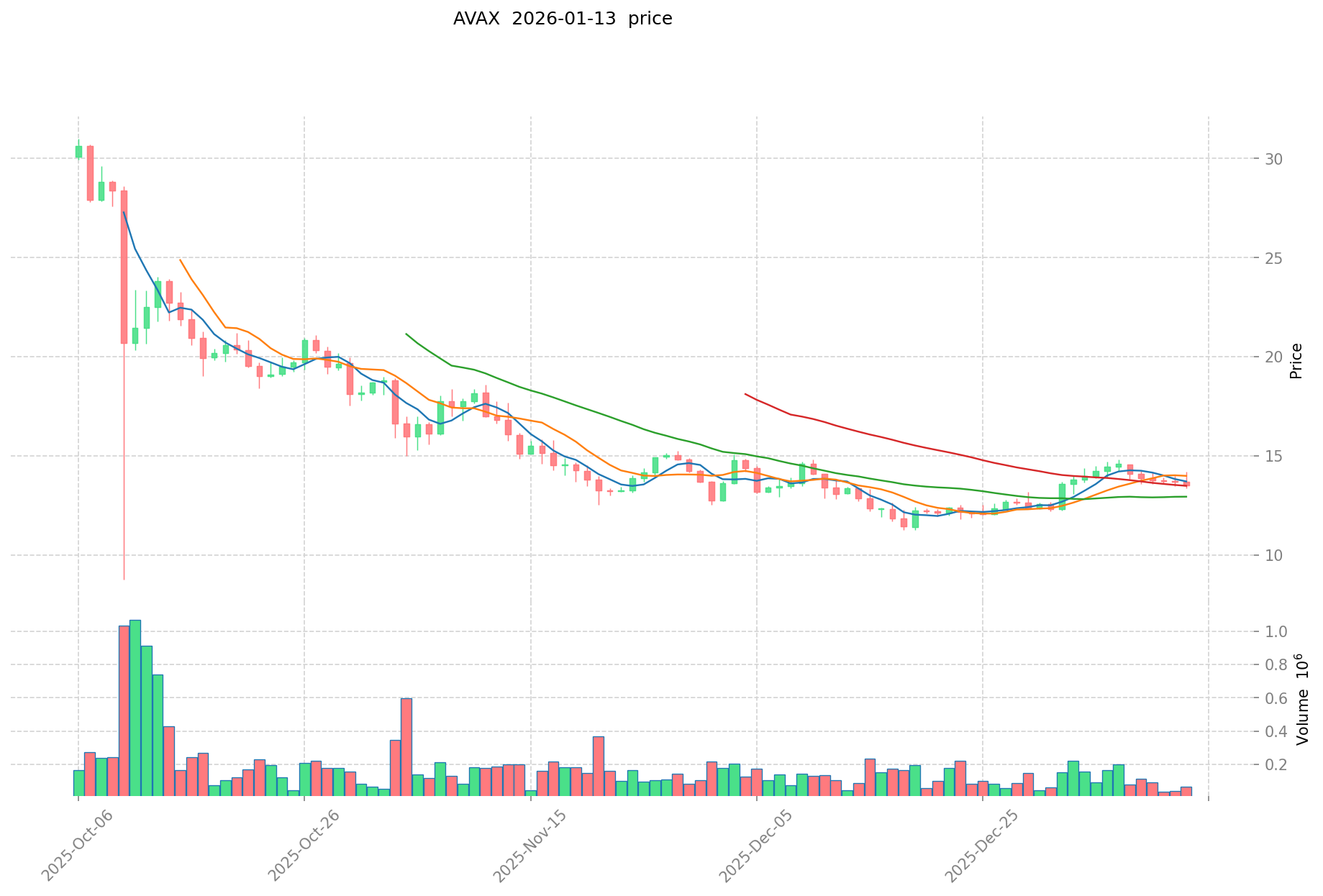
- AVAX Current Price: $13.81
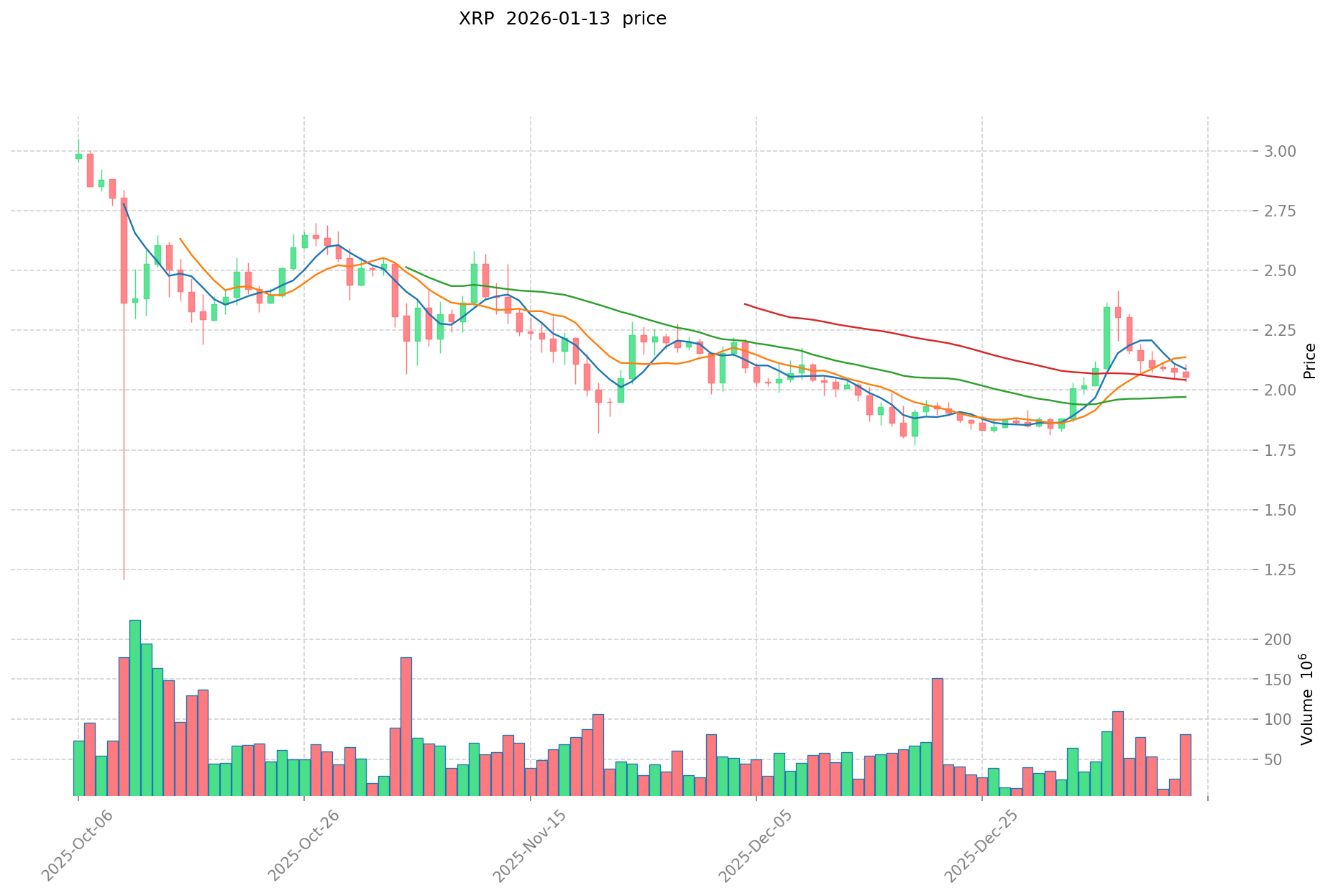
- XRP Current Price: $2.067
- 24-Hour Trading Volume: AVAX recorded $690.06 million vs XRP's $107.32 million
- Market Sentiment Index (Fear & Greed Index): 26 (Fear)
View Real-Time Prices:
II. Core Factors Influencing AVAX vs XRP Investment Value
Supply Mechanism Comparison (Tokenomics)
-
AVAX: Operates with a capped maximum supply model, where tokens are burned through transaction fees, creating deflationary pressure over time. The supply dynamics are designed to balance network growth with scarcity incentives.
-
XRP: Features a pre-mined total supply with a significant portion held in escrow, released periodically. The supply model differs fundamentally from mineable cryptocurrencies, with no inflation through mining.
-
📌 Historical Pattern: Supply mechanisms have influenced price cycles differently - deflationary models tend to create upward pressure during adoption phases, while pre-mined supplies may face distribution-related volatility.
Institutional Adoption and Market Application
-
Institutional Holdings: XRP has attracted attention from financial institutions exploring cross-border payment solutions, while AVAX has gained interest from organizations evaluating blockchain infrastructure for decentralized applications.
-
Enterprise Adoption: XRP has been explored for international payment settlements and remittance services. AVAX has been integrated into projects involving decentralized finance platforms and enterprise blockchain solutions, with partnerships reported in various sectors.
-
National Policies: Regulatory environments vary by jurisdiction. XRP has faced regulatory scrutiny in certain markets, which has influenced institutional adoption patterns. AVAX operates within frameworks applicable to smart contract platforms and DeFi applications.
Technology Development and Ecosystem Building
-
AVAX Technology Upgrades: The platform emphasizes high-speed transaction processing and scalability through its consensus protocol. Development initiatives have focused on expanding DeFi capabilities, NFT infrastructure, and cross-chain compatibility.
-
XRP Technology Development: The focus remains on optimizing payment efficiency and settlement speed for financial institutions. Developments have centered on enhancing transaction throughput and integration capabilities.
-
Ecosystem Comparison: AVAX has concentrated on building decentralized applications, DeFi protocols, and NFT marketplaces. XRP's ecosystem primarily serves payment and settlement use cases, with less emphasis on smart contract functionality compared to AVAX.
Macroeconomic and Market Cycles
-
Performance in Inflationary Environments: Both assets have shown sensitivity to broader cryptocurrency market trends. Neither has established a clear historical pattern as an inflation hedge comparable to traditional stores of value.
-
Macroeconomic Monetary Policy: Interest rate changes and dollar index movements have influenced both assets through their impact on overall cryptocurrency market sentiment and capital flows.
-
Geopolitical Factors: XRP's value proposition relates to cross-border transaction efficiency, which may be influenced by international payment system dynamics. AVAX is more closely tied to the adoption of decentralized applications and DeFi infrastructure, which face different geopolitical considerations.
III. 2026-2031 Price Forecasting: AVAX vs XRP
Short-term Forecast (2026)
- AVAX: Conservative $12.04-$13.84 | Optimistic $13.84-$20.07
- XRP: Conservative $1.74-$2.07 | Optimistic $2.07-$2.56
Medium-term Forecast (2028-2029)
- AVAX may enter a growth phase with projected price range of $14.14-$25.89
- XRP may enter an expansion phase with projected price range of $1.52-$3.80
- Key drivers: institutional capital inflows, ETF developments, ecosystem expansion
Long-term Forecast (2030-2031)
- AVAX: Base scenario $14.98-$22.46 | Optimistic scenario $22.46-$32.80
- XRP: Base scenario $1.98-$3.49 | Optimistic scenario $3.49-$4.46
View detailed price predictions for AVAX and XRP
Disclaimer
AVAX:
| Year |
Predicted High Price |
Predicted Average Price |
Predicted Low Price |
Price Change |
| 2026 |
20.068 |
13.84 |
12.0408 |
0 |
| 2027 |
17.97124 |
16.954 |
10.1724 |
22 |
| 2028 |
20.6058916 |
17.46262 |
14.1447222 |
26 |
| 2029 |
25.886587888 |
19.0342558 |
17.892200452 |
37 |
| 2030 |
29.1985483972 |
22.460421844 |
18.64215013052 |
62 |
| 2031 |
32.803446103162 |
25.8294851206 |
14.981101369948 |
87 |
XRP:
| Year |
Predicted High Price |
Predicted Average Price |
Predicted Low Price |
Price Change |
| 2026 |
2.56432 |
2.068 |
1.73712 |
0 |
| 2027 |
3.1963008 |
2.31616 |
2.1077056 |
12 |
| 2028 |
3.803597952 |
2.7562304 |
1.51592672 |
33 |
| 2029 |
3.70630301888 |
3.279914176 |
2.09914507264 |
58 |
| 2030 |
4.2615924888768 |
3.49310859744 |
2.7595557919776 |
68 |
| 2031 |
4.45895312463216 |
3.8773505431584 |
1.977448777010784 |
87 |
IV. Investment Strategy Comparison: AVAX vs XRP
Long-term vs Short-term Investment Strategies
-
AVAX: May suit investors focused on decentralized application ecosystem growth, DeFi infrastructure development, and technological innovation in smart contract platforms. The asset's positioning in the blockchain infrastructure space suggests alignment with long-term thesis on decentralized technology adoption.
-
XRP: May suit investors interested in payment infrastructure evolution, cross-border settlement efficiency, and institutional financial system integration. The asset's focus on transaction speed and cost efficiency aligns with use cases in traditional finance modernization.
Risk Management and Asset Allocation
-
Conservative Investors: Consider balanced allocation such as AVAX 30-40% vs XRP 60-70%, reflecting XRP's relatively more established payment use case and lower volatility compared to AVAX's infrastructure-focused positioning.
-
Aggressive Investors: May consider allocation such as AVAX 60-70% vs XRP 30-40%, reflecting higher risk appetite for ecosystem growth potential associated with smart contract platforms versus payment-focused assets.
-
Hedging Tools: Stablecoin reserves for portfolio stability, options instruments for downside protection, cross-asset combinations to manage correlation risk and sector-specific exposures.
V. Potential Risk Comparison
Market Risk
-
AVAX: Subject to volatility associated with competition in smart contract platform space, DeFi market cycles, and broader technology adoption trends. The asset has experienced significant price corrections from historical peaks, indicating sensitivity to market sentiment shifts.
-
XRP: Faces volatility related to payment technology adoption rates, competition from traditional payment systems and other cryptocurrencies, and fluctuations in institutional interest. Price movements may be influenced by developments in cross-border payment infrastructure.
Technical Risk
-
AVAX: Considerations include network scalability under high transaction loads, consensus mechanism performance, smart contract security vulnerabilities, and competitive pressures from alternative Layer 1 platforms.
-
XRP: Technical considerations include network reliability for payment processing, transaction throughput sustainability, and infrastructure dependencies for institutional integration.
Regulatory Risk
- Global regulatory frameworks impact both assets differently: XRP faces ongoing scrutiny related to its classification and use in payment systems across jurisdictions. AVAX operates within regulatory frameworks applicable to smart contract platforms and DeFi applications, which vary significantly by region and continue to evolve.
VI. Conclusion: Which Is the Better Buy?
📌 Investment Value Summary:
-
AVAX Strengths: Positioning in decentralized application infrastructure, smart contract functionality enabling diverse use cases, active development in DeFi and NFT ecosystems, technological focus on transaction speed and scalability.
-
XRP Strengths: Established presence in payment infrastructure discussions, transaction efficiency characteristics (speed and cost), exploration by financial institutions for cross-border settlements, relatively more mature market positioning compared to newer platforms.
✅ Investment Considerations:
-
New Investors: Consider starting with smaller position sizes in either asset, prioritize understanding fundamental differences between payment-focused and platform infrastructure cryptocurrencies, maintain awareness of market volatility, and avoid concentration in single assets.
-
Experienced Investors: Evaluate portfolio alignment with either payment infrastructure thesis (XRP) or decentralized application platform thesis (AVAX), consider diversification across different cryptocurrency use cases, monitor technological developments and adoption metrics.
-
Institutional Investors: Assess regulatory clarity in relevant jurisdictions, evaluate infrastructure maturity and enterprise integration capabilities, consider custody solutions and compliance requirements, analyze correlation with broader portfolio holdings.
⚠️ Risk Disclosure: Cryptocurrency markets exhibit extreme volatility. This analysis does not constitute investment advice. Market conditions, regulatory environments, and technological landscapes change rapidly. Investors should conduct independent research and consult qualified financial advisors before making investment decisions.
VII. FAQ
Q1: What is the fundamental difference between AVAX and XRP in terms of their core technology and use cases?
AVAX is a smart contract platform designed for decentralized applications and DeFi ecosystems, while XRP is specifically built for payment processing and cross-border settlements. AVAX operates as a Layer 1 blockchain with 1-second transaction finality, supporting complex smart contracts, NFT infrastructure, and decentralized finance protocols. In contrast, XRP functions primarily as a digital payment asset with approximately 3-second transaction speeds and $0.0002 transaction costs, focusing on institutional payment solutions rather than programmable applications. This fundamental distinction means AVAX competes with platforms like Ethereum in the smart contract space, while XRP targets traditional financial payment systems and remittance services.
Q2: How have AVAX and XRP performed historically, and what explains their different price trajectories?
AVAX reached its all-time high of $144.96 in November 2021 but has declined significantly to current levels around $13.81, representing substantial correction from peak values. XRP achieved a new all-time high of $3.65 in July 2025 and currently trades at $2.067, showing stronger resilience with a smaller decline from recent peaks. The divergence reflects their different market cycles: AVAX's performance has been closely tied to DeFi and smart contract platform adoption trends, experiencing sharper corrections during broader crypto market downturns. XRP's relatively stronger recovery has been supported by increased regulatory clarity and growing institutional interest in payment infrastructure, making it less correlated with the DeFi market cycle that heavily impacted AVAX.
Q3: Which asset offers better risk-adjusted returns for different investor profiles?
For conservative investors, XRP may offer a more suitable risk profile with suggested allocation of 60-70% due to its established payment use case, relatively lower volatility, and mature market positioning. For aggressive investors, AVAX allocation of 60-70% may align better with higher risk appetite, targeting ecosystem growth potential in the expanding smart contract platform space. The key consideration is that AVAX carries higher volatility associated with competitive Layer 1 platform dynamics and DeFi market cycles, while XRP faces risks related to payment technology adoption rates and regulatory developments. Neither asset has established itself as a stable store of value, and both remain subject to significant cryptocurrency market volatility. Investors should base allocation decisions on their risk tolerance, investment horizon, and thesis alignment with either payment infrastructure (XRP) or decentralized application platforms (AVAX).
Q4: What are the supply mechanisms for AVAX and XRP, and how do they impact long-term value?
AVAX operates with a capped maximum supply model featuring a deflationary mechanism where tokens are burned through transaction fees, creating scarcity pressure over time as network activity increases. XRP utilizes a pre-mined total supply model with a significant portion held in escrow and released periodically, eliminating inflation through mining but facing potential distribution-related volatility. The deflationary design of AVAX theoretically creates upward price pressure during adoption phases, as increasing transaction activity reduces circulating supply. However, XRP's fixed supply model provides predictability without ongoing dilution, though escrow releases may create periodic selling pressure. Historical patterns suggest deflationary models can support value appreciation during growth phases, while pre-mined supplies may experience different dynamics related to distribution schedules and institutional holdings.
Q5: How do regulatory risks differ between AVAX and XRP?
XRP faces significant regulatory scrutiny related to its classification and use in payment systems across multiple jurisdictions, with ongoing legal proceedings and regulatory uncertainty affecting institutional adoption patterns and market sentiment. AVAX operates within regulatory frameworks applicable to smart contract platforms and DeFi applications, which are evolving but generally face less specific regulatory targeting compared to payment-focused assets like XRP. The regulatory landscape for XRP directly impacts its core use case in institutional payment infrastructure, making regulatory developments a primary risk factor for investment consideration. AVAX's regulatory risks are more broadly tied to DeFi sector regulations, smart contract platform oversight, and securities law interpretations that vary significantly by jurisdiction. Investors should monitor both assets' regulatory developments in their relevant jurisdictions, as favorable or unfavorable rulings can materially impact adoption prospects and price performance.
Q6: What price forecasts exist for AVAX and XRP through 2031?
For 2026, AVAX shows a conservative range of $12.04-$13.84 with an optimistic scenario of $13.84-$20.07, while XRP forecasts conservatively at $1.74-$2.07 with optimistic potential of $2.07-$2.56. Medium-term projections for 2028-2029 suggest AVAX may reach $14.14-$25.89 and XRP $1.52-$3.80, driven by institutional capital inflows and ecosystem expansion. Long-term forecasts for 2030-2031 project AVAX base scenario of $14.98-$22.46 (optimistic $22.46-$32.80) and XRP base scenario of $1.98-$3.49 (optimistic $3.49-$4.46). These projections reflect different growth trajectories: AVAX shows higher percentage growth potential from current levels based on smart contract platform adoption scenarios, while XRP demonstrates more moderate but steadier progression aligned with payment infrastructure integration timelines. However, cryptocurrency price predictions carry significant uncertainty and should not be relied upon as guaranteed outcomes.
Q7: What are the key technological developments differentiating AVAX and XRP ecosystems?
AVAX focuses on technological upgrades centered around high-speed transaction processing, scalability through its consensus protocol, and expanding DeFi capabilities including NFT infrastructure and cross-chain compatibility. The platform emphasizes smart contract functionality enabling diverse decentralized applications, liquidity protocols, and programmable financial instruments. XRP's technological development prioritizes optimizing payment efficiency and settlement speed specifically for financial institutions, with enhancements targeting transaction throughput and integration capabilities with existing banking infrastructure. The ecosystem comparison reveals fundamental divergence: AVAX concentrates on building decentralized applications, DeFi protocols, and NFT marketplaces with active developer communities, while XRP's ecosystem primarily serves payment and settlement use cases with less emphasis on smart contract functionality. This technological positioning means AVAX competes in the crowded Layer 1 platform space requiring continuous innovation, while XRP operates in the specialized payment infrastructure niche with different competitive dynamics.
Q8: How should investors approach position sizing and risk management when choosing between AVAX and XRP?
New investors should consider starting with smaller position sizes in either asset, prioritizing understanding of fundamental differences between payment-focused cryptocurrencies (XRP) and platform infrastructure assets (AVAX) before committing substantial capital. Position sizing should reflect individual risk tolerance, with cryptocurrency allocation typically representing a limited portion of overall investment portfolios due to extreme volatility. Risk management strategies include maintaining stablecoin reserves for portfolio stability (typically 20-30% of crypto allocation), utilizing options instruments for downside protection when available, and implementing cross-asset combinations to manage correlation risk across different cryptocurrency sectors. Experienced investors might employ dynamic rebalancing strategies, adjusting AVAX/XRP ratios based on market cycles, regulatory developments, and technological adoption metrics. Critical risk management principles include avoiding concentration in single assets regardless of conviction level, setting predetermined exit points for both profit-taking and loss-limitation, and maintaining awareness that both assets can experience drawdowns exceeding 70-80% during market downturns as demonstrated in historical price patterns.
* The information is not intended to be and does not constitute financial advice or any other recommendation of any sort offered or endorsed by Gate.