This comprehensive analysis compares AXS and ARB, two distinct crypto assets serving different market segments—gaming entertainment versus Ethereum Layer 2 infrastructure. AXS, ranked #254, represents the Axie Infinity play-to-earn ecosystem launched in 2020, currently trading at $1.08 after a 99% decline from its 2021 peak. ARB, ranked #75, functions as Arbitrum's governance token for Layer 2 scaling, trading at $0.21 after a 91% decline from 2024 highs. The article examines historical price trends, supply mechanisms (AXS 62.3% vs ARB 57.2% circulating), institutional adoption patterns, and technical ecosystems to address which token offers better investment value. Through 2031 price forecasting, risk assessment, and tailored investment strategies for different investor profiles, this guide provides balanced perspective on AXS versus ARB fundamentals and market positioning within distinct blockchain sectors.
Introduction: AXS vs ARB Investment Comparison
In the cryptocurrency market, the comparison between AXS and ARB has become an increasingly relevant topic for investors. Both tokens exhibit distinct differences in market capitalization ranking, application scenarios, and price performance, representing different positioning within the crypto asset landscape.
Axie Infinity (AXS): Launched in 2020, this gaming token has gained market recognition through its play-to-earn model and blockchain gaming ecosystem. As a governance and utility token for the Axie Infinity platform, AXS enables players to participate in battles, breeding, and land ownership within a digital pet universe built on Ethereum.
Arbitrum (ARB): Introduced in 2023, this Layer 2 scaling solution for Ethereum has positioned itself as a technical infrastructure token. ARB serves as the governance token for Arbitrum's rollup protocol, which offers faster and cheaper transactions compared to Ethereum mainnet.
This article will comprehensively analyze the investment value comparison between AXS and ARB through the lenses of historical price trends, supply mechanisms, institutional adoption, technological ecosystems, and future projections, attempting to address investors' most pressing question:
"Which is the better buy right now?"
By examining market ranking (AXS at #254 vs ARB at #75), circulating supply dynamics (AXS: 62.3% vs ARB: 57.2%), and year-over-year performance (AXS: -83.52% vs ARB: -73.72%), we aim to provide a balanced perspective on these two fundamentally different crypto assets—one rooted in gaming entertainment, the other in blockchain infrastructure.
I. Historical Price Comparison and Current Market Status
AXS and ARB Historical Price Trends
- 2021: AXS experienced significant price appreciation during the play-to-earn gaming boom, reaching an all-time high of $164.9 in November 2021.
- 2023: ARB launched in March 2023 with its token generation event, initially trading before reaching an all-time high of $2.39 in January 2024.
- Comparative Analysis: During the 2021-2024 market cycle, AXS declined from its peak of $164.9 to current levels around $1.08, representing a decline of over 99%, while ARB has decreased from its high of $2.39 to approximately $0.21, showing a decline of approximately 91%.
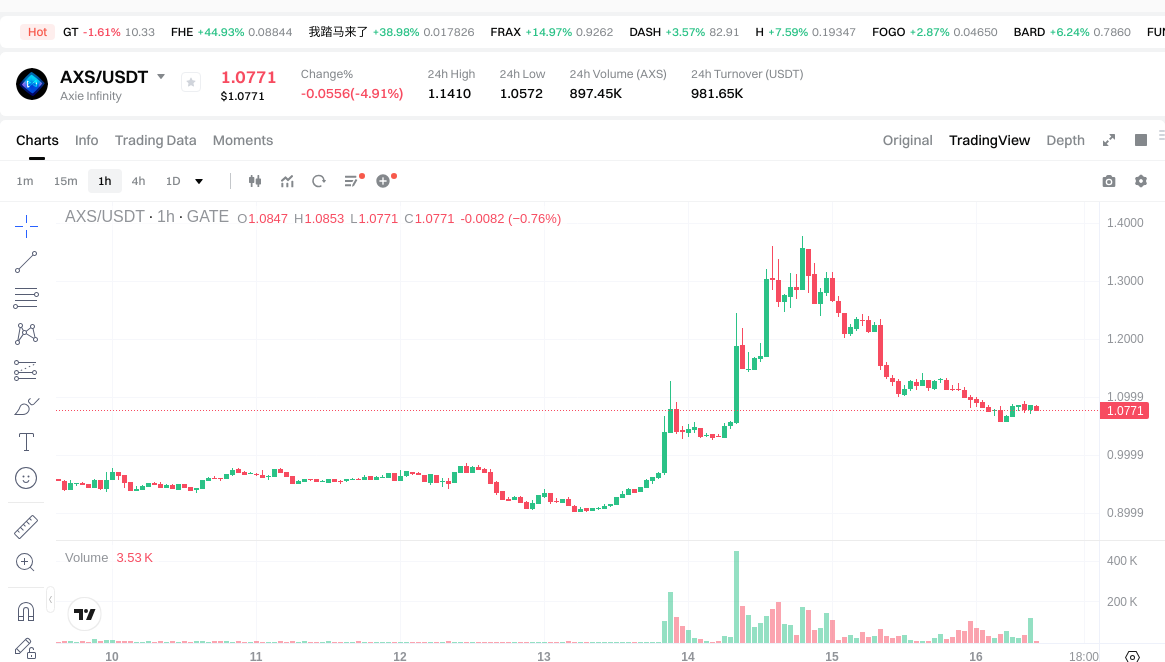
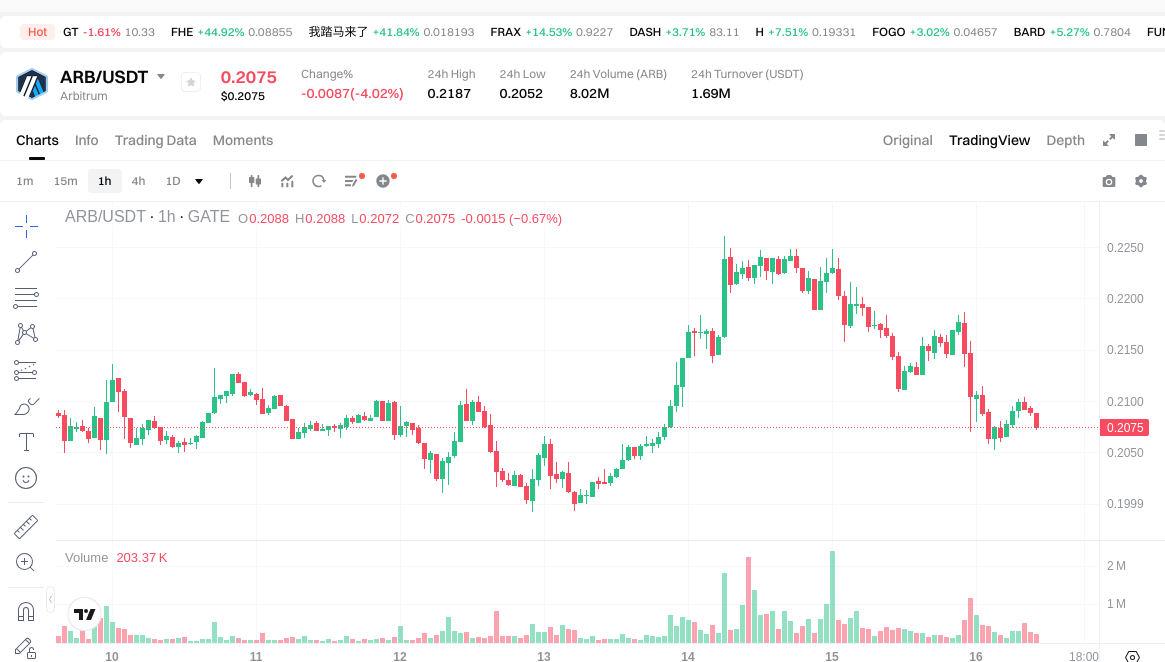
Current Market Status (2026-01-16)
- AXS Current Price: $1.0837
- ARB Current Price: $0.2088
- 24-Hour Trading Volume: AXS $979,057.89 vs ARB $1,664,841.69
- Market Sentiment Index (Fear & Greed Index): 49 (Neutral)
Click to view real-time prices:
II. Core Factors Influencing AXS vs ARB Investment Value
Supply Mechanism Comparison (Tokenomics)
-
AXS: The token operates within the Axie Infinity gaming ecosystem with mechanisms designed to support in-game economics and governance participation. The supply structure includes rewards distribution and staking incentives that influence circulation patterns.
-
ARB: As the native token of the Arbitrum Layer 2 scaling solution, ARB follows a distribution model that includes allocations for ecosystem development, community rewards, and protocol governance. The token economics are designed to incentivize network participation and protocol improvement.
-
📌 Historical Pattern: Supply mechanisms play a role in shaping token circulation dynamics, where controlled release schedules and utility-driven demand can influence price cycles over time.
Institutional Adoption and Market Application
-
Institutional Holdings: Both tokens attract different investor profiles. AXS appeals to those interested in gaming and metaverse applications, while ARB draws attention from participants focused on Ethereum scaling solutions and DeFi infrastructure.
-
Enterprise Adoption: AXS finds primary application within the gaming sector, particularly in play-to-earn models and digital asset ownership. ARB serves as a governance token within a Layer 2 ecosystem that supports various decentralized applications, DeFi protocols, and cross-chain solutions.
-
National Policies: Regulatory approaches toward gaming tokens and infrastructure tokens vary across jurisdictions, with some regions maintaining stricter oversight on gaming-related assets while others focus on blockchain infrastructure compliance.
Technical Development and Ecosystem Building
-
AXS Technical Progress: The Axie Infinity platform continues to develop its gaming infrastructure and land delegation systems, aiming to enhance user experience and expand gameplay mechanics.
-
ARB Technical Development: Arbitrum focuses on optimizing Layer 2 scaling technology, improving transaction throughput, and reducing costs for Ethereum-based applications. The ecosystem benefits from ongoing protocol enhancements and compatibility improvements.
-
Ecosystem Comparison: AXS concentrates on gaming applications, NFT integration, and virtual world development. ARB supports a broader range of applications including DeFi protocols, NFT marketplaces, decentralized exchanges, and smart contract platforms. The DeFi and cross-chain interoperability capabilities differ significantly between the two ecosystems.
Macroeconomic Environment and Market Cycles
-
Performance Under Inflation: Gaming tokens and infrastructure tokens respond differently to macroeconomic conditions. Gaming-related assets may correlate with discretionary spending patterns, while infrastructure tokens often align with broader blockchain adoption trends.
-
Macroeconomic Monetary Policy: Interest rate changes and monetary policy shifts can affect risk appetite across different crypto sectors. Both tokens may experience varying degrees of sensitivity to liquidity conditions and capital flows in the digital asset space.
-
Geopolitical Factors: Cross-border transaction demand and international market dynamics influence infrastructure tokens like ARB through increased Layer 2 adoption. Gaming tokens such as AXS may be affected by regional attitudes toward digital entertainment and blockchain gaming regulations.
III. 2026-2031 Price Forecast: AXS vs ARB
Short-term Forecast (2026)
- AXS: Conservative $0.71-$1.08 | Optimistic $1.08-$1.24
- ARB: Conservative $0.11-$0.21 | Optimistic $0.21-$0.24
Mid-term Forecast (2028-2029)
- AXS may enter a growth phase, with projected prices ranging from $1.12 to $2.27
- ARB may enter a growth phase, with projected prices ranging from $0.17 to $0.44
- Key drivers: institutional capital inflows, ETF developments, ecosystem expansion
Long-term Forecast (2030-2031)
- AXS: Baseline scenario $1.75-$1.94 | Optimistic scenario $2.21-$2.72
- ARB: Baseline scenario $0.24-$0.38 | Optimistic scenario $0.42-$0.51
View detailed price predictions for AXS and ARB
Disclaimer
AXS:
| Year |
Predicted High Price |
Predicted Average Price |
Predicted Low Price |
Price Change |
| 2026 |
1.23878 |
1.0772 |
0.710952 |
0 |
| 2027 |
1.6443458 |
1.15799 |
0.8684925 |
6 |
| 2028 |
1.835529949 |
1.4011679 |
1.12093432 |
29 |
| 2029 |
2.2656884943 |
1.6183489245 |
1.45651403205 |
49 |
| 2030 |
2.485783948032 |
1.9420187094 |
1.74781683846 |
79 |
| 2031 |
2.72309863432068 |
2.213901328716 |
1.97037218255724 |
104 |
ARB:
| Year |
Predicted High Price |
Predicted Average Price |
Predicted Low Price |
Price Change |
| 2026 |
0.244968 |
0.2076 |
0.105876 |
0 |
| 2027 |
0.31227192 |
0.226284 |
0.11766768 |
8 |
| 2028 |
0.3850674828 |
0.26927796 |
0.1696451148 |
28 |
| 2029 |
0.435139719462 |
0.3271727214 |
0.215933996124 |
56 |
| 2030 |
0.46119902672151 |
0.381156220431 |
0.24012841887153 |
82 |
| 2031 |
0.505413148291506 |
0.421177623576255 |
0.28218900779609 |
101 |
IV. Investment Strategy Comparison: AXS vs ARB
Long-term vs Short-term Investment Strategies
-
AXS: Potentially suitable for investors interested in gaming sector exposure and blockchain entertainment applications. The token's connection to the play-to-earn model and virtual world development may appeal to those seeking participation in gaming ecosystem growth.
-
ARB: Potentially suitable for investors focused on Ethereum scaling infrastructure and DeFi ecosystem expansion. The token's role in Layer 2 technology and cross-chain interoperability may attract those interested in blockchain infrastructure development.
Risk Management and Asset Allocation
-
Conservative Investors: A balanced approach might consider limited exposure to either token, such as AXS: 20-30% vs ARB: 20-30% of crypto portfolio allocation, with remaining assets in established cryptocurrencies or stablecoins.
-
Aggressive Investors: Higher risk tolerance profiles might consider AXS: 40-50% vs ARB: 40-50% allocation within speculative crypto holdings, acknowledging the higher volatility associated with smaller market cap assets.
-
Hedging Tools: Stablecoin allocation for liquidity management, options contracts for downside protection where available, and cross-asset diversification across different blockchain sectors.
V. Potential Risk Comparison
Market Risks
-
AXS: Gaming token volatility tied to player engagement trends, competition from emerging blockchain games, and sensitivity to broader gaming industry cycles. Market ranking at #254 indicates lower liquidity compared to larger cap assets.
-
ARB: Infrastructure token performance linked to Ethereum ecosystem adoption rates, competition from alternative Layer 2 solutions, and exposure to broader DeFi market sentiment. Despite higher ranking at #75, subject to Ethereum network dynamics.
Technical Risks
-
AXS: Platform scalability challenges related to user growth, network stability considerations for gaming infrastructure, and dependency on sustained gameplay mechanics innovation.
-
ARB: Layer 2 technical implementation complexities, potential smart contract vulnerabilities in rollup architecture, and ongoing requirements for protocol optimization and security audits.
Regulatory Risks
- Global regulatory approaches differ significantly between gaming tokens and infrastructure tokens. Gaming-related assets may face scrutiny regarding gambling classifications and virtual asset regulations in certain jurisdictions. Infrastructure tokens may encounter regulatory considerations related to securities classification, DeFi oversight, and cross-border transaction compliance requirements.
VI. Conclusion: Which Is the Better Buy?
📌 Investment Value Summary:
-
AXS Characteristics: Exposure to blockchain gaming sector, established platform with historical user base, governance participation in gaming ecosystem, and potential benefit from metaverse development trends.
-
ARB Characteristics: Positioning within Ethereum scaling infrastructure, broader application support across DeFi protocols, participation in Layer 2 ecosystem growth, and potential benefit from increasing demand for cost-effective blockchain transactions.
✅ Investment Considerations:
-
Beginning Investors: Consider starting with limited exposure to either token after thorough research, prioritizing understanding of fundamental use cases, and maintaining significant allocation to more established crypto assets or traditional diversified portfolios.
-
Experienced Investors: May evaluate both tokens based on sector preferences (gaming vs infrastructure), risk tolerance alignment with market cap positions (#254 vs #75), and portfolio diversification objectives across different blockchain applications.
-
Institutional Investors: Assessment might focus on ecosystem maturity, regulatory clarity in relevant jurisdictions, liquidity considerations for position sizing, and alignment with broader digital asset allocation strategies.
⚠️ Risk Disclosure: Cryptocurrency markets exhibit high volatility. This content does not constitute investment advice. Both AXS and ARB carry significant risks including potential capital loss. Investors should conduct independent research and consult qualified financial advisors before making investment decisions.
VII. FAQ
Q1: What are the main differences between AXS and ARB in terms of their primary use cases?
AXS serves as a gaming and governance token within the Axie Infinity play-to-earn ecosystem, while ARB functions as a governance token for Arbitrum's Layer 2 scaling infrastructure. AXS focuses on digital pet battles, NFT breeding, and virtual land ownership within a gaming platform launched in 2020. ARB, introduced in 2023, supports Ethereum scaling solutions that enable faster and cheaper transactions across various decentralized applications, DeFi protocols, and smart contracts. The fundamental distinction lies in AXS addressing entertainment and gaming applications versus ARB providing blockchain infrastructure services.
Q2: How do the current market rankings of AXS (#254) and ARB (#75) impact investment considerations?
ARB's higher market ranking at #75 compared to AXS at #254 suggests greater market capitalization, typically indicating higher liquidity and broader institutional recognition. Higher-ranked assets generally offer better price discovery, easier entry and exit positions, and reduced slippage during transactions. However, lower-ranked tokens like AXS may present different risk-return profiles. The ranking gap reflects ARB's positioning within the growing Layer 2 infrastructure sector versus AXS's niche in blockchain gaming, which has experienced significant contraction since the 2021 play-to-earn boom.
Q3: What explains the significant price declines from all-time highs for both tokens?
AXS declined over 99% from its November 2021 peak of $164.9 to current levels around $1.08, while ARB decreased approximately 91% from its January 2024 high of $2.39 to $0.21. These declines reflect broader crypto market cycles, with AXS particularly affected by the cooling of the 2021 play-to-earn gaming trend and reduced player engagement. ARB's decline occurred during a shorter timeframe, influenced by general market corrections and evolving Layer 2 competition. Both tokens experienced significant drawdowns typical of smaller-cap crypto assets during bearish market conditions and sector-specific headwinds.
Q4: How do supply mechanisms differ between AXS and ARB, and why does this matter?
AXS operates with 62.3% circulating supply within its gaming ecosystem, incorporating staking rewards and in-game economic mechanisms. ARB features 57.2% circulating supply with allocations for ecosystem development, community rewards, and protocol governance. These supply dynamics influence token circulation patterns and potential selling pressure. Controlled release schedules can affect price volatility, where tokens with lower circulating percentages may face future dilution as additional tokens enter circulation. Understanding these mechanisms helps investors anticipate potential supply-side pressures on price performance over time.
Q5: What are the projected price ranges for AXS and ARB through 2031?
For 2026, AXS conservative estimates range $0.71-$1.08 with optimistic scenarios reaching $1.08-$1.24, while ARB conservative projections span $0.11-$0.21 with optimistic targets of $0.21-$0.24. By 2031, AXS baseline scenarios project $1.75-$1.94 with optimistic estimates at $2.21-$2.72, whereas ARB baseline forecasts suggest $0.24-$0.38 with optimistic scenarios reaching $0.42-$0.51. These projections reflect potential ecosystem growth, institutional adoption trends, and broader market cycle dynamics. Investors should note these are speculative estimates subject to significant uncertainty and market volatility.
Q6: Which token presents better risk-adjusted potential for different investor profiles?
For gaming sector exposure and metaverse development interest, AXS offers participation in blockchain entertainment applications, though with higher volatility given its #254 ranking and gaming-specific risks. For Ethereum scaling infrastructure exposure and DeFi ecosystem participation, ARB provides broader application support with potentially higher liquidity due to its #75 ranking. Conservative investors might consider 20-30% allocation to either token within crypto portfolios, while aggressive profiles might increase to 40-50%. The choice depends on sector preference (gaming vs infrastructure), risk tolerance alignment with market positioning, and portfolio diversification objectives across blockchain applications.
Q7: What regulatory risks differentiate AXS and ARB investments?
AXS faces regulatory considerations related to gaming tokens, including potential gambling classifications and virtual asset regulations that vary significantly across jurisdictions. Some regions maintain stricter oversight on gaming-related blockchain assets due to concerns about player protection and gaming mechanics. ARB encounters regulatory considerations surrounding infrastructure tokens, including potential securities classification questions, DeFi oversight requirements, and cross-border transaction compliance. The regulatory landscape differs between entertainment-focused tokens and infrastructure-focused tokens, with evolving frameworks in various jurisdictions potentially impacting both assets differently based on their primary use cases.
Q8: How do macroeconomic conditions affect AXS versus ARB differently?
Gaming tokens like AXS may correlate with discretionary spending patterns, as blockchain gaming participation often reflects consumer sentiment toward entertainment expenditures during economic cycles. Infrastructure tokens like ARB typically align with broader blockchain adoption trends and may benefit from increased demand for cost-effective transaction solutions during periods of high gas fees. Interest rate changes and monetary policy shifts affect both tokens through overall crypto market liquidity, but gaming assets may show greater sensitivity to consumer confidence metrics while infrastructure tokens may respond more closely to developer activity and DeFi protocol adoption rates across the Ethereum ecosystem.
* The information is not intended to be and does not constitute financial advice or any other recommendation of any sort offered or endorsed by Gate.