This comprehensive analysis compares B2 Network and Stellar (XLM), two distinct blockchain projects serving different market segments. B2, launched in 2025, is a Bitcoin Layer 2 scaling solution utilizing zero-knowledge proof rollups, while XLM, established since 2014, focuses on cross-border payments and financial institution connectivity. The article examines historical price trends, current market status, tokenomics, institutional adoption, technological ecosystems, and investment strategies across timeframes. B2 currently trades at $0.8116 with higher volatility reflecting its emerging status, while XLM trades at $0.21335 with established liquidity. Investment considerations vary by investor profile: conservative investors favor XLM's track record, while aggressive investors may pursue B2's Bitcoin ecosystem growth potential. Price forecasts through 2031 suggest B2 could reach $1.80 optimistically, while XLM targets $0.62. The analysis on Gate provides detailed risk assessments and strategic recommendatio
Introduction: Investment Comparison Between B2 and XLM
In the cryptocurrency market, the comparison between B² Network (B2) and Stellar (XLM) has become a topic of interest for investors. These two projects differ significantly in market cap ranking, application scenarios, and price performance, representing distinct positioning within the crypto asset landscape.
B² Network (B2): Launched in 2025, this modular Bitcoin scaling solution has gained attention through its innovative approach combining B² Rollup (the first Bitcoin rollup utilizing zero-knowledge proof verification), B² Hub (a Bitcoin Data Availability layer achieving finality on the Bitcoin network), and MiningSquared (a Bitcoin mining pool with auto-subscribable BTC yield products).
Stellar (XLM): Since its launch in 2014 by Jed McCaleb, one of Ripple's co-founders, Stellar has established itself as a decentralized gateway for digital asset transfers between banks, payment institutions, and individuals. Its network throughput capacity and low-cost characteristics have attracted numerous projects to issue new assets on the Stellar network.
This article will provide a comprehensive analysis of the investment value comparison between B2 and XLM, examining historical price trends, supply mechanisms, institutional adoption, technical ecosystems, and future outlook, attempting to address investors' most pressing question:
"Which is the better buy right now?"
I. Historical Price Comparison and Current Market Status
Historical Price Trends of B2 (Coin A) and XLM (Coin B)
- 2025: B2 launched its mainnet in April 2025, with price movements reflecting initial market adoption and volatility.
- 2018: XLM reached its historical peak at $0.875563 in January 2018, driven by broader cryptocurrency market momentum during that period.
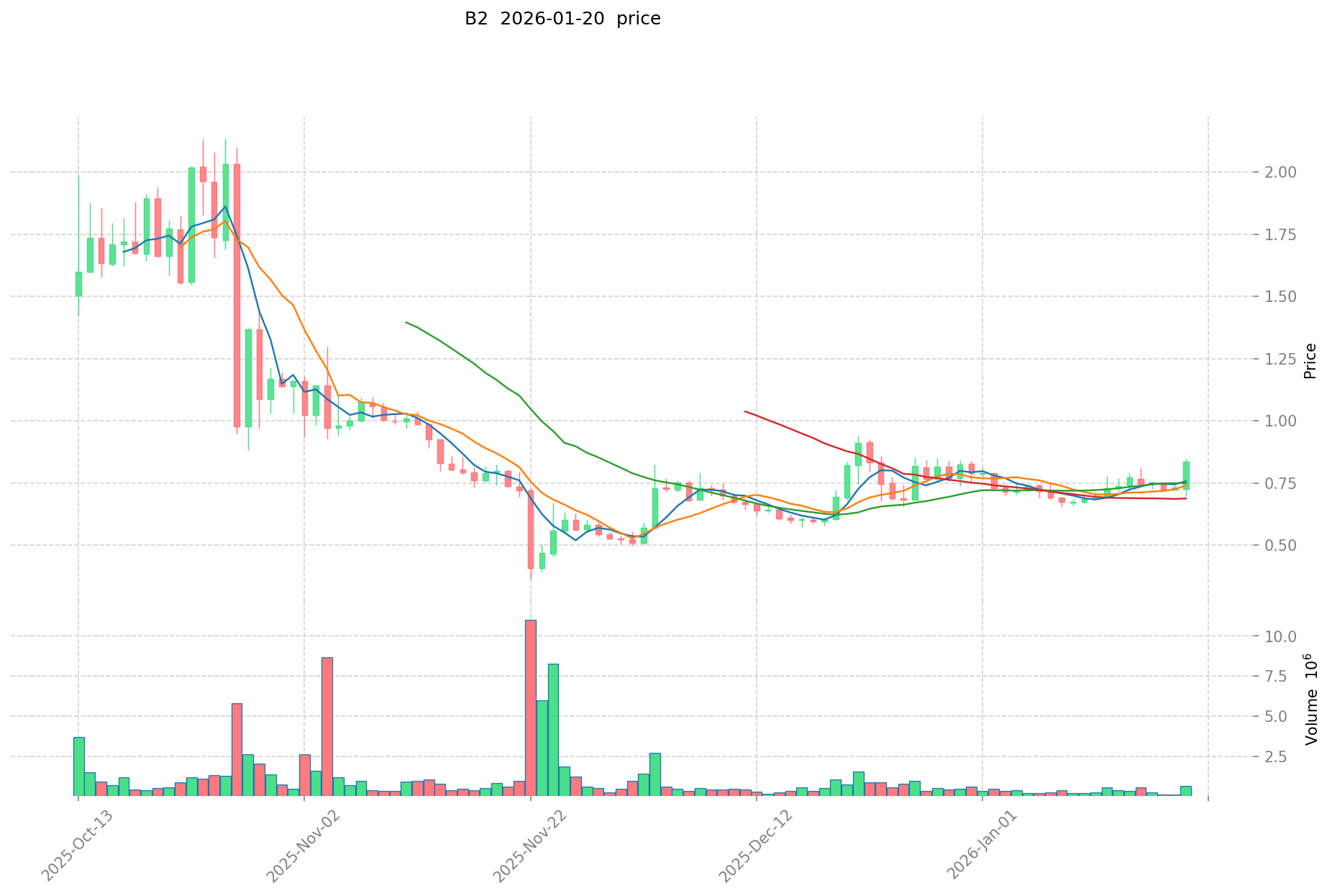
- Comparative Analysis: During the 2025 market cycle, B2 experienced a range from its historical high of $2.2184 (October 2025) to a low of $0.3154 (June 2025), while XLM demonstrated relatively stable price action within a narrower range compared to its historical extremes.
Current Market Situation (2026-01-20)
- B2 Current Price: $0.8116
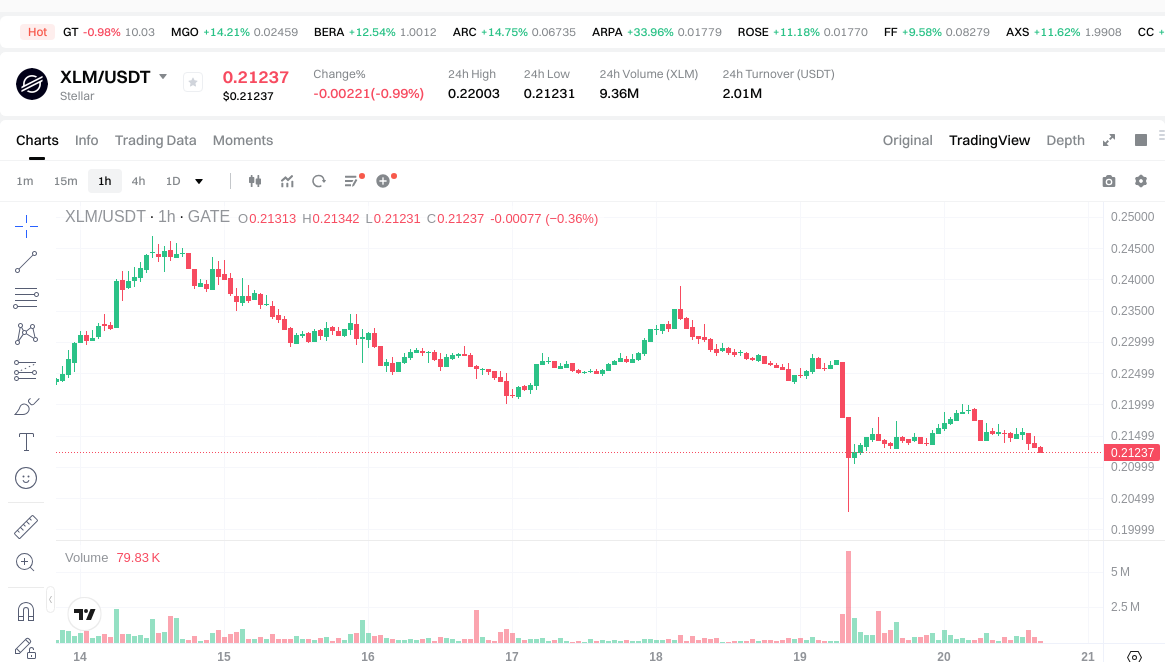
- XLM Current Price: $0.21335
- 24-Hour Trading Volume: B2 $584,310.20 vs XLM $2,029,252.40
- Market Sentiment Index (Fear & Greed Index): 32 (Fear)
View real-time prices:
- Check B2 Current Price Market Price
- Check XLM Current Price Market Price
II. Core Factors Affecting B2 vs XLM Investment Value
Supply Mechanism Comparison (Tokenomics)
Due to the absence of specific supply mechanism data in the provided materials, a detailed comparison cannot be presented at this time. Generally speaking, different supply models may influence long-term price dynamics through various mechanisms such as inflation rates, burn mechanisms, or fixed supply caps.
Institutional Adoption and Market Application
Institutional Holdings: Current data regarding institutional preference between B2 and XLM is not available in the reference materials.
Enterprise Adoption: Information on the comparative application of B2 and XLM in cross-border payments, settlement systems, and investment portfolios is not provided in the source materials.
National Policies: Specific regulatory attitudes from different jurisdictions toward these two assets are not detailed in the available references.
Technology Development and Ecosystem Building
B2 Technology Upgrades: Detailed information about B2's technical developments and their potential impact is not available in the provided materials.
XLM Technology Development: Specific data regarding XLM's technological advancements and their implications is not included in the reference sources.
Ecosystem Comparison: Comparative analysis of DeFi, NFT, payment solutions, and smart contract implementations between B2 and XLM ecosystems cannot be performed based on the current materials.
Macroeconomic Environment and Market Cycles
Performance in Inflationary Environments: Data comparing the inflation-hedging characteristics of B2 versus XLM is not present in the provided references.
Macroeconomic Monetary Policy: Analysis of how interest rates and the US Dollar Index affect both assets requires additional data not contained in the source materials.
Geopolitical Factors: Information regarding cross-border transaction demand and international developments impacting B2 and XLM is not available in the current references.
III. 2026-2031 Price Forecast: B2 vs XLM
Short-term Forecast (2026)
- B2: Conservative $0.79-$0.82 | Optimistic $1.13
- XLM: Conservative $0.13-$0.21 | Optimistic $0.26
Mid-term Forecast (2028-2029)
- B2 may enter a consolidation phase with projected price range of $0.69-$1.41
- XLM may experience gradual growth with projected price range of $0.23-$0.39
- Key drivers: institutional capital inflows, ETF developments, ecosystem expansion
Long-term Forecast (2030-2031)
- B2: Baseline scenario $0.81-$1.34 | Optimistic scenario $1.80
- XLM: Baseline scenario $0.26-$0.43 | Optimistic scenario $0.62
View detailed price predictions for B2 and XLM
Disclaimer
B2:
| Year |
Predicted High Price |
Predicted Average Price |
Predicted Low Price |
Price Change |
| 2026 |
1.129668 |
0.8186 |
0.794042 |
0 |
| 2027 |
1.32482224 |
0.974134 |
0.72085916 |
20 |
| 2028 |
1.1839624636 |
1.14947812 |
0.689686872 |
41 |
| 2029 |
1.411731553078 |
1.1667202918 |
0.770035392588 |
43 |
| 2030 |
1.39236399623412 |
1.289225922439 |
0.81221233113657 |
58 |
| 2031 |
1.79666524551099 |
1.34079495933656 |
1.153083665029441 |
65 |
XLM:
| Year |
Predicted High Price |
Predicted Average Price |
Predicted Low Price |
Price Change |
| 2026 |
0.259982 |
0.2131 |
0.134253 |
0 |
| 2027 |
0.29567625 |
0.236541 |
0.14665542 |
10 |
| 2028 |
0.33263578125 |
0.266108625 |
0.23417559 |
24 |
| 2029 |
0.39217758609375 |
0.299372203125 |
0.2574600946875 |
40 |
| 2030 |
0.515204592967968 |
0.345774894609375 |
0.266246668849218 |
62 |
| 2031 |
0.619905231055687 |
0.430489743788671 |
0.262598743711089 |
101 |
IV. Investment Strategy Comparison: B2 vs XLM
Long-term vs Short-term Investment Strategies
-
B2: May appeal to investors focused on Bitcoin Layer 2 scaling solutions and emerging blockchain infrastructure opportunities. The project's innovative approach to Bitcoin rollup technology with zero-knowledge proofs could attract those seeking exposure to Bitcoin ecosystem expansion.
-
XLM: May suit investors interested in established cross-border payment infrastructure and decentralized financial gateways. With its longer operational history since 2014 and focus on connecting financial institutions, XLM presents characteristics that could appeal to those seeking more mature market positioning.
Risk Management and Asset Allocation
-
Conservative Investors: Consider a balanced approach with potential allocation emphasis on XLM given its longer operational track record, while maintaining limited exposure to B2 for diversification within innovation-focused portions of portfolios.
-
Aggressive Investors: May consider higher allocation toward B2 to capture potential upside from emerging Bitcoin Layer 2 adoption, while maintaining XLM positions for exposure to established payment network use cases.
-
Hedging Tools: Portfolio risk management strategies may include stablecoin allocations, options instruments where available, and cross-asset diversification across different blockchain ecosystems.
V. Potential Risk Comparison
Market Risk
-
B2: As a project launched in 2025, B2 faces market risks associated with newer protocols, including potential volatility related to adoption uncertainty, ecosystem development progress, and competition within the Bitcoin Layer 2 landscape.
-
XLM: Market risks include exposure to competitive dynamics within the cross-border payment sector, potential shifts in financial institution adoption patterns, and general cryptocurrency market sentiment fluctuations.
Technical Risk
-
B2: Technical considerations include the scalability and security validation of its zero-knowledge proof-based rollup system, network stability during growth phases, and the integration reliability of its multi-component architecture (B² Rollup, B² Hub, and MiningSquared).
-
XLM: Technical aspects to monitor include network throughput maintenance as transaction volumes scale, consensus mechanism resilience, and the continued technical evolution required to maintain competitive positioning.
Regulatory Risk
Both assets face evolving regulatory frameworks across different jurisdictions. B2, as a Bitcoin-focused scaling solution, may encounter regulatory considerations related to its connection to the Bitcoin network. XLM, with its focus on financial institution connectivity and cross-border payments, may face scrutiny under payment system regulations and international transfer frameworks. Investors should monitor ongoing regulatory developments that could affect either project's operational capabilities or market access.
VI. Conclusion: Which Is the Better Buy?
📌 Investment Value Summary:
-
B2 Characteristics: Represents exposure to Bitcoin Layer 2 innovation with its zero-knowledge proof-based rollup technology and integrated Bitcoin Data Availability layer. The project offers potential participation in Bitcoin ecosystem expansion through a relatively recent market entry with distinct technical architecture.
-
XLM Characteristics: Provides access to an established cross-border payment network with operational history dating to 2014. The platform's focus on connecting financial institutions and its network capacity characteristics position it within the digital asset transfer infrastructure sector.
✅ Investment Considerations:
-
New Investors: Consider beginning with established assets that have longer operational histories and clearer use case validation. Thorough research into both projects' fundamentals, risk factors, and alignment with individual investment objectives is recommended before any allocation decisions.
-
Experienced Investors: May evaluate portfolio diversification opportunities across different blockchain ecosystem segments, balancing exposure between emerging Layer 2 solutions and established payment networks based on individual risk tolerance and market outlook.
-
Institutional Investors: Should conduct comprehensive due diligence including technical audits, regulatory compliance assessments, liquidity analysis, and strategic alignment with institutional investment mandates before considering allocations to either asset.
⚠️ Risk Disclosure: Cryptocurrency markets exhibit significant volatility characteristics. This content does not constitute investment advice, financial guidance, or recommendations for specific allocation decisions. Investors should conduct independent research, consult qualified financial advisors, and carefully assess their risk tolerance and investment objectives before making any cryptocurrency investment decisions.
VII. FAQ
Q1: What are the main differences between B2 and XLM in terms of their core technology?
B2 is a Bitcoin Layer 2 scaling solution utilizing zero-knowledge proof-based rollup technology, while XLM is a decentralized payment network protocol for cross-border transfers. B2 focuses on expanding Bitcoin's functionality through its modular architecture (B² Rollup, B² Hub, and MiningSquared), targeting scalability improvements for the Bitcoin ecosystem. In contrast, XLM operates as an independent blockchain designed to facilitate low-cost digital asset transfers between financial institutions, payment processors, and individuals, with emphasis on network throughput and transaction efficiency.
Q2: Which asset has demonstrated more price stability historically?
XLM has shown relatively more stable price patterns compared to B2. Since launching in 2014, XLM has established a longer price history with its all-time high reaching $0.875563 in January 2018. B2, having launched its mainnet in April 2025, experienced significant volatility with a range from $2.2184 (October 2025 high) to $0.3154 (June 2025 low) within its first year. However, it's important to note that newer assets typically exhibit higher volatility during initial market adoption phases.
Q3: How do the 2026-2031 price forecasts compare between B2 and XLM?
According to the forecasts, B2 shows higher price projections with a 2026 conservative range of $0.79-$0.82 (optimistic: $1.13) and a 2031 optimistic scenario reaching $1.80. XLM's forecasts are more conservative, with a 2026 range of $0.13-$0.21 (optimistic: $0.26) and a 2031 optimistic scenario of $0.62. B2 demonstrates a projected 65% price change by 2031 from baseline, while XLM shows a 101% change. These forecasts reflect B2's position as an emerging technology with higher growth potential but also greater uncertainty, while XLM's projections reflect its established market position with potentially steadier growth trajectories.
Q4: What investment strategy is appropriate for different types of investors?
Conservative investors may consider emphasizing XLM allocation due to its longer operational track record since 2014 and established use cases in cross-border payments, while maintaining limited B2 exposure for diversification within innovation-focused portfolio segments. Aggressive investors might allocate higher percentages toward B2 to capture potential upside from Bitcoin Layer 2 adoption growth, while maintaining XLM positions for exposure to proven payment network infrastructure. New investors should prioritize established assets with clearer use case validation and conduct thorough research before any allocation decisions.
Q5: What are the primary risks associated with investing in B2 versus XLM?
B2 faces risks associated with newer protocols including adoption uncertainty, ecosystem development progress, and competition within the Bitcoin Layer 2 landscape. Technical considerations include validating its zero-knowledge proof rollup system's scalability and security. XLM's risks involve competitive dynamics within cross-border payments, potential shifts in financial institution adoption patterns, and general market sentiment fluctuations. Both assets face evolving regulatory frameworks—B2 may encounter regulations related to Bitcoin network connections, while XLM may face scrutiny under payment system and international transfer regulations.
Q6: How do current market conditions affect the investment outlook for both assets?
As of January 20, 2026, the market sentiment index indicates a Fear level of 32, suggesting cautious market conditions. B2 trades at $0.8116 with 24-hour volume of $584,310.20, while XLM trades at $0.21335 with higher volume of $2,029,252.40. The fear sentiment may present potential accumulation opportunities for long-term investors but also indicates heightened volatility risk. XLM's higher trading volume suggests greater market liquidity, while B2's lower volume may indicate less established market depth but potentially higher price sensitivity to new developments.
Q7: Which asset aligns better with Bitcoin ecosystem exposure goals?
B2 provides direct Bitcoin ecosystem exposure through its Layer 2 scaling solution built specifically to expand Bitcoin's functionality. Its architecture (B² Rollup, B² Hub, and MiningSquared) is designed to enhance Bitcoin's scalability while maintaining connection to the Bitcoin network. Investors seeking pure Bitcoin ecosystem participation may find B2's positioning more aligned with this objective. XLM, while a valuable digital asset, operates as an independent blockchain focused on cross-border payments rather than Bitcoin-specific infrastructure, making it more suitable for investors seeking exposure to payment network innovation outside the Bitcoin ecosystem.
Q8: What due diligence steps should investors take before choosing between B2 and XLM?
Investors should conduct comprehensive research including: (I) Technical evaluation—reviewing whitepaper documentation, code repositories, and security audit reports for both projects; (II) Use case assessment—analyzing real-world adoption patterns, partnership announcements, and ecosystem development progress; (III) Regulatory compliance—monitoring regulatory developments in relevant jurisdictions and understanding compliance frameworks affecting each asset; (IV) Liquidity analysis—examining trading volumes, exchange availability, and market depth; (V) Risk-reward alignment—evaluating how each asset fits within individual risk tolerance, investment timeframe, and portfolio diversification objectives. Consulting qualified financial advisors is recommended before making allocation decisions.
* The information is not intended to be and does not constitute financial advice or any other recommendation of any sort offered or endorsed by Gate.